

Direct answer: Yes, vegan protein powder can help you build muscle when your total daily protein and training are right. Research shows that plant and animal protein give similar gains when intake is matched.
The powder itself is not magic. Training, enough total protein, enough calories and sleep do most of the work, and a powder simply makes the protein easier to reach.
I am Chef Ashutosh Awasthi, founder of Sheer MADness, professional chef, marathon runner and author of Great Health Comes from Exercise & Nutrition. Gym members ask me the same questions again and again, and most come from old gym talk or clever marketing. This post tests ten common myths against research, and it also says plainly what our own powders can and cannot do. It is part of my complete guide, Plant Protein, Protein Everything you should be aware of.
For decades, gym culture treated whey, eggs and chicken as the only serious muscle foods. Plant protein was seen as something for people who did not train. As a result, many beliefs spread without any evidence behind them.
Meanwhile, supplement companies add to the confusion. Some exaggerate plant protein to sell a tub, and others dismiss it to protect another product. Therefore, it helps to check each claim on its own.
Muscle grows when you train hard, eat enough protein and calories, and recover well. That rule holds for every diet. The myths below are all variations on the question of whether plants can meet it.
Whey is a good protein, and it is rich in the amino acid leucine. However, it is not required. Studies that compare plant and animal protein in trained and untrained people often find similar gains in strength and lean mass.
A 12 week trial by Hevia-Larraín and colleagues in 2021 compared vegans with omnivores. Both groups trained and ate about the same high amount of protein. Muscle gains were similar, and the vegan group did not lag behind.
In short, total protein matters more than the animal or plant label. If a plant diet lets you reach your target, you can build muscle on it. We covered the research in more detail in Muscle growth to health: plant protein powders are the future.
A complete protein contains all nine essential amino acids. Soya and quinoa are complete on their own. Other plant foods are lower in one amino acid, such as lysine in cereals or methionine in legumes.
Nevertheless, this is easy to fix. Dal with rice, roti with chana, or a blend of pea and rice protein cover each other’s gaps. Your body also pools amino acids across the day, so each meal need not be perfect.
I should be honest about one point. I will not call a single almond and flaxseed blend a complete protein, because the amino acid profile has not been analysed in a lab. A varied diet makes the question far less important. You can read more on the basics in What is plant protein?
Leucine acts as a signal that switches on muscle building. Animal proteins carry more of it per gram. Because of this, people claim that plants cannot trigger muscle growth.
The gap is real but small. Soya and pea protein contain decent leucine, while rice and most nuts contain less. You can close the gap by eating a little more protein per meal or by combining sources.
Some practical numbers help. A meal with 25 to 40 grams of plant protein usually delivers enough leucine for most people. Older adults may need the upper end of that range.
Meanwhile, the old version of this post said almond and flaxseed are “rich in BCAAs”. I removed that claim. These foods contain some leucine. However, a scoop does not supply enough to count as a leucine source.
This myth is partly true, and it depends on the type of powder. Pea and soya isolates give about 20 to 25 grams of protein per scoop. That equals a typical whey scoop.
Whole-food powders work differently. They are ground from roasted nuts and seeds, so they give less protein per scoop. In return, they carry fibre, healthy fats, vitamin E and minerals.
Our Moringa blend gives about 7.5 grams of protein per 25 gram serving. That is a snack-level top-up and not a post-workout protein bomb. If you want 25 grams in one scoop, an isolate will do that job better, and I say so openly.
Compare the types before you buy. Our guide on the best plant protein in India shows how to calculate protein per rupee.
The “anabolic window” is one of the most repeated gym rules. Early studies suggested that muscle only responds if protein arrives within half an hour of the last rep. Later reviews, including work by Schoenfeld and Aragon, found the window is much wider.
Total daily protein matters far more than the minute you drink it. A meal before training also keeps amino acids in your blood for hours afterwards. Thus, a late shake rarely ruins a workout.
If you train fasted, eating protein soon after is sensible. For everyone else, spread protein across three to five meals. Your daily total and consistency are what move the needle.
Many lifters believe that if 100 grams is good, 200 grams must be better. Research disagrees. A large 2018 analysis by Morton and colleagues found that gains levelled off at around 1.6 grams per kilogram of body weight per day.
Beyond that point, extra protein mostly becomes energy. It does not build extra muscle. Besides, it replaces carbohydrate and fat that you may need for training.
A 70 kilogram person therefore aims for roughly 110 to 140 grams a day, depending on goals. Some people go a little higher for convenience, which is fine. Our post on protein for endurance and strength training gives target ranges for different types of athlete.
This fear began with studies on soya isoflavones, which are plant compounds that resemble oestrogen weakly. Some people concluded that soya makes men feminine. Large reviews of human trials have not supported this.
Meta-analyses of dozens of studies found that soya foods and isoflavones do not change testosterone or oestrogen levels in men in a meaningful way. Gains in muscle were also similar between soya and whey groups in resistance training trials. Moderate intake looks safe for most people.
However, soya is a common allergen, and some people prefer to avoid it. If you do, pea, rice, pumpkin seed or whole-food blends are fine. For more on hormones, read Does moringa plant protein increase testosterone?
In healthy people, research does not show that high protein harms the kidneys. A review of studies on high protein diets in people with normal kidney function found no harm to kidney markers. The fear mostly comes from advice meant for people who already have kidney disease.
That said, people with kidney disease should follow their doctor’s protein limits. Anyone with a condition, or a family history, should get their kidneys checked before raising protein. Drinking enough water also helps.
For a fuller discussion, read Is vegan protein powder bad for kidneys? Let’s debunk the myths.
No powder can build muscle without training. If you do not lift, push or pull against resistance, the protein simply supports normal repair. Calories and sleep matter just as much.
Think of protein as the bricks and training as the order to build. Without the order, the bricks sit idle. Furthermore, if you eat too little overall, your body uses protein for energy instead.
A beginner who trains three days a week, eats enough dal, curd, paneer, eggs or soya, and sleeps well will make progress. A powder may add convenience. It does not replace effort.
Early plant powders were often chalky, bitter or grassy. Some still are. However, taste has improved a lot, and whole-food powders taste very different from isolates.
Roasted almonds, cocoa and dark chocolate taste nutty and rich. Moringa with cardamom tastes earthy and slightly sweet. Taste is personal, so I suggest buying a small pack first.
Mix the powder with milk, soya milk, curd or a banana. A smoothie hides texture better than plain water. For ideas, see our Desi Protein Shake recipe.
| Myth | What the Evidence Suggests |
|---|---|
| You need whey to build muscle | Plant and animal protein give similar gains when total protein is matched |
| Plant protein is incomplete | Soya is complete; other plants combine easily across the day |
| Vegans cannot get enough leucine | The gap is small and easy to close with a slightly larger serving |
| Plant powders lack protein | Isolates match whey; whole-food powders give less per scoop |
| You must drink a shake in 30 minutes | The window is wide; daily total matters most |
| More protein is always better | Gains level off at about 1.6 g per kg per day |
| Soya lowers testosterone | Human trials show no meaningful change at moderate intake |
| Protein harms healthy kidneys | No harm shown in healthy people; kidney disease needs medical advice |
| A powder builds muscle alone | Training, calories and sleep are essential |
| Plant powders taste bad | Taste varies; whole-food powders are nutty and rich |
Once the myths are gone, the real formula is simple. Train with progressive resistance, so that you lift a little more or do a few more reps over time. Eat enough total calories, since a deficit slows growth.
Next, reach your protein target, usually 1.4 to 2.0 grams per kilogram for those training hard. Sleep seven to nine hours, because most repair and hormone release happen at night. Finally, stay consistent for months, because muscle takes time.
Vitamin D, iron, vitamin B12, zinc and omega-3 fats are worth watching in a vegan diet. Vegans need a reliable B12 source, and a doctor can test levels. These nutrients support training and recovery in their own right.
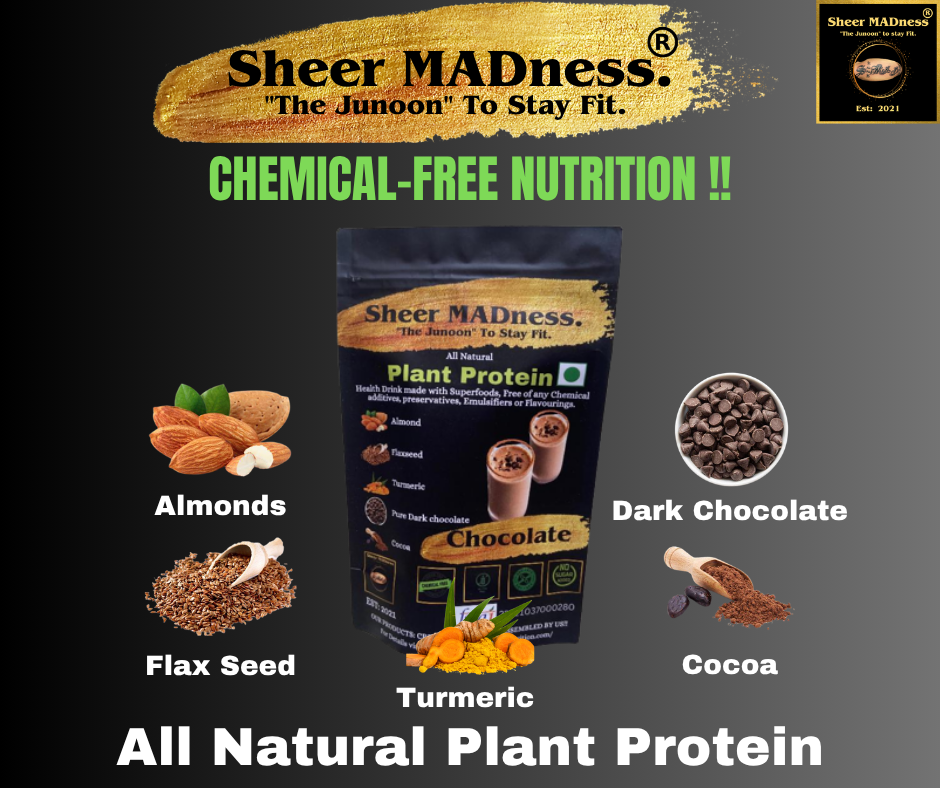
Our Chocolate powder contains roasted almond, roasted flaxseed, cocoa powder, dark chocolate and turmeric. Our Moringa powder contains moringa leaf, almond, flaxseed, turmeric and cardamom. Both are vegan, sieved and vacuum packed.
We use no protein isolate and no anti-caking agent. The dark chocolate uses cocoa solids and a small amount of jaggery, with no refined sugar. Every ingredient has appeared on the front of the pack since 2021.
Here are the limits. Our powders give less protein per scoop than an isolate, so they work as a snack or a top-up and not as your only protein. They contain almonds, so they are unsuitable for tree nut allergy. They also carry calories and fibre, so start with a half serving.
A sensible lifter might use pea or soya protein after a heavy session and our powder as an everyday snack. That is a fair and honest plan. I will not claim our powders are the best for muscle building.
Start the day with oats or besan chilla, curd and a handful of nuts. Have dal, rice or roti, vegetables and paneer or tofu for lunch. Between meals, blend a serving of whole-food plant powder with milk and a banana.
After training, add a pea or soya shake, or simply eat sattu, soya chunks or boiled chana. Dinner can be rajma, khichdi with dal, or eggs if you eat them. Spread protein across meals, and keep water close.
Rough numbers help. A 70 kilogram person aiming for 120 grams could combine several foods. Two katoris of dal, a cup of curd, 100 grams of paneer or tofu and a shake would get close. Adjust for your appetite and your doctor’s advice.
Most healthy adults tolerate plant protein well. However, people with kidney or liver disease, pregnant and breastfeeding women, and those on prescription medicines should ask a doctor first. Teenagers should focus on food and training before any supplement.
Beware of products that promise fast muscle gain, hormone changes or fat loss. Check for an FSSAI licence, batch number and allergen declaration. Ask for batch test reports covering heavy metals if you can. Our post Is plant protein safe? explains each step.
Increase protein gradually, and drink plenty of water. If gas or loose motion occurs, reduce the serving. See our posts on gas and loose motion for help.
Yes, when you train with resistance and eat enough total protein and calories. Studies show similar gains from plant and animal protein when intake is matched.
Most people aim for about 1.4 to 2.0 grams per kilogram of body weight each day. Many vegans aim for the middle or upper part of that range.
Research suggests pea protein supports similar muscle gains to whey when taken in matched amounts. You may need a slightly larger serving to match the leucine.
No. Building a lot of muscle needs heavy training, plenty of calories and years of effort. Protein alone does not make anyone bulky.
It can help, but it gives less protein per scoop than an isolate. After hard sessions, pair it with other protein foods or choose an isolate.
Anytime that suits your day works. Spreading protein over three to five meals matters more than the exact minute.
Not always. Dal, curd, paneer, eggs, soya chunks and sattu can meet your needs. A powder is a convenient top-up.
So, can vegan protein powder build muscle? Yes, as part of a plan that includes progressive training, enough total protein, enough calories and good sleep. Most of the myths fall apart when you look at total intake.
Honest advice means choosing the powder that fits your goal. An isolate gives more protein per scoop, and a whole-food powder gives fibre and a simple label. Use either as a helper and not as a shortcut, and see a doctor if you have a health condition.
I built Sheer MADness powders from whole roasted almond and flaxseed, with turmeric and either cocoa with dark chocolate or moringa with cardamom. You can see every ingredient on the front of the pack before you buy. Try Plant Protein Chocolate or Plant Protein Moringa as an everyday snack alongside your training.
a) Everyone is an individual, so what suits me may or may not suit the next person.
b) If a person has a medical condition, a doctor’s advice and prescribed medication come first.
c) While buying any protein powder from the market, read the labels carefully. Watch out for codes and words such as anti-caking agent and INS 551, also known as silicon dioxide. These are laboratory-made additives, and although regulators approve them, it is fair to ask whether you want them in your daily scoop. Hence, read the ingredient list of every product before buying.
If you are interested in buying natural vegan protein powder, health drinks for kids, or our energy bars and protein bars, shop at Sheer MADness.
One can also buy our Products From Flipkart, Jio Mart or ONDC in India.
d) Exercise is the key to fitness. Exercise and nutrition are two sides of the same coin, and nutrition alone will not help you reach your goals without movement.
e) Excess of anything is wrong. Even the best nutrient-filled superfood should be consumed only in recommended quantities.
f) Regarding health, fitness and nutrition, remember that Rome was not built in a day. Your discipline and consistency are the key.
g) It’s not only exercise and protein that build muscles. A healthy gut, rest, your body type, genetics and your lifestyle all matter. Exercise and nutrition are within our control, so focus on these two first.
h) The most important part of fitness is that nothing is better than exercise and a balanced meal.
Disclaimer: Our products are a source of nutrients and are made from whole foods.
We do not claim to cure any medical condition.
The content provided is informational. We do not claim to diagnose or treat a person with any specific medical condition.