

Direct answer: No, vegan protein powder does not make you fat by itself. Fat gain happens when you eat more calories than you burn over weeks and months, and a scoop of powder adds only a modest amount.
A powder can contribute to weight gain when it comes on top of your usual meals, or when it is blended with sugary, high-calorie extras. Used with care, it can fit comfortably into a weight-stable plan.
I am Chef Ashutosh Awasthi, founder of Sheer MADness, professional chef, marathon runner and author of Great Health Comes from Exercise & Nutrition. People often ask me whether a protein shake will give them a belly. This post explains how weight gain really works, where powders can go wrong, and how to use one without gaining fat. It is part of my complete guide, Plant Protein, Protein Everything you should be aware of.
Many people link protein powder with bulky gym bodies, and they assume the powder itself adds fat. Others gained weight after starting a shake and blamed the tub. Both reactions are understandable.
However, weight is a result of the whole day. A shake is one small piece. Therefore, the useful question is not “does the powder make me fat?” but “what happened to my total calories when I added it?”
If your diet stayed the same and the shake was extra, your calories rose. If the shake replaced a sugary snack, your calories may have fallen. The label on the tub tells only part of the story.
Sleep, stress and movement also play a part. Poor sleep raises hunger in many people, and a desk job lowers daily energy use. Consequently, a shake may get blamed for a change that started elsewhere. Look at the whole picture before you stop a useful habit.
Your body stores fat when you take in more energy than you use, and it does this over a long period. One extra snack does not change your body in a day. A steady surplus of 200 to 300 calories, repeated for months, does.
Protein and carbohydrate each give about 4 calories per gram, and fat gives about 9. Alcohol gives 7. So a scoop of powder with 20 grams of protein supplies roughly 80 calories from protein alone, plus whatever else the product contains.
A well-known 2012 overfeeding study by Bray and colleagues in the Journal of the American Medical Association showed this clearly. People ate about 1,000 extra calories a day for eight weeks on low, normal or high protein diets. Everyone gained fat in proportion to the extra calories, and only the high protein group gained extra lean mass. In other words, calories drove fat gain, and protein did not.
Protein is generally more filling than carbohydrate or fat. Reviews by Leidy and colleagues in 2015 found that higher protein meals reduce hunger and increase fullness in many people. As a result, some people eat less later in the day.
That effect is helpful, but it is not guaranteed. Satiety depends on the whole meal, including fibre, fat, volume and sleep. A protein shake in water may fill you less than a plate of dal, rice and vegetables.
I will not promise that any powder reduces hunger or burns fat. The research is encouraging, but individual responses vary. Pay attention to your own hunger signals instead.
Powders themselves are rarely the problem. Instead, the extras are. The common mistakes follow a pattern.
First, people add a shake on top of a full diet. Second, they blend it with banana, dates, peanut butter, ice cream or sweetened milk, and a 150 calorie scoop becomes a 600 calorie drink. Third, they treat the shake as a “free” item and relax elsewhere.
Liquid calories also feel less filling than solid food. You may drink a 500 calorie shake and still feel hungry an hour later. Hence, count your shakes as meals, and do not forget them.
Isolates, such as pea or soya protein, are mostly protein. A 30 gram scoop usually gives about 100 to 120 calories. Because the fat and fibre are removed, the calories stay low.
Whole-food powders work differently. They are ground from nuts and seeds, so they carry natural fats and fibre along with protein. As a result, a 25 gram serving may supply roughly 100 to 150 calories, depending on the recipe. It also gives less protein than an isolate.
Check the nutrition panel on every pack, and compare per-serving calories with per-serving protein. Mass gainer powders are a different product, since they can supply 600 to 1,200 calories a serving. Those are made for people who want to gain weight.
When the scale goes up, the cause may not be fat. Starting resistance training and eating more protein can add muscle, which is a good thing. Muscle is denser than fat, so the scale rises while your waist may not.
Glycogen and water also change your weight. A heavy workout day or a meal rich in carbohydrate can raise the scale by one or two kilograms overnight. This is temporary and does not mean fat gain.
Therefore, judge your progress by more than the scale. Measure your waist, take photos and track how your clothes fit. Watch your strength in the gym, too. Our post on muscle building myths explains how muscle grows.
For fat gain, calories matter far more than the protein source. Whey and plant powders with the same calories have the same energy effect. There is no reason that a vegan powder should add more fat than a dairy one.
Digestion can differ. Some people retain water or feel bloated on certain powders, and this is not fat. Our guide on gas and plant protein explains why and how to reduce it.
Watch the sweeteners too. Flavoured powders may contain added sugar or sweeteners, and the amount varies widely. Read the label rather than the front of the tub.
Some powders are ultra-processed, with flavours, gums and sweeteners. A 2019 controlled study by Kevin Hall and colleagues at the National Institutes of Health compared two diets. People ate more calories and gained weight on the ultra-processed diet. The study was small and short, so it does not prove that every processed product causes fat gain.
Still, it is a reason to prefer simple labels. A powder made from recognisable foods is easier to judge. I also point out that “whole-food” does not mean “low calorie”, since nuts and seeds are energy dense.
Start by counting the calories of your usual day, even roughly. Then decide whether the shake replaces something or adds to it. Replace a biscuit, a sugary tea or a fried snack, and your day may stay level.
Use water, milk or unsweetened soya milk as the base. Add fruit for taste, but measure it. A banana or a few dates is enough, and a cup of juice is not needed.
Place the shake where it helps. For example, drink it after a workout, or use it as a mid-morning snack when you might otherwise reach for a samosa.
Start with the label. Suppose a serving gives 120 calories, and you add 250 millilitres of toned milk, which is roughly 150 calories. A banana adds about 100. The drink now totals around 370 calories.
Next, ask what it replaced. If it replaced a 300 calorie snack, your day barely changed. If it came on top of that snack, you added 370 calories, and over a month that can matter.
Do this sum once for your usual recipe. Then you will know exactly what your shake costs, and you can adjust it. A little arithmetic beats a lot of worry.
Breakfast might be oats cooked in water, with curd and a handful of nuts. Lunch could be dal, rice, vegetables and salad. In the evening, a shake with milk and a fruit replaces the usual tea and biscuits.
Dinner can be roti, sabzi and paneer or eggs. This pattern keeps protein steady across the day without extra calories. Adjust the portions to your own size, activity and doctor’s advice.
Some readers want to gain weight, and a powder can help them. Add a scoop to milk, a banana, oats and a spoon of peanut butter. This can supply 400 to 600 calories in one glass.
Gain slowly, at about 0.25 to 0.5 kilogram a week, and combine the shakes with resistance training. That way, more of the gain is muscle. Check with a doctor or dietitian if you are underweight for a medical reason.
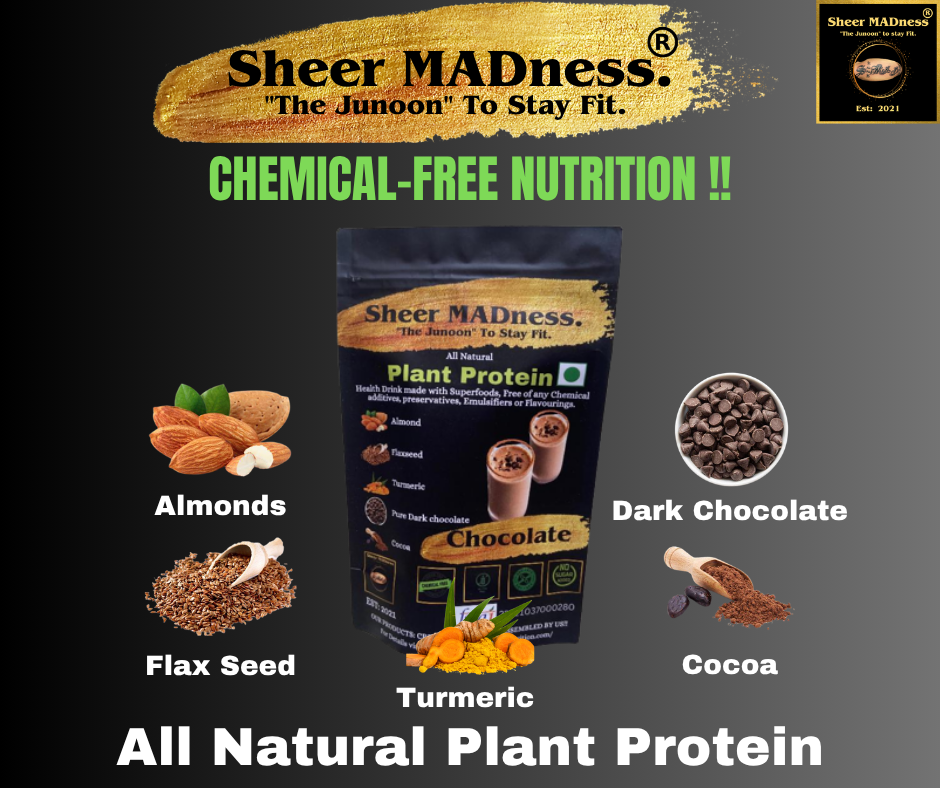
Our Chocolate powder contains roasted almond, roasted flaxseed, cocoa powder, dark chocolate and turmeric. Our Moringa powder contains moringa leaf, almond, flaxseed, turmeric and cardamom. Both are vegan, sieved and vacuum packed.
Because they are made from whole nuts and seeds, our powders carry natural fats and fibre. They are not a zero-calorie product, and I will not claim they help you lose weight. Please read the calories and protein on the pack before you decide how much to use.
Here are the limits. Our Moringa blend gives about 7.5 grams of protein per 25 gram serving, which is less than an isolate. Both powders contain almonds, so they are unsuitable for tree nut allergy. Start with a half serving, and count it as part of your daily food and not an extra.
We use no protein isolate and no anti-caking agent. The dark chocolate uses cocoa solids and a small amount of jaggery, with no refined sugar. Every ingredient has appeared on the front of the pack since 2021.
| Myth | What the Evidence Suggests |
|---|---|
| Protein powder makes you fat | Total calories decide fat gain, not the powder alone |
| Plant protein has more calories than whey | Calories depend on the product and its extras |
| Shakes are free calories | Liquid calories count, even if they feel light |
| Protein turns into fat | Excess calories of any kind can be stored as fat |
| Weight gain on a shake is always fat | It may be muscle, water or glycogen |
| Whole-food powders are always low calorie | Nuts and seeds are energy dense |
Most healthy adults tolerate plant protein powders well. However, people with kidney or liver disease, diabetes, eating disorders, or a history of weight problems should ask a doctor first. Pregnant and breastfeeding women should do the same.
If you have had disordered eating, avoid counting every calorie without guidance. A doctor or registered dietitian can help you build a plan that feels safe. Powders are not a substitute for professional support.
Beware of products that promise fast fat loss or “burn fat” effects. Check for an FSSAI licence, batch number and allergen declaration. Our post Is plant protein safe? explains each step.

Only if it pushes your total calories above what you burn. A scoop alone rarely does this, but adding sugary extras can.
It depends on the product. Isolates usually give about 100 to 120 calories, and whole-food nut and seed powders give roughly 100 to 150 for a 25 gram serving. Check your pack.
No powder targets belly fat. Fat gain across the body follows a long-term calorie surplus.
Not necessarily. If you meet your protein needs from food, you may not need one. A shake is a convenient top-up.
Either works. Choose the time that fits your schedule, and keep your daily total in mind.
It can in some people, especially with legume-based or high-fibre powders. Start small and increase slowly.
Not always. Dal, curd, paneer, eggs, soya chunks and sattu can meet most needs. A powder is a convenient top-up.
So, will vegan protein powder make you fat? Not by itself. Weight follows your total calories over time, and the powder is one small part of that.
Honest advice means reading the label, counting the shake as food and watching what you add to it. Judge progress by your waist, strength and energy, and not only the scale. See a doctor if you have a health condition.
I built Sheer MADness powders from whole roasted almond and flaxseed, with turmeric and either cocoa with dark chocolate or moringa with cardamom. You can see every ingredient on the front of the pack before you buy. Try Plant Protein Chocolate or Plant Protein Moringa as a measured snack within your day.
a) Everyone is an individual, so what suits me may or may not suit the next person.
b) If a person has a medical condition, a doctor’s advice and prescribed medication come first.
c) While buying any protein powder from the market, read the labels carefully. Watch out for codes and words such as anti-caking agent and INS 551, also known as silicon dioxide. These are laboratory-made additives, and although regulators approve them, it is fair to ask whether you want them in your daily scoop. Hence, read the ingredient list of every product before buying.
If you are interested in buying natural vegan protein powder, health drinks for kids, or our energy bars and protein bars, shop at Sheer MADness.
One can also buy our Products From Flipkart, Jio Mart or ONDC in India.
d) Exercise is the key to fitness. Exercise and nutrition are two sides of the same coin, and nutrition alone will not help you reach your goals without movement.
e) Excess of anything is wrong. Even the best nutrient-filled superfood should be consumed only in recommended quantities.
f) Regarding health, fitness and nutrition, remember that Rome was not built in a day. Your discipline and consistency are the key.
g) Body weight depends on many factors, including your food, sleep, stress, gut health, genetics and lifestyle. Exercise and nutrition are within our control, so focus on these two first.
h) The most important part of fitness is that nothing is better than exercise and a balanced meal.
Disclaimer: Our products are a source of nutrients and are made from whole foods.
We do not claim to cure any medical condition.
The content provided is informational. We do not claim to diagnose or treat a person with any specific medical condition.