

Direct answer: Vegan protein isolate is a plant protein separated from the rest of the food. It is usually about 85 to 90 percent protein or more. Makers start with peas, soya, rice or similar sources, then remove most of the starch, fibre and fat.
The result is a fine, neutral powder with lots of protein per scoop. It is efficient and convenient, but it lacks the fibre and other nutrients of the whole food.
I am Chef Ashutosh Awasthi, founder of Sheer MADness, professional chef, marathon runner and author of Great Health Comes from Exercise & Nutrition. Readers often ask me what the word “isolate” on a tub really means. I make whole-food powders and not isolates, so I will state the strengths of isolates as fairly as the limits.
This post explains how isolates are made, how they differ from other powders, and what to check on a label. It is part of my complete guide, Plant Protein, Protein Everything you should be aware of.
To isolate something is to separate it from everything else. A protein isolate is therefore the protein part of a food, separated from the other parts. Pea isolate comes from peas, and soya isolate comes from soybeans.
Peas contain only about 20 to 25 percent protein by weight. The rest is starch, fibre, water, oils and minerals. An isolate concentrates the protein part so strongly that the powder is mostly protein.
This is why a single scoop of isolate can give 20 to 25 grams of protein. A scoop of ground peas, nuts or seeds would give far less. If you are new to the basics, start with What is plant protein?
Three terms appear on labels, and they are not the same. Knowing the difference helps you compare products.
A protein concentrate is the mildest form. It usually contains about 60 to 80 percent protein, and it keeps some of the fibre, fat and carbohydrate. An isolate goes further and usually reaches 85 to 90 percent or more.
A hydrolysate is an isolate or concentrate that has been partly broken into smaller pieces by enzymes. Makers do this to improve solubility or to ease digestion. Hydrolysates are less common in vegan powders, and they can taste bitter.
Pea and soya are the most common sources. Rice, potato, hemp, pumpkin seed, sunflower seed, chickpea and fava bean isolates also exist. Each has its own taste and amino acid profile.
Soya isolate is a complete protein, and it is rich in lysine. Pea isolate is rich in lysine too, but it is lower in methionine. Rice isolate is the opposite, since it is low in lysine and fairly good in methionine.
As a result, many powders blend pea and rice. The two cover each other’s gaps. We explore other sources in Vegan protein powder beyond soya and peas.
The exact steps differ by source and factory, but the main method is similar. The general idea is to dissolve the protein, remove the solids and then recover the protein. I describe it in broad terms here.
First, workers clean the raw crop and mill it into flour. For soya, the oil often comes out first. Then the flour goes into water at an alkaline pH, which makes the protein dissolve.
Next, a machine spins the mixture to separate the dissolved protein from the starch and fibre. After that, the makers adjust the acidity until the protein clumps and settles out. They collect the clumps, neutralise and wash them, and dry them into a powder.
Many factories also use heat treatment and fine screens to give a smooth, consistent product. Quality control teams then test each batch for protein content, moisture and microbes. Good brands add tests for metals as well.
Some factories add filtration steps to concentrate protein further. Others use enzymes or dry-milling methods to reach a concentrate. The word “isolate” on the pack tells you the end result, and it does not tell you the method.
Hexane is a solvent that the edible oil industry uses to extract oil from seeds such as soybeans. Some soya isolates start from soya flour that manufacturers defatted with hexane. Regulators permit this when residues stay under set limits, and processing removes most of the solvent.
Not every isolate uses it. Some makers use mechanical pressing or other methods, and many pea isolates need no oil-extraction solvent. If this matters to you, ask the brand how it makes the product, and ask for a test report.
I do not want to frighten anyone with this. Approved processing aids are regulated, and they are not unusual in the food industry. Still, asking questions is reasonable, and a good brand will answer them.
The first benefit is protein density. A scoop gives 20 to 25 grams of protein with only a few grams of fat and carbohydrate. That helps when you want protein without many calories.
Convenience is another benefit. Isolates mix easily, store well and are quick after a workout. Many are low in fibre and gentle on sensitive stomachs, which suits people who get gas from beans or whole grains.
They also suit dairy-free diets, since they contain no lactose. Research on muscle building shows that plant proteins can match animal proteins when total intake is high enough. We covered this in Vegan protein powder for muscle building: let’s cut out the myths.
Isolates lack the fibre, many vitamins and the plant compounds of the whole food. The process removes most of them, and some brands do not add them back. If you rely only on powders, you may miss out on whole-food nutrition.
Taste and texture can be an issue. Pea isolate can taste beany or chalky, and rice isolate can feel gritty. To hide this, makers often add flavours, sweeteners and gums.
Isolates are also more processed than a ground nut or seed. Some people prefer to avoid that for personal reasons. Furthermore, allergies remain, since soya is a common allergen.
No. Processing covers everything from roasting almonds to extracting a protein. Many processed foods, such as curd, paneer, tofu and bread, are useful and healthy. What matters is the ingredient list and the overall diet.
In 2019, Hall and colleagues at the National Institutes of Health compared two diets. People ate more on the ultra-processed diet than on the unprocessed one. That study looked at whole diets, and not at protein powders alone. It does not show that every isolate is harmful.
So I suggest a balanced view. Isolates can be a practical tool, particularly for athletes and older adults who struggle to eat enough protein. Whole foods should still form most of your intake.
Scientists score protein quality with methods called PDCAAS and DIAAS. These compare the amino acids in a protein with human needs, after adjusting for digestion. Soya isolate scores high on both, and pea isolate scores a little lower. Rice isolate scores lower, because it is low in lysine.
The scores are approximate and depend on the product. In practice, they matter less if you eat a varied diet, since your meals fill the gaps. Blends of pea and rice often score better together than either alone.
Digestion also varies by person. Some feel fine on an isolate, while others get gas or bloating from added gums, sweeteners or fibres. Our post on gas and plant protein explains how to reduce this.
Plants absorb metals from soil and water. Some analyses of protein powders have found lead, cadmium or arsenic in certain products, including some plant powders. Levels vary widely between brands and batches.
Because isolates concentrate the plant, they can also concentrate contaminants. This does not mean that every isolate is unsafe. It means you should buy from brands that test each batch, and you should ask to see the results. Read more in Do vegan protein powders have heavy metals?
Start with the ingredient list. The first item should be the protein source, such as “pea protein isolate”. Be cautious with long lists of gums, flavours and sweeteners.
Then check the nutrition panel. Look at protein per serving, serving size, sugar and sodium. Compare similar serving sizes across brands.
After that, check for an FSSAI licence, batch number and expiry date. Look at the allergen declaration for soya, nuts and sesame. Ask the seller for test reports covering heavy metals. Our post Is plant protein safe? covers each step.
| Feature | Vegan Protein Isolate | Whole-Food Nut and Seed Powder |
|---|---|---|
| Protein per 100 g | About 80 to 90 g | About 20 to 30 g |
| Protein per scoop | About 20 to 25 g | Usually much less |
| Fibre | Very low | Higher |
| Fats | Low | Higher, mostly unsaturated |
| Processing | Extracted and dried | Roasted and ground |
| Taste | Neutral, sometimes beany or chalky | Nutty or earthy |
| Cost per gram of protein | Usually lower | Usually higher |
| Best for | High protein with few calories | A snack with fibre and a short label |
Neither type is better in every situation. Many people use both, an isolate after heavy training and a whole-food powder as a daily snack. Our guide on the best plant protein in India shows how to calculate protein per rupee.

Athletes who need 25 grams of protein in one drink often choose isolates. Older adults who have small appetites can also benefit, since a small volume gives a lot of protein. People with high protein needs, such as those recovering from illness, may use them on medical advice.
Isolates also suit people who cannot tolerate fibre well. For example, some digestive conditions make beans or whole grains uncomfortable. A doctor or dietitian can guide the choice.
On the other hand, if you already eat enough protein from food, you may not need a powder. Dal, curd, paneer, eggs, soya chunks and sattu are excellent, and they cost less.
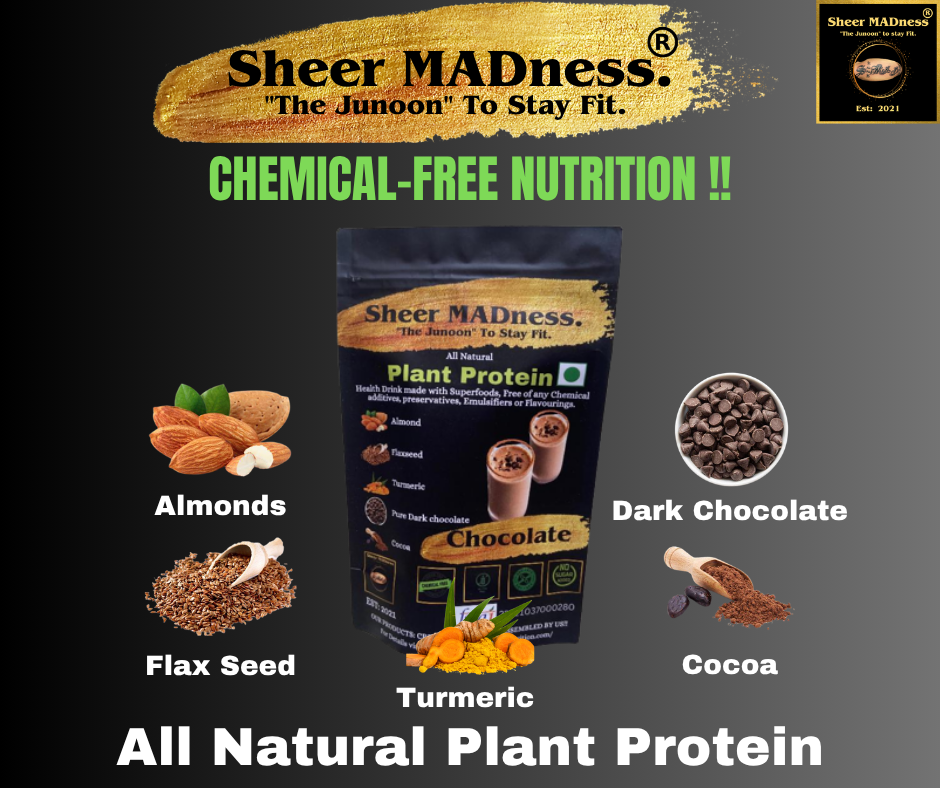
Sheer MADness powders are not protein isolates. Our Chocolate powder contains roasted almond, roasted flaxseed, cocoa powder, dark chocolate and turmeric. Our Moringa powder contains moringa leaf, almond, flaxseed, turmeric and cardamom.
Both are vegan, sieved and vacuum packed. We use no protein isolate and no anti-caking agent. The dark chocolate uses cocoa solids and a small amount of jaggery, with no refined sugar.
Here are the limits. Our Moringa blend gives about 7.5 grams of protein per 25 gram serving, which is much less than an isolate. Both powders contain almonds, so they are unsuitable for tree nut allergy. They also carry calories and fibre, so start with a half serving.
I do not claim that our powders are better than isolates. They are different, and they suit people who want a simple, whole-food snack with a clear label. If you need a high-protein scoop, an isolate may serve you better.
It is a plant protein separated from the rest of the food and dried into a powder. It is usually about 85 to 90 percent protein.
No. A concentrate is less refined and usually contains about 60 to 80 percent protein. An isolate is more refined and contains more.
It is a widely used and well-studied protein for most people. Choose a product with a short label and good testing, and check for allergies.
Isolates are generally considered safe for healthy adults. People with kidney disease or other conditions should ask a doctor first.
Some soya isolates start from flour defatted with hexane, and regulators limit residues. Many pea isolates avoid it. Ask the brand how its product is made.
They are different. Isolates give more protein per scoop, and whole-food powders give fibre and a simpler label.
Not always. Food can meet most needs, and a powder is a convenient top-up.
So, what is vegan protein isolate? It is a concentrated protein made by separating the protein from a plant and drying it. It gives lots of protein per scoop, but it leaves most of the fibre and other nutrients behind.
Honest advice means choosing by your goal. Use an isolate when you want efficient protein, and use whole foods for everything else. Ask about the method and the test reports, and see a doctor if you have a health condition.
I built Sheer MADness powders from whole roasted almond and flaxseed, with turmeric and either cocoa with dark chocolate or moringa with cardamom. You can see every ingredient on the front of the pack before you buy. Try Plant Protein Chocolate or Plant Protein Moringa if a short, whole-food label appeals to you.
a) Everyone is an individual, so what suits me may or may not suit the next person.
b) If a person has a medical condition, a doctor’s advice and prescribed medication come first.
c) While buying any protein powder from the market, read the labels carefully. Watch out for codes and words such as anti-caking agent and INS 551, also known as silicon dioxide. These are laboratory-made additives, and although regulators approve them, it is fair to ask whether you want them in your daily scoop. Hence, read the ingredient list of every product before buying.
If you are interested in buying natural vegan protein powder, health drinks for kids, or our energy bars and protein bars, shop at Sheer MADness.
One can also buy our Products From Flipkart, Jio Mart or ONDC in India.
d) Exercise is the key to fitness. Exercise and nutrition are two sides of the same coin, and nutrition alone will not help you reach your goals without movement.
e) Excess of anything is wrong. Even the best nutrient-filled superfood should be consumed only in recommended quantities.
f) Regarding health, fitness and nutrition, remember that Rome was not built in a day. Your discipline and consistency are the key.
g) Good nutrition depends on many factors, including your food, gut health, sleep, stress, genetics and lifestyle. Exercise and nutrition are within our control, so focus on these two first.
h) The most important part of fitness is that nothing is better than exercise and a balanced meal.
Disclaimer: Our products are a source of nutrients and are made from whole foods.
We do not claim to cure any medical condition.
The content provided is informational. We do not claim to diagnose or treat a person with any specific medical condition.