

Direct answer: No powder can control diabetes. Blood sugar is controlled by your medicines, your overall diet pattern, activity, sleep and regular check-ups. A well-chosen vegan protein powder with no added sugar can fit safely into a diabetes meal plan, and it may make meals steadier. The only way to know how it affects you is to read the label, test your own readings and agree the plan with your doctor.
This post is different from our other diabetes and sugar articles. They explain what protein does to blood sugar and cravings. This one is a practical, step-by-step guide for a person who lives with diabetes or prediabetes and wants to try a powder without risk.
I am Chef Ashutosh Awasthi, founder of Sheer MADness, professional chef, marathon runner and author of Great Health Comes from Exercise & Nutrition. Because I am not a doctor, I will not tell you to change a medicine. Instead, this guide shows how to make food choices safely and what to ask your care team. This post is part of my complete guide, Plant Protein, Protein Everything you should be aware of.

India has one of the largest diabetes populations in the world. The ICMR-INDIAB study, published by Anjana and colleagues in 2023, estimated about 101 million people with diabetes and 136 million with prediabetes. Many are not aware of it.
Food is a big part of daily management. People often ask whether a protein powder helps, harms or does nothing. The honest answer depends on the powder, the person and the plan.
So, instead of a yes or no, this guide helps you decide for yourself. It also protects you from products that promise too much.
Protein has little direct effect on blood sugar in most people with type 2 diabetes. When eaten with carbohydrate, it can slow how quickly glucose rises after a meal. It also helps you feel full, which makes portion control easier.
A study by Gannon and colleagues in 2003 found that protein eaten by people with type 2 diabetes raised insulin without raising glucose much. Protein can therefore stimulate insulin release. That is useful in some cases, and it matters for people on insulin or certain tablets.
The American Diabetes Association says that there is no single ideal split of protein, fat and carbohydrate. The best pattern depends on your health, your tastes and your goals. So, protein is a tool, and not a cure.
A powder can add protein to a meal that lacks it. That may flatten the rise after a high-carbohydrate meal, such as a breakfast of poha or paratha. It can also help a person with a small appetite or low muscle mass eat enough protein.
A powder cannot lower your HbA1c on its own. It cannot replace medicine, and it cannot undo a poor diet. It should never lead you to stop or change a prescribed treatment.
Therefore, think of a powder as a small support within a bigger plan. The plan itself has four pillars: medicine as prescribed, meals you can sustain, daily movement and regular tests.
For people with diabetes, the label is the most important part of choosing a powder. Look at carbohydrate per serving, added sugar and sweeteners. Many “protein” products hide sugar under names such as dextrose, maltodextrin, honey, fruit powder and syrup.
Also check fibre, which slows glucose absorption. Check the protein per serving, and the serving size.
Compare two powders. One has 24 grams of protein and 3 grams of sugar. The other has 8 grams of protein and 12 grams of sugar.
Sugar alcohols such as sorbitol and maltitol raise sugar less, but they can cause gas and loose stools. Some artificial sweeteners are fine for many people, and your doctor can advise on them. Avoid products that do not show their ingredients clearly.
| What to Check | What You Want to See | Why It Matters |
|---|---|---|
| Added sugar | None, or very little | Sugar spikes readings |
| Total carbohydrate per serving | Low, and clearly listed | Needed for carb counting |
| Fibre | Present | Slows glucose absorption |
| Sweeteners | Few, understood by you | Some cause gas, some affect cravings |
| Protein per serving | Clearly listed, with serving size | Lets you plan meals |
| Ingredients | Short, readable | Easier to trust and to test |
| Allergens | Clearly stated | Safety |
| Batch test report | Available on request | Contaminants matter for kidneys |
This table is a guide, not a prescription. Show the label to your dietitian before you buy.
Every body responds differently. If you use a glucometer or a continuous monitor, you can test a powder at home. Ask your doctor first, and keep it simple.
Choose a usual breakfast, and record your reading before the meal and two hours after. Repeat the next day with the same breakfast plus the powder. Do this for two or three days, and compare the numbers.
Many guidelines aim for readings under about 180 mg/dL two hours after a meal. The fasting target is roughly 80 to 130 mg/dL. Your doctor may set different targets for you. Share your results at your next visit, so that the plan fits you.
If you take insulin or tablets that lower sugar strongly, such as sulfonylureas, your meals and doses are linked. Replacing a normal meal with a shake can lead to low blood sugar. Do not make such a change without your doctor’s advice.
Know the signs of low sugar: shaking, sweating, hunger, confusion and a fast heartbeat. Keep a fast-acting source of sugar nearby, as your doctor has advised. Seek urgent help if symptoms do not settle.
In type 1 diabetes, protein can raise glucose slowly several hours after a meal. Insulin dosing for high-protein meals needs the guidance of your diabetes team. Adults with type 1 diabetes should not experiment on their own.
Diabetes is one of the leading causes of chronic kidney disease. High protein is not a problem for healthy kidneys, but it needs care once kidney damage appears. A yearly check of eGFR and urine albumin is part of good diabetes care.
If your doctor says your kidneys are affected, ask for a protein target before using a powder. Our post Is vegan protein powder bad for kidneys? explains the tests and the questions to ask.
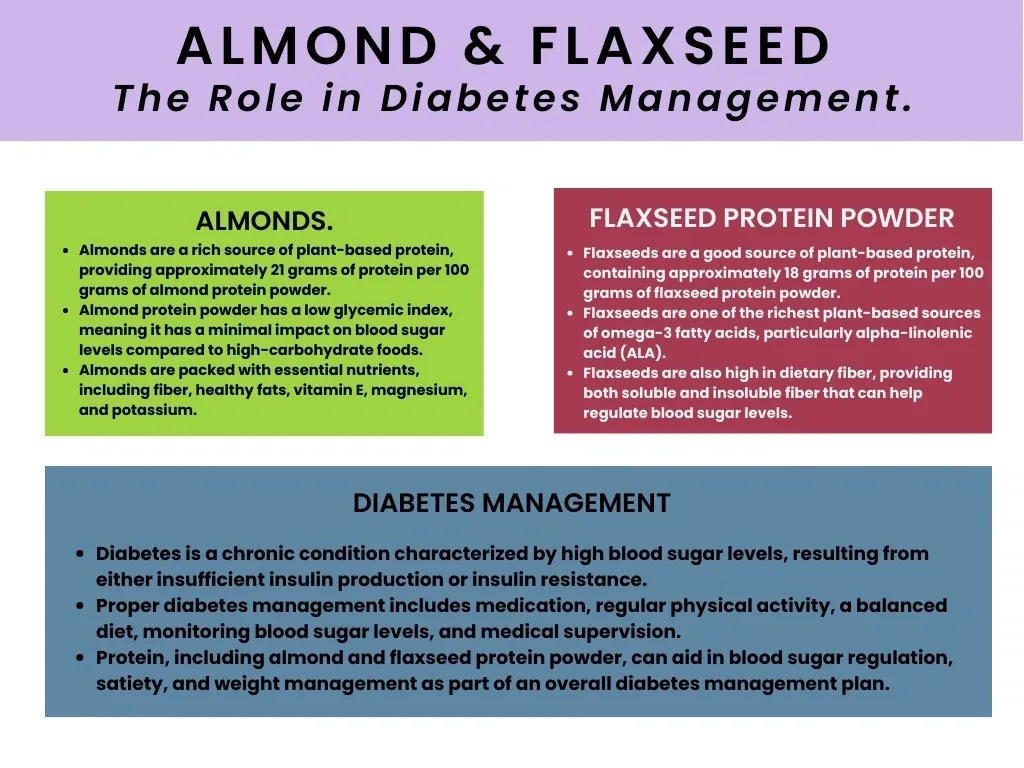
Nuts have been studied in diabetes. Li and colleagues, in 2011, found that people with type 2 diabetes who ate almonds for four weeks improved glycaemic control and lipid readings. The study was small and short, and it used whole almonds, not a powder.
Flaxseed gives mixed results. Some trials in prediabetes report small improvements, and others find none. A study by Hutchins and colleagues in 2013 suggested better insulin sensitivity with daily ground flaxseed in people with prediabetes, but more research is needed.
Turmeric needs a careful note. Chuengsamarn and colleagues, in 2012, gave curcumin capsules at a high dose to people with prediabetes for nine months. Fewer progressed to diabetes. The dose was far above what a pinch of turmeric in a powder gives, so the result does not apply to food.
I make no claim from these studies for our powders. They show that nuts and seeds can be part of a diabetes-friendly diet. They do not show that any product treats diabetes.
The plate method is simple and works at home. Fill half the plate with non-starchy vegetables, a quarter with protein and a quarter with whole grains or millets. Dal, chana, rajma, paneer, tofu, curd, eggs and sprouts are good protein choices.
Choose ragi, jowar, bajra and brown rice in modest portions over white rice and refined flour. Add salad and a little healthy fat. Eat slowly, and stop when you are comfortably full.
Walking after meals helps as well. Reynolds and colleagues, in 2016, found that a short walk after meals lowered post-meal glucose in people with type 2 diabetes. About ten minutes was enough, and even a slow stroll counts.
This sample is only an example, so adjust it with your dietitian. For breakfast, have besan or moong chilla with vegetables and a bowl of curd. Mid-morning, take a handful of nuts and a small fruit.
Lunch can be dal, a large plate of sabzi, one roti or a small portion of millet, and a salad. In the afternoon, blend a half serving of a no-added-sugar powder with water or plain milk. Dinner might be tofu or paneer with greens and one roti.
Take a short walk after each main meal. Check your readings as your doctor advises. Notice the difference on days with and without the powder.
Poor sleep and high stress raise blood sugar in many people, even when food is perfect. Aim for seven to nine hours, and keep a regular bedtime. Short breathing exercises, yoga or a walk can lower tension.
Alcohol and smoking also work against good control. Ask your doctor for safe limits. As a result, small lifestyle steps often add more than any single supplement.
Social meals test every plan. Eat a small protein snack, such as curd or roasted chana, before you leave home. It takes the edge off hunger and helps you choose well.
At weddings and festivals, fill your plate with salad, dal and grilled or tandoori items first. Take a small portion of sweets, and eat it slowly after the meal, not alone. Walk for ten minutes afterwards.
Carry your medicines and a fast-acting sugar source, as your doctor advises. In addition, tell the host or a friend about your needs if you feel comfortable doing so.
Many people choose a sweet, flavoured powder and ignore the sugar line. Others use a shake in place of a meal without telling their doctor. Adding fruit, honey and sweet toppings on top is a third trap.
Another mistake is believing a marketing claim such as “diabetic friendly” without checking carbohydrates and your own readings. A further mistake is stopping medicine because the numbers look good. Finally, some people skip yearly eye, foot and kidney checks.
Bring a short list to your visit. Ask how much protein you should eat each day. Check whether a powder suits your medicines and your kidney results.
Find out if you should test your readings after a new food. Learn what to do if you feel low. Finally, ask how often to repeat HbA1c, kidney and eye tests.
Write the answers down, and keep a log of your meals and readings. A good care team will respect an informed patient. In addition, a log makes the next visit far more useful.
Our Chocolate powder contains roasted almond, roasted flaxseed, cocoa powder, dark chocolate and turmeric. Our Moringa powder contains moringa leaf, almond, flaxseed, turmeric and cardamom. Both are vegan, sieved and vacuum packed, with no protein isolate and no anti-caking agent.
I will not claim that either powder controls diabetes, lowers blood sugar, improves insulin sensitivity or suits diabetics specially. I do not have carbohydrate, sugar or glycaemic figures for them, and I have not tested them on people with diabetes.
What I can say is what is in the pack. The Moringa blend lists no sweetener among its ingredients. The Chocolate blend contains dark chocolate with cocoa solids and a small amount of jaggery. Therefore, a person with diabetes should count it and test their own response.
Our Moringa blend gives about 7.5 grams of protein per 25 gram serving. Both powders contain almonds, so they are unsuitable for tree nut allergy. Nuts and seeds are calorie-dense, so count the serving in your daily plan.
One myth says that protein powder lowers blood sugar. Protein can help meals feel steadier, but it does not treat diabetes. Another myth says that “natural” means safe for any sugar level. Nuts, jaggery and cocoa still carry carbohydrate and calories.
A third myth says that isolates and additives make insulin resistance worse. There is no good evidence for that claim as a rule. A fourth myth says that turmeric addresses the root cause of diabetes. It does not, and kitchen amounts are far below trial doses.
Everyone with diabetes should speak to their doctor before adding a powder. This applies most to people on insulin, people with kidney disease, pregnant women and older adults. It also applies to anyone with a food allergy.
For wider questions, read Is plant protein safe? Our guide to side effects lists symptoms to watch. For the science of protein and blood sugar, read Is plant protein good for diabetes? For cravings, read plant protein and sugar cravings.
No powder controls diabetes. A powder with no added sugar can fit into a meal plan, but medicine, diet, activity and check-ups do the real work.
It can be, if the label is low in sugar and your doctor agrees. Test your own readings, and watch for low sugar if you take insulin.
Most unsweetened powders have little direct effect, but sweetened ones can. Check carbohydrate and sugar on the label.
Only with your doctor’s advice, especially if you use insulin or sulfonylureas. A shake alone is not a balanced meal.
There is no single best. Choose a short ingredient list, no added sugar and a protein level your kidneys can handle.
It depends on kidney health, weight and activity. Many adults use 0.8 to 1.2 grams per kilogram, and your doctor can tailor it.
Yes, if you test at home. Compare readings before and two hours after the same meal, with and without the powder.
So, can vegan protein powder help control diabetes? Not by itself. It can be a small, helpful part of a plan when it has no added sugar, fits your kidney health and suits your medicines.
Read the label, test your own response and talk to your care team. Keep the basics strong: medicine, meals, movement and check-ups. A powder is only a convenience in the background.
I built Sheer MADness powders from whole roasted almond and flaxseed, with turmeric and either cocoa with dark chocolate or moringa with cardamom. You can see every ingredient on the front of the pack before you buy. If your doctor agrees, try Plant Protein Moringa or Plant Protein Chocolate with a half serving, and check your readings.
a) Everyone is an individual, so what suits me may or may not suit the next person.
b) If a person has a medical condition, a doctor’s advice and prescribed medication come first.
c) While buying any protein powder from the market, read the labels carefully. Watch out for codes and words such as anti-caking agent and INS 551, also known as silicon dioxide. These are laboratory-made additives, and although regulators approve them, it is fair to ask whether you want them in your daily scoop. Hence, read the ingredient list of every product before buying.
If you are interested in buying natural vegan protein powder, health drinks for kids, or our energy bars and protein bars, shop at Sheer MADness.
One can also buy our Products From Flipkart, Jio Mart or ONDC in India.
d) Exercise is the key to fitness. Exercise and nutrition are two sides of the same coin, and nutrition alone will not help you reach your goals without movement.
e) Excess of anything is wrong. Even the best nutrient-filled superfood should be consumed only in recommended quantities.
f) Regarding health, fitness and nutrition, remember that Rome was not built in a day. Your discipline and consistency are the key.
g) Diabetes control depends on many factors, including medicines, diet, activity, sleep, stress, genetics and regular check-ups. Exercise and nutrition are within our control, so focus on these two first.
h) The most important part of fitness is that nothing is better than exercise and a balanced meal.
Disclaimer: Our products are a source of nutrients and are made from whole foods.
We do not claim to cure any medical condition.
The content provided is informational. We do not claim to diagnose or treat a person with any specific medical condition.