
Direct answer: Protein bars taste artificial and chalky because they are built around protein isolates — chemically extracted protein powders that taste like nothing on their own. To mask that taste, manufacturers add artificial flavours, synthetic sweeteners, emulsifiers, and texture agents. The result is a bar that smells aggressively sweet, tastes artificially flavoured, leaves a metallic or bitter aftertaste, and has a dry, chalky, or rubbery texture that no amount of food science can make feel like food.
The irony is that this is entirely a self-inflicted problem. It happens because manufacturers chose protein isolates over real food in the first place. When you start with real ingredients — oats, almonds, dates, sattu, dark chocolate — you don’t need artificial flavour systems. The food tastes like food because it is food.
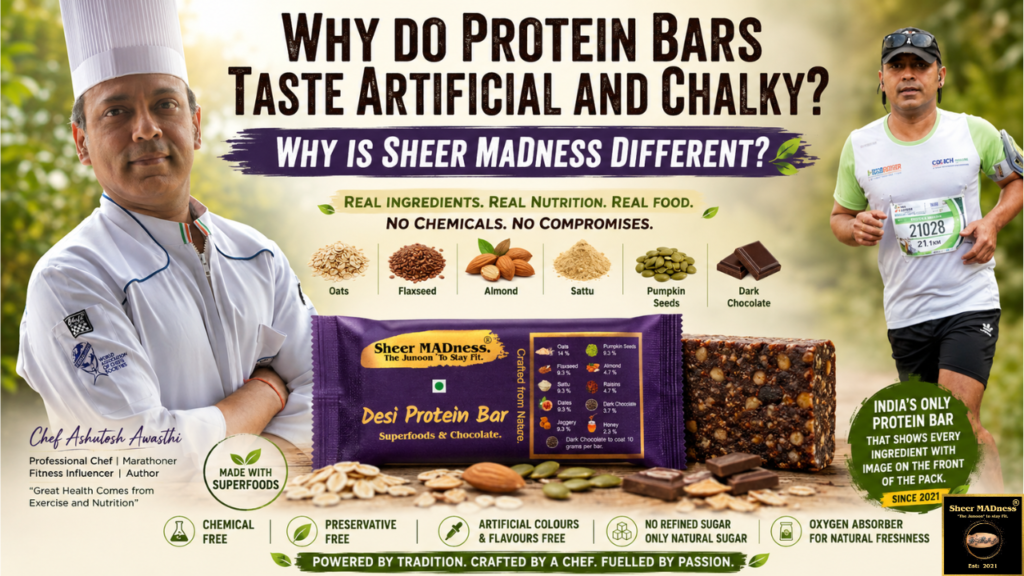
I’m Chef Ashutosh Awasthi, founder of Sheer MADness, professional chef, marathon runner, and author of Great Health Comes from Exercise & Nutrition. I’ve spent my career understanding what ingredients do to taste, texture, and the eating experience. Let me explain the food science behind why most protein bars taste artificial — and why Sheer MADness bars taste genuinely different.
Understanding why protein bars taste artificial requires understanding what protein isolates actually are and what they do to taste and texture.
Whey protein isolate, soy protein isolate, and casein concentrate are produced through industrial chemical extraction. Liquid whey — a dairy by-product — is filtered, acid-washed, and processed through membrane separation to remove fat, lactose, and water, leaving a powder that is 90 percent protein by weight.
The extraction process removes virtually everything that made the original food taste like something. The fats that carry flavour compounds. The natural sugars that create sweetness. The fibre that gives texture and mouthfeel. What remains is a white or pale yellow powder with a mildly bitter, slightly sulphurous, distinctly unappetising flavour profile.
Food scientists call this “denatured protein taste” — the flavour of protein molecules after they have been stripped of their natural food matrix. It is the same phenomenon that makes unflavoured protein shakes taste like chalk stirred into water. Furthermore, the denaturation of protein structure during extraction changes the physical characteristics of the powder — it becomes hydrophilic, absorbing moisture from saliva rapidly and creating the dry, chalky mouthfeel that consumers consistently complain about.
A bar built on protein isolate needs to taste like something other than chalk. Consequently, manufacturers add elaborate artificial flavour systems to compensate.
These flavour systems are built from chemical flavour compounds — esters, aldehydes, ketones, and lactones — that are synthesised to mimic the aromatic profile of chocolate, vanilla, peanut butter, or strawberry. They are highly concentrated and engineered to be detected by smell receptors at extremely low concentrations.
The problem is that synthetic flavour systems are one-dimensional approximations of complex natural flavours. Real chocolate contains over 400 separate flavour compounds that interact with each other dynamically — the flavour changes as you chew because different compounds volatilise at different temperatures and interact with saliva enzymes differently. A synthetic chocolate flavour compound captures perhaps three or four of those 400 interactions.
This is why artificially flavoured protein bars smell intensely of chocolate but taste nothing like actual chocolate once you bite into them. The smell is overpowering because it is engineered to be. The taste falls flat because real flavour complexity cannot be synthetically replicated.
Most “sugar-free” or “low-carb” protein bars use sugar alcohols — maltitol, sorbitol, erythritol, or xylitol — as sweeteners. Each of these creates specific and consistent taste problems.
Maltitol — the most commonly used — has a lower sweetness intensity than refined sugar, so manufacturers add more of it to achieve the desired sweetness level. The result is a heavy, cloying sweetness that lingers far longer than natural sugar. Furthermore, maltitol metabolises differently in the body’s taste receptors, creating a flavour that consumers consistently describe as “artificial sweetness” even when they cannot identify the specific ingredient causing it.
Erythritol and xylitol both create a cooling sensation in the mouth as they dissolve — a specific physical phenomenon where they absorb heat from the tongue’s surface. This cooling effect creates a “minty” background sensation even in chocolate-flavoured bars, disrupting the expected chocolate flavour experience.
Sucralose, acesulfame-K, and aspartame all have well-documented bitter aftertastes that become more pronounced at higher concentrations and after warming in the mouth. The longer they sit in saliva, the more the bitter notes emerge — which is why protein bars sweetened with these compounds taste progressively stranger from first bite to finish.
A bar built on protein powder, sugar alcohols, and artificial flavours needs structural help. Consequently, manufacturers add emulsifiers — soy lecithin (INS 322), mono- and diglycerides (INS 471), glycerol — to bind the ingredients together, and humectants like glycerine to retain enough moisture to prevent the bar from crumbling like a chalk stick.
These texture agents create the rubbery, synthetic mouthfeel that many commercial bars have. Glycerine specifically gives bars an unusual waxy, sticky texture that clings to teeth and creates an unpleasant film in the mouth. Carrageenan, used in some bar coatings, creates a gelatinous texture that is processed food’s approximation of the natural creaminess that comes from real dairy fat or nut butter.
None of these texture agents solve the underlying problem. They mask it. The bar still tastes artificial — just slightly less inedibly so than without them.

Let me explain something about flavour that food scientists often miss because they approach ingredients as chemical compounds rather than as food.
Real ingredients don’t need flavour masking. They need flavour development.
When I work with oats, almonds, dates, and dark chocolate in a bar — the same ingredients that go into Sheer MADness — the flavour challenge is not “how do I make this taste like something.” The flavour challenge is “how do I balance the sweetness of the dates against the bitterness of the dark chocolate, and how do I let the nuttiness of the almonds come through without being overwhelmed by either.”
These are culinary problems. They require a chef’s sensibility — understanding ingredient interaction, flavour balance, and texture harmony. These cannot be solved with a flavour compound added to a protein isolate base. They require starting from real food.
Dates naturally contribute caramel sweetness alongside iron and fibre. Jaggery adds molasses complexity that refined sugar never achieves. Dark chocolate brings genuine bitterness and cocoa depth — not a synthetic facsimile. Almonds deliver a roasted nuttiness that comes from their natural fat content and the Maillard reaction that develops during toasting. Sattu adds an earthy, roasted-chickpea flavour that grounds the sweetness.
These flavours are complex, layered, and dynamic because they come from hundreds of naturally occurring flavour compounds interacting with each other — not from three synthetic compounds added to a protein powder base.
Furthermore, the natural fats in almonds and the natural moisture in dates create a mouthfeel that no glycerine or emulsifier system can replicate — because they are actual food fats and food moisture rather than food-science approximations of them.
This is something every food manufacturer who switches to protein isolates discovers too late.
Fat carries flavour. This is not marketing language — it is basic food chemistry. The vast majority of flavour compounds in food are fat-soluble, meaning they are only released and perceived by taste receptors when they are dissolved in fat. Remove the fat, and you remove most of the flavour.
When manufacturers create low-fat or fat-removed protein isolates, they therefore also remove most of the natural flavour of the original ingredient. The resulting powder is both low-fat and low-flavour simultaneously — which is why every low-fat protein isolate needs artificial flavour added to it.
Sheer MADness bars contain natural fats from almonds, flaxseed, and pumpkin seeds — healthy monounsaturated and polyunsaturated fats that are not only nutritionally valuable but are also the fat matrix that carries the natural flavour compounds from every other ingredient throughout the bar. Consequently, every bite of a Sheer MADness bar releases flavour continuously as you chew, rather than delivering a synthetic flavour front-load that fades immediately.
This is the difference between real food and formulated food in the most literal, food-science sense.
The Maillard reaction is one of the most important flavour-development processes in food. It occurs when amino acids and reducing sugars react under heat — creating hundreds of complex flavour and aroma compounds that are responsible for the appealing taste of roasted nuts, toasted oats, dark chocolate, and caramelised jaggery.
Sattu — roasted chickpea flour — undergoes the Maillard reaction during its roasting process. The result is a deeply flavoured, nutty, toasty protein source that contributes genuine complexity to a bar’s flavour profile. No soy or whey isolate undergoes this process. Consequently, no isolate-based bar has access to this depth of flavour without artificially adding a synthetic “roasted” flavour compound.
Dark chocolate development involves extensive Maillard and caramelisation reactions during fermentation, roasting, and conching of the cacao bean. Pure dark chocolate in a Sheer MADness bar therefore brings hundreds of flavour compounds developed through these natural processes. Alkali-processed cocoa powder — used in most commercial bars — destroys a significant portion of these flavour compounds along with the antioxidants, creating a flatter, less complex chocolate taste that requires more artificial flavour supplementation.
Toasted oats develop Maillard compounds that contribute the warm, biscuity, wholesome flavour that oat-based bars naturally have when the oats are actually present rather than replaced by isolate powder.
These are the flavour advantages that whole-food ingredients provide — advantages that exist because of chemistry, but emerge from natural food processes rather than synthetic manufacturing.
Most protein bars available in India are either imported products or domestic products built on imported Western formulation frameworks — primarily whey or soy isolate bases derived from global supply chains.
These formulation frameworks were developed for Western palates — specifically for the sweet-dominant, artificial-flavour-tolerant taste preferences of mass-market Western supplement consumers. Indian palates, by contrast, are trained on layered, complex flavour profiles — the interplay of spices, natural sweeteners, aromatic whole grains, and fermented foods that define Indian cooking.
Artificial flavour systems do not translate to Indian palates nearly as well as to Western ones. The metallic aftertaste of sucralose, the waxy texture of glycerine-bound bars, and the synthetic chocolate of alkali-processed cocoa feel more obviously fake to consumers whose reference points for chocolate are real chocolate and whose reference points for sweetness are jaggery, honey, and dates.
Sheer MADness was built from Indian ingredient traditions precisely because these are the flavour profiles that Indian palates recognise and respond to. Jaggery sweetness feels natural to an Indian consumer because jaggery has sweetened Indian food for centuries. Dark chocolate made from real cocoa registers as genuinely satisfying to Indian consumers because it is genuinely satisfying — not because it has been engineered to approximate satisfaction.
This is not just a philosophical point. It is a taste science point that explains why Sheer MADness consistently receives comments like “this actually tastes like real food” from customers who have been consuming commercial protein bars for years.
Sheer MADness Protein Bars, Energy Bars, and Millet Bars are formulated with a chef’s approach to ingredient selection and flavour balance — not a food scientist’s approach to protein percentage optimisation.
Every ingredient in Sheer MADness bars is a whole food that tastes genuinely good on its own. Dates are naturally caramel-sweet. Almonds are naturally rich and nutty. Dark chocolate is naturally deep and complex. Jaggery is naturally warm and molasses-flavoured. Sattu is naturally earthy and toasty.
Consequently, when these ingredients are combined, the starting flavour baseline is genuinely pleasant — not a chalky, bitter protein powder that needs flavour intervention. The formulation challenge is balance, not masking.
Sheer MADness bars contain zero artificial flavours. Every flavour note in every bar comes from the natural compounds present in the whole-food ingredients themselves.
The chocolate taste comes from pure dark chocolate — with all of its 400-plus naturally occurring flavour compounds intact. The sweetness comes from dates, raisins, jaggery, and honey — each contributing a different sweetness character that creates complexity rather than uniform synthetic sweetness. The nuttiness comes from almonds, pumpkin seeds, and melon seeds — roasted naturally to develop Maillard flavour compounds.
This is why the flavour profile of a Sheer MADness bar changes as you eat it — different compounds volatilise at different points during chewing, creating a dynamic eating experience rather than a flat, one-dimensional synthetic flavour hit.
Healthy monounsaturated fats from almonds and polyunsaturated fats from flaxseed and pumpkin seeds create the natural mouthfeel that commercial bars try to replicate with glycerine and emulsifiers. Natural food fats coat the mouth smoothly and disperse gradually — creating the satisfying, rich mouthfeel associated with real food.
Furthermore, natural food fats carry the fat-soluble flavour compounds from every ingredient throughout the bar, ensuring that every bite delivers the full flavour profile rather than just the water-soluble top notes that synthetic flavour systems deliver.
Most chemical preservatives affect flavour either directly or indirectly. BHA and BHT have their own subtle chemical notes that food scientists account for in flavour system design. Anti-caking agents like INS 551 coat particle surfaces — affecting how flavour compounds are released during chewing.
Sheer MADness uses oxygen absorbers instead. We remove oxygen from inside the packaging entirely, preventing oxidation without any chemical contact with the food. The flavour of a Sheer MADness bar on day three in a travel bag is therefore chemically identical to the flavour on day one — because nothing has been added to the food that could alter it over time.
Since 2021, Sheer MADness has displayed every ingredient with its own image on the front of every pack. The confidence to put every ingredient visually on the front — not hidden in small print on the back — comes from having nothing to hide. When your bar is oats, almonds, dates, sattu, flaxseed, pumpkin seeds, raisins, jaggery, honey, and dark chocolate, you display it proudly. When your bar is whey isolate, maltitol, artificial flavour, INS 471, and BHA, you put it in small print on the back.
This is something food scientists study but rarely discuss in marketing — and something chefs understand intuitively.
The human brain recognises authenticity in food at a sensory level that precedes conscious evaluation. When you bite into a genuinely natural food, the sensory experience — the visual appearance, the aroma as you open the packaging, the feel in your hand, the sound as you bite, the flavour as it develops during chewing — all align with each other and with the brain’s stored experience of what that food is supposed to be.
When you bite into an artificially flavoured protein bar, these sensory signals conflict. The smell says “strong chocolate.” The taste says “slightly bitter sweet chemical.” The texture says “chalky dry powder.” The appearance says “brown confectionery.” None of these experiences align with each other or with the brain’s experience of actual chocolate or actual food.
This conflict is what creates “food fatigue” from commercial protein bars — the experience of finding a bar acceptable initially but increasingly unpleasant with daily consumption. The brain registers the sensory mismatch and progressively signals dissatisfaction with repeated exposure.
Real food doesn’t do this. The sensory signals from real ingredients align — which is why traditional Indian snacks made from the same ingredients as Sheer MADness bars have been eaten daily by millions of people across generations without ever becoming repellent. Jaggery ladoos, sattu paratha, almond milk, date-based sweets — people don’t tire of these the way they tire of commercial protein bars.
I built Sheer MADness after transforming my own health in my forties. During that journey, I ate many commercial protein bars. I found every one of them — to varying degrees — artificial, unsatisfying, and disconnected from what food is supposed to feel like.
As a professional chef, I understood why. They were built by people who understand chemistry, not food. Their answers to taste problems were chemical solutions — more flavour compound, different sweetener, different texture agent. None of those solutions address the real problem, which is that you started with the wrong ingredient.
My solution was to start with the right ingredient. Almonds, oats, sattu, flaxseed, dates, jaggery, pumpkin seeds, honey, and dark chocolate. These are the ingredients Indian households have used for centuries to make food that is simultaneously nutritious, genuinely enjoyable to eat, and satisfying over the long term.
The formulation challenge I faced was not “how do I make protein isolate taste like food.” It was “how do I combine these whole-food ingredients into a bar that is convenient for a modern lifestyle without losing what makes each ingredient genuinely good.”
That is a chef’s question. It has a chef’s answer. And that answer is what Sheer MADness bars are.
| Sensory Element | Sheer MADness Bar | Typical Commercial Bar |
|---|---|---|
| Smell when opened | Natural chocolate and roasted nut aroma | Intensely synthetic, perfume-like artificial chocolate |
| First bite texture | Firm, chewy, moist from natural food fats and dates | Dry, chalky, rubbery or waxy from glycerine and isolate |
| Flavour development | Changes and deepens as you chew — multiple notes | Flat synthetic hit that fades quickly into bitterness |
| Aftertaste | Clean — natural chocolate and date sweetness | Metallic, bitter, or cooling from sweeteners |
| Feeling after eating | Satisfied and full | Often still craving something real despite calories consumed |
| Eating daily | Remains pleasant — brain recognises real food | Progressively less appealing — sensory mismatch fatigue |
| Ingredient visibility | Every ingredient pictured on front label | INS codes in small print on back label |
Sheer MADness is a registered trademark under the Government of India. The Natural Plant Protein formula is patent published under Patent No. 202331036733, searchable on Intellectual Property India. The brand holds a valid FSSAI licence and GSTIN registration.
Why do protein bars taste chalky?
The chalky taste comes from protein isolates — specifically from the dry, powdery physical characteristics of denatured protein molecules that absorb moisture rapidly from saliva. This chalky texture is a direct result of using protein powder instead of whole-food protein sources. Whole-food bars built on oats, almonds, and sattu don’t have this problem because the protein is embedded in the natural food matrix of those ingredients.
Why do protein bars have an artificial taste?
Protein bars taste artificial because they are built on protein isolates that taste like nothing naturally, and then flavoured with synthetic flavour compounds to mask that taste. Synthetic flavour systems are chemical approximations of natural flavours — they capture a few of the hundreds of compounds that make real food taste the way it does. The result is an obvious approximation that the brain recognises as artificial.
Why do protein bars leave a metallic aftertaste?
The metallic aftertaste comes primarily from artificial sweeteners — sucralose, acesulfame-K, and aspartame. These compounds are metabolised differently by taste receptors than natural sugars. As they warm in the mouth and break down in saliva, their bitter and metallic secondary flavour notes become progressively more pronounced. This is the characteristic “protein bar aftertaste” that consumers consistently report.
Erythritol is endothermic when it dissolves — it absorbs heat from the tongue’s surface during dissolution, creating a cooling sensation. This physical cooling effect creates a minty or icy background sensation that disrupts the expected flavour profile of chocolate or vanilla bars significantly.
Do Sheer MADness bars taste artificial?
No. Sheer MADness bars contain no artificial flavours, no artificial sweeteners, and no synthetic texture agents. The flavour comes entirely from natural whole-food ingredients — dates, dark chocolate, almonds, sattu, jaggery, and honey — each contributing complex natural flavour compounds that create a genuine food taste rather than a synthetic approximation.
Why does my protein bar taste worse over time?
This is the sensory mismatch fatigue effect. The brain progressively registers the conflict between the artificial sensory signals in a commercial bar — between the smell, taste, texture, and after-feeling — and signals decreasing satisfaction with repeated exposure. Real food doesn’t do this because its sensory signals align with each other and with the brain’s stored experience of genuine food.
Starting with whole-food ingredients that taste genuinely good on their own — oats, almonds, dates, dark chocolate, sattu, jaggery — and combining them with a chef’s understanding of flavour balance rather than a food scientist’s understanding of flavour masking. Natural fats carry flavour. Natural sweeteners provide flavour complexity. Real chocolate provides genuine chocolate taste. There is no substitute for starting with the right ingredients.
Is alkali-processed cocoa different from natural cocoa?
Yes, significantly. Alkali processing (dutching) darkens the colour and smooths the taste of cocoa by reducing its acidity. However, it simultaneously destroys a significant proportion of the natural flavour compounds and antioxidant flavonoids that make real cocoa valuable. Bars using natural, non-alkalized cocoa and pure dark chocolate have a more complex, genuine chocolate flavour. Bars using alkali-processed cocoa require more artificial flavour supplementation to compensate for the flavour compounds destroyed in processing.
Protein bars taste artificial and chalky because they start with the wrong ingredients. Protein isolates are not food — they are a processed fraction of food that has been stripped of everything that made the original food taste like something. Everything that follows — the artificial flavours, the sugar alcohol sweeteners, the emulsifiers, the texture agents — is an attempt to compensate for a problem created by that initial ingredient choice.
The solution is not better chemistry. The solution is better ingredients.
Sheer MADness starts with whole foods — oats, almonds, sattu, flaxseed, dates, jaggery, honey, pumpkin seeds, and dark chocolate. These ingredients have natural flavours developed through thousands of years of human agricultural selection and preparation tradition. They do not need artificial flavour systems because they already taste like the genuinely satisfying, complex, layered food that the human palate evolved to recognise and enjoy.
That is the difference a chef’s approach makes. And it is a difference you can taste from the very first bite.
I would also request you to kindly read my previous post about “Healthiest Protein Bar in India“.
a) Everyone is an individual, so what suits me may not suit the next person.
b) If a person has a medical condition, a doctor’s advice and prescribed medication will only help.
c) While buying any protein bar from the market, read the labels carefully. Watch out for codes and words like Anti-caking agent, INS 551 (Silicon dioxide), BHA (Butylated hydroxyanisole), BHT (Butylated hydroxytoluene), maltitol, sorbitol, sucralose, acesulfame-K, and other lab-made chemicals that quietly appear on most commercial labels.
If you are interested in buying chemical-free Natural Plant Protein Moringa, Health Drinks for Kids, or our delicious chemical-free Energy Bars, Protein Bars, and Millet Bars, shop at Sheer MADness.
You can also find us on Flipkart, Jio Mart, or ONDC in India.
d) Exercise is the key to fitness. Exercise and nutrition are two sides of the same coin and always go hand in hand.
e) Excess of anything is wrong, even the best whole-food snack. Consume only recommended quantities.
f) Rome was not built in a day. Discipline and consistency are the only keys to lasting health.
g) It is not only exercise and protein that builds health. A healthy gut, macro and micronutrients, body type, rest, and lifestyle all matter. Of all these, exercise and nutrition are within our control. Focus on these two primary aspects first.
h) The most important part of fitness is that nothing is better than exercise and a balanced meal.
Article by Chef Ashutosh Awasthi
Disclaimer: Our products are a source of HEALTHY NUTRIENTS and are COMPLETELY FREE OF ANY ADDED CHEMICALS. We do not claim to cure any medical condition. The content provided is informational. We do not claim to diagnose or treat a person with any specific medical condition.