
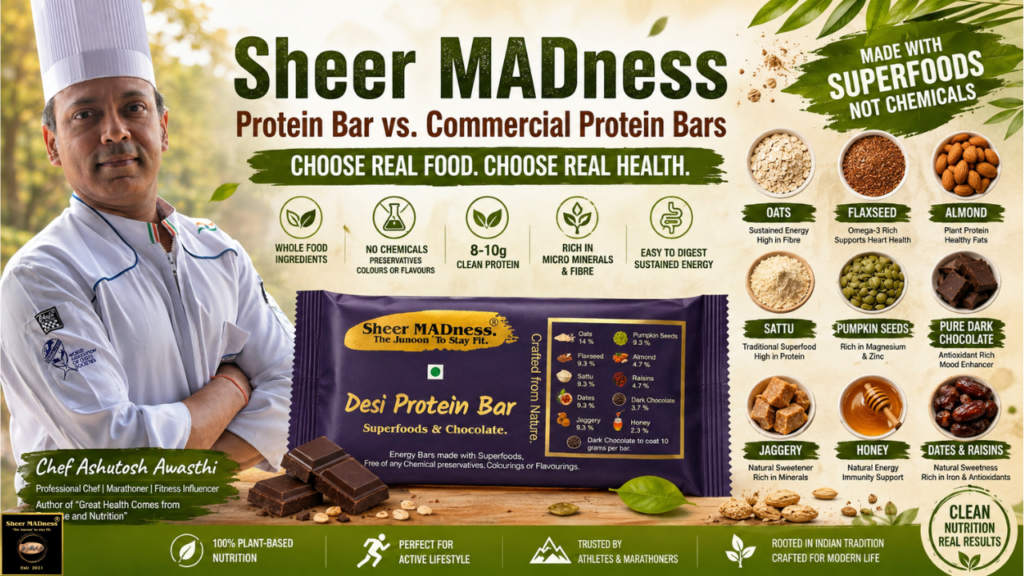
Direct answer: When comparing a natural protein bar vs a commercial protein bar, the fundamental difference is this — one is built from real food, and the other is built around an isolated protein fraction with chemistry added to make it edible.
Sheer MADness Protein Bars contain oats, sattu, almonds, flaxseed, pumpkin seeds, melon seeds, dates, raisins, jaggery, honey, and pure dark chocolate. That is the complete ingredient list.
Most commercial protein bars, by contrast, are built around whey protein isolate or soy protein concentrate — chemically extracted protein fractions — then sweetened with maltitol or sucralose, bound with emulsifiers like INS 322, and preserved with anti-caking agents like INS 551 (silicon dioxide).
Both are sold as protein bars. However, they are fundamentally different products. One is food. The other is chemistry shaped into a food-like form.
I’m Chef Ashutosh Awasthi, founder of Sheer MADness, professional chef, marathon runner, and author of Great Health Comes from Exercise & Nutrition. I built this brand specifically because I couldn’t find a single bar on the market I felt comfortable eating myself. Let me explain exactly why the difference between a natural protein bar and a commercial one matters more than most people realise.
The first thing most people look at on a protein bar is the protein number on the front of the pack. More grams of protein means a better bar. That logic sounds reasonable, but it completely misses how nutrition actually works.
Consider this comparison honestly.
Bar A — a commercial protein bar delivering 20 grams of protein from whey isolate, sweetened with maltitol, preserved with BHA, and containing INS 551 as an anti-caking agent.
Bar B — a natural protein bar delivering 10 grams of protein from oats, sattu, almonds, flaxseed, and pumpkin seeds, sweetened with dates and jaggery, and preserved using oxygen absorbers.
The first bar delivers more protein. However, that protein comes stripped of the fibre, fats, and micronutrients the original food contained. Furthermore, Bar A delivers a daily dose of maltitol — a sugar alcohol that ferments in the large intestine causing gas and bloating — alongside BHA and INS 551 that pass through your digestive system as chemical residues every single day.
Bar B delivers less protein. However, that protein comes packaged with 3 to 5 grams of dietary fibre, omega-3 fatty acids from flaxseed, magnesium and Vitamin E from almonds, iron from sattu and pumpkin seeds, and natural energy from dates and jaggery. Moreover, it delivers zero chemical residues.
The goal of nutrition is not to maximise a single nutrient. The goal is to support long-term health. Viewed through that lens, Bar B wins by a significant margin.
Understanding the manufacturing process helps explain why a natural protein bar vs commercial protein bar comparison matters so much.
Most commercial bars start with a protein isolate. Whey protein isolate, for example, is produced by taking liquid whey — a dairy by-product — and passing it through a series of filtration, acid washing, and alkaline processing steps to strip away everything except protein. The result is a white powder that is 90 percent protein by weight.
The process strips away the fat, the lactose, the vitamins, and the minerals that whole dairy contains. Furthermore, it strips away the fibre and the natural food structure that slows digestion and supports gut health.
Protein isolate powder does not naturally bind into a bar. It needs help. Consequently, manufacturers add emulsifiers — soy lecithin (INS 322), mono- and diglycerides (INS 471), or glycerol — to hold the bar together.
Protein isolate tastes bitter and chalky. It needs flavour. Most commercial bars therefore add maltitol, sorbitol, sucralose, or acesulfame-K to mask the taste. Sugar alcohols like maltitol provide sweetness without adding calories — but they cause gut fermentation, bloating, and loose stools in a significant number of people.
A bar built on protein powder, emulsifiers, and synthetic sweeteners needs preservation. BHA, BHT, and anti-caking agents like INS 551 (silicon dioxide) are added to prevent oxidation and clumping. These compounds extend shelf life to 12 to 18 months — but they pass through your digestive system daily as chemical residues your body has to process and excrete.
By the time a commercial bar reaches the shelf, it typically contains 20 to 30 ingredients — many of which are industrial processing aids rather than food. The front of the pack says “natural” or “real food.” The back of the pack tells a different story in small print.
The manufacturing process for Sheer MADness bars could not be more different.
Every ingredient in a Sheer MADness bar is a whole food. Oats go in as oats. Almonds go in as almonds. Sattu goes in as roasted chickpea flour. Dates go in as dates. There is no extraction, no chemical processing, and no stripping away of the food’s natural nutritional complexity.
Consequently, the protein in a Sheer MADness bar comes packaged with the fibre, fats, vitamins, and minerals that those ingredients naturally contain. It arrives in the form your gut evolved to process — because it is the actual food, not an industrial fraction of it.
Dates and honey act as natural binders in Sheer MADness bars. Their natural sugars and sticky texture hold the bar together without any synthetic emulsifier. Therefore, there is no INS 322, no INS 471, and no glycerol in any Sheer MADness bar.
Dates, raisins, jaggery, and honey sweeten every Sheer MADness bar. These are whole-food sweeteners with nutritional value — iron from jaggery, potassium from dates, antioxidants from raisins. Furthermore, their natural fibre content means the sugars release gradually rather than causing the blood sugar spike associated with refined sweeteners.
There is no maltitol, no sorbitol, no sucralose, and no acesulfame-K in any Sheer MADness bar.
Sheer MADness uses oxygen absorbers rather than chemical preservatives. We place oxygen absorbers inside each pack, removing oxygen from the environment entirely. No oxygen means no oxidation and no microbial growth — without adding BHA, BHT, INS 551, or any other chemical compound to the food itself.
Therefore, we change the physical environment around the bar. We do not change the chemistry of the bar.
This is the section that separates a natural protein bar from a commercial one most clearly. Every ingredient in Sheer MADness earns its place through genuine nutritional function — not as a processing aid or a flavour-masking tool.
Oats provide beta-glucan, one of the most extensively studied soluble fibres in nutritional science. Beta-glucan slows glucose absorption, feeds beneficial gut bacteria, and delivers energy that lasts several hours rather than several minutes. Furthermore, oats act as a natural binder, holding the bar together without any synthetic emulsifier.
Sattu is roasted chickpea flour — one of India’s oldest protein foods. Consumed for centuries in Bihar, Bengal, and Uttar Pradesh for its protein density, cooling digestive quality, and sustained energy, sattu is the most genuinely desi protein source possible. Indian bodies have handled it comfortably for generations. The same cannot be said of imported whey isolate.
Almonds deliver Vitamin E, magnesium, healthy monounsaturated fats, and plant protein. Magnesium from almonds supports over 300 enzymatic reactions in the body including energy production and muscle contraction. Vitamin E protects cell membranes from oxidative damage. Additionally, the calcium in almonds supports bone density in a form the body absorbs well alongside food rather than as an isolated supplement.
Flaxseed is one of the richest plant sources of alpha-linolenic acid, the omega-3 fatty acid that supports cardiovascular health, reduces inflammation, and aids muscle recovery. Furthermore, flaxseed lignans support hormonal balance in both men and women. The soluble and insoluble fibre in flaxseed actively prevents the constipation that most commercial protein bars cause through their sugar alcohol content.
Pumpkin seeds and melon seeds contribute zinc, iron, magnesium, and phosphorus — four minerals commonly deficient in Indian vegetarian diets. Zinc supports immune function and testosterone production. Iron supports haemoglobin production and oxygen delivery to muscles. Together, these two seeds make Sheer MADness bars a meaningful daily contribution to micronutrient intake — something no protein isolate-based bar can replicate.
These four natural sweeteners replace every synthetic sweetener and sugar alcohol found in commercial bars. Dates provide iron and natural fructose packaged with fibre. Raisins contribute potassium and antioxidant polyphenols. Jaggery delivers trace minerals and iron with every gram of sweetness. Honey adds antimicrobial compounds and natural flavour complexity.
Moreover, none of these cause the gut fermentation and bloating that maltitol and sorbitol cause in a significant percentage of people who consume commercial bars regularly.
The dark chocolate in Sheer MADness bars is pure, chemical-free, and free of any alkali processing or synthetic emulsifier. It contributes magnesium, iron, and antioxidant flavonoids while delivering the chocolate taste that makes the bar genuinely enjoyable rather than mediocre.
This is the most overlooked difference in any natural protein bar vs commercial protein bar comparison.
A protein isolate delivers protein. That is its entire nutritional contribution. Every other compound in the original food — the vitamins, minerals, phytonutrients, and antioxidants — is stripped away during extraction.
Sheer MADness bars, by contrast, deliver a meaningful profile of micronutrients through whole-food ingredients naturally.
Vitamin E comes naturally from almonds. Omega-3 fatty acids come naturally from flaxseed. Iron comes naturally from sattu, pumpkin seeds, jaggery, and raisins. Magnesium comes naturally from almonds, oats, and dark chocolate. Zinc comes naturally from pumpkin seeds and melon seeds. Antioxidant flavonoids come naturally from dark chocolate and cocoa. Potassium comes naturally from dates and raisins. Calcium comes naturally from almonds.
These nutrients are not added as synthetic supplements to a processed protein base. They are inherently present in the whole-food ingredients themselves — in the forms and ratios that the human body evolved to absorb and use.
This is the micronutrient advantage that no commercial bar can replicate without adding a synthetic multivitamin supplement to an already processed base.
This is a conversation the commercial protein bar industry in India has never had honestly.
The most popular commercial protein bars in India are built around whey protein isolate — a dairy-derived ingredient. Research consistently shows that 60 to 70 percent of Indian adults have some degree of lactose intolerance. Whey protein concentrate still contains residual lactose, causing chronic low-grade digestive disruption — bloating, gas, and irregular bowel movement — in a large proportion of Indian consumers who don’t connect their symptoms to their bar.
Furthermore, the synthetic sweeteners and sugar alcohols in most commercial bars are not part of the traditional Indian digestive experience. Indian guts evolved alongside jaggery, dates, honey, and natural fruit sugars — not maltitol, sucralose, or acesulfame-K.
Sheer MADness bars are built on ingredients Indian families have consumed comfortably for generations. Sattu, oats, almonds, dates, jaggery, flaxseed — these are not foreign concepts to the Indian digestive system. They are its native language.
Let me be honest about why I built Sheer MADness.
I am a professional chef. I transformed my own health in my forties — going from overweight and unfit to completing marathons and inspiring thousands of people. That transformation is documented in my book, Great Health Comes from Exercise & Nutrition.
During that process, I looked for a protein bar I could genuinely eat every day — one that was built from real food rather than chemical ingenuity. It didn’t exist in the Indian market in a form I trusted.
So I asked the question that drives everything Sheer MADness makes: what did Indian households eat for protein, energy, and recovery before the supplement industry existed?
The answer was sattu laddoos in Bihar and Bengal. Almond and date energy balls in Rajasthani households. Oat and jaggery chikkis. Dark chocolate-coated nut bars made in home kitchens. Flaxseed in everyday cooking. These were the original protein bars of Indian food culture.
Moreover, not one of them contained a chemical preservative. Not one needed an emulsifier. Not one required a protein isolate. They built strength, supported digestion, and fuelled daily life across generations — because they were real food.
Sheer MADness bars are those original recipes brought back in a modern, convenient format. The philosophy hasn’t changed. Only the packaging has.

Since 2021, Sheer MADness has displayed every ingredient with its own image on the front of every pack. No INS codes in small print. No chemical names requiring a food science degree to decipher. There are no vague terms like “natural flavour” or “nature identical flavour” hiding synthetic compounds.
To the best of my knowledge, we remain the only Indian nutrition brand doing this consistently across our entire product range.
The reason most brands don’t do this is simple. Most brands have things to hide. Their labels are designed to be read quickly and understood incompletely. The protein number on the front is big and bold. The sugar alcohol and anti-caking agent list on the back is small and technical.
Sheer MADness has nothing to hide. Consequently, every ingredient is on the front — named and pictured — so you know exactly what you are eating before you open the bar.
| Feature | Sheer MADness Natural Bar | Typical Commercial Bar |
|---|---|---|
| Protein source | Oats, sattu, almonds, flaxseed, pumpkin seeds, melon seeds — whole foods | Whey protein isolate, soy protein concentrate — chemically extracted |
| Protein per bar | 8 to 10g from whole foods | 10 to 20g mostly from isolates |
| Sweetener | Dates, raisins, jaggery, honey | Maltitol, sucralose, sorbitol, refined sugar |
| Preservatives | None — oxygen absorbers used | BHA, BHT, synthetic antioxidants |
| Anti-caking agents | None | INS 551 (silicon dioxide) |
| Emulsifiers | None | INS 322 (soy lecithin), INS 471 |
| Dietary fibre | 3 to 5g naturally from whole foods | 1 to 2g, often from added isolated fibre |
| Micronutrients | Vitamin E, omega-3, iron, zinc, magnesium naturally | Often only what synthetic supplements add |
| Ingredient count | 10 to 11 whole foods | Often 20 to 30, many are processing aids |
| Suitable for lactose-intolerant | Yes — completely dairy-free | No — whey isolate has dairy origin |
| Gut fermentation risk | None — no sugar alcohols | High — maltitol and sorbitol ferment in large intestine |
| Front label transparency | Every ingredient named and pictured | INS codes in small print on back |
| Price per bar | ₹57.50 to ₹60 | ₹80 to ₹150 |
| Made in India | Yes — Kolkata, West Bengal | Varies — often imported or contract manufactured |
| Shelf life method | Oxygen absorbers — no chemistry | Chemical preservatives |
Sheer MADness is a registered trademark under the Government of India. The Natural Plant Protein formula is patent published under Patent No. 202331036733, searchable on Intellectual Property India. The brand holds a valid FSSAI licence and GSTIN registration. Every certification is publicly displayed on the website and on the product label.
Is a natural protein bar better than a commercial protein bar?
For long-term daily consumption, yes. A natural protein bar delivers whole-food protein alongside fibre, micronutrients, and healthy fats, without the chemical additives, sugar alcohols, and synthetic preservatives that commercial bars require. The lower protein number is more than compensated by the significantly richer overall nutritional profile.
Why do commercial protein bars use protein isolates?
Protein isolates deliver a higher protein percentage per gram at a lower cost than whole foods. They also have a longer shelf life and a more consistent protein content per batch, which makes manufacturing simpler and label claims more straightforward. However, the extraction process strips away everything that makes the original food nutritious beyond its protein fraction.
Are sugar alcohols in protein bars harmful?
Not in small amounts for most people. However, maltitol and sorbitol — the most common sugar alcohols in commercial bars — are known to cause gas, bloating, and loose stools in a significant proportion of consumers, particularly when consumed daily. For people with IBS or sensitive digestive systems, they are particularly problematic.
We use oxygen absorbers inside each pack, removing oxygen from the packaging environment entirely. No oxygen means no oxidation and no microbial growth. Consequently, we achieve a shelf life of 4 to 6 months without adding BHA, BHT, INS 551, or any other chemical preservative to the food itself.
Does a lower protein content mean a worse bar?
No. Protein content is one metric among many. A bar delivering 10 grams of whole-food protein alongside 4 grams of fibre, omega-3 fatty acids, magnesium, zinc, and Vitamin E provides significantly better overall nutrition than a bar delivering 20 grams of isolated protein with no fibre and a daily dose of synthetic chemicals.
Why does Sheer MADness use sattu instead of whey protein?
Sattu is roasted chickpea flour — one of India’s oldest, most easily digestible protein foods. It has been consumed by Indian people for centuries without digestive issues. Whey protein isolate, by contrast, is chemically extracted from dairy and contains residual lactose that 60 to 70 percent of Indian adults cannot fully digest. Sattu is the more appropriate protein source for Indian consumers by a significant margin.
To the best of our knowledge, yes. We are not aware of any other Indian protein bar brand that is simultaneously free of protein isolates, sugar alcohols, artificial sweeteners, chemical preservatives, anti-caking agents, and emulsifiers — while also displaying every ingredient with its image on the front of the pack. If you find one, we’d genuinely be delighted to know about it.
What makes Sheer MADness bars suitable for daily eating?
Three things. First, every ingredient is a recognisable whole food. Second, there is zero chemical additive of any kind. Third, the bars are preserved through oxygen removal rather than chemistry, meaning the food itself is completely unaltered. Daily consumption of real food has no ceiling the way daily consumption of chemical additives does.
The comparison between a natural protein bar and a commercial protein bar ultimately comes down to a single question: do you want protein, or do you want food?
Commercial bars give you protein — efficiently, economically, at high grams per serving. However, they give it to you stripped of its natural nutritional complexity, sweetened with compounds that ferment in your gut, preserved with chemicals your body has to excrete, and packaged with an ingredient list designed to be misunderstood.
Sheer MADness gives you food — specifically, the same whole-food ingredients Indian households have trusted for centuries for energy, strength, and recovery. The protein number is lower. However, everything surrounding that protein number — the fibre, the omega-3s, the micronutrients, the antioxidants, the gut-friendly natural sweeteners, the zero chemical residues — makes this a fundamentally different and genuinely superior daily nutrition choice.
Furthermore, at ₹57.50 to ₹60 per bar versus ₹80 to ₹150 for most commercial alternatives, it is also the better value.
Real food. No chemistry. Every ingredient on the front of the pack since 2021. That is the Sheer MADness standard — and it is the standard every protein bar in India should be held to.
I would also request you to kindly read my previous post about “Healthiest Protein Bar in India“.
a) Everyone is an individual, so what suits me may not suit the next person.
b) If a person has a medical condition, a doctor’s advice and prescribed medication will only help.
c) While buying any protein bar from the market, read the labels carefully. Watch out for codes and words like Anti-caking agent, INS 551 (Silicon dioxide), BHA (Butylated hydroxyanisole), BHT (Butylated hydroxytoluene), maltitol, sorbitol, sucralose, and other lab-made chemicals that quietly appear on most commercial labels.
If you are interested in buying chemical-free Natural Plant Protein Moringa, Health Drinks for Kids, or our delicious chemical-free Energy Bars, Protein Bars, and Millet Bars, shop at Sheer MADness.
You can also find us on Flipkart, Jio Mart, or ONDC in India.
d) Exercise is the key to fitness. Exercise and nutrition are two sides of the same coin and always go hand in hand.
e) Excess of anything is wrong, even the best whole-food snack. Consume only recommended quantities.
f) Rome was not built in a day. Discipline and consistency are the only keys to lasting health.
g) It is not only exercise and protein that builds health. A healthy gut, macro and micronutrients, body type, rest, and lifestyle all matter. Of all these, exercise and nutrition are within our control. Focus on these two primary aspects first.
h) The most important part of fitness is that nothing is better than exercise and a balanced meal.
Article by Chef Ashutosh Awasthi
Disclaimer: Our products are a source of HEALTHY NUTRIENTS and are COMPLETELY FREE OF ANY ADDED CHEMICALS. We do not claim to cure any medical condition. The content provided is informational. We do not claim to diagnose or treat a person with any specific medical condition.