
Direct answer: Protein bars with natural sugar only — bars sweetened exclusively with dates, jaggery, honey, and raisins rather than refined sugar, maltitol, sucralose, or high-fructose corn syrup — are genuinely better for your health, your gut, and your long-term relationship with food.
This isn’t a marketing claim. It’s food science and metabolic research that the supplement industry prefers you don’t examine too closely.
The difference between natural whole-food sweeteners and synthetic sugar alternatives isn’t simply about calorie count. It’s about what happens inside your gut, your liver, and your metabolic system every day you consume that bar. Furthermore, it’s about whether the sweetness in your bar comes with nutritional value attached or simply with chemical residue.
I’m Chef Ashutosh Awasthi, founder of Sheer MADness, professional chef, marathon runner, and author of Great Health Comes from Exercise & Nutrition. I transformed my own health in my forties. Every product I formulate, I formulate for myself first. Let me explain exactly why natural sugar in protein bars matters — and why the “sugar-free” marketing on most commercial bars is hiding a worse problem than the sugar it replaced.
The protein bar industry created a specific problem and then sold you its solution.
Here is what happened. Commercial protein bars built on whey protein isolate need sweetening — isolate powder tastes bitter and chalky on its own. Refined sugar was the original solution. However, as health consciousness grew and “low sugar” became a selling point, manufacturers switched from refined sugar to sugar alcohols and artificial sweeteners instead.
The marketing changed from “healthy” to “low sugar” or “sugar free.” The product didn’t get healthier. It got more chemically complex. Furthermore, in many cases it got worse for your body than the refined sugar version it replaced.
Consumers searching for protein bars with natural sugar only are therefore asking exactly the right question. They have correctly identified that neither refined sugar nor synthetic substitutes is what they want in a daily bar. What they want is the third option — sweetness from whole foods that comes with nutritional value rather than with chemical residue.
This is the part the “low sugar” bar industry doesn’t want you to understand clearly.
Maltitol is the most commonly used sugar alcohol in commercial “low sugar” protein bars. It has a glycaemic index of approximately 35 — lower than refined sugar at 65 — which is why manufacturers market maltitol-sweetened bars as blood-sugar-friendly.
However, maltitol has two serious problems that the glycaemic index number doesn’t capture.
First, maltitol passes largely undigested through the small intestine and reaches the large intestine intact. There, gut bacteria ferment it rapidly — producing gas, bloating, loose stools, and significant digestive discomfort. For daily bar consumption, this is a daily gut disruption that accumulates over time into chronic low-grade digestive irritation.
Second, maltitol’s glycaemic response is dose-dependent. At the quantities used in most commercial bars — typically 15 to 20 grams per bar — the insulin response can be surprisingly significant despite the lower GI number, particularly in people with metabolic sensitivity.
Furthermore, maltitol alters the composition of the gut microbiome with regular daily consumption — reducing populations of beneficial Lactobacillus and Bifidobacterium species that are central to immune function, mood regulation, and digestive health.
Sucralose, aspartame, and acesulfame-K are used in bars marketed as “zero sugar” or “no added sugar.” Each creates specific metabolic concerns with daily consumption.
A 2023 study published in Cell found that sucralose specifically impairs the body’s signalling response to sweet taste, potentially disrupting appetite regulation and glucose tolerance with regular daily consumption.</cite> This means that daily sucralose consumption may actually worsen the blood sugar management it is marketed to support.
Research published in Nature Medicine in 2023 found that erythritol — increasingly popular as a “natural” sugar substitute — was associated with increased risk of cardiovascular events including heart attack and stroke in a large cohort study, raising significant concerns about its long-term safety at the doses found in commercial protein bars.
A comprehensive review published in PLOS Medicine found that higher consumption of non-sugar sweeteners was not associated with long-term weight loss benefits and was associated with potentially adverse effects on cardiometabolic health markers.
This research collectively makes a strong case that the “sugar-free” solution the industry sold us may be significantly worse than a moderate amount of natural whole-food sweetener consumed in the context of fibre-rich whole-food ingredients.
Natural sweeteners in protein bars with natural sugar only are not simply “less bad” versions of refined sugar. They are genuinely different metabolic experiences — because they are whole foods rather than isolated sugar fractions.
Dates have a glycaemic index of approximately 42 to 55 — lower than refined sugar — but that number only tells part of the story. The natural fructose and glucose in dates arrive packaged with dietary fibre, potassium, iron, and antioxidant polyphenols. The fibre specifically slows glucose absorption, blunting the blood sugar response compared to isolated fructose or refined sugar at the same calorie count.
Furthermore, dates are one of the richest natural sources of potassium available — more potassium per 100 grams than bananas. Potassium supports electrolyte balance, muscle function, and blood pressure regulation. A natural sweetener that simultaneously supports electrolyte balance is categorically different from refined sugar that provides nothing beyond calories.
Dates also provide insoluble fibre that supports bowel regularity — the opposite of the gut disruption that maltitol causes. Moreover, their sticky, adhesive natural texture helps bind bar ingredients together without any synthetic emulsifier or binder, making them both a nutritional ingredient and a functional food processing aid simultaneously.
Jaggery is unrefined cane sugar — the juice of sugarcane boiled down and solidified without the refining process that strips away colour, flavour, and nutrition. The result is a dark, molasses-rich sweetener that retains the minerals present in the original sugarcane juice.
Specifically, jaggery contains iron, magnesium, potassium, calcium, phosphorus, and small amounts of zinc and copper. These are not supplemented minerals — they are naturally present in the food because the refining process that would remove them has not been applied.
Jaggery also contains phenolic compounds — plant antioxidants that contribute to its characteristic flavour complexity. These are completely absent from refined white sugar.
The glycaemic index of jaggery is approximately 84 — higher than refined sugar’s 65 — which is why it should be consumed in appropriate portions rather than treated as a completely free food. However, in the quantities used in a Sheer MADness bar alongside fibre from oats, flaxseed, and almonds, the overall glycaemic impact of the whole bar is significantly blunted compared to what the jaggery GI alone suggests.
Furthermore, jaggery has been used in Indian households for centuries as a digestive aid — traditionally consumed after meals to support bowel movement. This traditional use is consistent with its known mineral and fibre content. Indian bodies have processed jaggery comfortably for generations. The same cannot be said of maltitol or sucralose.
Honey contains fructose, glucose, and water as its primary components — but also contains over 180 bioactive compounds including flavonoids, phenolic acids, and antimicrobial peptides that are unique to honey and absent in all synthetic sweeteners.
The glycaemic index of honey varies between 45 and 64 depending on the floral source. Like dates and jaggery, the natural sugars in honey arrive with bioactive compounds that modify their metabolic effect compared to isolated fructose or sucrose.
Additionally, honey’s natural antimicrobial properties complement the oxygen-absorber preservation method used in Sheer MADness bars — contributing mildly to the preservation environment without any chemical intervention.
Raisins provide concentrated natural glucose and fructose alongside potassium, iron, and antioxidant polyphenols — specifically resveratrol and anthocyanins. Their natural sugar arrives packaged with fibre and the full micronutrient profile of the grape from which they were made.
In a bar context, raisins add both sweetness and a pleasant chewiness that improves the eating experience without any artificial texture agent. Furthermore, their polyphenol content supports gut microbiome health — specifically the growth of beneficial bacteria — which is the direct opposite of what artificial sweeteners do.
The combination of dates, jaggery, honey, and raisins in Sheer MADness bars is not incidental. Each contributes a different flavour note, a different sweetness character, and a different nutritional profile that together create something more complete than any single sweetener alone.
Dates provide caramel depth and binding function. Jaggery provides molasses complexity and mineral richness. Honey provides floral brightness and antimicrobial activity. Raisins provide fruit sweetness and polyphenol antioxidants.
Together, they create the layered, complex, naturally satisfying sweetness that makes Sheer MADness bars taste genuinely enjoyable to eat every day — without the one-dimensional synthetic sweetness of maltitol, the metallic aftertaste of sucralose, or the cooling sensation of erythritol.
Furthermore, each of these sweeteners is a whole food that Indian palates have recognised and enjoyed for centuries. Jaggery in traditional mithai. Dates in Ramadan celebrations and everyday snacking. Honey in Ayurvedic preparations and chai. Raisins in pulao, kheer, and everyday cooking. These are not exotic health ingredients — they are the everyday sweeteners of Indian food culture, present in protein bar form.
This is the most compelling research-based argument for protein bars with natural sugar only — and it’s the argument the synthetic sweetener industry most actively resists.
A landmark 2022 study published in Cell found that artificial sweeteners including saccharin, sucralose, aspartame, and stevia altered the gut microbiome in a highly individual and consistent manner — reducing populations of beneficial bacteria and increasing pathogenic bacteria in ways that negatively affected glucose metabolism.</cite>
Research from the Weizmann Institute found that sweetener-induced gut microbiome changes directly led to impaired glucose tolerance in previously healthy individuals — meaning that the very people eating “sugar-free” bars to manage blood sugar were experiencing a worsened blood sugar response due to gut microbiome disruption from the sweeteners designed to help them.</cite>
Natural whole-food sweeteners do not have this effect. Dates, jaggery, and raisins contain prebiotics and polyphenols that feed and support beneficial gut bacteria rather than disrupting them. Honey contains oligosaccharides that act as prebiotics for Bifidobacterium species — one of the most beneficial bacterial families in the human gut.
A daily bar sweetened with natural whole-food sugars therefore actively supports the gut microbiome. A daily bar sweetened with maltitol or sucralose actively disrupts it. For daily consumption over months and years, this difference becomes one of the most significant health distinctions between bar types.
This table puts the sweetener comparison in concrete context.
| Sweetener | Glycaemic Index | Fibre | Micronutrients | Gut Microbiome Effect | Daily Safety |
|---|---|---|---|---|---|
| Refined white sugar | 65 | None | None | Negative at high doses | With moderation |
| Maltitol | 35 | None | None | Negative — fermentation and disruption | Problematic daily |
| Sucralose | 0 | None | None | Negative — disrupts beneficial bacteria | Concerning daily |
| Erythritol | 0 | None | None | Associated with cardiovascular risk | Under review |
| Dates | 42-55 | Yes — 6-8g/100g | Iron, potassium, magnesium | Positive — prebiotic polyphenols | Safe and beneficial |
| Jaggery | 84 | Trace | Iron, magnesium, calcium | Neutral to positive | Safe in portions |
| Honey | 45-64 | None | Flavonoids, enzymes | Positive — prebiotic oligosaccharides | Safe in portions |
| Raisins | 64 | Yes — 3-4g/100g | Iron, potassium, resveratrol | Positive — anthocyanin polyphenols | Safe and beneficial |
The picture this table presents is clear. Natural sweeteners from whole foods are not simply “less bad” — they are categorically better for daily bar consumption in ways that GI numbers alone do not capture.
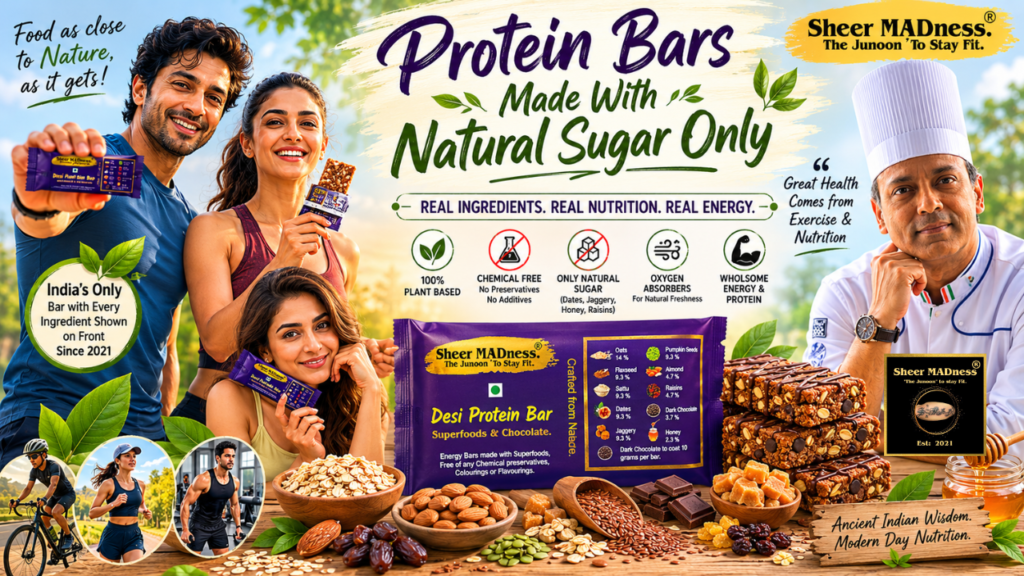
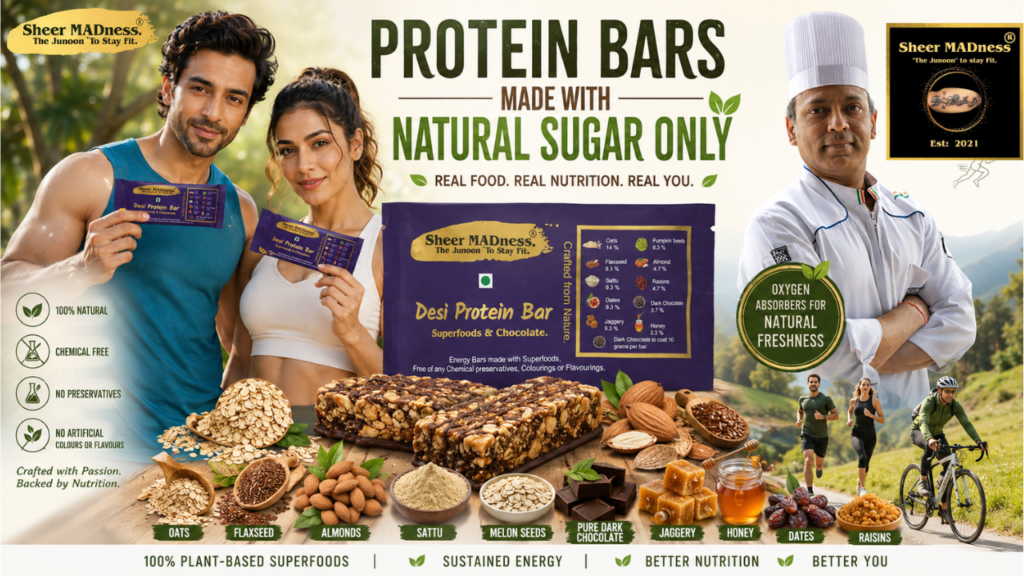
Sheer MADness Protein Bars, Energy Bars, and Millet Bars are sweetened exclusively with dates, raisins, jaggery, and honey. Not one gram of refined sugar, maltitol, sorbitol, sucralose, erythritol, or any other synthetic sweetener appears in any Sheer MADness product.
Furthermore, these natural sweeteners don’t work in isolation — they work in combination with 3 to 5 grams of dietary fibre per bar from oats, flaxseed, almonds, and sattu that further slow natural sugar absorption and blunt the glycaemic response of the whole bar.
Since 2021, Sheer MADness has displayed every ingredient with its own image on the front of every pack. The sweetener ingredients are displayed as clearly as the protein ingredients — dates, raisins, jaggery, and honey, named and pictured.
This transparency is possible because there is nothing to hide. No synthetic sweetener is buried in small print, there are no maltitol listed in a long additive section. No “natural flavour” covering a synthetic compound. If you can see it on the front of the pack, it’s in the bar. What you see is what you eat.
Sheer MADness uses oxygen absorbers rather than chemical preservatives. This matters specifically in the context of natural sweeteners because oxygen absorbers preserve the natural sugars in dates and jaggery in their original form — no chemical interaction alters their structure or metabolic effect. The dates you see in the bar are preserved dates. They are not dates treated with potassium sorbate. They are not dates sprayed with sodium benzoate; these are dates.
As a professional chef, I understand that sweetness in food is not binary — it’s not simply “sweet” or “not sweet.” Natural sweeteners from different sources provide different flavour characters — the caramel depth of dates, the molasses warmth of jaggery, the floral brightness of honey, the fruit acidity of raisins — that together create a complex, satisfying sweetness that synthetic systems cannot replicate.
This layered sweetness is what makes Sheer MADness bars genuinely enjoyable to eat every day rather than progressively less appealing. Real food sweetness does not create flavour fatigue. Synthetic sweetness does — which is why most people find commercial protein bars increasingly unpleasant after the first few weeks of daily consumption.
The combination of low-to-moderate GI natural sweeteners alongside 3 to 5 grams of whole-food fibre makes Sheer MADness bars a significantly better choice for people monitoring blood sugar than bars sweetened with maltitol or sucralose. Furthermore, the absence of gut microbiome disruption from synthetic sweeteners means the bars actively support rather than undermine glucose tolerance with daily use.
However, people with diagnosed diabetes should always monitor individual blood sugar response to any food and consult their doctor for personalised guidance.
Natural sweeteners from dates, jaggery, and honey are the sweeteners Indian families have given children for centuries. They are recognisable, safe, and nutritionally appropriate for daily consumption in children above 6 years. Moreover, they support rather than disrupt the developing gut microbiome that is critical to childhood immunity and cognitive development.
Natural sweeteners provide quick and sustained energy for athletic performance without the digestive disruption that sugar alcohols cause during or after physical activity. The potassium from dates supports electrolyte balance during exercise. The iron from jaggery supports haemoglobin production and oxygen delivery. Furthermore, the antioxidant polyphenols from raisins and honey reduce post-exercise oxidative stress.
The elimination of maltitol and sorbitol alone — the two most common digestive triggers in commercial protein bars — makes Sheer MADness bars significantly better tolerated by people with irritable bowel syndrome or sensitive digestion. Additionally, the prebiotic effect of date and raisin polyphenols actively supports a healthier gut environment for people managing chronic digestive issues.
If you read labels carefully before buying anything you eat daily, Sheer MADness bars were built for you. Every sweetener is a named whole food displayed on the front of the pack. There is no investigative label-reading required to understand what is sweetening this bar.
I want to close with the cultural dimension of this topic — because it matters beyond food science.
Jaggery, honey, dates, and raisins are not modern health food trends. They are ancient Indian sweeteners that have been part of Indian food culture for thousands of years. Jaggery has sweetened Indian cooking since before refined sugar existed in India. Honey appears in Ayurvedic medicine as a therapeutic food. Dates have been part of Indian festival cooking and everyday nutrition across multiple regional traditions. Raisins appear in everything from pulao to kheer to traditional mithai.
These are not ingredients Indian bodies need to be introduced to or slowly adapted to. They are ingredients Indian bodies have evolved alongside. They are genuinely compatible with Indian digestive physiology in a way that maltitol, sucralose, and erythritol — which have existed for decades at most — cannot be.
When I formulated Sheer MADness bars, I was not innovating by using these sweeteners. I was restoring. Bringing back the sweeteners that Indian food culture always knew were the right ones — before the global supplement industry convinced us that synthetic alternatives were superior because they had a better marketing story.
They don’t have a better story. They have a louder story. Real food has a quieter story — but a far longer, more consistently reliable one.
Sheer MADness is a registered trademark under the Government of India. The Natural Plant Protein formula is patent published under Patent No. 202331036733, searchable on Intellectual Property India. The brand holds a valid FSSAI licence and GSTIN registration.
Are protein bars with natural sugar better than sugar-free bars?
Yes — for daily consumption. Research consistently shows that synthetic sweeteners in “sugar-free” bars disrupt the gut microbiome, impair glucose tolerance with regular use, and cause digestive fermentation and discomfort. Natural sweeteners from dates, jaggery, honey, and raisins provide sweetness alongside fibre and micronutrients without these negative effects.
Do dates and jaggery in protein bars spike blood sugar?
The glycaemic impact of dates and jaggery in a Sheer MADness bar is significantly blunted by 3 to 5 grams of dietary fibre from oats, almonds, flaxseed, and sattu that slow glucose absorption. The whole bar’s glycaemic impact is considerably lower than either ingredient’s individual GI number suggests. People with diabetes should monitor their individual blood sugar response and consult their doctor.
Is maltitol safe in protein bars?
Maltitol is approved as a food additive. However, it causes significant gut fermentation and bloating in a large proportion of consumers, and its daily consumption is associated with gut microbiome disruption. Furthermore, at the doses used in commercial bars, its insulin response can be meaningful despite its lower GI. It is not an improvement over natural whole-food sweeteners for daily consumption.
Four natural whole-food sweeteners — dates, raisins, jaggery, and honey — sweeten every Sheer MADness bar. Each contributes a different flavour character alongside genuine nutritional value. Together, they create a layered, genuinely satisfying sweetness without any refined sugar, sugar alcohol, or artificial sweetener of any kind.
Are natural sugars suitable for weight management?
Yes, in appropriate portions and within a calorie-controlled diet. Natural sugars from whole foods arrive with fibre that slows absorption and increases satiety. Furthermore, avoiding the gut microbiome disruption caused by artificial sweeteners supports the healthy metabolic function that underpins effective weight management. One Sheer MADness bar daily is appropriate within a balanced calorie-conscious diet.
Is honey in protein bars better than refined sugar?
Honey is metabolically different from refined sugar — it contains bioactive compounds, antioxidant flavonoids, and prebiotic oligosaccharides that are completely absent from refined sugar. Its glycaemic index is also lower than refined sugar in most varieties. Furthermore, honey’s natural antimicrobial compounds complement the oxygen-absorber preservation used in Sheer MADness bars. In food-appropriate amounts, honey is a genuinely superior sweetening choice to refined sugar.
Is jaggery suitable for people with diabetes?
Jaggery has a higher glycaemic index than refined sugar and should be consumed carefully by people managing diabetes. However, in Sheer MADness bars where jaggery is one of four natural sweeteners used in modest amounts alongside significant fibre, the overall glycaemic impact of the bar is considerably moderated. People with diabetes should monitor their individual blood sugar response to any new food and consult their doctor for personalised guidance.
Can children eat protein bars sweetened with natural sugar?
Yes. Dates, raisins, jaggery, and honey are the sweeteners Indian families have given children for generations. They are nutritionally appropriate, safe, and compatible with children’s developing digestive systems. One Sheer MADness bar daily for children above 6 years provides natural sweetness alongside iron, potassium, and antioxidants rather than synthetic chemicals.
The choice between natural whole-food sweeteners and synthetic sugar substitutes in protein bars is not simply about calories or glycaemic index. It’s about what happens inside your gut, your liver, and your microbiome every day you consume that bar.
Research now clearly shows that synthetic sweeteners — maltitol, sucralose, erythritol — disrupt the gut microbiome in ways that worsen the metabolic outcomes they were designed to improve. Natural whole-food sweeteners — dates, jaggery, honey, raisins — support the gut microbiome, provide micronutrients alongside their sweetness, and are compatible with daily long-term consumption in a way that synthetic alternatives simply are not.
Sheer MADness bars are sweetened with natural sugar only — four ancient Indian whole-food sweeteners that have been part of Indian nutrition for thousands of years. They are preserved with oxygen absorbers rather than chemistry. Every ingredient is displayed on the front of the pack since 2021.
That is the standard protein bars with natural sugar should meet. And in India today, Sheer MADness is the bar meeting it.
I would also request you to kindly read my previous post about “Healthiest Protein Bar in India“.
a) Everyone is an individual, so what suits me may not suit the next person.
b) If a person has a medical condition, a doctor’s advice and prescribed medication will only help.
c) While buying any protein bar from the market, read the labels carefully. Watch out for codes and words like maltitol, sorbitol, sucralose, erythritol, acesulfame-K, INS 551 (Silicon dioxide), BHA (Butylated hydroxyanisole), BHT (Butylated hydroxytoluene), and other lab-made chemicals that quietly appear on most commercial labels.
If you are interested in buying chemical-free Natural Plant Protein Moringa, Health Drinks for Kids, or our delicious chemical-free Energy Bars, Protein Bars, and Millet Bars, shop at Sheer MADness.
You can also find us on Flipkart, Jio Mart, or ONDC in India.
d) Exercise is the key to fitness. Exercise and nutrition are two sides of the same coin and always go hand in hand.
e) Excess of anything is wrong, even the best whole-food snack. Consume only recommended quantities.
f) Rome was not built in a day. Discipline and consistency are the only keys to lasting health.
g) It is not only exercise and protein that builds health. A healthy gut, macro and micronutrients, body type, rest, and lifestyle all matter. Of all these, exercise and nutrition are within our control. Focus on these two primary aspects first.
h) The most important part of fitness is that nothing is better than exercise and a balanced meal.
Article by Chef Ashutosh Awasthi
Disclaimer: Our products are a source of HEALTHY NUTRIENTS and are COMPLETELY FREE OF ANY ADDED CHEMICALS. We do not claim to cure any medical condition. The content provided is informational. We do not claim to diagnose or treat a person with any specific medical condition.