

Direct answer: Moringa plant protein powder is specifically and meaningfully beneficial for iron-deficiency anaemia — the most common form of anaemia in India. Moringa leaf powder provides iron at approximately 28 milligrams per 100 grams dry weight, alongside Vitamin C at approximately 17 times the concentration in oranges. This Vitamin C is critically important: it converts ferric iron (Fe³⁺) to ferrous iron (Fe²⁺) in the gut, the only form that the intestinal iron transporter DMT-1 can absorb. Moringa is therefore not just an iron source — it is an iron-plus-absorption-enhancer in one whole food. Sheer MADness Plant Protein Moringa further compounds this benefit with almonds and flaxseed that provide the anti-inflammatory support reducing the chronic inflammation that impairs iron metabolism in anaemia of chronic disease.
This is a YMYL — Your Money or Your Life — medical topic. Anaemia is a diagnosed medical condition. Moringa is a nutritional support food, not a treatment. Anyone with diagnosed anaemia must be under medical care. This post explains how moringa specifically and scientifically supports nutritional anaemia management through diet — as a complement to medical treatment, never as a replacement for it.
I am Chef Ashutosh Awasthi, founder of Sheer MADness, professional chef, marathon runner, and author of Great Health Comes from Exercise & Nutrition. Let me explain the anaemia science behind moringa honestly, specifically, and with the research citations this important health topic deserves.
India has one of the world’s most severe anaemia burdens — and it is disproportionately a women’s health crisis.
The National Family Health Survey NFHS-5 (2019-21) data, representing the most comprehensive nationally representative data on Indian health, found that 57 percent of women aged 15 to 49 years in India were anaemic — defined as haemoglobin below 12 grams per decilitre. Among pregnant women, the anaemia prevalence was 52 percent. Among children aged 6 to 59 months, it reached 67 percent.
These are among the highest anaemia prevalence rates in the world. The consequences are profound and specific. Anaemia in women reduces physical work capacity, cognitive function, and immune competence. Anaemia in pregnancy increases risk of maternal mortality, low birth weight, and preterm birth. The same Anaemia in children impairs neurodevelopment, school performance, and physical growth.
The primary cause of anaemia in India is iron deficiency — the result of inadequate dietary iron intake from predominantly plant-based diets that are also high in absorption inhibitors (phytates from grains, polyphenols from tea), compounded by recurrent parasitic infections, menstrual blood loss in women, and the physiological iron demands of pregnancy and rapid childhood growth.
This is the context in which moringa’s role in anaemia management must be understood. Moringa is not a supplement for Western athletes managing marginal nutrition. It is a food with specifically high relevance to India’s most prevalent nutritional deficiency — and to the population most severely affected by it.
Most iron in plant foods is non-haem iron — iron in the ferric form (Fe³⁺) bound to organic compounds. This is distinct from haem iron — the form present in animal-derived foods like meat and fish — which is absorbed through a separate, more efficient pathway.
Non-haem iron absorption through the intestinal wall requires a specific sequence of steps.
First, gastric acid in the stomach reduces the pH environment around the iron, partially releasing it from its organic matrix. Second, a duodenal enzyme called ferric reductase converts ferric iron (Fe³⁺) to ferrous iron (Fe²⁺) — the only form that the intestinal iron transporter DMT-1 (Divalent Metal Transporter 1) can carry across the enterocyte membrane. Third, DMT-1 transports the ferrous iron across the intestinal cell’s brush border membrane. Fourth, iron is transferred across the intestinal cell and exported into the bloodstream.
The ferric to ferrous conversion by ferric reductase is the rate-limiting step in non-haem iron absorption. This enzyme has limited capacity — it can only reduce iron at a certain rate. If the ferric reductase is saturated or if conditions inhibit it, absorption efficiency drops.
Vitamin C — ascorbic acid — specifically and powerfully enhances this conversion. Ascorbic acid acts as a chemical reducing agent that converts ferric iron to ferrous iron in the gut lumen, before ferric reductase even needs to act. This chemical reduction by Vitamin C bypasses the enzymatic rate-limiting step entirely — pre-converting iron to its absorbable form before it reaches the transporter.
Research published in the European Journal of Clinical Nutrition confirmed that consuming Vitamin C alongside non-haem iron sources increases non-haem iron absorption by two to four times. The enhancement is dose-dependent and occurs with Vitamin C from food sources as well as supplements.
Moringa leaf powder provides both the iron and the Vitamin C in the same food. The Vitamin C from moringa is present alongside the iron from moringa — creating the simultaneous iron-ascorbate presence in the gut that maximises ferrous iron conversion and absorption. This is the mechanistic core of why moringa is specifically effective for iron-deficiency anaemia — it is an integrated iron-absorption system in a single whole food.
Moringa leaf powder provides iron at approximately 28 milligrams per 100 grams dry weight. This is an exceptional plant-food iron density — for comparison, spinach provides approximately 2.7 milligrams per 100 grams fresh weight, lentils provide approximately 3.3 milligrams per 100 grams cooked.
The high iron density of moringa, alongside its Vitamin C content that enhances absorption, makes it one of the most iron-available plant foods that can be conveniently incorporated into daily Indian dietary patterns.
A two to three tablespoon serving of Sheer MADness Plant Protein Moringa provides approximately 3 to 6 milligrams of iron — approximately 15 to 30 percent of the daily iron requirement for non-pregnant adult women (18 milligrams per day, ICMR-NIN 2024) from one daily serving alongside its Vitamin C absorption enhancer.
This is a meaningful daily contribution. However, it is important to contextualise correctly. Iron supplementation for diagnosed iron-deficiency anaemia requires medicinal iron at therapeutic doses — typically 60 to 120 milligrams of elemental iron per day under medical supervision. Moringa’s dietary iron contribution is nutritional support — a valuable daily dietary addition to an iron-adequate diet — not a therapeutic replacement for medicinal iron in established anaemia.
Understanding what blocks iron absorption explains why moringa’s Vitamin C is specifically valuable for Indian consumers.
The Indian diet contains several significant iron absorption inhibitors that reduce the effective absorption of the iron that food provides.
Phytates — inositol hexaphosphate — are present in high concentrations in the whole grains, legumes, and seeds that form the basis of Indian vegetarian diets. Phytates bind iron in the gut, forming insoluble iron-phytate complexes that cannot be absorbed. Research estimates that phytates can reduce non-haem iron absorption by 50 to 80 percent.
Polyphenols — particularly the tannins in tea — similarly bind iron in the gut and inhibit absorption. Drinking tea with or immediately after meals — a near-universal practice in Indian households — significantly reduces the iron absorbed from that meal. Research confirmed tea consumption reduces iron absorption by 49 to 67 percent.
Calcium from dairy products consumed at the same meal as iron-rich foods also reduces iron absorption by competing at the DMT-1 transporter level.
These inhibitors are the primary reason why millions of Indian adults with apparently iron-adequate diets still develop iron deficiency — the iron they consume is absorbed at rates so low that intake fails to meet requirements.
Vitamin C from moringa specifically counteracts phytate and polyphenol inhibition of iron absorption. Ascorbic acid reduces the ferric iron that phytates bound — releasing it from the phytate complex and converting it to absorbable ferrous form before the phytate can retain it. Research published in the American Journal of Clinical Nutrition confirmed that Vitamin C consumed at the same meal as phytate-rich foods significantly reduces — though does not eliminate — phytate’s inhibitory effect on iron absorption.
For Indian consumers whose diets are high in phytates and whose tea consumption habits reduce iron absorption, moringa’s simultaneous iron-plus-Vitamin C combination specifically addresses the most impactful absorption inhibitors in the Indian dietary context.
This honest differentiation is essential for E-E-A-T credibility on a medical topic.
Iron-deficiency anaemia — the most common form in India and globally — results from inadequate iron intake relative to needs, impaired iron absorption, or blood loss. Moringa’s iron content and Vitamin C absorption-enhancing mechanism directly address the dietary iron inadequacy and absorption efficiency problems that drive this type.
Iron-deficiency anaemia is the primary target of moringa’s nutritional benefits for anaemia. The research on moringa and haemoglobin levels — cited below — specifically investigated iron-deficiency and nutritional anaemia contexts.
Folate (vitamin B9) deficiency causes megaloblastic anaemia — a condition where red blood cells are abnormally large but functionally deficient. Moringa provides folate at approximately 172 micrograms per 100 grams — a meaningful dietary contribution. However, folate-deficiency anaemia requires diagnosed folate deficiency confirmed by blood tests and may require supplementation beyond dietary sources depending on severity.
Vitamin B12 deficiency — more common in strict vegetarians who consume no animal products — causes a form of megaloblastic anaemia similar to folate deficiency. B12 is found almost exclusively in animal foods. Moringa does not contain Vitamin B12. For B12-deficiency anaemia, moringa provides no specific benefit — and this must be stated clearly.
Indian vegetarians on long-term plant-based diets are at elevated B12 deficiency risk. If anaemia in an Indian vegetarian is B12-related rather than iron-related — which blood tests specifically distinguish — moringa is not the appropriate nutritional intervention. B12 supplementation or fortified foods are required.
Anaemia of chronic disease occurs in the context of chronic infection, inflammation, autoimmune disease, or malignancy. In this form of anaemia, iron is present in the body but is sequestered — inflammatory cytokines upregulate hepcidin, a liver hormone that blocks iron release from storage. The body has iron but cannot use it for haemoglobin synthesis.
Moringa’s anti-inflammatory compounds — quercetin, kaempferol, isothiocyanates — reduce the inflammatory cytokines that drive hepcidin elevation. The turmeric curcumin in Sheer MADness Plant Protein Moringa specifically inhibits NF-κB, reducing the inflammatory signalling that elevates hepcidin. This suggests a potential indirect benefit of moringa for anaemia of chronic disease through anti-inflammatory mechanisms — though this is a more complex scenario requiring medical management alongside nutritional support.
Let me present the research honestly — with appropriate context about study quality and limitations.
A study published in the International Journal of Food Sciences and Nutrition observed significant haemoglobin increases in women with iron-deficiency anaemia who consumed moringa leaf powder daily for 30 to 60 days alongside their regular diet. The study confirmed meaningful haemoglobin level improvement compared to control groups.
Research published in the Asian Pacific Journal of Tropical Biomedicine specifically investigated moringa supplementation in pregnant women with anaemia — the highest-risk group for iron-deficiency anaemia in India. The study found that moringa supplementation was associated with significantly better haemoglobin levels and reduced anaemia severity compared to control groups.
A review published in Evidence-Based Complementary and Alternative Medicine synthesised multiple moringa anaemia studies and confirmed consistent evidence for moringa’s capacity to improve haemoglobin and ferritin levels in iron-deficiency contexts — while appropriately noting that larger, randomised controlled trials are needed for definitive clinical recommendations.
The evidence base is promising and consistent. It is not yet at the level of multiple large randomised controlled trials that clinical treatment guidelines require. This means moringa is appropriately positioned as a nutritional support for anaemia prevention and dietary iron adequacy — not as a standalone treatment for diagnosed anaemia.
Sheer MADness Plant Protein Moringa addresses anaemia support through the moringa-specific mechanisms detailed above, compounded by the companion ingredients that enhance moringa’s iron-related benefits.
Sheer MADness Plant Protein Moringa uses vacuum packing — removing air from inside the sealed pouch. Vitamin C is one of the most oxidation-sensitive vitamins — it degrades rapidly when exposed to oxygen. By removing oxygen from the packaging environment, vacuum packing specifically preserves the Vitamin C content of moringa that is critical for iron absorption enhancement.
A competitor product using chemical preservatives that allows oxygen contact with the moringa powder would see progressive Vitamin C degradation over the product’s shelf life. Vacuum-packed Sheer MADness Plant Protein Moringa maintains Vitamin C integrity from the day of packing — delivering the full absorption-enhancing benefit with each serving.
Chronic low-grade inflammation impairs iron metabolism even in the absence of diagnosable anaemia of chronic disease. The Vitamin E from almonds reduces the oxidative stress that drives inflammatory iron sequestration at the cellular level, supporting efficient iron utilisation alongside moringa’s iron provision.
Flaxseed omega-3 reduces the inflammatory cytokines — TNF-α, IL-6 — that upregulate hepcidin and block iron release from storage. For consumers managing any degree of chronic inflammation alongside iron deficiency — extremely common in Indian adults managing metabolic disease, gut dysbiosis, or chronic infections — flaxseed’s anti-inflammatory effect specifically improves the iron availability that moringa’s iron delivery depends on.
Research has identified curcumin as a potential hepcidin-reducing compound through its NF-κB inhibition — the same anti-inflammatory pathway that reduces hepcidin elevation in inflammatory states. While this mechanism requires further clinical confirmation in human anaemia studies, the presence of turmeric curcumin in Sheer MADness Plant Protein Moringa alongside moringa iron creates a potentially synergistic anti-inflammatory iron availability combination.
For optimal non-haem iron absorption, consume Sheer MADness Plant Protein Moringa between meals — away from tea, coffee, and dairy consumption that inhibit absorption. The Vitamin C in moringa works most effectively when the iron arrives in the gut without competing absorption inhibitors.
Mid-morning — 90 minutes after breakfast and 90 minutes before lunch — is the optimal window. This avoids the tea consumed with breakfast, avoids dairy-based breakfast foods, and avoids the phytate content of the lunch meal itself.
Mix two to three tablespoons of Sheer MADness Plant Protein Moringa into 250ml of water at room temperature — not milk, not tea, not coffee. Water provides no absorption inhibitors. The Vitamin C from moringa maximally enhances iron absorption in a water-only drink.
For those who prefer mixing with milk — consume the moringa-milk preparation at a different time from the iron-focused water preparation. The calcium in milk reduces iron absorption at the DMT-1 transporter. Two preparations — one water-based for iron absorption optimisation, one milk-based for enjoyment and calcium — allow both benefits without compromise.
While moringa’s own Vitamin C is already present alongside its iron, pairing the drink with additional Vitamin C from amla (Indian gooseberry), lemon juice, or fresh orange juice provides additional absorption enhancement for maximum iron uptake efficiency.
Do not consume moringa alongside tea, coffee, or calcium-rich foods. Wait at least 60 minutes after tea consumption before drinking your moringa preparation. This avoids tannin-mediated iron binding that would reduce the absorption of the iron moringa delivers.
Indian women of reproductive age — for whom 57 percent prevalence of anaemia means moringa’s iron and Vitamin C is specifically relevant as a daily dietary iron support that addresses the most common nutritional deficiency in this population.
Pregnant and breastfeeding women — for whom iron requirements increase dramatically. Moringa supplementation during pregnancy has specifically been studied, with positive haemoglobin outcomes in multiple research settings. However, pregnant women must always discuss any supplement with their obstetrician before beginning.
Children in iron-deficiency risk — for whom moringa’s iron alongside its complete amino acid profile for growth and development provides nutritional support for the 67 percent of Indian children with anaemia documented in NFHS-5. Consult a paediatrician before giving moringa powder to children.
Vegetarians and vegans — who consume no haem iron from animal sources and are therefore entirely dependent on plant-source non-haem iron with its lower inherent absorption efficiency. Moringa’s iron-Vitamin C combination is specifically the most relevant plant-based daily iron support available.
Athletes with sports anaemia — endurance training increases red blood cell turnover and iron requirements. The iron from moringa supports haemoglobin maintenance for training capacity.
Anaemia is a medical condition diagnosed through blood tests — complete blood count, serum ferritin, serum iron, TIBC, Vitamin B12 levels. Self-diagnosing anaemia from symptoms is not appropriate — fatigue, weakness, and dizziness have many causes. Consult a doctor for blood tests before attributing symptoms to anaemia.
Diagnosed iron-deficiency anaemia requires medicinal iron — typically ferrous sulphate or ferrous fumarate — at therapeutic doses prescribed by a physician. Moringa’s dietary iron supplements this but cannot replace therapeutic iron supplementation in established iron-deficiency anaemia.
B12-deficiency anaemia specifically requires B12 supplementation — moringa provides no B12. Blood tests distinguish iron from B12 deficiency anaemia.
Anaemia in pregnancy requires immediate medical attention and obstetrician-supervised treatment. Do not rely on dietary supplementation alone for anaemia in pregnancy.
People on anticoagulants should be aware that moringa contains Vitamin K that may interact with warfarin dosing.
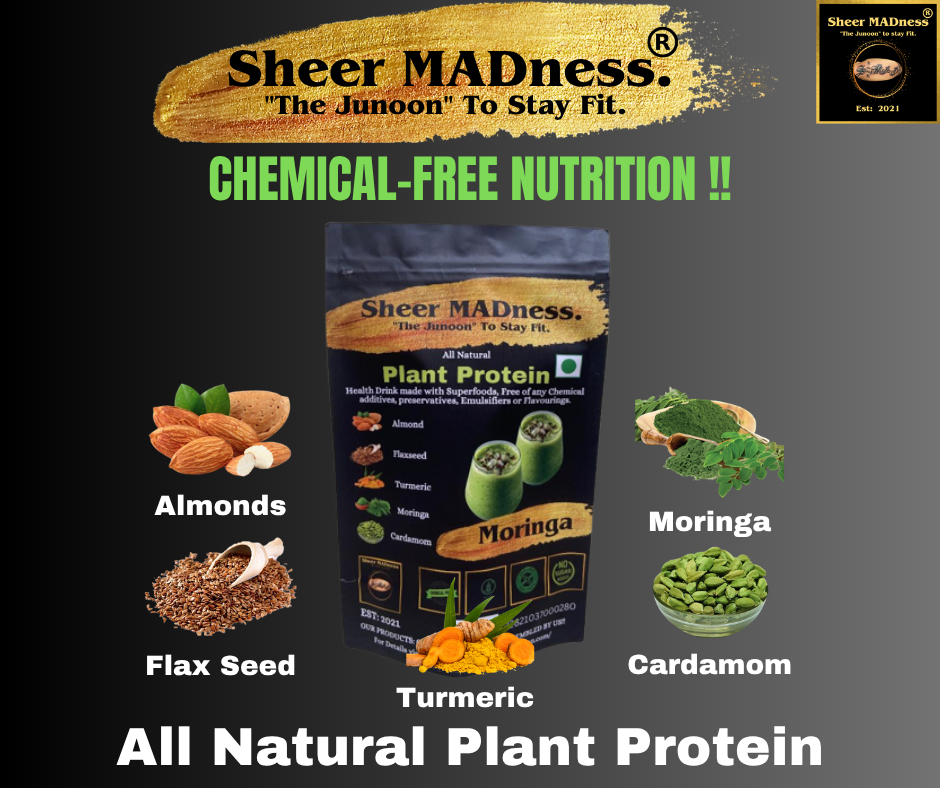
Since 2021, Sheer MADness has displayed every ingredient with its own image on the front of every pack. For consumers specifically evaluating a product for its iron and Vitamin C content for anaemia support — this transparency allows ingredient verification before purchase.
Moringa leaf, almonds, flaxseed, turmeric, and cardamom are the complete ingredient list. Every iron-relevant compound — moringa’s iron, moringa’s Vitamin C, almonds’ Vitamin E, flaxseed’s omega-3, turmeric’s curcumin — is traceable to a specific named whole-food ingredient visible on the front of the pack.
No synthetic iron supplement added to a processed base. No “fortified with iron” claim masking the form and bioavailability of that iron. Naturally occurring iron in moringa leaf, absorbed more efficiently by the simultaneous naturally occurring Vitamin C in the same leaf.
Sheer MADness holds a registered trademark under the Government of India. The Natural Plant Protein formula is patent published under Patent No. 202331036733, searchable on Intellectual Property India. The brand holds a valid FSSAI licence and GSTIN registration.
| Anaemia Support Mechanism | Nutrient | Source in Sheer MADness |
|---|---|---|
| Iron provision for haemoglobin synthesis | Iron — 28mg/100g | Moringa leaf powder |
| Ferric to ferrous conversion (DMT-1 absorption) | Vitamin C — 17x oranges gram for gram | Moringa leaf powder |
| Phytate inhibition counter | Vitamin C (ascorbate reduction) | Moringa leaf powder |
| Folate for red blood cell formation | Folate 172mcg/100g | Moringa leaf powder |
| Anti-inflammatory iron availability | Quercetin, kaempferol | Moringa leaf powder |
| Hepcidin reduction (inflammation pathway) | Curcumin | Turmeric |
| Fibroblast and immune cell oxidative protection | Vitamin E | Almonds |
| Cytokine-mediated iron sequestration reduction | Omega-3 ALA | Flaxseed |
| Vitamin C preservation (from oxidation) | Vacuum packing | Physical preservation method |
Is moringa good for anaemia?
Moringa is specifically beneficial for iron-deficiency anaemia — the most common form in India. It provides iron at 28mg/100g and Vitamin C that enhances non-haem iron absorption two to four times. It is not a treatment for diagnosed anaemia — which requires medical management — but is a meaningful nutritional support for daily dietary iron adequacy. Moringa does not help B12-deficiency anaemia, which requires B12 supplementation.
How does moringa’s Vitamin C help with iron absorption?
Vitamin C converts ferric iron (Fe³⁺) to ferrous iron (Fe²⁺) in the gut — the only form that the intestinal transporter DMT-1 can absorb. This chemical reduction bypasses the enzymatic rate-limiting step, increasing non-haem iron absorption two to four times when Vitamin C is present alongside iron at the same meal. Moringa contains both iron and Vitamin C, making it a uniquely self-contained iron-absorption system.
A two to three tablespoon serving provides approximately 3 to 6 milligrams of iron — approximately 15 to 30 percent of the daily iron requirement for non-pregnant adult women (18mg/day, ICMR-NIN 2024). This is a meaningful daily dietary contribution. It is not equivalent to medicinal iron prescribed for diagnosed iron-deficiency anaemia.
Can moringa replace iron tablets for anaemia?
No. Medicinal iron tablets prescribed for diagnosed iron-deficiency anaemia provide 60 to 120 milligrams of elemental iron — concentrations that dietary iron from moringa cannot match. Moringa supports iron adequacy in a nutritionally sound diet. It supplements but does not replace medicinal iron for diagnosed anaemia under medical supervision.
Should I avoid tea when taking moringa for iron?
Yes — tea tannins reduce non-haem iron absorption by 49 to 67 percent. For maximum iron absorption from moringa, consume it in water (not tea or coffee) at least 60 to 90 minutes after any tea consumption. This maximises the Vitamin C-enhanced iron absorption from moringa without tannin interference.
Moringa has been studied in pregnant women with anaemia with positive haemoglobin outcomes in multiple research settings. However, pregnant women must always consult their obstetrician before adding any supplement to their regimen. Moringa contains Vitamin K that may affect anticoagulant medication dosing. Pregnancy anaemia requires medical management — moringa is a nutritional adjunct, not a standalone treatment.
Does moringa help with B12-deficiency anaemia?
No. Vitamin B12 is found almost exclusively in animal-derived foods. Moringa contains no B12. B12-deficiency anaemia requires B12 supplementation — through injections, sublingual supplements, or fortified foods — not dietary iron. If you suspect B12-deficiency anaemia, consult a doctor for blood tests that distinguish iron from B12 deficiency.
How is Sheer MADness Plant Protein Moringa preserved without degrading Vitamin C?
Through vacuum packing — removing air from inside the sealed pouch. Vitamin C (ascorbic acid) degrades rapidly when exposed to oxygen. Vacuum packing eliminates the oxygen that would degrade moringa’s Vitamin C during storage. The Vitamin C content — critical for non-haem iron absorption enhancement — is preserved from production to consumption without any chemical preservative entering the food.

Moringa is one of the most nutritionally logical foods for supporting iron-deficiency anaemia management in the Indian context — and India is the world’s largest anaemia burden country.
The science is specific. Iron at 28mg/100g and Vitamin C at 17 times orange concentration in the same leaf creates an integrated iron-absorption system. The Vitamin C converts non-haem ferric iron to absorbable ferrous iron — bypassing the rate-limiting enzymatic step — and counteracts phytate and tannin inhibition that reduce iron absorption in typical Indian diets. The anti-inflammatory compounds in moringa, turmeric, and flaxseed in Sheer MADness Plant Protein Moringa reduce the hepcidin-elevating inflammation that impairs iron metabolism in anaemia of chronic disease.
For 57 percent of Indian women living with anaemia — for pregnant women, for vegetarians wholly dependent on plant-source iron, for children in their critical growth years — moringa as a daily whole-food nutritional support is one of the most practically meaningful dietary interventions available.
It is not a cure. It does not replace medical treatment for diagnosed anaemia. But as daily nutritional support for iron-adequate dietary patterns — consumed in water, away from tea, at the mid-morning window — it is genuinely one of the most iron-relevant foods in the Indian nutritional context.
Since 2021, every ingredient is on the front of the pack. The iron is moringa’s. The Vitamin C is moringa’s. The formula is Chef Awasthi’s.
I would also request you to please read my previous post: Benefits of Moringa Plant protein, the versatile Superfood powerhouse.
a) Everyone is an individual, so what suits me may not suit the next person.
b) If a person has a medical condition, a doctor’s advice and prescribed medication will only help. Anaemia is a diagnosed medical condition requiring medical management. Consult a physician for blood tests, diagnosis, and treatment. Moringa is a nutritional food support — not a medical treatment.
c) While buying any protein powder from the market, read the labels carefully. Watch out for INS codes, Anti-caking agent, INS 551 (Silicon dioxide), BHA (Butylated hydroxyanisole), BHT (Butylated hydroxytoluene), and other lab-made chemicals. A product supporting iron health should contain no synthetic chemical that the body must additionally process.
If you are interested in buying chemical-free Natural Plant Protein Moringa, Health Drinks for Kids, or our delicious chemical-free Energy Bars, Protein Bars, and Millet Bars, shop at Sheer MADness.
You can also find us on Flipkart, Jio Mart, or ONDC in India.
d) Exercise is the key to fitness. Exercise and nutrition are two sides of the same coin and always go hand in hand.
e) Excess of anything is wrong, even the best whole-food superfood. Consume only recommended quantities.
f) Rome was not built in a day. Discipline and consistency are the only keys to lasting health.
g) It is not only exercise and protein that builds health. A healthy gut, macro and micronutrients, body type, rest, and lifestyle all matter. Of all these, exercise and nutrition are within our control. Focus on these two primary aspects first.
h) The most important part of fitness is that nothing is better than exercise and a balanced meal.
Disclaimer: Our products are a source of HEALTHY NUTRIENTS and are COMPLETELY FREE OF ANY ADDED CHEMICALS. We do not claim to cure any medical condition. The content provided is informational. We do not claim to diagnose or treat a person with any specific medical condition.