

Direct answer: Moringa is specifically and meaningfully beneficial for eye health through four documented nutritional mechanisms. Its exceptional beta-carotene content — providing Vitamin A for rhodopsin synthesis that enables night vision and corneal integrity — addresses the most prevalent cause of preventable blindness in India. Moringa’s lutein and zeaxanthin form the macular pigment optical density (MPOD) that physically filters blue light and protects retinal photoreceptors from oxidative damage. Its Vitamin C maintains the blood-retinal barrier through tight junction collagen synthesis. Its quercetin and kaempferol antioxidants reduce the oxidative stress in retinal cells that drives both age-related macular degeneration and diabetic retinopathy — India’s fastest growing cause of vision loss. Sheer MADness Plant Protein Moringa compounds these moringa-specific eye health benefits with almond Vitamin E for lens antioxidant protection and flaxseed omega-3 for retinal DHA support and dry eye syndrome prevention.
I am Chef Ashutosh Awasthi, founder of Sheer MADness, professional chef, marathon runner, and author of Great Health Comes from Exercise & Nutrition. Let me explain the eye health science behind moringa honestly, specifically, and with the India-relevant context that this increasingly urgent topic deserves.
India carries one of the world’s most significant preventable eye disease burdens — and three specific trends make nutritional eye health support increasingly urgent for Indian adults.
Vitamin A deficiency remains the world’s leading preventable cause of childhood blindness, and India carries a disproportionate share of this burden. The World Health Organisation estimates that Vitamin A deficiency affects millions of pre-school children in South Asia, contributing to night blindness, corneal ulceration, and in severe cases complete blindness. Moringa’s exceptional beta-carotene content makes it one of the most practically significant dietary interventions for this condition.
Diabetic retinopathy is India’s fastest-growing cause of vision loss. With approximately 77 million Indian adults with Type 2 diabetes — the world’s largest diabetic population — and diabetic retinopathy affecting approximately 20 to 30 percent of diabetics with poor glucose control, the scale of retinal damage from diabetes is enormous. Moringa’s ability to reduce oxidative stress in retinal cells — the primary mechanism of diabetic retinopathy progression — and to support glycaemic control through AMPK activation (discussed in the metabolism post) makes it specifically relevant to this population.
Digital screen time is India’s most rapidly growing eye stressor. India has among the highest smartphone penetration and daily screen time globally — with urban Indian adults averaging 5 to 7 hours of daily screen exposure. Blue light from digital screens penetrates deeply into the retina, generating free radicals in retinal photoreceptors and accumulating lipofuscin deposits in the retinal pigment epithelium — a specific mechanism of accelerated macular degeneration. The dietary blue light filters — lutein and zeaxanthin — that moringa provides are specifically relevant to India’s digital screen generation.
Understanding the eye’s specific nutritional dependencies explains precisely why moringa’s nutrient profile is so well-aligned with eye health.
The retina is, gram for gram, the most metabolically active tissue in the entire body — exceeding even cardiac muscle in its metabolic intensity. This extraordinary metabolic activity creates extreme requirements for oxygen delivery, antioxidant protection, and specific nutrient availability.
The photoreceptor cells — rods and cones — are the light-detecting cells of the retina. Rods detect low-light intensity and form the basis of night vision. Cones detect colour and fine detail. Both photoreceptor types require Vitamin A in its active retinaldehyde form to function.
The retinal pigment epithelium (RPE) — the cell layer behind the photoreceptors — performs the most metabolically demanding single-cell function in the body: it continually phagocytoses and renews the outer segments of photoreceptor cells, processes absorbed light, maintains the blood-retinal barrier, and manages the metabolic exchange between the photoreceptors and the choroidal blood supply. The RPE’s extraordinary metabolic demands make it the primary site of oxidative stress and the primary site of age-related macular degeneration pathology.
The crystalline lens of the eye is the only tissue in the body with no blood supply and no protein turnover throughout life. The lens proteins — crystallins — were synthesised at birth and must last a lifetime. Oxidative damage to crystallin proteins causes them to aggregate and lose their optical clarity — the biological basis of cataracts.
Cataract is the world’s leading cause of blindness and one of India’s most significant preventable visual impairment causes. Dietary antioxidants — particularly Vitamin E and Vitamin C — that protect lens crystallin proteins from oxidative cross-linking are the most directly cataract-preventive nutritional compounds available.
This is moringa’s most clinically significant eye health contribution — and the one most directly relevant to India’s vitamin A deficiency burden.
Vitamin A in its active retinaldehyde form is the chromophore of rhodopsin — the photosensitive pigment in rod photoreceptors. When a single photon of light strikes the rhodopsin molecule, retinal undergoes isomerisation from 11-cis retinal to all-trans retinal — triggering a molecular conformation change that activates the phototransduction cascade, generating a neural signal that the brain interprets as vision.
This rhodopsin-dependent phototransduction is the molecular basis of all vision in low-light conditions. Without adequate Vitamin A, rhodopsin cannot be synthesised — and night vision fails. This is the specific molecular mechanism of Vitamin A-deficiency night blindness.
Vitamin A also maintains the integrity of corneal epithelial cells — the cells of the eye’s transparent outer surface. Vitamin A deficiency causes corneal cell differentiation failure, producing the non-secretory squamous metaplasia that leads to xerophthalmia (dry, thickened cornea) and in severe cases corneal ulceration and perforation.
Moringa leaf provides beta-carotene at approximately 6.78 milligrams per 100 grams of dry weight — one of the highest beta-carotene concentrations in any commonly available plant food. Beta-carotene is converted to Vitamin A in the intestinal wall through beta-carotene dioxygenase enzyme activity — with conversion efficiency of approximately one microgram of Vitamin A from every 6 micrograms of beta-carotene in mixed diets. The beta-carotene from daily moringa consumption provides meaningful daily Vitamin A provision specifically for corneal integrity and rhodopsin synthesis.
Furthermore, the fat in almonds in Sheer MADness Plant Protein Moringa — healthy monounsaturated fats — specifically enhances beta-carotene absorption. Beta-carotene is a fat-soluble compound requiring dietary fat for intestinal micelle formation and absorption. Consuming moringa’s beta-carotene alongside almond fat in Sheer MADness Plant Protein Moringa maximises the Vitamin A availability from every serving.
This is the mechanism most directly relevant to India’s digital screen generation — and the mechanism that has the strongest human clinical trial evidence base.
The macula — the central 5mm of the retina responsible for all sharp, colour, and fine-detail vision — contains the highest concentration of lutein and zeaxanthin of any tissue in the body. These two carotenoids, collectively called macular pigment, serve a specific optical function: they absorb blue light (wavelength 400-500nm) in the path between the eye’s crystalline lens and the foveal photoreceptors.
Blue light penetrates the lens without absorption and reaches the foveal photoreceptors, where it generates free radicals through photooxidation — specifically the Type II photosensitised oxidation reactions that produce singlet oxygen in retinal tissue. This light-induced oxidative damage progressively accumulates in RPE cells as lipofuscin deposits — the hallmark of early AMD pathology.
Macular pigment optical density (MPOD) is the quantitative measure of lutein and zeaxanthin concentration in the macular pigment. Higher MPOD means more blue light filtering before it reaches the photoreceptors, and lower free radical generation from blue light exposure. Research published in the Archives of Biochemistry and Biophysics confirmed that MPOD is directly proportional to dietary lutein and zeaxanthin intake from food sources.
The Age-Related Eye Disease Study 2 (AREDS2) — the gold standard randomised controlled trial for AMD nutrition — confirmed that lutein and zeaxanthin supplementation reduced the risk of advanced AMD progression by approximately 25 percent in high-risk individuals. This is the most directly relevant clinical trial evidence for macular nutrition — and it specifically identified lutein and zeaxanthin as the primary effective carotenoids.
Moringa leaf contains lutein and zeaxanthin as part of its carotenoid complex. Research published in Food Chemistry confirmed that moringa leaf provides meaningful lutein alongside its beta-carotene — making it one of the few plant foods that simultaneously provides both Vitamin A precursor and macular carotenoids.
For Indian urban adults with 5 to 7 hours of daily screen exposure — generating continuous blue light macular stress — daily moringa consumption is among the most practically relevant dietary interventions for long-term macular health.
The blood-retinal barrier (BRB) — formed by tight junctions between retinal pigment epithelium cells — controls the passage of nutrients and proteins between the retinal circulation and the photoreceptors. The BRB integrity is essential for maintaining the controlled retinal microenvironment that photoreceptors require. BRB breakdown is an early event in diabetic retinopathy — hyperglycaemia specifically impairs the tight junction proteins that maintain BRB integrity, causing the vessel leakage and exudation that characterises early diabetic retinal disease.
Tight junction proteins — including occludin, claudin, and ZO-1 — require collagen scaffold integrity for their proper organisation. Collagen synthesis in the retinal vasculature requires Vitamin C as the mandatory cofactor for prolyl hydroxylase — as established in the collagen synthesis discussion in the weight training and cardiovascular posts.
Moringa’s exceptional Vitamin C — approximately 17 times orange concentration gram for gram — provides the collagen synthesis cofactor that specifically maintains tight junction scaffold integrity in the blood-retinal barrier. For the diabetic population most vulnerable to BRB breakdown and diabetic retinopathy progression, daily moringa Vitamin C provision is a specific nutritional support for the vascular integrity that determines diabetic eye disease progression.
Furthermore, Vitamin C is present in the aqueous humour — the fluid filling the anterior chamber of the eye — at concentrations 25 to 50 times higher than in blood plasma. This extreme concentration gradient suggests the eye specifically concentrates Vitamin C for antioxidant protection of the lens epithelium. Dietary Vitamin C directly increases aqueous humour Vitamin C, enhancing lens antioxidant protection against the crystallin oxidation that drives cataract formation.
Research published in Ophthalmology confirmed that dietary Vitamin C intake is inversely associated with cataract risk — with higher habitual Vitamin C intake associated with significantly slower lens opacification over a 10-year follow-up period.
Quercetin — at 50 to 60 milligrams per 100 grams of moringa dry leaf — provides specific antioxidant protection in retinal tissue through two complementary mechanisms.
First, quercetin crosses the blood-retinal barrier. Research published in the Journal of Natural Products confirmed that quercetin and its metabolites achieve meaningful concentrations in retinal tissue after dietary consumption — making its antioxidant effects directly operative where retinal photooxidative damage occurs.
Second, quercetin specifically inhibits advanced glycation end-product (AGE) formation — a mechanism particularly relevant to diabetic retinopathy. AGEs form when glucose non-enzymatically bonds to proteins — crosslinking and stiffening them. In the retinal vasculature, AGE formation crosslinks basement membrane proteins, thickening vessel walls, impairing retinal blood flow, and promoting the endothelial dysfunction that initiates diabetic retinopathy. Quercetin’s anti-glycation activity specifically reduces AGE formation in hyperglycaemic retinal tissue.
Research published in Current Eye Research confirmed that quercetin reduces retinal oxidative stress markers and protects retinal ganglion cells from oxidative damage in experimental diabetic retinopathy models — with specific effects on the Nrf2 pathway in retinal tissue.
Vitamin E — natural mixed tocopherols at 12.5 milligrams per 100 grams from almonds — provides specific protection for lens crystallin proteins from oxidative modification.
The crystalline lens has the highest Vitamin E concentration of any tissue in the body per unit of lipid — reflecting the lens’s extraordinary dependence on Vitamin E for oxidative protection. Lens epithelial cells maintain active transport systems for concentrating Vitamin E from the aqueous humour into the lens interior. When Vitamin E becomes depleted in the lens — through chronic oxidative stress, UV exposure, or dietary insufficiency — crystallin proteins lose their oxidative protection and begin the cross-linking aggregation that produces cataracts.
The Nurses’ Health Study found that women with the highest dietary Vitamin E intake had significantly lower risk of cataracts requiring surgery over an 8-year follow-up — confirming dietary Vitamin E’s lens protection role.
The retinal photoreceptor outer segment membranes contain the highest DHA concentration of any tissue in the body — approximately 50 to 60 percent of total phospholipid fatty acids in rod outer segments are DHA. This extraordinary DHA concentration is functionally required: DHA’s molecular structure enables the rhodopsin-containing disc membranes to maintain the fluidity and conformation flexibility that phototransduction requires.
Flaxseed provides ALA omega-3 at 22 grams per 100 grams — the richest plant omega-3 source available. The body converts ALA to DHA through the desaturation and elongation pathway, providing the building blocks for retinal DHA maintenance — specifically relevant for vegetarians and vegans who consume no direct DHA from fish or marine sources.
Furthermore, omega-3 fatty acids — both from flaxseed and from dietary fish — specifically prevent dry eye syndrome through two mechanisms: they increase lacrimal gland secretion of the tear film’s aqueous layer, and they reduce the meibomian gland inflammation that causes the lipid layer of the tear film to become dysfunctional. Research published in the British Journal of Ophthalmology confirmed that dietary omega-3 supplementation significantly reduces dry eye syndrome symptoms and corneal staining scores in a double-blind placebo-controlled trial.
For Indian office workers with 5 to 7 hours of daily screen exposure — during which the blink rate falls from 15 per minute to 5 to 7 per minute, dramatically reducing tear film renewal — flaxseed omega-3 from Sheer MADness Plant Protein Moringa provides specific prevention for the accelerated tear film dysfunction that digital screen exposure creates.
India’s smartphone and laptop screen time has created an epidemic of digital eye strain — affecting office workers, students, children, and professionals across the country. Symptoms include eye fatigue, blurred vision, dry eyes, headaches, and increased light sensitivity — the constellation of complaints now called Computer Vision Syndrome (CVS).
The nutritional response to digital eye strain requires three specific supports: macular pigment reinforcement through lutein and zeaxanthin to increase blue light filtering capacity; antioxidant protection for retinal cells undergoing elevated photooxidative stress; and omega-3 support for the tear film that protects the corneal surface during extended blink-rate-reduced screen use.
Sheer MADness Plant Protein Moringa provides all three simultaneously — moringa lutein and beta-carotene for macular pigment density, moringa quercetin and almond Vitamin E for retinal antioxidant protection, and flaxseed omega-3 for tear film and dry eye prevention.
For the Indian urban professional consuming Sheer MADness Plant Protein Moringa as a morning preparation before a 9-hour screen day — this is the most practically evidence-aligned nutritional eye health routine available from a single whole-food powder.
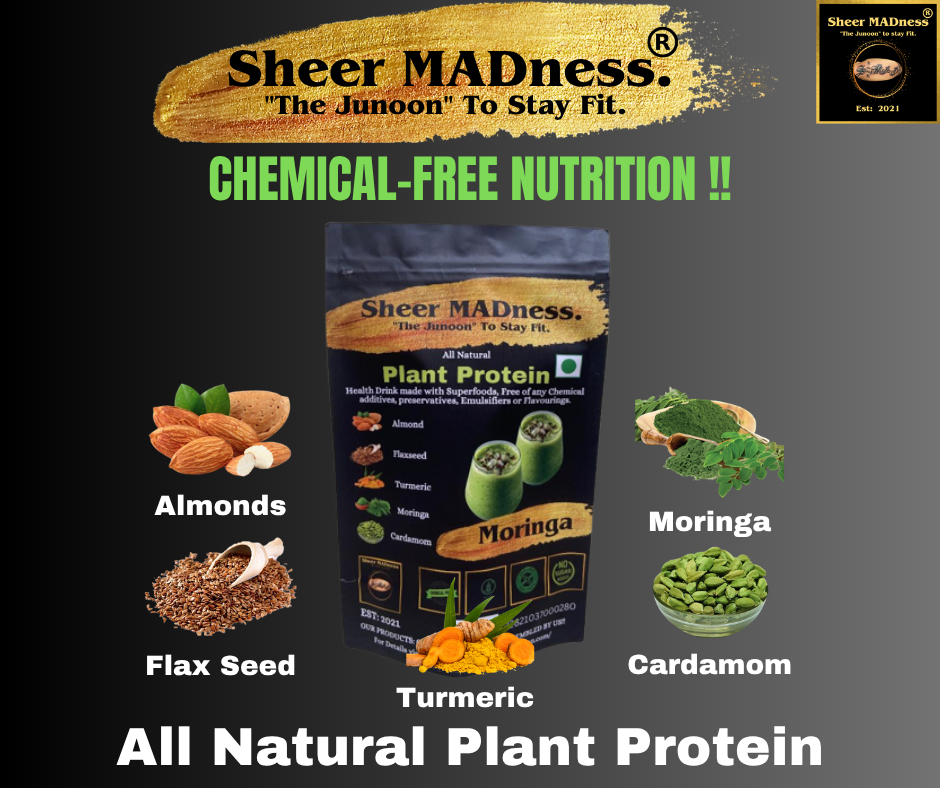
Sheer MADness Plant Protein Moringa creates the most comprehensive plant-based eye health nutritional system available in a single daily preparation — through the specific synergies between its five whole-food ingredients.
Moringa beta-carotene absorbed in the presence of almond fat (fat-soluble absorption enhanced) → Vitamin A for rhodopsin and corneal integrity. Moringa lutein and zeaxanthin → macular pigment optical density for blue light filtering. Vitamin C from Moringa→ blood-retinal barrier tight junction collagen and lens aqueous humour antioxidant. Moringa quercetin → retinal Nrf2 activation and anti-glycation protection for diabetic retinopathy prevention. Almond Vitamin E → lens crystallin oxidative protection. Flaxseed ALA → retinal DHA precursor and tear film omega-3 support.
Since 2021, every ingredient is visible on the front of every pack. Every eye health mechanism is traceable to a named whole-food ingredient that requires no chemistry degree to understand.
The product is vacuum-packed — preserving the beta-carotene, lutein, Vitamin C, and quercetin that would degrade with oxygen exposure. The vacuum-packed moringa you open delivers the full carotenoid and flavonoid concentration that was present when the product was sealed.
Moringa is a nutritional food that supports eye health through dietary mechanisms. It does not treat eye diseases. Anyone with diagnosed eye conditions — glaucoma, macular degeneration, diabetic retinopathy, cataracts, retinal detachment — must be under ophthalmologist care. Dietary nutrition complements but does not replace prescribed ophthalmic treatment.
Regular eye examinations are essential for early detection of eye conditions — particularly for diabetics (annual dilated fundus examination), adults over 40 (glaucoma risk assessment), and anyone with family history of macular degeneration.
Vitamin A toxicity is possible from preformed Vitamin A supplements at high doses — but beta-carotene from plant foods like moringa is safe because the conversion to Vitamin A is self-limiting. The intestinal conversion of beta-carotene to retinal is downregulated when Vitamin A status is adequate — making dietary beta-carotene a safe source that does not cause Vitamin A toxicity even at high moringa consumption.
Sheer MADness holds a registered trademark under the Government of India. The Natural Plant Protein formula is patent published under Patent No. 202331036733, searchable on Intellectual Property India. The brand holds a valid FSSAI licence and GSTIN registration.
| Eye Health Mechanism | Nutrient | Source | Evidence Level |
|---|---|---|---|
| Rhodopsin synthesis for night vision | Beta-carotene → Vitamin A | Moringa leaf — 6.78mg/100g | WHO Vitamin A deficiency research |
| Corneal epithelial integrity | Vitamin A | Moringa leaf | Xerophthalmia prevention research |
| Beta-carotene absorption enhancement | Healthy fats (MUFAs) | Almonds | Fat-soluble nutrient absorption research |
| Macular pigment optical density | Lutein and zeaxanthin | Moringa leaf | AREDS2 trial — 25% AMD risk reduction |
| Blue light filtering at macula | Lutein and zeaxanthin | Moringa leaf | Archives of Biochemistry and Biophysics |
| Blood-retinal barrier collagen | Vitamin C (prolyl hydroxylase) | Moringa leaf | Tight junction collagen synthesis |
| Aqueous humour antioxidant (lens) | Vitamin C | Moringa leaf | Ophthalmology — cataract risk reduction |
| Retinal antioxidant protection | Quercetin, kaempferol | Moringa leaf | Journal of Natural Products BBB crossing |
| Anti-glycation — AGE prevention (diabetic retinopathy) | Quercetin | Moringa leaf | Current Eye Research experimental DR |
| Lens crystallin oxidative protection | Vitamin E (mixed tocopherols) | Almonds — 12.5mg/100g | Nurses’ Health Study cataract risk |
| Retinal photoreceptor DHA | ALA omega-3 → DHA conversion | Flaxseed — 22g/100g | Rod outer segment membrane physiology |
| Dry eye syndrome prevention | Omega-3 ALA | Flaxseed | British Journal of Ophthalmology RCT |
| Tear film lacrimal secretion support | Omega-3 | Flaxseed | Omega-3 dry eye research literature |
| Digital screen blue light protection | Lutein + zeaxanthin MPOD | Moringa leaf | AREDS2 and MPOD research |
Is moringa good for eye health?
Moringa specifically supports eye health through beta-carotene for Vitamin A and rhodopsin synthesis, lutein and zeaxanthin for macular pigment blue light filtering, Vitamin C for blood-retinal barrier and lens antioxidant protection, and quercetin for retinal oxidative stress reduction and anti-glycation protection. These are documented nutritional support mechanisms — not treatments for eye diseases.
Does moringa provide lutein for eye health?
Yes — moringa leaf contains lutein as part of its carotenoid profile. Lutein concentrates in the macular pigment — the physical blue light filter protecting retinal photoreceptors. Higher dietary lutein intake increases macular pigment optical density (MPOD), specifically reducing retinal blue light damage. This is particularly relevant for Indian adults with high daily digital screen exposure.
Vitamin A from moringa’s beta-carotene is converted to retinaldehyde — the chromophore of rhodopsin in rod photoreceptors. Rhodopsin enables vision in low-light conditions. Vitamin A also maintains corneal epithelial integrity, preventing the dry eye, corneal ulceration, and blindness of Vitamin A deficiency. Moringa’s beta-carotene is among the highest plant-food concentrations available.
Can moringa help with diabetic eye disease?
Moringa’s quercetin specifically reduces AGE formation — the glycation mechanism driving diabetic retinopathy vascular basement membrane changes. Moringa’s Vitamin C supports blood-retinal barrier tight junction integrity that hyperglycaemia impairs. It’s antioxidants reduce retinal oxidative stress elevated in diabetes. These are supportive dietary mechanisms — anyone with diabetic retinopathy must be under ophthalmologist supervision.
Does flaxseed in Sheer MADness help with dry eyes?
Yes — flaxseed omega-3 ALA specifically addresses dry eye syndrome through two mechanisms: increasing lacrimal gland aqueous secretion and reducing meibomian gland inflammatory dysfunction. Research published in the British Journal of Ophthalmology confirmed that dietary omega-3 supplementation significantly reduces dry eye symptoms and corneal staining in a controlled trial.
The crystalline lens has the body’s highest Vitamin E concentration per unit of lipid — reflecting extreme dependence on Vitamin E for crystallin protein protection from oxidative cross-linking that causes cataracts. Almond Vitamin E as natural mixed tocopherols provides the lens with oxidative protection. The Nurses’ Health Study confirmed that higher dietary Vitamin E intake was associated with significantly lower cataract surgery risk.
Is beta-carotene from moringa safe to consume daily?
Yes. Beta-carotene from plant foods — unlike preformed Vitamin A from animal sources or supplements — has self-limiting conversion to Vitamin A regulated by intestinal enzyme activity. When Vitamin A status is adequate, beta-carotene conversion is reduced automatically. Plant-source beta-carotene does not cause Vitamin A toxicity. High beta-carotene consumption may cause harmless skin yellowing (carotenodermia) at very high doses — not a health concern.
Does moringa help with computer eye strain?
Moringa’s lutein and zeaxanthin increase macular pigment optical density — specifically increasing the macula’s blue light filtering capacity against the blue light from digital screens. Moringa’s quercetin and Vitamin C reduce the oxidative stress that elevated blue light exposure generates in retinal cells. Flaxseed omega-3 reduces tear film dysfunction from reduced blink rate during screen use. Together, these mechanisms specifically address the three primary ocular effects of digital screen exposure.

The eye is arguably the most nutritionally demanding and most nutritionally specific organ in the body. Rhodopsin requires Vitamin A. Macular photoreceptors require lutein and zeaxanthin for blue light protection. Lens crystallins require Vitamin E and Vitamin C for oxidative protection against cataract formation. The blood-retinal barrier requires Vitamin C for collagen synthesis. Rod outer segment membranes require DHA for phototransduction membrane dynamics.
Moringa addresses every one of these specific eye nutritional requirements — through beta-carotene for Vitamin A, lutein and zeaxanthin for macular pigment, Vitamin C for barrier and lens protection, and quercetin for retinal antioxidant and anti-glycation protection. Sheer MADness Plant Protein Moringa amplifies these with almond Vitamin E for lens crystallin protection and flaxseed omega-3 for retinal DHA and dry eye prevention.
For India’s specific eye health context — the Vitamin A deficiency burden, the world’s largest diabetic retinopathy risk population, and the highest per-capita digital screen time in the world — moringa’s eye health nutritional system is among the most practically relevant dietary interventions available.
Since 2021, every ingredient is on the front of every pack. The vision mechanisms are in the ingredients. And the fat from almonds in the same preparation ensures the beta-carotene, lutein, and zeaxanthin absorb as completely as they can.
That is nutrition for vision — from food, not from a chemistry laboratory.
I would also request you to please read my previous post: Benefits of Moringa Plant protein, the versatile Superfood powerhouse.
a) Everyone is an individual, so what suits me may not suit the next person.
b) If a person has a medical condition, a doctor’s advice and prescribed medication will only help. Diagnosed eye conditions — glaucoma, macular degeneration, diabetic retinopathy, cataracts — require ophthalmologist care. Moringa is a nutritional food that supports eye health. It does not treat eye disease.
c) While buying any protein powder from the market, read the labels carefully. Watch out for INS codes, Anti-caking agent, INS 551 (Silicon dioxide), BHA (Butylated hydroxyanisole), BHT (Butylated hydroxytoluene), and other lab-made chemicals. A product that supports eye health should contain no synthetic oxidative compounds that add to the free radical burden that retinal tissue must manage.
If you are interested in buying chemical-free Natural Plant Protein Moringa, Health Drinks for Kids, or our delicious chemical-free Energy Bars, Protein Bars, and Millet Bars, shop at Sheer MADness.
You can also find us on Flipkart, Jio Mart, or ONDC in India.
d) Exercise is the key to fitness. Exercise and nutrition are two sides of the same coin and always go hand in hand.
e) Excess of anything is wrong, even the best whole-food superfood. Consume only recommended quantities.
f) Rome was not built in a day. Discipline and consistency are the only keys to lasting health.
g) It is not only exercise and protein that builds health. A healthy gut, macro and micronutrients, body type, rest, and lifestyle all matter. Of all these, exercise and nutrition are within our control. Focus on these two primary aspects first.
h) The most important part of fitness is that nothing is better than exercise and a balanced meal.
Disclaimer: Our products are a source of HEALTHY NUTRIENTS and are COMPLETELY FREE OF ANY ADDED CHEMICALS. We do not claim to cure any medical condition. The content provided is informational. We do not claim to diagnose or treat a person with any specific medical condition.