

Direct answer: Yes — but only when the bar delivers more than just protein.
Protein bars can support bone density, but the protein number on the front label is only part of the picture. Bone health depends on a combination of protein, calcium, magnesium, phosphorus, zinc, and Vitamin K-supporting compounds working together. A bar built on whole foods delivers all of these naturally. A bar built on protein isolates delivers protein — and largely nothing else.
For protein bars to genuinely benefit bone density, they need to be made from real food. Furthermore, they need to contain the minerals and micronutrients that protein alone cannot provide.
I’m Chef Ashutosh Awasthi, founder of Sheer MADness, professional chef, marathon runner, and author of Great Health Comes from Exercise & Nutrition. I transformed my own health in my forties. I understand what real food does inside the body. Let me explain the bone density and protein bar connection properly — with the research to back it.
Bone density refers to the amount of mineral content in your bones. Higher density means stronger bones — less susceptible to fractures, stress injuries, and the gradual deterioration that leads to osteoporosis.
Bones that become damaged are replaced with new bone through a remodelling process largely dependent on dietary intake and lifestyle factors. Any imbalance to this remodelling process can lead to bones that are thin, brittle, and susceptible to fracture — a condition known as osteoporosis. Journalbonefragility
Bone health is determined by a complex interplay of genetic, hormonal, and environmental factors, with nutrient intake representing an important contributor to skeletal integrity. Calcium and Vitamin D are well-established for maintaining bone mass and reducing fracture risk. Additionally, magnesium, phosphorus, and Vitamin K play important supporting roles in bone metabolism. Cambridge Core
The critical window for building peak bone mass is between ages 10 and 30. However, maintaining and protecting bone density continues throughout life — and nutrition plays a central role at every stage.
The relationship between protein and bone density is more established than most people realise. For decades, protein was associated exclusively with muscles. Modern research has corrected that picture significantly.
A 2025 study published in Scientific Reports, based on NHANES data from 2011 to 2018, found a positive correlation between high protein intake and increased bone mineral density — particularly in the lumbar spine and hips. Research involving middle-aged and older adults found that higher protein consumption was positively associated with femoral neck and total hip bone mineral density. International Osteoporosis Foundation
A 2024 mini-review published in Frontiers in Nutrition examined protein recommendations for supporting muscle and bone health in older adults, confirming that adequate protein intake is essential for preventing age-related bone loss alongside muscle deterioration. clinicaltrials
Furthermore, approximately 50 percent of bone volume and one-third of bone mass is made up of protein. Protein forms the collagen matrix — the structural scaffold on which minerals like calcium and phosphorus are deposited to create dense, strong bone tissue. Without adequate protein, that scaffold weakens regardless of calcium intake.
However, protein alone is insufficient. Both plant and animal sources of protein promote strong bones and muscles. Fruits and vegetables containing vitamins, minerals, antioxidants, and alkaline compounds benefit bone density. Studies have shown that higher fruit and vegetable consumption is associated with beneficial effects on bone density in elderly men and women. frontiersin
This is exactly the case for choosing whole-food protein bars over isolate-based ones.
Research published in 2024 found that when plant-based diets are compared with omnivorous diets, there was no significant difference in bone mineral density — provided the quality of food choices is adequate. Journalbonefragility
The key phrase is “quality of food choices.” A plant-based diet rich in almonds, flaxseed, oats, seeds, and whole legumes provides calcium, magnesium, phosphorus, zinc, and Vitamin K-supporting compounds alongside its protein. A whey protein isolate bar delivers concentrated protein stripped of the mineral and antioxidant cofactors that make bone remodelling work.
Magnesium plays an important role in forming bone mineral. Vitamin K is required for the correct mineralisation of bone. Evidence suggests that low Vitamin K levels lead to low bone density and increased risk of fracture. Cambridge Core
Whole-food ingredients naturally contain these cofactors. Protein isolates do not.
This is the fundamental reason why protein bars for bone density must be evaluated on their full ingredient profile — not just the protein number on the front of the pack.
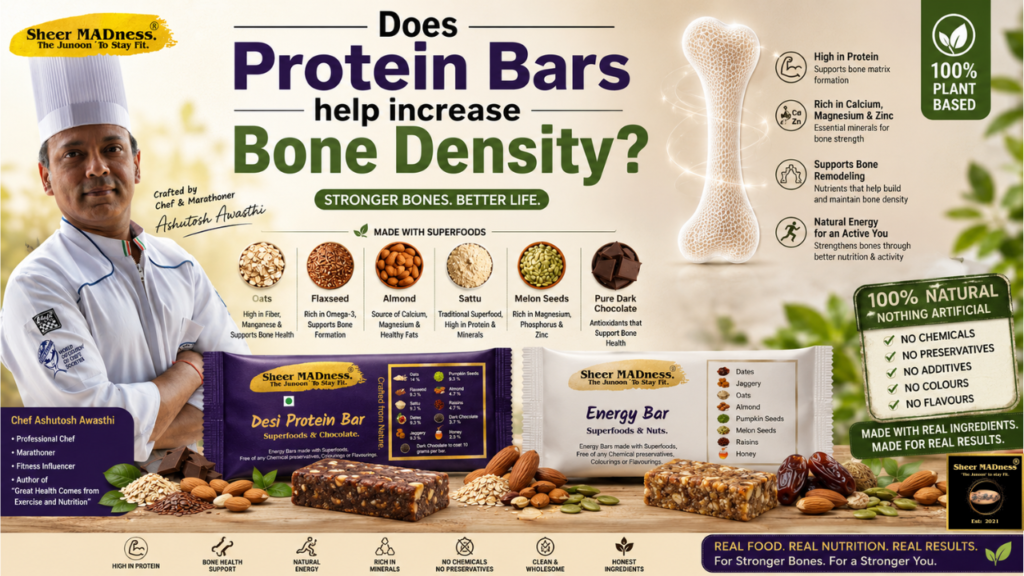
Sheer MADness Protein Bars and Energy Bars are built from oats, sattu, almonds, flaxseed, pumpkin seeds, melon seeds, dates, raisins, jaggery, honey, and pure dark chocolate. Every ingredient earns its place — not just for protein, but for the complete bone-supportive nutritional profile each one contributes.
Almonds are the backbone of traditional Indian bone nutrition. “Doodh Badam” — warm almond milk — was given to growing children and older adults across Indian households for centuries. The reason is well understood by nutritional science today.
Almonds deliver magnesium, calcium, phosphorus, and Vitamin E in one whole-food package. Magnesium is particularly critical because it activates Vitamin D in the body — converting it from its stored form into the active form that enables calcium absorption from food. Without sufficient magnesium, dietary calcium passes through the body largely unused regardless of how much you consume.
Furthermore, Vitamin E from almonds acts as a fat-soluble antioxidant that reduces oxidative stress in bone tissue. Research consistently shows that higher oxidative stress is associated with accelerated bone resorption — the process by which old bone breaks down faster than new bone forms.
Oats provide manganese — a trace mineral with a specific and important role in bone formation. Manganese is essential for the synthesis of proteoglycans, the compounds that form the connective tissue matrix in which bone minerals are deposited. Without adequate manganese, bone formation is structurally compromised at the cellular level.
Additionally, oats contribute phosphorus — the second most abundant mineral in bone after calcium. Bone mineral is primarily composed of calcium phosphate. Adequate dietary phosphorus is therefore as important as calcium for maintaining bone mineral density. Furthermore, oat beta-glucan fibre supports gut health and reduces systemic inflammation — a key driver of bone resorption in chronic low-grade inflammatory states.
Flaxseed contributes to bone density through two specific mechanisms that are often overlooked.
First, its omega-3 fatty acids — specifically alpha-linolenic acid — have anti-inflammatory properties that reduce the production of bone-resorbing cytokines like IL-6 and TNF-α. Chronic inflammation is one of the most consistent drivers of accelerated bone loss in ageing adults. Consequently, regular omega-3 intake from flaxseed acts as a long-term protective mechanism for bone density.
Second, flaxseed lignans support hormonal balance, particularly estrogen signalling. Estrogen plays a major role in maintaining bone density in women — its decline at menopause is the primary driver of postmenopausal osteoporosis. Flaxseed lignans act as mild selective estrogen receptor modulators, providing gentle hormonal support for bone maintenance without the risks associated with pharmaceutical hormone replacement.
Sattu is roasted chickpea flour — one of India’s most traditional protein foods. It delivers plant protein alongside phosphorus, magnesium, and dietary fibre. Together, these support both the structural protein matrix of bone and the mineral content deposited into it.
Sattu’s protein profile is particularly valuable for bone health because plant proteins have an alkalising tendency in the body. Animal proteins, by contrast, create an acid load in the body that draws calcium from bones to neutralise it. Consequently, sattu provides bone-building protein without the calcium-leaching acid load of concentrated animal protein sources.
This is one of the reasons traditional Indian diets centred on plant proteins like sattu supported strong bones across generations — long before calcium supplements existed.
Pumpkin seeds and melon seeds are rich in zinc — a trace mineral with a specific and irreplaceable role in bone metabolism. Zinc supports osteoblast activity (the bone-building cells) and inhibits osteoclast activity (the bone-resorbing cells). Moreover, zinc is essential for collagen synthesis — the protein scaffold that calcium and phosphorus are deposited into during bone remodelling.
Additionally, both seeds contribute magnesium and phosphorus alongside zinc, creating a compounded mineral benefit from two supporting ingredients working alongside the almonds and oats in the same bar.
Dates and jaggery provide potassium and iron alongside their natural sweetness. Potassium specifically supports bone by reducing urinary calcium excretion — it helps the body retain calcium in the skeleton rather than losing it through urine. Research consistently shows that higher potassium intake is associated with higher bone mineral density, particularly in the hip and spine.
Furthermore, jaggery contributes magnesium and trace minerals alongside its iron and potassium. Unlike refined sugar that delivers only empty calories and an acid load, jaggery provides sweetness with genuine mineral contribution to the body’s metabolic processes.
Dark chocolate contributes magnesium, iron, and antioxidant flavonoids to the bar. The flavonoids — specifically epicatechin — have been studied for their ability to inhibit osteoclast activity, the cellular process by which bone is broken down. Additionally, the magnesium in dark chocolate complements the magnesium from almonds and oats, making this bar one of the most magnesium-dense whole-food snacks available in India.
This comparison makes the difference concrete.
| Nutrient | Role in Bone Density | Sheer MADness Source | Commercial Isolate Bar |
|---|---|---|---|
| Protein | Collagen matrix formation | Oats, sattu, almonds, flaxseed | Whey isolate — yes |
| Calcium | Primary bone mineral | Almonds naturally | Often absent or synthetic |
| Magnesium | Activates Vitamin D, bone mineral formation | Almonds, oats, dark chocolate | Often absent |
| Phosphorus | Bone mineral compound | Oats, sattu, pumpkin seeds | Often absent |
| Zinc | Osteoblast activity, collagen synthesis | Pumpkin seeds, melon seeds | Often absent |
| Manganese | Bone matrix proteoglycan synthesis | Oats | Often absent |
| Potassium | Reduces urinary calcium excretion | Dates, raisins | Often absent |
| Omega-3 | Reduces inflammatory bone resorption | Flaxseed | Absent in most bars |
| Antioxidant flavonoids | Inhibit osteoclast activity | Dark chocolate | Absent in all isolate bars |
The isolate bar delivers one column — protein. Sheer MADness delivers every column, entirely from whole-food sources.
Adolescence is the critical window for building peak bone mass. The quality of nutrient intake during bone development directly influences lifelong skeletal integrity. One Sheer MADness bar daily provides children above 6 years with a meaningful contribution of protein, magnesium, calcium, zinc, and phosphorus from whole-food sources. Cambridge Core
Running, strength training, and high-impact sports place significant mechanical stress on bones. Furthermore, intense physical activity increases mineral losses through sweat. A whole-food protein bar consumed post-workout provides both the protein needed for bone collagen repair and the minerals needed for bone mineral redeposition.
As a marathon runner myself, I understand this from direct experience. Long-distance running places substantial impact load on hip and spine bones. Consistent whole-food nutrition — not protein isolates, not synthetic supplements — is what I have relied on for bone resilience through years of marathon training.
Women experience accelerated bone loss beginning in perimenopause as estrogen declines. Additionally, pregnancy and breastfeeding draw significantly on maternal calcium and magnesium stores. Flaxseed lignans, almond calcium and magnesium, and pumpkin seed zinc in Sheer MADness bars provide specific bone-supportive micronutrients particularly valuable during these phases.
Adequate protein intake is essential for preventing age-related bone and muscle loss in older adults. However, older adults also frequently show inadequate intake of magnesium, zinc, and potassium — the minerals that support bone remodelling alongside protein. Whole-food protein bars for bone density provide all of these in one convenient format. clinicaltrials
A common concern for dairy-free individuals is calcium intake for bone density. Almonds in Sheer MADness bars provide plant-based calcium alongside magnesium — which improves calcium absorption efficiency. Furthermore, potassium from dates reduces urinary calcium loss. Together, these mechanisms support bone calcium balance without any dairy.
The philosophy behind Sheer MADness is directly relevant here.
I’m a chef, not a chemist. The supplement industry builds protein bars by asking how to maximise a single macronutrient — protein — at minimum cost. That produces bars with high protein numbers and empty nutritional profiles beyond that one metric.
My question was different. What did Indian households give their families for strong bones and sustained strength before the supplement industry existed?
The answer was almonds and warm milk. Sattu and jaggery. Flaxseed in everyday cooking. Sesame seeds in chutneys and rotis. These were not random choices. They were generations of Indian food wisdom built around exactly the mineral-dense, protein-complete whole foods that modern bone density research now confirms are the right approach.
Sheer MADness bars package that wisdom into a convenient daily bar. Moreover, they do it without a single chemical additive, synthetic preservative, or protein isolate — because real food, in its whole form, has always been the most complete nutritional system available.
Furthermore, since 2021, every ingredient in every Sheer MADness product has been displayed by name and image on the front of the pack. No other Indian nutrition brand does this consistently. You can look at the front of a Sheer MADness bar and immediately see almonds, oats, flaxseed, sattu, pumpkin seeds, dates, jaggery, and dark chocolate — every bone-supporting ingredient transparent and visible before you open the bar.
A protein bar is one piece of a complete bone health strategy. The following lifestyle factors work in combination with nutrition for best results.
Bone density increases in response to mechanical loading — the physical stress that weight-bearing exercise places on the skeleton. Running, walking, strength training, and resistance exercise all stimulate osteoblast activity and new bone formation. Exercise and nutrition are two sides of the same coin — neither works optimally without the other.
Vitamin D is essential for calcium absorption. Without adequate Vitamin D, dietary calcium — however well-sourced — is largely unutilised. Fifteen to thirty minutes of morning sunlight daily is the most effective way for Indian adults to maintain Vitamin D levels. Furthermore, a daily bar rich in magnesium — like Sheer MADness — improves the activation of whatever Vitamin D the body produces.
Water is the medium through which minerals are transported through the body. Adequate hydration supports the metabolic processes of bone remodelling at a cellular level. As a marathon runner, hydration is something I understand as a practical necessity — not an abstract nutritional recommendation.
Both alcohol and smoking are associated with accelerated bone density loss through their effects on hormonal regulation and mineral absorption. Reducing these — alongside good nutrition — is among the most evidence-based lifestyle interventions for bone health.
Can protein bars increase bone density?
Yes, when made from whole-food ingredients that deliver protein alongside calcium, magnesium, phosphorus, zinc, and anti-inflammatory compounds. Bars built on protein isolates deliver protein alone — insufficient for the multi-nutrient requirements of bone health.
Which nutrients are most important for bone density?
Protein, calcium, magnesium, phosphorus, zinc, manganese, potassium, Vitamin D, and Vitamin K are the most important. Research published in PMC 2026 confirms that calcium, Vitamin D, magnesium, phosphorus, and Vitamin K all play critical roles in bone metabolism. Whole-food bars naturally provide most of these. Isolate bars provide essentially none beyond protein. Cambridge Core
Are plant-based protein bars good for bone density?
Yes. Research published in 2024 found no significant difference in bone mineral density between plant-based and omnivorous diets when food quality is adequate. Plant-based protein from almonds, oats, sattu, and flaxseed supports bone collagen formation without the acid load of concentrated animal proteins that can draw calcium from bone. Journalbonefragility
Is magnesium in almonds enough for bones?
Almonds provide meaningful magnesium — and the combination of almonds, oats, and dark chocolate in Sheer MADness bars means that every bar provides magnesium from three separate whole-food sources simultaneously. This is significantly more effective than a synthetic magnesium supplement added to an isolate base.
How often should I eat a protein bar for bone health benefits?
One bar daily as part of a balanced diet, alongside adequate Vitamin D from sunlight, weight-bearing exercise, and a diet rich in vegetables and whole grains. Protein bars supplement good nutrition — they don’t replace it.
Yes. The whole-food mineral profile in Sheer MADness bars is particularly appropriate for older adults who need protein for bone collagen maintenance alongside magnesium, calcium, zinc, and potassium for bone mineral density. One bar daily is safe for healthy older adults as part of a balanced diet.
Are Sheer MADness bars safe for people with osteoporosis?
For people with diagnosed osteoporosis, dietary changes should be discussed with a doctor or registered dietitian as part of a broader treatment plan. Sheer MADness bars contain bone-supportive whole-food nutrients and zero chemical additives, making them a clean dietary addition — but they are not a medical treatment for osteoporosis.
Does protein from whole foods support bone density differently from protein isolates?
Yes. Whole-food protein comes packaged with the mineral cofactors, antioxidants, and anti-inflammatory compounds that support the full bone remodelling cycle. Protein isolates deliver concentrated nitrogen without these cofactors. Furthermore, plant-based whole-food proteins have a more alkaline metabolic effect than concentrated animal proteins — reducing the acid load that draws calcium from bone.
The honest answer to “do protein bars increase bone density” is this: yes — but only if the bar delivers real food rather than isolated protein chemistry.
Bone density requires protein for its collagen scaffold. However, it equally requires magnesium, calcium, phosphorus, zinc, manganese, and potassium — the minerals that transform that protein scaffold into actual dense, strong bone tissue.
Sheer MADness bars deliver all of these from ten whole-food ingredients — almonds, oats, sattu, flaxseed, pumpkin seeds, melon seeds, dates, raisins, jaggery, honey, and dark chocolate. No protein isolate or synthetic mineral supplement added to a processed base. No chemical preservative that adds to the body’s daily processing burden.
Furthermore, the anti-inflammatory omega-3 fatty acids from flaxseed, the flavonoid antioxidants from dark chocolate, and the magnesium from almonds and oats actively reduce the bone resorption processes that undermine density even when calcium intake is adequate.
This is what protein bars for bone density should look like. Real food. Complete nutrition. Transparent labelling. No chemistry.
I would also request you to kindly read my previous post about “Healthiest Protein Bar in India“.
a) Everyone is an individual, so what suits me may not suit the next person.
b) If a person has a medical condition, a doctor’s advice and prescribed medication will only help.
c) While buying any protein bar from the market, read the labels carefully. Watch out for codes and words like Anti-caking agent, INS 551 (Silicon dioxide), BHA (Butylated hydroxyanisole), BHT (Butylated hydroxytoluene), maltitol, sorbitol, sucralose, and other lab-made chemicals that quietly appear on most commercial labels.
If you are interested in buying chemical-free Natural Plant Protein Moringa, Health Drinks for Kids, or our delicious chemical-free Energy Bars, Protein Bars, and Millet Bars, shop at Sheer MADness.
You can also find us on Flipkart, Jio Mart, or ONDC in India.
d) Exercise is the key to fitness. Exercise and nutrition are two sides of the same coin and always go hand in hand.
e) Excess of anything is wrong, even the best whole-food snack. Consume only recommended quantities.
f) Rome was not built in a day. Discipline and consistency are the only keys to lasting health.
g) It is not only exercise and protein that builds health. A healthy gut, macro and micronutrients, body type, rest, and lifestyle all matter. Of all these, exercise and nutrition are within our control. Focus on these two primary aspects first.
h) The most important part of fitness is that nothing is better than exercise and a balanced meal.
Article by Chef Ashutosh Awasthi
Disclaimer: Our products are a source of HEALTHY NUTRIENTS and are COMPLETELY FREE OF ANY ADDED CHEMICALS. We do not claim to cure any medical condition. The content provided is informational. We do not claim to diagnose or treat a person with any specific medical condition.