

Direct answer: Some protein bars do cause loose motion — but the protein itself is almost never the cause. The culprits are almost always specific ingredients added to commercial bars: sugar alcohols like maltitol and sorbitol that ferment in the large intestine, lactose in whey protein concentrate that Indian adults predominantly cannot digest, artificial sweeteners that alter gut motility and microbiome composition, and synthetic emulsifiers that irritate the gut lining.
Whole-food protein bars built from oats, almonds, sattu, flaxseed, dates, and jaggery — with no sugar alcohols, no dairy protein, and no chemical additives — do not cause loose motion. They actively support healthy digestion.
I’m Chef Ashutosh Awasthi, founder of Sheer MADness, professional chef, marathon runner, and author of Great Health Comes from Exercise & Nutrition. Let me explain the specific gut chemistry behind why some bars cause loose motion — and why Sheer MADness bars don’t.
Most countries have a 15 to 20 percent lactose intolerance rate. India is different.
Research published in the Indian Journal of Gastroenterology estimates that 60 to 70 percent of Indian adults have some degree of lactose intolerance. Lactose intolerance means insufficient production of lactase — the enzyme that breaks down lactose, the sugar naturally present in dairy products.
Most commercial protein bars use whey protein concentrate or whey protein isolate. Both come from dairy. Whey protein concentrate contains significant residual lactose. Whey protein isolate contains lower but still present residual lactose.
When a lactose-intolerant person — which describes the majority of Indian adults — eats a whey-based bar, the undigested lactose reaches the large intestine intact. There, gut bacteria ferment it rapidly. This fermentation produces gas, bloating, cramping, and — very commonly — loose stools or diarrhoea within 30 to 90 minutes of consumption.
Many Indian consumers blame “protein” for their digestive reaction to a whey bar. The protein is not the problem. The dairy origin of the protein — and the lactose that comes with it — is the problem. This distinction matters enormously for choosing the right bar.
Let me map each cause to its specific mechanism — because understanding the mechanism tells you exactly how to avoid it.
Whey protein concentrate typically contains 3 to 8 percent lactose by weight. For a bar with 20 grams of whey protein concentrate, this means 0.6 to 1.6 grams of lactose per bar.
At these levels, lactose-intolerant individuals — the majority of Indian adults — experience osmotic diarrhoea. Undigested lactose draws water into the large intestine through osmosis. Stool becomes loose and watery. Urgency to defecate follows.
This mechanism is called osmotic diarrhoea — the same mechanism behind drinking too much fruit juice or eating very large amounts of fruit sugar. The undigested sugar pulls water into the gut, accelerating bowel transit.
A 2022 review published in Nutrients on lactose intolerance management confirmed that even small amounts of lactose — as low as 3 to 4 grams per serving — trigger symptoms in highly sensitive individuals. At Indian population-level lactose intolerance prevalence, this makes whey-based bars a daily loose motion risk for a majority of Indian bar consumers.
Maltitol, sorbitol, xylitol, and erythritol are sugar alcohols used to sweeten most “low sugar” or “zero sugar” commercial protein bars. Each has its own gut mechanism for causing loose motion.
Maltitol and sorbitol are the worst offenders. Both pass through the small intestine largely unabsorbed. When they reach the large intestine, gut bacteria ferment them. This fermentation produces hydrogen gas, carbon dioxide, and short-chain fatty acids.
The hydrogen gas causes bloating and cramping. The fermentation process itself draws water into the colon — the same osmotic mechanism as lactose intolerance. The combination of gas production and osmotic water influx produces loose, watery stools and urgent bowel movements within one to three hours of consuming the bar.
Research published in the European Journal of Clinical Nutrition confirmed that doses of maltitol as low as 30 to 40 grams reliably cause diarrhoea in the general population. Most commercial bars contain 10 to 20 grams of maltitol or sorbitol per bar. For people with sensitive guts or existing gut conditions — IBS, inflammatory bowel disease — even these lower amounts trigger symptoms.
Erythritol is better absorbed than maltitol but not fully absorbed. At high doses, it causes the same osmotic diarrhoea mechanism. Furthermore, a 2023 study in Nature Medicine associated high erythritol consumption with cardiovascular risk markers — making it a poor choice for daily bar consumption beyond its gut effects.
Sucralose and aspartame do not directly cause osmotic diarrhoea. However, they affect gut motility through a different mechanism — one that is more subtle and more disruptive over time.
Research published in Gut Microbes in 2021 confirmed that sucralose specifically altered gut microbiome composition in human subjects — reducing Lactobacillus and Bifidobacterium populations after four weeks of daily consumption. The reduction of these beneficial bacteria increases the population of less beneficial species that produce looser stool consistency.
Furthermore, sucralose activates sweet taste receptors in the gut — not just in the mouth. These gut sweet receptors influence the speed of intestinal transit through an enteroendocrine signalling pathway. When activated by sucralose without the glucose the receptors expect to follow, they send confused signals that can accelerate gut transit — producing diarrhoea through neurological rather than osmotic mechanisms.
This is a more insidious cause of loose motion than maltitol — it operates through gut-brain signalling rather than through direct fermentation, and it accumulates with daily consumption rather than appearing as an immediate reaction.
Soy lecithin (INS 322), carrageenan, and mono- and diglycerides (INS 471) are emulsifiers added to most commercial protein bars to bind isolated protein powder into a cohesive bar texture.
Research published in Nature in 2015 by Chassaing and colleagues demonstrated that common dietary emulsifiers — specifically polysorbate-80 and carboxymethylcellulose — disrupted the gut mucous layer in mice and promoted inflammatory changes in gut microbiota. Subsequent research on carrageenan specifically has shown similar inflammatory effects on intestinal epithelial cells in laboratory models.
When the gut’s protective mucous layer is disrupted, gut barrier function decreases. Foreign particles and bacterial products that would normally be excluded cross into the gut lining. This triggers localised inflammation. Gut motility increases in response — producing looser, faster bowel movements as the gut attempts to flush the inflammatory stimulus.
Daily consumption of emulsifier-containing bars contributes to cumulative gut lining disruption. This explains why some people find their bar-related loose motion gradually worsens rather than resolving over time — the emulsifiers are progressively disrupting the protective barrier rather than causing an acute one-time reaction.
This section is important for honesty and completeness.
Some people experience temporary loose stools when they significantly increase their dietary fibre intake — from any whole-food source. This is not the same as maltitol-driven diarrhoea. It is a normal, temporary adjustment period.
When fibre intake increases dramatically — from a very low-fibre diet to including a bar with 3 to 5 grams of whole-food fibre daily — the gut microbiome adjusts. Different bacteria populations that process fibre become more active. This adjustment can produce looser stools, mild gas, and altered bowel frequency for three to seven days.
This adjustment is distinct from the ongoing loose motion that sugar alcohols, lactose, and emulsifiers cause. The key difference is timing. Adjustment-related changes resolve within a week. Ingredient-driven loose motion persists consistently every time the bar is consumed.
Furthermore, the type of fibre matters. Inulin and fructooligosaccharides — isolated prebiotic fibres added to many commercial bars to boost fibre numbers — ferment rapidly in the large intestine. This rapid fermentation produces gas and loose stools more aggressively than the slow-fermenting soluble fibre naturally present in oats, flaxseed, and almonds.
Sheer MADness bars contain only naturally occurring fibre from whole foods — no isolated inulin, no chicory root fibre, no added fructooligosaccharides. The 3 to 5 grams of fibre per bar comes from oat beta-glucan, flaxseed mucilage, almond prebiotic fibre, and sattu’s naturally occurring fibre. These digest and ferment slowly — supporting healthy bowel regularity rather than triggering loose stools.
Sheer MADness Protein Bars and Energy Bars eliminate every specific loose-motion cause through ingredient choice, not through additives that mask the problem.
Every gram of protein in Sheer MADness bars comes from sattu, almonds, oats, flaxseed, pumpkin seeds, and melon seeds. Not one dairy ingredient appears in any Sheer MADness bar.
Sattu specifically — roasted Bengal gram flour — has been consumed by Indian adults for centuries without digestive issues. It contains no lactose. Its protein digests through gentle enzymatic breakdown without the osmotic disruption that lactose causes in the large intestine.
For Indian adults — among whom 60 to 70 percent have some lactose sensitivity — this is not a small distinction. It is the most important single differentiator between Sheer MADness and commercial whey-based bars for digestive comfort.
Sheer MADness bars contain no maltitol, no sorbitol, no xylitol, and no erythritol. Every source of sweetness is a whole food — dates, raisins, jaggery, and honey.
These natural sweeteners contain glucose and fructose in whole-food form — packaged with fibre that slows their absorption. They absorb through the small intestine normally. They do not reach the large intestine in significant quantities to ferment. Therefore, they produce no hydrogen gas, no osmotic water influx, and no fermentation-driven loose stools.
This is the most direct and most mechanistically specific reason Sheer MADness bars do not cause loose motion. The fermentation that maltitol and sorbitol cause in the large intestine simply does not occur with dates and jaggery — because these natural sugars absorb normally before reaching the large intestine.
No sucralose, no aspartame, no acesulfame-K appears in any Sheer MADness bar. The gut sweet receptors receive no false signalling. The gut microbiome receives no daily sucralose-driven disruption. The enteroendocrine signals that artificial sweeteners confuse remain undisturbed.
No soy lecithin, no carrageenan, no mono- and diglycerides, and no glycerol appear in any Sheer MADness bar. Dates and honey act as natural binders — holding the bar together through their natural adhesive properties without any synthetic emulsifier.
The gut mucous layer receives no daily emulsifier-driven disruption from Sheer MADness bars. Gut barrier function stays intact. Inflammatory gut reactions from emulsifier exposure do not occur.
The 3 to 5 grams of fibre per Sheer MADness bar comes from oat beta-glucan, flaxseed soluble fibre, almond prebiotic fibre, and sattu’s natural dietary fibre. These are slow-fermenting fibres that feed beneficial gut bacteria gradually.
Beta-glucan specifically forms a gel in the gut that slows gastric emptying and moderates bowel transit. It prevents both constipation and loose stools by moderating the speed of intestinal transit — precisely the opposite of what isolated inulin or sugar alcohols do.
If you have experienced loose motion after eating a protein bar, this elimination approach identifies the specific cause.
Step 1 — Check the sweetener. If the bar contains maltitol, sorbitol, or xylitol, this is almost certainly the primary cause. Sugar alcohol fermentation is the most common single cause of protein bar-related loose motion.
Step 2 — Check the protein source. If the bar uses whey protein concentrate, and you experience symptoms within 30 to 90 minutes of eating, lactose intolerance is likely the cause. Stop the bar for five days and note whether symptoms resolve.
Step 3 — Check for artificial sweeteners. If the bar contains sucralose or aspartame, and you experience gradual worsening of digestive symptoms over weeks of daily consumption, gut microbiome disruption is the likely cause.
Step 4 — Check the emulsifiers. If the bar contains carrageenan or soy lecithin, and you experience diffuse gut irritation and loose stools consistently, gut lining disruption from daily emulsifier consumption may be the cause.
Step 5 — Rule out other causes. Sudden large increases in fibre from any source can cause temporary adjustment-period loose stools. Other foods eaten on the same day, stress, travel, or an unrelated gut condition may also be responsible. Isolate the bar by removing it for one week and observing.
Stop the bar immediately. Persistent loose motion from any food causes dehydration and electrolyte imbalance. Rehydrate with oral rehydration salts (ORS) or a homemade equivalent of salt, sugar, and water. Most bar-related loose motion resolves within 24 to 48 hours of stopping the problematic bar.
If loose motion persists beyond 48 hours after stopping the bar, or if it is accompanied by fever, blood in stool, or severe abdominal pain, consult a doctor. These symptoms require medical evaluation beyond dietary adjustment.
Once symptoms resolve, switch to a whole-food bar with no sugar alcohols, no whey protein, no artificial sweeteners, and no synthetic emulsifiers. Give your gut seven to ten days to stabilise before evaluating your new bar’s digestive effects.
Most commercial bars use chemical preservatives — BHA, BHT, or potassium sorbate — that pass through the gut daily as synthetic residues. While these compounds don’t directly cause acute loose motion for most people, they contribute to cumulative gut lining disruption that lowers the gut’s tolerance threshold over time.
Sheer MADness uses oxygen absorbers. We remove oxygen from inside the packaging entirely. The food’s chemistry never changes. No synthetic preservative enters the food or passes through the gut. This is especially relevant for people who have already experienced gut disruption from other sources — their gut lining is more sensitive, not less.
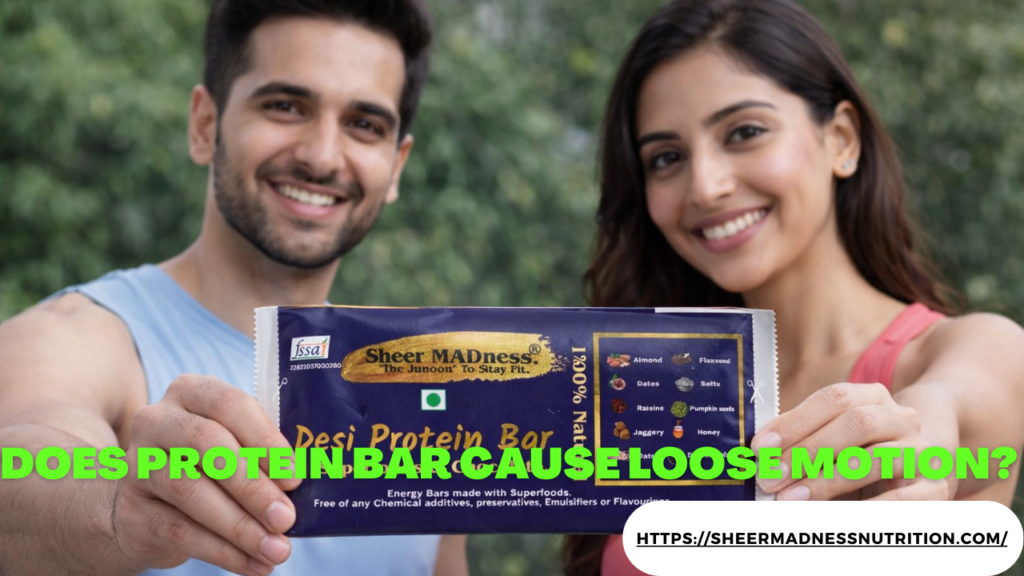
Since 2021, Sheer MADness displays every ingredient with its own image on the front of every pack. When you are choosing a bar specifically to avoid loose motion, this transparency is the most important verification available.
You see oats, almonds, sattu, flaxseed, pumpkin seeds, melon seeds, dates, raisins, jaggery, honey, and dark chocolate on the front before you open the bar. No sugar alcohol hides in the ingredient list, and no emulsifier appears under an unfamiliar code. No whey protein sits in a “protein blend” listing.
This is the verification standard that every protein bar sold to Indian consumers should meet — and currently only Sheer MADness provides.
Sheer MADness holds a registered trademark under the Government of India. The Natural Plant Protein formula is patent published under Patent No. 202331036733, searchable on Intellectual Property India. The brand holds a valid FSSAI licence and GSTIN registration.
| Ingredient | Mechanism | Loose Motion Risk |
|---|---|---|
| Whey protein concentrate | Lactose osmotic diarrhoea | High for Indian adults (60-70% lactose intolerant) |
| Maltitol / Sorbitol | Large intestine fermentation + osmotic effect | Very high |
| Erythritol | Partial absorption, osmotic at high doses | Moderate |
| Sucralose | Gut motility disruption, microbiome alteration | Low to moderate, worsens over time |
| Carrageenan / INS 471 | Gut lining disruption, inflammatory | Low to moderate |
| Isolated inulin / FOS | Rapid large intestine fermentation | Moderate |
| Sattu | Enzymatic digestion, no lactose | Very low |
| Oat beta-glucan | Slow fermentation, gel-forming | Very low — regulates transit |
| Dates / Jaggery | Normal small intestine absorption | Very low |
| Almonds | Slow enzymatic digestion | Very low |
| Flaxseed | Gel-forming soluble fibre, gut soothing | Very low |
Does protein bar cause loose motion?
Some protein bars cause loose motion — specifically those containing sugar alcohols (maltitol, sorbitol), whey protein with lactose, artificial sweeteners, or synthetic emulsifiers. Whole-food bars made from oats, sattu, almonds, dates, and jaggery — with none of these ingredients — do not cause loose motion for most people.
Why does a whey protein bar cause loose motion for Indians?
Approximately 60 to 70 percent of Indian adults have some degree of lactose intolerance. Whey protein concentrate contains residual lactose. Undigested lactose reaches the large intestine and causes osmotic diarrhoea — pulling water into the colon and producing loose, watery stools within 30 to 90 minutes of consumption.
Is maltitol in protein bars responsible for loose motion?
Yes — this is the most common single cause of protein bar-related loose motion. Maltitol passes largely unabsorbed through the small intestine and ferments in the large intestine. This fermentation produces gas, draws water into the colon through osmosis, and causes loose stools. Research confirms maltitol causes diarrhoea at 30 to 40-gram doses in most people — amounts present in many commercial bars.
Does Sheer MADness Protein Bar cause loose motion?
No — for the vast majority of people. Sheer MADness bars contain no lactose, no sugar alcohols, no artificial sweeteners, and no synthetic emulsifiers. The natural sweeteners from dates, jaggery, and raisins absorb normally through the small intestine without reaching the large intestine to ferment. The whole-food protein from sattu and almonds digests without osmotic disruption.
Stop the bar immediately and rehydrate with ORS or salt-sugar water. Check the ingredient list for maltitol, sorbitol, whey protein concentrate, sucralose, or carrageenan. Symptoms from sugar alcohol fermentation typically resolve within 24 to 48 hours. If loose motion persists beyond 48 hours or accompanies fever, blood in stool, or severe pain, consult a doctor.
Can the fibre in protein bars cause loose motion?
Whole-food fibre from oats, flaxseed, and almonds does not cause loose motion — it regulates bowel transit. Isolated fibre additives — inulin, chicory root fibre, fructooligosaccharides — ferment rapidly and can cause loose stools when added in large quantities. Always check whether a bar’s fibre comes from whole-food ingredients or from isolated fibre supplements.
Can I continue eating protein bars if I had loose motion once?
Yes — but switch to a whole-food bar with no sugar alcohols, no whey protein, no artificial sweeteners, and no emulsifiers. Give your gut seven to ten days to stabilise before evaluating your new bar. Most protein bar-related loose motion stops completely within 24 to 48 hours of switching away from the problematic bar.
Is loose motion from protein bars dangerous?
Occasional loose motion from a bar is uncomfortable but not dangerous for healthy adults. Persistent loose motion causes dehydration and electrolyte imbalance — manageable with ORS and dietary adjustment. Consult a doctor if symptoms include fever, blood in stool, or persist beyond 48 hours after stopping the bar.
Protein bars cause loose motion when they contain ingredients that the human gut cannot process efficiently. The most common culprits are maltitol and sorbitol through large intestine fermentation, lactose from whey protein through osmotic diarrhoea in lactose-intolerant individuals — the majority of Indian adults — and artificial sweeteners through gut motility disruption.
None of these ingredients appear in Sheer MADness bars. The whole-food sweeteners from dates, jaggery, and raisins absorb normally. The dairy-free plant protein from sattu and almonds digests without lactose-driven osmotic disruption. The natural fibre from oats and flaxseed regulates bowel transit rather than accelerating it.
If you have experienced loose motion from a protein bar, the bar was the problem — not protein itself. Choose differently. A whole-food bar built on Indian superfoods, preserved with oxygen absorbers, and displayed transparently on the front label since 2021 solves this problem completely.
I would also request you to kindly read my previous post about “Healthiest Protein Bar in India“.
a) Everyone is an individual, so what suits me may not suit the next person.
b) If a person has a medical condition, a doctor’s advice and prescribed medication will only help. If loose motion persists after stopping the problematic bar, consult a doctor before making further dietary changes.
c) While buying any protein bar from the market, read the labels carefully. Watch out for maltitol, sorbitol, sucralose, carrageenan, INS 322 (soy lecithin), INS 471, and whey protein concentrate — all of which can cause loose motion in sensitive individuals and are present in most commercial bars.
If you are interested in buying chemical-free Natural Plant Protein Moringa, Health Drinks for Kids, or our delicious chemical-free Energy Bars, Protein Bars, and Millet Bars, shop at Sheer MADness.
You can also find us on Flipkart, Jio Mart, or ONDC in India.
d) Exercise is the key to fitness. Exercise and nutrition are two sides of the same coin and always go hand in hand.
e) Excess of anything is wrong, even the best whole-food snack. Consume only recommended quantities.
f) Rome was not built in a day. Discipline and consistency are the only keys to lasting health.
g) It is not only exercise and protein that builds health. A healthy gut, macro and micronutrients, body type, rest, and lifestyle all matter. Of all these, exercise and nutrition are within our control. Focus on these two primary aspects first.
h) The most important part of fitness is that nothing is better than exercise and a balanced meal.
Article by Chef Ashutosh Awasthi
Disclaimer: Our products are a source of HEALTHY NUTRIENTS and are COMPLETELY FREE OF ANY ADDED CHEMICALS. We do not claim to cure any medical condition. The content provided is informational. We do not claim to diagnose or treat a person with any specific medical condition.