

Direct answer: No — moringa plant protein does not cause constipation. It actively prevents it through four specific digestive mechanisms. Moringa’s soluble fibre feeds Akkermansia muciniphila and Bifidobacterium — the gut bacteria that produce the SCFAs (short-chain fatty acids) driving colonocyte energy and mucus production for smooth stool transit. Its isothiocyanates reduce the NF-κB-driven gut inflammation that impairs enteric nervous system motility signalling. Flaxseed’s mucilage arabinoxylan absorbs water and swells to five times its dry volume — lubricating the intestinal wall and increasing stool water content for effortless passage. Furthermore, moringa’s quercetin and magnesium support the ENS (Enteric Nervous System) neurotransmitter signalling that drives the coordinated peristaltic contractions moving intestinal contents. This post covers the complete gut biology of constipation, why conventional protein powders cause it, and why the Sheer MADness Plant Protein Moringa blend specifically avoids every mechanism that makes protein supplementation constipating.
I am Chef Ashutosh Awasthi, founder of Sheer MADness, professional chef, marathon runner, and author of Great Health Comes from Exercise & Nutrition. Gut health is where nutrition begins. Consequently, how a protein supplement affects digestion is as important as how much protein it provides.
The question “does moringa protein make you constipated?” arises because conventional protein supplements — particularly whey isolate, casein, and egg white protein — are strongly associated with constipation. Consequently, anyone considering a protein supplement reasonably asks whether moringa will cause the same problem.
The answer is the opposite — but understanding why requires understanding both why conventional protein powders cause constipation and why moringa’s whole-food formulation avoids those mechanisms entirely. This post therefore covers both sides of the comparison — the gut biology of constipation first, then the specific mechanisms by which conventional proteins cause it and moringa prevents it.
Constipation is not simply “not enough fibre.” It is a multi-mechanism disorder involving impaired colonic motility, reduced stool water content, dysbiotic gut microbiome composition, and sometimes impaired ENS neurotransmitter signalling. Understanding these mechanisms explains precisely where moringa’s nutritional compounds intervene.
The Enteric Nervous System (ENS) is the largest division of the peripheral nervous system outside the brain and spinal cord — containing 100 to 500 million neurons embedded in the wall of the gastrointestinal tract. The ENS controls all aspects of intestinal motility — from the rhythmic peristaltic contractions that move food through the small intestine to the mass movements of the colon that propel stool toward the rectum.
The ENS operates largely independently of the central nervous system — which is why it is called the “second brain.” Specifically, the myenteric plexus (Auerbach’s plexus) between the longitudinal and circular muscle layers of the muscularis externa coordinates the sequential contraction and relaxation waves of peristalsis. The submucosal plexus (Meissner’s plexus) regulates mucosal secretion and blood flow. Together, these plexuses respond to luminal content — specifically to mechanical stretch from food or stool mass and to chemical signals from gut epithelial enterochromaffin cells — to initiate and coordinate the propulsive contractions that prevent constipation.
The key neurotransmitter driving ENS propulsive reflexes is serotonin (5-HT) — with approximately 90 percent of the body’s serotonin stored in gut enterochromaffin cells. When a food bolus stretches the intestinal wall, enterochromaffin cells release serotonin — activating 5-HT3 and 5-HT4 receptors on ENS neurons to initiate the ascending contraction and descending relaxation that constitutes peristalsis. Consequently, anything that impairs enterochromaffin serotonin production or ENS serotonin receptor sensitivity impairs peristalsis and promotes constipation.
Between meals, the gastrointestinal tract undergoes the Migrating Motor Complex (MMC) — a cyclical pattern of contractions occurring approximately every 90 to 120 minutes. The MMC sweeps undigested residues, mucus, desquamated cells, and bacteria from the small intestine toward the colon — preventing small intestinal bacterial overgrowth (SIBO) and maintaining the clean small intestinal environment for optimal nutrient absorption.
The MMC is triggered by motilin — a hormone released from the duodenum and jejunum in the fasted state. Stable blood glucose between meals promotes regular motilin release and consistent MMC cycling. Conversely, frequent blood glucose fluctuations — from refined carbohydrate snacking — disrupt the fasted-state hormonal environment and impair MMC frequency. Consequently, stable inter-meal blood glucose is a prerequisite for the gut’s normal housekeeping that prevents constipation from bacterial fermentation residues accumulating in the small intestine.
Moringa’s AMPK activation and quercetin SIRT1 insulin sensitivity improvement — established in the diabetes and weight loss posts — specifically stabilise inter-meal blood glucose. Consequently, moringa indirectly supports MMC regularity through blood glucose stabilisation — a constipation-prevention mechanism that no standard protein supplement addresses.
The protein powder-constipation association is real and explained by three specific mechanisms that are entirely absent from the moringa formulation.
Whey protein isolate, casein isolate, pea protein isolate, and egg white protein are all isolated proteins — meaning everything except the protein fraction has been removed from the source food. Consequently, they provide zero dietary fibre. Adequate fibre stimulates peristalsis through two mechanisms: insoluble fibre mechanically increases stool bulk, stretching the colonic wall to trigger ENS propulsive reflexes; soluble fibre feeds colonic bacteria producing SCFAs that activate colonocyte motility through FFAR (free fatty acid receptor) signalling. Zero-fibre protein supplements remove both stimulatory mechanisms simultaneously. Furthermore, high-protein diets without adequate fibre increase colonic transit time — precisely the condition that defines constipation.
When protein reaches the colon undigested — which occurs at high supplementation doses when small intestinal peptidase capacity is exceeded — colonic bacteria ferment the amino acids anaerobically. This proteolytic fermentation produces hydrogen sulphide (H₂S), ammonia (NH₃), and branched-chain fatty acids — compounds that reduce Bifidobacterium and Lactobacillus populations while increasing Bacteroides and Clostridium species associated with slower transit and reduced SCFA production. Research published in Gut confirmed that high-protein, low-carbohydrate dietary patterns — typical of whey supplement users — significantly reduce the saccharolytic (fibre-fermenting) bacteria that produce transit-supporting butyrate, while increasing proteolytic dysbiosis. Consequently, high-dose protein supplementation without fibre progressively worsens the microbiome composition that determines colonic motility.
Protein metabolism requires water — specifically for urea synthesis in the liver (the ornithine urea cycle converting ammonia from amino acid catabolism to urea for excretion). High protein intake significantly increases water requirement for urinary urea excretion. Furthermore, protein supplements are often consumed in minimal water volume — concentrated protein shakes without the hydration typically accompanying food. Consequently, high-protein supplement users frequently experience relative dehydration of the colonic environment — reducing stool water content below the 70 to 75 percent hydration level required for formed, easily passed stool. The result is hard, pellet-like stool characteristic of protein supplement-associated constipation.
Sheer MADness Plant Protein Moringa specifically avoids each of the three constipation mechanisms that conventional protein powders create — because it is a whole-food preparation, not an isolated protein.
Moringa provides protein alongside fibre — specifically both soluble fibre (prebiotic glucosinolates and pectin-like polysaccharides) and insoluble fibre (cellulosic plant cell wall material). The soluble fibre specifically feeds Akkermansia muciniphila and Bifidobacterium — the bacteria producing the butyrate that colonocytes use for energy and the propionate that activates FFAR2/3 receptors driving colonic smooth muscle contractions. The insoluble fibre increases stool bulk — mechanically stimulating the colonic wall stretch receptors that trigger ENS propulsive reflexes. Consequently, moringa’s protein comes packaged with the same fibre content that prevents the fibre-depletion constipation mechanism.
Furthermore, moringa’s protein fraction is highly digestible (DIAAS 0.84 to 1.16 — established in the protein content post) — meaning the proportion of undigested protein reaching the colon for proteolytic fermentation is significantly lower than from isolated proteins at comparable doses. Consequently, the microbiome-disrupting proteolytic fermentation mechanism does not operate with moringa’s well-digested whole-food protein.
Flaxseed in Sheer MADness Plant Protein Moringa provides the most mechanistically specific anti-constipation compound in the formulation — flaxseed mucilage.
Flaxseed mucilage is a complex polysaccharide gel composed primarily of arabinoxylan (the dominant component, approximately 75 percent) and rhamnogalacturonan (approximately 25 percent), located in the outer seed coat of flaxseed. When flaxseed powder contacts water, these polysaccharides absorb water and swell — forming a viscous gel that can expand to five times the dry powder’s volume. This hydration produces two simultaneous effects on stool mechanics.
First, the mucilage gel forms a lubricating layer between stool and the intestinal wall — reducing the friction resistance to stool passage that causes the straining and discomfort of constipation. Second, the gel retains water osmotically — specifically increasing stool water content from the 60 to 65 percent of dehydrated hard stool to the optimal 70 to 75 percent of easily passed formed stool. Research published in a 2017 Nutrients meta-analysis — covering 21 randomised controlled trials — confirmed that flaxseed supplementation significantly improved constipation severity, stool frequency, and stool consistency across diverse populations. Consequently, flaxseed mucilage provides the most directly anti-constipation mechanism in the entire Sheer MADness formulation.
Beyond its mechanical mucilage effect, flaxseed arabinoxylan specifically feeds Akkermansia muciniphila — the gut bacterium that produces and maintains the colonic mucus layer. Akkermansia abundance is directly associated with intestinal barrier integrity, colonic transit regularity, and protection against IBS-C symptoms. Furthermore, flaxseed’s ALA omega-3 specifically reduces the colonic LPS-NF-κB inflammation that depletes Akkermansia populations in urban Indian gut microbiomes. Consequently, flaxseed supports gut motility from both the mechanical mucilage and the microbiome restoration pathways simultaneously.
The gut microbiome’s role in constipation is the most important and most overlooked dimension of gut health in standard nutrition content. Understanding the SCFA-colonocyte-motility connection explains why moringa’s prebiotic profile is as important as its fibre content for preventing constipation.
When gut bacteria ferment dietary fibre, they produce short-chain fatty acids — primarily butyrate, propionate, and acetate. Butyrate is the primary energy source for colonocytes (colonic epithelial cells) — fuelling approximately 70 percent of the colonocyte’s energy needs through beta-oxidation. Well-energised colonocytes maintain the tight junctions, mucus secretion, and fluid transport that produce the optimal intraluminal environment for stool transit. When butyrate production falls — from low fibre intake, from antibiotic-driven dysbiosis, or from the protein-fermentation dysbiosis caused by high-dose isolated protein supplements — colonocytes are energy-starved. Consequently, tight junction integrity falls, mucus production reduces, and colonocyte-driven fluid secretion into the lumen decreases — producing the dry, slow-transit stool of constipation.
Additionally, propionate and acetate activate FFAR2 (GPR43) and FFAR3 (GPR41) receptors on colonic smooth muscle cells and ENS neurons — specifically driving the colonic motility contractions that propel stool toward the rectum. Research in Gut Microbes confirmed that SCFA-producing microbiome diversity specifically predicts colonic transit time — with higher SCFA production associated with faster, more regular transit. Consequently, moringa’s prebiotic fibre supporting SCFA-producing bacteria is a direct motility mechanism, not merely a vague “gut health” claim.
India has a very high prevalence of functional constipation and IBS-C (irritable bowel syndrome with predominant constipation) — affecting approximately 22 percent of the Indian population by some estimates. India’s constipation burden has a specific set of drivers: urban diets increasingly high in refined carbohydrates and processed foods reduce the dietary fibre that SCFA-producing bacteria require. Chronic stress from urban work and commuting elevates cortisol — which specifically reduces MMC frequency and slows colonic transit through direct ENS cortisol receptor signalling. Additionally, India’s widespread antibiotic use in food production and medical care has reduced Bifidobacterium and Akkermansia populations across the population — worsening the SCFA production deficit that drives constipation.
Moringa specifically addresses the primary Indian urban constipation drivers: its prebiotic fibres restore Bifidobacterium and Akkermansia for SCFA production; its NF-κB and cortisol modulation reduce the stress-gut axis impairment of MMC and ENS motility; its blood sugar stabilisation maintains regular motilin-driven MMC cycling; and its complete whole-food formulation provides protein without the fibre-depletion and proteolytic dysbiosis that make conventional protein supplements constipating.
The existing post mentions that some users may experience temporary bloating when starting moringa. This deserves honest, specific explanation.
When someone transitions from a low-fibre diet — common in urban Indian adults consuming refined grains and minimal vegetables — to moringa’s fibre-prebiotic preparation, the gut microbiome requires adaptation time. Specifically, the new prebiotic substrates (moringa glucosinolates, flaxseed arabinoxylan) feed bacteria that produce gas as a fermentation by-product — before the microbiome composition shifts toward the SCFA-dominant profile that reduces gas and improves transit. This adaptation typically requires one to two weeks of gradual introduction. Consequently, the recommendation is to begin with one teaspoon (approximately half serving) of Sheer MADness Plant Protein Moringa in warm milk for the first week — allowing the microbiome to adapt before increasing to the full two-tablespoon serving. Furthermore, adequate water intake (at minimum 2 litres daily) is essential alongside any fibre increase — because insoluble fibre requires water to expand appropriately and add bulk without becoming hard.
Many conventional protein supplements contain sucralose as a sweetener. Sucralose is a chlorinated sucrose derivative that passes through the small intestine without significant absorption — reaching the colon largely intact. Research in Gut Microbiota for Health confirmed that sucralose reduces Lactobacillus and Bifidobacterium populations and increases the intestinal permeability markers indicating tight junction disruption. Specifically, the chlorine groups on sucralose’s galactose moiety are toxic to these bacteria at the concentrations produced in the colon from typical daily supplement doses. Consequently, daily sucralose consumption in protein supplements progressively worsens the exact microbiome dysbiosis that produces constipation — counteracting any fibre benefit the same product might provide.
Sheer MADness Plant Protein Moringa contains zero sucralose, zero maltodextrin, and zero synthetic sweetener. Consequently, it does not impose the microbiome-disrupting chemical burden that makes conventional protein supplementation constipating for many users.
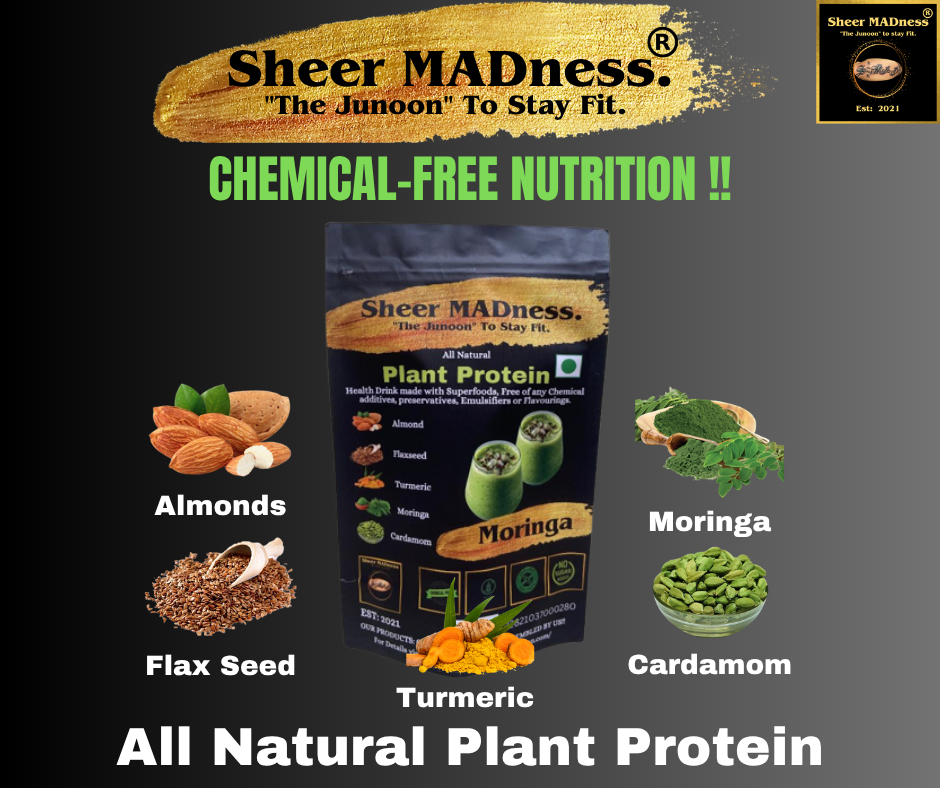
Sheer MADness Plant Protein Moringa provides protein and anti-constipation digestive support simultaneously — from five whole-food ingredients.
Moringa leaf provides soluble prebiotic fibre feeding Akkermansia and Bifidobacterium for SCFA-driven colonic motility, insoluble fibre for mechanical peristaltic stimulation, and quercetin for ENS 5-HT receptor support and NF-κB gut inflammation reduction. Flaxseed provides mucilage arabinoxylan gel for intestinal lubrication and stool hydration — the most directly laxative natural compound available from any conventional food source — plus ALA for Akkermansia-supporting omega-3 anti-inflammatory signalling. Almonds provide magnesium — which specifically relaxes intestinal smooth muscle, reduces intestinal spasm, and draws water into the colon through osmotic action. Turmeric curcumin reduces the colonic mucosal NF-κB inflammation that impairs the tight junction integrity required for healthy stool water balance. Cardamom supports ENS function through its volatile oil carminative effect on digestive smooth muscle.
Furthermore, zero sucralose ensures that the beneficial microbiome moringa’s prebiotic fibres build is not simultaneously destroyed by synthetic sweetener toxicity. Every ingredient on the front of every pack since 2021.
Sheer MADness holds a registered trademark under the Government of India. The Natural Plant Protein formula is patent published under Patent No. 202331036733, searchable on Intellectual Property India. The brand holds a valid FSSAI licence and GSTIN registration.
| Dimension | Conventional Protein Isolate | Sheer MADness Plant Protein Moringa |
|---|---|---|
| Dietary fibre | Zero | Soluble + insoluble from moringa and flaxseed |
| Prebiotic effect | None | Feeds Akkermansia, Bifidobacterium for SCFA production |
| SCFA-colonic motility | No — zero fibre for fermentation | Yes — soluble fibre drives SCFA-FFAR colonic motility |
| Stool lubrication | None | Flaxseed mucilage arabinoxylan gel |
| Stool hydration | Worsens — protein metabolism dehydrates | Improves — mucilage osmotic water retention |
| Proteolytic dysbiosis risk | High at large doses | Low — high DIAAS digestibility, minimal undigested protein reaching colon |
| Sucralose microbiome damage | Common — most flavoured isolates | Zero — no synthetic sweetener |
| ENS support | None | Quercetin 5-HT receptor modulation + magnesium smooth muscle |
| MMC regularity support | No blood glucose stabilisation | Yes — AMPK-SIRT1 inter-meal glucose stability |
| Constipation outcome | Commonly reported | Specifically prevented by multiple mechanisms |

Does moringa make you constipated?
No. Moringa specifically prevents constipation through four mechanisms: its prebiotic fibres feed SCFA-producing bacteria that drive colonic motility; its flaxseed mucilage lubricates and hydrates stool; its magnesium relaxes intestinal smooth muscle; and its quercetin reduces gut inflammation impairing ENS motility signalling. The question arises because conventional protein supplements cause constipation — but moringa’s whole-food formulation avoids every mechanism that makes protein powders constipating.
Why do conventional protein powders cause constipation?
Conventional protein isolates cause constipation through three mechanisms: they contain zero fibre, removing the peristaltic stimulation and SCFA production that drive colonic motility; they produce proteolytic dysbiosis from undigested protein reaching the colon, reducing butyrate-producing bacteria; and high-protein diets dehydrate the colon through elevated water demand for urea synthesis and excretion. Moringa avoids all three — by providing protein with fibre, at a digestibility level that minimises colonic protein fermentation, without synthetic additives disrupting the microbiome.
Flaxseed mucilage is arabinoxylan gel — complex polysaccharides in the flaxseed outer coat that absorb water and swell to five times their dry volume. This gel simultaneously lubricates the intestinal wall for stool passage and retains water osmotically in the stool — increasing stool water content from the 60 to 65 percent of hard constipated stool to the 70 to 75 percent of easily passed formed stool. A 2017 Nutrients meta-analysis of 21 randomised controlled trials confirmed flaxseed significantly improves constipation severity, stool frequency, and stool consistency.
What is the role of the gut microbiome in constipation?
Gut bacteria fermenting dietary fibre produce SCFAs — primarily butyrate, propionate, and acetate. Butyrate fuels approximately 70 percent of colonocyte energy needs — with energy-starved colonocytes producing less mucus and less fluid secretion into the lumen, causing dry hard stool. Propionate and acetate activate FFAR2/3 receptors on colonic smooth muscle, driving the propulsive contractions that move stool toward the rectum. When gut dysbiosis reduces SCFA production — from low fibre or from protein-fermentation dysbiosis — colonic motility slows and constipation follows. Moringa’s prebiotic fibres specifically restore the SCFA-producing bacteria this mechanism requires.
Can I get bloating when starting moringa?
Yes — temporarily, for some users transitioning from low-fibre diets. The new prebiotic substrates feed bacteria that produce gas as a fermentation by-product during the microbiome adaptation period. This typically resolves within one to two weeks as the microbiome shifts toward SCFA-dominant composition. Starting with one teaspoon (half serving) for the first week and increasing gradually, alongside at least 2 litres of water daily, minimises this adaptation response for most users.
Sucralose reaches the colon largely unabsorbed — and the chlorine groups on its galactose moiety are specifically toxic to Lactobacillus and Bifidobacterium at concentrations produced from typical daily supplement doses. Consequently, daily sucralose consumption progressively depletes the beneficial bacteria producing the SCFAs that drive colonic motility. Sheer MADness contains zero sucralose — specifically protecting the microbiome that moringa’s prebiotic fibres are building.
Does the Sheer MADness blend contain enough fibre to prevent constipation?
Sheer MADness Plant Protein Moringa provides fibre from moringa leaf and from flaxseed. The moringa fibre is primarily soluble prebiotic type — feeding beneficial bacteria. The flaxseed provides both the highly effective mucilage gel and additional fibre. Consumed alongside a balanced diet with adequate vegetables, this preparation contributes meaningfully to the 25 to 38 grams of daily fibre that Indian adults require for regular bowel function. Furthermore, the almond magnesium provides additional osmotic and smooth muscle relaxation support for regular transit.
The question “does moringa protein make you constipated?” is actually the wrong question. The right question is: compared to what? Compared to conventional protein isolates — which cause constipation through three specific mechanisms (zero fibre, proteolytic dysbiosis, and dehydration) — moringa is not just non-constipating; it is actively anti-constipating.
Moringa’s prebiotic fibres restore the SCFA-producing microbiome. Flaxseed mucilage lubricates and hydrates stool through arabinoxylan gel mechanics. Magnesium relaxes intestinal smooth muscle. Quercetin supports ENS serotonin signalling for peristalsis. Blood glucose stabilisation maintains MMC regularity. Zero sucralose preserves the microbiome being built. Zero synthetic additive removes the chemical gut burden that makes protein supplementation digestively problematic for so many Indian urban adults.
Sheer MADness Plant Protein Moringa is the only protein supplement that provides protein and digestive health support simultaneously — from whole-food ingredients whose gut-supportive mechanisms have been understood by Indian food tradition for centuries and by nutritional science for decades. Every ingredient on the front of every pack since 2021. Your gut knows the difference.
I would also request you to please read my previous post: Benefits of Moringa Plant protein, the versatile Superfood powerhouse.
a) Everyone is an individual, so what suits me may not suit the next person.
b) If a person has a medical condition, a doctor’s advice and prescribed medication will only help. Chronic constipation, IBS-C, and inflammatory bowel conditions require physician evaluation. Moringa provides nutritional support for normal gut function — it is not a treatment for diagnosed gastrointestinal disorders.
c) While buying any protein powder from the market, read the labels carefully. Watch out for sucralose, maltitol, acesulfame-K, and other synthetic sweeteners specifically — these are the chemical additives most directly damaging to gut microbiome composition. For gut health specifically, sweetener-free protein is not a preference — it is a necessity.
If you are interested in buying chemical-free Natural Plant Protein Moringa, Health Drinks for Kids, or our delicious chemical-free Energy Bars, Protein Bars, and Millet Bars, shop at Sheer MADness.
You can also find us on Flipkart, Jio Mart, or ONDC in India.
d) Exercise is the key to fitness. Exercise and nutrition are two sides of the same coin and always go hand in hand. For gut motility specifically, regular physical activity increases colonic transit time by stimulating ENS activity and increasing motilin release — making exercise the most evidence-based lifestyle intervention for constipation prevention alongside dietary fibre.
e) Excess of anything is wrong, even the best whole-food superfood. Consume only recommended quantities.
f) Rome was not built in a day. Discipline and consistency are the only keys to lasting health.
g) It is not only exercise and protein that builds health. A healthy gut, macro and micronutrients, body type, rest, and lifestyle all matter. Of all these, exercise and nutrition are within our control. Focus on these two primary aspects first.
h) The most important part of fitness is that nothing is better than exercise and a balanced meal.
Disclaimer: Our products are a source of HEALTHY NUTRIENTS and are COMPLETELY FREE OF ANY ADDED CHEMICALS. We do not claim to cure any medical condition. The content provided is informational. We do not claim to diagnose or treat a person with any specific medical condition.