
Direct answer: Some protein bars have vitamins and minerals — but there are two fundamentally different ways a bar can deliver them, and only one actually benefits your health. Commercial bars often add synthetic vitamins as supplements to a processed isolate base — listed as “Vitamin A Palmitate,” “Pyridoxine Hydrochloride,” or “Cyanocobalamin.” Whole-food bars deliver vitamins and minerals naturally through their ingredients — Vitamin E from almonds, iron from jaggery, magnesium from dark chocolate, zinc from pumpkin seeds. The nutritional quality of these two delivery methods is not equivalent.
Sheer MADness bars do not list synthetic vitamins anywhere on the label. They deliver vitamins and minerals entirely through whole-food ingredients — because whole foods provide micronutrients in their natural food matrix, with the cofactors, enzymes, and companion compounds that determine how well the body actually absorbs and uses them.
I’m Chef Ashutosh Awasthi, founder of Sheer MADness, professional chef, marathon runner, and author of Great Health Comes from Exercise & Nutrition. Let me explain the nutritional science behind protein bar micronutrients — and why the number of vitamins on the label is not the right measure of a bar’s micronutrient quality.
Protein is a macronutrient. It provides structure, repair, and energy. However, protein cannot perform its biological functions without micronutrients — the vitamins and minerals that serve as cofactors, catalysts, and regulatory compounds in the metabolic pathways that protein participates in.
Vitamin E from almonds protects muscle protein from oxidative damage during exercise. Magnesium from almonds and dark chocolate supports the ATP synthesis that powers muscle contraction. Iron from jaggery and sattu supports the haemoglobin that carries oxygen to protein-synthesising tissues. Zinc from pumpkin seeds supports the enzyme systems that break down and reconstruct protein during muscle repair.
Without these micronutrients, the protein in a bar does its job less efficiently — not more. The macronutrient and micronutrient systems are not separate. They work together, which is why the food matrix they come from matters.
Furthermore, India has specific micronutrient deficiency profiles that make this discussion particularly urgent. The WHO identifies India as one of the countries with the highest burden of micronutrient deficiencies — iron deficiency affects approximately 57 percent of Indian women, zinc deficiency is prevalent across the adult population, and Vitamin E insufficiency is common due to diets heavy in refined grains and vegetable oils that strip fat-soluble vitamin content.
A daily protein bar that addresses these specific Indian micronutrient deficiencies through whole-food sources provides genuinely different health value from a bar that adds synthetic vitamins to a processed base.
This is the most important section in this post — and the distinction that most protein bar content completely ignores.
Many commercial protein bars advertise “18 essential vitamins and minerals” or “fortified with vitamins and minerals” as a selling point. The actual process involves taking a synthetic vitamin blend — manufactured versions of vitamins and minerals, typically identical in chemical structure to natural forms but produced in laboratories from chemical precursors — and adding them to a protein isolate base after processing.
The FULFIL bar ingredient list illustrates this clearly: “VITAMIN BLEND / ASCORBIC ACID (VITAMIN C), NIACINAMIDE (VITAMIN B3), ALPHA-TOCOPHEROL ACETATE (VITAMIN E), RIBOFLAVIN (VITAMIN B2), PYRIDOXINE HYDROCHLORIDE (VITAMIN B6)…” These are synthetic vitamins added after the protein powder base was created through chemical extraction.
This fortification approach is not necessarily without value — synthetic vitamins are often bioavailable and do contribute to daily micronutrient intake. However, several specific limitations make fortified-isolate bars nutritionally inferior to whole-food bars.
Vitamins and minerals in whole food do not exist in isolation. They exist in complex food matrices — surrounded by companion compounds, enzymes, fibre, fats, and other micronutrients that collectively determine absorption, transport, and cellular utilisation.
Vitamin E from almonds — the whole food — arrives alongside the monounsaturated fats that are essential for its absorption as a fat-soluble vitamin. Alpha-tocopherol acetate from a synthetic vitamin blend added to a low-fat protein bar arrives without the fat matrix that enables fat-soluble vitamin absorption. The synthetic vitamin is present in the bar’s nutritional content. However, its absorption depends entirely on the fat content of whatever else the person eats at the same time.
Research published in the American Journal of Clinical Nutrition has consistently shown that fat-soluble vitamins — A, D, E, and K — require dietary fat for absorption. A fortified bar with synthetic Vitamin E but low fat content delivers Vitamin E for the label and poor Vitamin E absorption for the body.
Iron from jaggery (as non-haem iron in a food matrix) and iron from ferrous sulphate (the synthetic iron supplement used in most fortified products) are absorbed differently by the gut. The iron from jaggery arrives alongside trace organic compounds present in unrefined cane sugar that modestly support its absorption. Furthermore, the natural vitamin C present in raisins and dates in the same Sheer MADness bar specifically enhances non-haem iron absorption — because ascorbic acid reduces ferric iron to ferrous iron, which the gut absorbs more efficiently.
Synthetic iron in a fortified bar does not automatically arrive with this absorption-enhancing combination unless it has been specifically engineered with synthetic ascorbic acid alongside it.
Similarly, magnesium from almonds arrives in a complex organic matrix that the gut processes differently from magnesium oxide or magnesium sulphate in synthetic supplements. Research published in Magnesium Research confirms that magnesium bioavailability from food sources is generally superior to that from inorganic magnesium supplements — particularly for individuals with existing gut sensitivity.
Whole foods deliver vitamins and minerals in the amounts that nature designed for the organisms that consume them. Almonds deliver Vitamin E at levels appropriate for a food — not at megadose supplement levels. Jaggery delivers iron at the concentration present in unrefined cane juice. The body’s evolved response to these concentrations is efficient and appropriate.
Synthetic vitamin fortification in commercial bars sometimes adds micronutrients at levels that significantly exceed dietary reference intakes — because the manufacturer wants large numbers on the label. Fat-soluble vitamins particularly — A, D, E, K — can accumulate to toxic levels with overconsumption from fortified products consumed alongside a diverse diet that already provides these vitamins from food.
Whole-food bars provide no such toxicity risk because the micronutrient concentrations from whole foods fall naturally within the ranges human physiology has always processed.
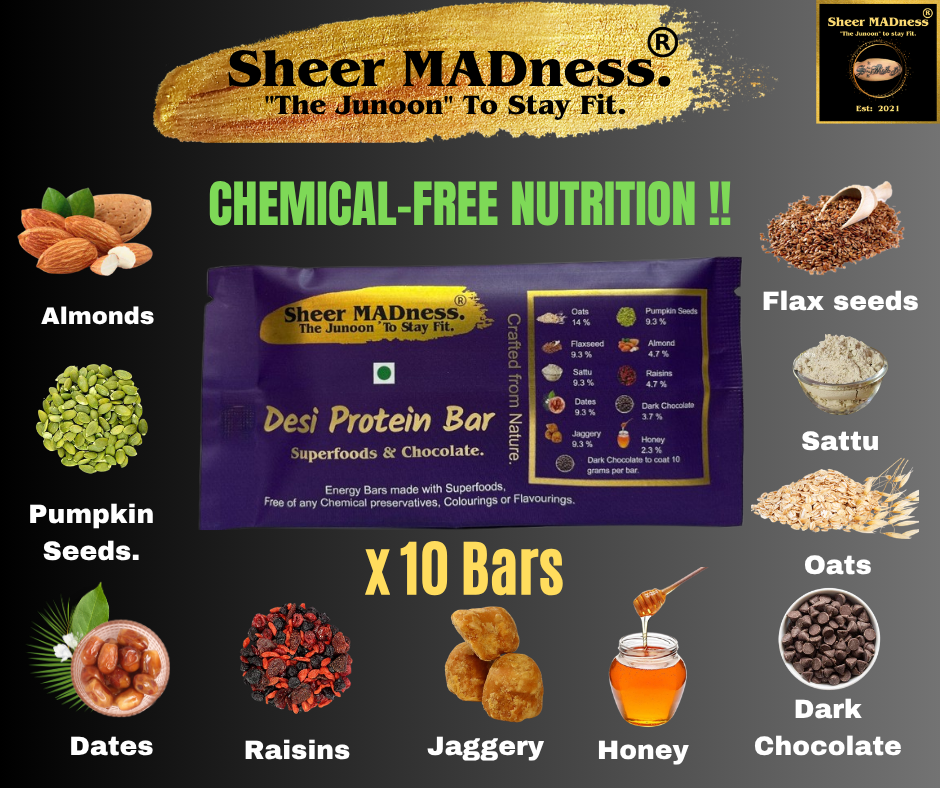
Let me map every significant micronutrient in Sheer MADness bars to its whole-food source, its specific function, and its prevalence of deficiency in Indian adults.
Almonds provide approximately 12.5 milligrams of Vitamin E per 100 grams — one of the richest whole-food Vitamin E sources available. Vitamin E is a fat-soluble antioxidant that specifically protects polyunsaturated fatty acids in cell membranes from oxidative damage. It supports immune function, skin health, and the integrity of muscle cell membranes during and after exercise.
Vitamin E insufficiency is common in Indian adults whose diets rely heavily on refined vegetable oils with low Vitamin E content and refined grains with reduced tocopherol levels. The Vitamin E from almonds in Sheer MADness bars arrives alongside the almond’s natural monounsaturated fats — ensuring the absorption that fat-soluble vitamins require.
Sheer MADness bars deliver iron from three separate whole-food sources simultaneously. Jaggery provides approximately 11 milligrams per 100 grams. Sattu provides 8 to 9 milligrams per 100 grams. Raisins contribute additional iron alongside natural vitamin C.
Iron deficiency is the most prevalent single micronutrient deficiency in India — affecting approximately 57 percent of Indian women and a significant proportion of Indian men. Fe(Iron) supports haemoglobin production, myoglobin in muscle tissue, and the cytochrome enzymes in mitochondria that produce cellular energy. Iron deficiency manifests as fatigue, reduced cognitive function, impaired immune response, and reduced exercise capacity — all problems that a daily bar addressing iron deficiency through whole-food sources can meaningfully support.
The natural vitamin C in raisins and dates in the same bar specifically enhances non-haem iron absorption — converting ferric iron to ferrous iron in the gut for more efficient uptake. This iron-vitamin C food synergy is a naturally occurring feature of the whole-food ingredient combination, not a manufactured supplement interaction.
Magnesium is delivered from three separate whole-food sources in Sheer MADness bars. Almonds provide 270 milligrams per 100 grams. Dark chocolate provides significant magnesium alongside its flavonoids. Oats contribute further magnesium alongside beta-glucan.
Magnesium supports over 300 enzymatic reactions in the body — including ATP synthesis, muscle contraction and relaxation, protein synthesis, nerve signal transmission, and blood sugar regulation. Magnesium insufficiency — subclinical magnesium status below optimal without clinical deficiency — is extremely common in India because processing of staple grains significantly reduces their natural magnesium content.
Three whole-food sources of magnesium in one bar creates a compounded daily magnesium contribution that approaches the level of a meaningful daily magnesium supplement — from food, not from a synthetic supplement added to a processed base.
Pumpkin seeds provide approximately 7.8 milligrams of zinc per 100 grams. Melon seeds add additional zinc. Together, these two seeds provide meaningful daily zinc from two whole-food sources.
Zinc deficiency is prevalent in Indian vegetarian adults whose phytate-rich diets from whole grains and legumes reduce zinc absorption. Zinc supports immune function through T-cell production and natural killer cell activity, collagen synthesis for skin and connective tissue repair, testosterone production, thyroid hormone synthesis, and the antioxidant enzyme superoxide dismutase that protects cells from oxidative damage.
The zinc from pumpkin seeds and melon seeds in Sheer MADness bars arrives in an organic food matrix that typically provides better bioavailability than inorganic zinc salts used in synthetic fortification.
Dates provide potassium at approximately 696 milligrams per 100 grams. Raisins contribute additional potassium alongside antioxidant polyphenols. Together, these two whole-food sources provide a meaningful daily potassium contribution from a snack.
Potassium counteracts sodium’s blood-pressure-raising effect, supports muscle contraction and cardiac function, maintains fluid balance, and reduces urinary calcium excretion — protecting bone density. Most Indian adults consume inadequate potassium relative to sodium — contributing to the hypertension prevalence that is one of India’s most significant cardiovascular risk factors.
Almonds provide calcium at approximately 264 milligrams per 100 grams — a meaningful whole-food calcium contribution. Calcium supports bone mineralisation, cardiac muscle contraction, nerve signal transmission, and enzymatic activation across multiple metabolic pathways.
The calcium from almonds arrives alongside magnesium — the mineral that improves calcium absorption and ensures it deposits appropriately in bone rather than accumulating in soft tissue. This calcium-magnesium combination from a single whole-food source is nutritionally superior to synthetic calcium carbonate added to a processed bar without accompanying magnesium.
Sattu provides folate at approximately 172 micrograms per 100 grams — a significant whole-food folate contribution. Oats provide thiamine (B1), riboflavin (B2), niacin (B3), and pantothenic acid. Dark chocolate contributes niacin alongside its flavonoids.
B vitamins support energy metabolism — they are the essential cofactors for the enzymatic pathways that convert food into ATP. Folate specifically supports DNA synthesis and cell division, reduces homocysteine levels relevant to cardiovascular health, and supports neural tube development in pregnancy.
These B vitamins from sattu, oats, and dark chocolate arrive in their natural food matrix with the companion compounds that support their metabolism — in contrast to synthetic pyridoxine hydrochloride or cyanocobalamin added to a protein base.
Selenium is a trace mineral that supports thyroid hormone synthesis, antioxidant enzyme activity, and immune function. Almonds and pumpkin seeds both provide meaningful selenium from whole-food sources.
Selenium deficiency is associated with hypothyroidism — one of the most common endocrine conditions in Indian women — and with reduced antioxidant capacity that increases susceptibility to oxidative stress-related conditions. Daily selenium from whole-food sources in Sheer MADness bars provides a consistent dietary selenium contribution relevant to thyroid and immune health.
Oats provide manganese — a trace mineral essential for bone matrix formation and the antioxidant enzyme manganese superoxide dismutase. Manganese deficiency is rare but manganese is an often-overlooked micronutrient that whole-food bars provide naturally and synthetic-fortified bars frequently omit.
This section provides the context that helps consumers evaluate vitamin and mineral claims on protein bar packaging.
When a bar claims “18 essential vitamins and minerals,” this typically means 18 synthetic micronutrients have been added to a processed protein base. The process involves dissolving or blending a manufactured vitamin-mineral premix into the protein powder before bar formation.
The resulting bar has a nutritional label that shows impressive numbers across multiple micronutrients. However, the actual nutritional benefit depends on bioavailability, food matrix effects, cofactor presence, and the health status of the individual consuming the bar.
A bar with 18 synthetic vitamins whose fat-soluble vitamins absorb poorly, whose synthetic iron competes with other minerals for absorption, and whose synthetic magnesium oxide is less bioavailable than food-based magnesium — provides a nutritional label that looks comprehensive and a body experience that is significantly more modest.
Furthermore, many synthetic vitamin-mineral premixes use the cheapest available form of each nutrient — not the most bioavailable. Synthetic vitamin E as alpha-tocopherol acetate is cheaper but less bioavailable than natural mixed tocopherols from whole foods. Synthetic iron as ferrous sulphate is the cheapest iron form but causes gut irritation and constipation in sensitive individuals. Similarly, synthetic magnesium as magnesium oxide has 4 percent bioavailability — one of the lowest of any magnesium form.
Sheer MADness delivers fewer micronutrients by count than a 18-vitamin fortified commercial bar. However, the micronutrients it delivers arrive in whole-food form with natural cofactors, appropriate dosages, and documented bioavailability from peer-reviewed research on the actual foods — almonds, pumpkin seeds, jaggery, oats, flaxseed, dark chocolate, dates — rather than from their cheapest synthetic equivalents.
This reference table provides the complete vitamin and mineral picture per bar.
| Nutrient | Whole-Food Source in Bar | Primary Function | Indian Deficiency Status |
|---|---|---|---|
| Vitamin E | Almonds (natural tocopherols) | Antioxidant, immune function, muscle cell membrane integrity | Common — refined diets low in tocopherols |
| Iron | Jaggery, sattu, raisins | Haemoglobin, energy metabolism, immune function | Severe — 57% of Indian women deficient |
| Magnesium | Almonds, dark chocolate, oats | ATP synthesis, muscle function, blood pressure | Insufficiency common — refined grains depleted |
| Zinc | Pumpkin seeds, melon seeds | Immune function, thyroid, testosterone, collagen | Prevalent — phytate-rich diets reduce absorption |
| Potassium | Dates, raisins | Blood pressure, cardiac function, fluid balance | Low in most Indian diets relative to sodium |
| Calcium | Almonds | Bone density, cardiac muscle, nerve function | Insufficiency common in non-dairy diets |
| Folate (B9) | Sattu | DNA synthesis, homocysteine reduction, neural tube | Deficiency risk in vegetarian women |
| Thiamine (B1) | Oats | Energy metabolism, nerve function | Risk in refined grain-heavy diets |
| Niacin (B3) | Oats, dark chocolate | Energy metabolism, DNA repair | Generally adequate in Indian diets |
| Manganese | Oats | Bone formation, antioxidant enzyme support | Generally adequate in whole-grain diets |
| Selenium | Almonds, pumpkin seeds | Thyroid hormone synthesis, antioxidant enzymes | Regional deficiency in India documented |
| Phosphorus | Oats, sattu, pumpkin seeds | Bone mineralisation, ATP synthesis | Generally adequate |
| Copper | Dark chocolate, almonds | Iron metabolism, antioxidant enzymes | Generally adequate |
| Antioxidant flavonoids | Dark chocolate, raisins | Cellular protection, cardiovascular health | Not a classical nutrient but functionally significant |
| Omega-3 ALA | Flaxseed | Anti-inflammatory, cardiovascular, brain health | Severely low in vegetarian Indian diets |
The specific micronutrient profile of Sheer MADness bars — iron, zinc, magnesium, Vitamin E, potassium, calcium, folate, selenium — maps almost exactly onto India’s documented micronutrient deficiency burden.
The ICMR-NIN 2024 Dietary Guidelines specifically identify iron, zinc, calcium, Vitamin D, Vitamin A, and folate as the micronutrients most commonly deficient in Indian adult diets. A daily bar that delivers iron from jaggery and sattu, zinc from pumpkin seeds, calcium from almonds, and folate from sattu — all in bioavailable whole-food form — directly addresses the specific nutritional gaps that India’s most authoritative dietary guidelines identify.
This is not coincidental. It reflects the fact that the Indian superfood ingredients in Sheer MADness bars — sattu, almonds, jaggery, flaxseed, pumpkin seeds — were selected and used by Indian food culture specifically because they addressed nutritional needs that Indian bodies faced. Indian grandmothers gave almonds for strength and calcium. They gave jaggery for iron and energy. Our grandmothers used sattu for protein and minerals. They incorporated flaxseed in everyday cooking for its oils and nutrients. These were intuitive applications of nutritional wisdom developed over centuries of experience with Indian dietary needs.
Sheer MADness bars formalise this wisdom in a convenient bar format — delivering the specific micronutrients Indian adults need most, from the specific whole-food sources their bodies have processed efficiently for generations.
For consumers evaluating vitamin and mineral claims on protein bars, this practical guide helps interpret what you see.
When a label lists vitamins by chemical name — “pyridoxine hydrochloride,” “cyanocobalamin,” “alpha-tocopherol acetate” — these are synthetic vitamins added as supplements. They are not inherently harmful but their bioavailability depends on the food matrix context they are consumed in.
When a label lists whole-food ingredients as the primary items — “almonds,” “pumpkin seeds,” “jaggery,” “oats,” “flaxseed” — and the nutrition panel shows vitamins and minerals, these micronutrients come from the foods themselves. They arrive with their natural cofactors, absorption-enhancing companion compounds, and appropriate food-matrix dosages.
The number of vitamins and minerals on the label is not the right measure of micronutrient quality. The source and food matrix of those micronutrients is the right measure.
Since 2021, Sheer MADness displays every ingredient with its own image on the front of every pack. You can see exactly which whole foods provide which micronutrients before opening the bar. This transparency is the most complete micronutrient communication available from any Indian bar brand.
Sheer MADness holds a registered trademark under the Government of India. The Natural Plant Protein formula is patent published under Patent No. 202331036733, searchable on Intellectual Property India. The brand holds a valid FSSAI licence and GSTIN registration.
Do protein bars have vitamins and minerals?
Some do — through two very different mechanisms. Commercial bars often add synthetic vitamin-mineral blends to a processed protein base. Whole-food bars like Sheer MADness deliver vitamins and minerals naturally through their ingredients — Vitamin E from almonds, iron from jaggery, magnesium from dark chocolate, zinc from pumpkin seeds. The bioavailability and nutritional quality of whole-food micronutrients is generally superior to synthetic fortification.
Are synthetic vitamins in protein bars as good as natural vitamins from food?
Synthetic vitamins can contribute to daily micronutrient intake. However, several limitations make whole-food vitamins generally superior. Fat-soluble vitamins require dietary fat for absorption — often absent from low-fat protein bars. Natural food matrices provide cofactors and companion compounds that support vitamin metabolism. Whole-food dosages fall within natural ranges without toxicity risk. The bioavailability of whole-food minerals like magnesium and iron is generally better than their cheapest synthetic equivalents used in fortification.
Which vitamins and minerals are in Sheer MADness bars?
Vitamin E from almonds, iron from jaggery and sattu and raisins, magnesium from almonds and dark chocolate and oats, zinc from pumpkin seeds and melon seeds, potassium from dates and raisins, calcium from almonds, folate and B vitamins from sattu and oats, selenium from almonds and pumpkin seeds, manganese from oats, and antioxidant flavonoids from dark chocolate. All delivered from whole-food sources with no synthetic vitamin additions.
Commercial bars add synthetic vitamin-mineral premixes to processed protein bases — allowing them to claim a long list of vitamins and minerals on the front label. These synthetic vitamins are real nutrients but their absorption depends on the food matrix context that a processed protein base often doesn’t provide. The number of vitamins is a marketing metric. The source and bioavailability of those vitamins is the nutritional metric.
Is the iron in Sheer MADness bars well-absorbed?
Yes — because it arrives alongside natural vitamin C from raisins and dates in the same bar. Vitamin C converts ferric iron to ferrous iron, which the gut absorbs more efficiently. This is a naturally occurring food synergy from the whole-food ingredient combination — not an engineered supplement interaction. Indian women with iron deficiency specifically benefit from this iron-vitamin C combination in a daily bar.
Are protein bars a substitute for a multivitamin?
No — a protein bar is a food, not a supplement. Sheer MADness bars deliver meaningful contributions to several key micronutrients — particularly those most deficient in Indian diets — but cannot replace the full micronutrient diversity of a balanced diet or a comprehensive multivitamin. They are best understood as nutritious daily snacks that supplement rather than replace broader dietary micronutrient intake.
No. Vitamin D is the one critical micronutrient that almost no food provides in meaningful amounts. The primary dietary source of Vitamin D in India is fortified milk and sunlight exposure. Sheer MADness bars do not claim to address Vitamin D — and any bar claiming to provide meaningful Vitamin D from non-fortified whole foods should be evaluated critically. Sunlight exposure of 15 to 30 minutes daily remains the most effective and most natural Vitamin D intervention available to Indian adults.
Why don’t Sheer MADness bars list vitamins on the label like commercial bars?
Because the vitamins and minerals in Sheer MADness bars come from the whole-food ingredients themselves — not from a synthetic vitamin-mineral premix added separately. They appear in the ingredient list as “almonds,” “pumpkin seeds,” “jaggery,” and “oats” — not as “alpha-tocopherol acetate” or “ferrous sulphate.” The nutrition panel shows the vitamins and minerals because they are naturally present in those foods. No synthetic vitamin addition was made, so no synthetic vitamin name appears.
The question “do protein bars have vitamins and minerals” has a simple answer that conceals a complex truth.
Most bars have vitamins and minerals — either from synthetic fortification added to a processed base, or from whole-food ingredients that naturally contain them. However, only whole-food vitamins and minerals arrive with the food matrix, cofactors, and companion compounds that determine how well the body actually absorbs and uses them.
Sheer MADness bars deliver Vitamin E from almonds, iron from jaggery and sattu and raisins, magnesium from three sources, zinc from pumpkin seeds, potassium from dates, calcium from almonds, and folate from sattu — mapping almost exactly onto India’s documented micronutrient deficiency burden. These micronutrients come from foods that Indian bodies have processed efficiently for generations. They arrive with the natural food matrix that maximises their absorption. No synthetic vitamin premix was added. No chemical name appears in place of a food name.
Since 2021, every ingredient is displayed on the front of every pack. The vitamins and minerals in Sheer MADness bars are the vitamins and minerals that those whole foods naturally contain — visible to you, traceable to their source, and delivered in the form that food has always delivered them.
I would also request you to kindly read my previous post about “Healthiest Protein Bar in India“.
a) Everyone is an individual, so what suits me may not suit the next person.
b) If a person has a medical condition, a doctor’s advice and prescribed medication will only help.
c) While buying any protein bar from the market, read the labels carefully. Watch out for INS 320 (BHA), INS 321 (BHT), INS 551 (silicon dioxide), maltitol, sorbitol, sucralose, and other lab-made chemicals that quietly appear on most commercial labels.
If you are interested in buying chemical-free Natural Plant Protein Moringa, Health Drinks for Kids, or our delicious chemical-free Energy Bars, Protein Bars, and Millet Bars, shop at Sheer MADness.
You can also find us on Flipkart, Jio Mart, or ONDC in India.
d) Exercise is the key to fitness. Exercise and nutrition are two sides of the same coin and always go hand in hand.
e) Excess of anything is wrong, even the best whole-food snack. Consume only recommended quantities.
f) Rome was not built in a day. Discipline and consistency are the only keys to lasting health.
g) It is not only exercise and protein that builds health. A healthy gut, macro and micronutrients, body type, rest, and lifestyle all matter. Of all these, exercise and nutrition are within our control. Focus on these two primary aspects first.
h) The most important part of fitness is that nothing is better than exercise and a balanced meal.
Article by Chef Ashutosh Awasthi
Disclaimer: Our products are a source of HEALTHY NUTRIENTS and are COMPLETELY FREE OF ANY ADDED CHEMICALS. We do not claim to cure any medical condition. The content provided is informational. We do not claim to diagnose or treat a person with any specific medical condition.