

Direct answer: Moringa protein and pea protein are both plant-based protein sources — but they are fundamentally different in how they are produced, what they deliver beyond their protein content, and how well they suit Indian bodies and Indian nutritional needs. Moringa protein from whole leaf powder is a complete plant protein that arrives with its natural food matrix — iron, calcium, antioxidants, fibre, and vitamins intact. Pea protein isolate is a chemically extracted protein fraction that arrives stripped of the pea’s natural nutrition beyond its protein content. For Indian consumers choosing between moringa protein vs pea protein, the comparison is not simply about protein grams per serving. It is about whole-food nutrition versus industrial protein extraction — and why that difference matters more in India than most supplement marketing acknowledges.
I am Chef Ashutosh Awasthi, founder of Sheer MADness, professional chef, marathon runner, and author of Great Health Comes from Exercise & Nutrition. I will give you the most complete, most honest, and most India-relevant comparison of moringa protein and pea protein available anywhere — including the chemistry that supplement brands prefer you don’t examine too closely.
Moringa protein comes from the dried leaves of Moringa oleifera — a tree native to the sub-Himalayan regions of India and widely distributed across South Asia and Africa. The leaves are harvested, dried at low temperatures to preserve their nutritional compounds, and ground into a fine powder.
This process involves no chemical extraction. The moringa leaf is ground — the same mechanical process used to make wheat flour or chickpea flour. Every compound present in the original leaf — protein, iron, calcium, potassium, magnesium, quercetin, kaempferol, chlorogenic acid, vitamins A, C, E, and B6, dietary fibre — remains present in the final powder in its natural proportion.
The result is a protein powder that is genuinely a whole food in powder form. The protein percentage is lower than isolates — approximately 25 to 30 percent of dry weight — because the powder contains all the other nutritional components of the leaf. However, this lower protein percentage comes alongside all the nutrition the leaf naturally provides. Nothing was removed to concentrate the protein.
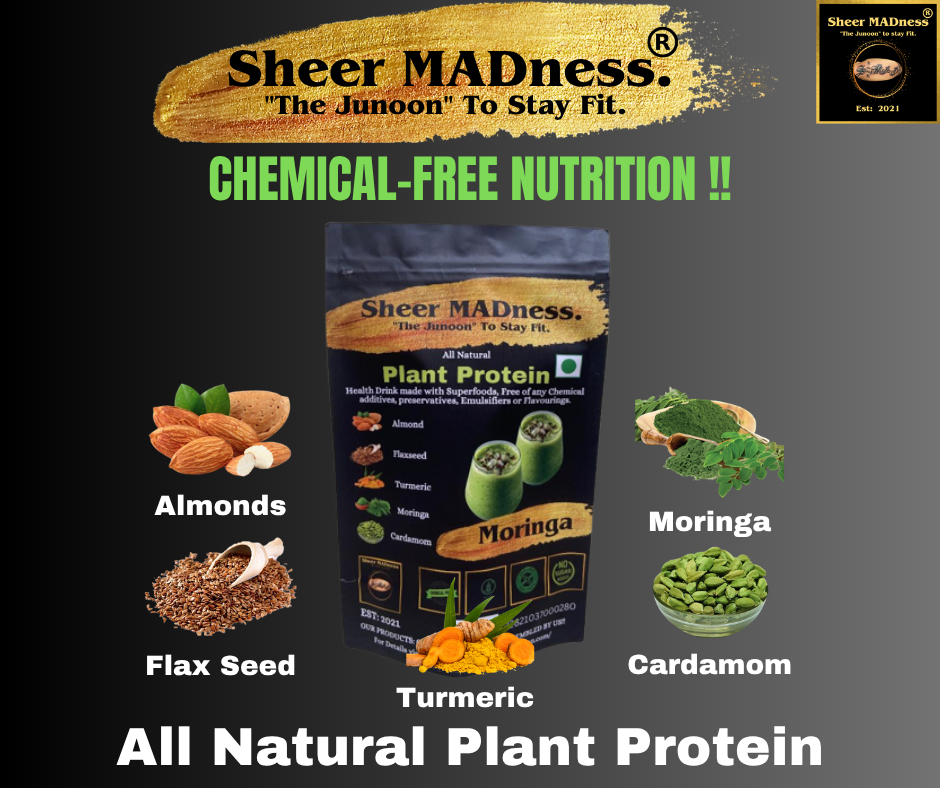
Sheer MADness Plant Protein Moringa adds almonds, flaxseed, turmeric, and cardamom to the moringa leaf base — creating a complementary whole-food protein blend that addresses the amino acid spectrum more completely than moringa alone, while adding the healthy fats, omega-3, and anti-inflammatory compounds that make the blend nutritionally comprehensive.
Pea protein isolate begins as yellow split peas — a nutritious legume that provides protein, fibre, B vitamins, iron, and zinc in its whole form. The transformation from whole pea to pea protein isolate involves a multi-step industrial process that permanently changes what the product delivers.
The peas are first dried and ground to flour. The flour is then suspended in water at an alkaline pH — typically using food-grade sodium hydroxide or potassium hydroxide — which selectively dissolves the protein fraction while leaving starch and fibre largely behind. This alkaline solution is then acidified — typically with hydrochloric acid — to the isoelectric point of pea protein, causing the protein to precipitate out of solution. The precipitated protein is then separated, neutralised, and spray-dried at high temperatures to produce the powder.
This process — alkaline extraction, acid precipitation, neutralisation, spray drying — is industrial chemistry. The finished pea protein isolate contains 80 to 90 percent protein by weight. However, the fibre that the whole pea contained has been removed in the alkaline extraction step. The B vitamins that the whole pea contained are partially destroyed by the heat of spray drying. The iron that the whole pea contained is significantly reduced through the repeated aqueous processing. The flavonoids and polyphenols are largely removed in the water wash steps.
The result is a product with impressive protein concentration numbers and a nutritional profile dramatically narrower than the whole pea from which it was derived.
A 2025 study published in Scientific Reports on protein digestibility across 1,641 commercial protein products found that products built on pea protein isolate and rice protein isolate showed some of the lowest protein digestibility rates — with values as low as 47 percent. This means a pea protein product claiming 25 grams of protein per serving may deliver as little as 11.75 grams of usable amino acids after digestion. The industrial extraction that concentrates the protein paradoxically reduces the digestibility of the protein it was supposed to maximise — because the natural food-matrix context that digestive enzymes evolved to work with has been removed.
The alkaline extraction and acid precipitation process used to manufacture pea protein isolate leaves chemical process residues in the supply chain. While FSSAI and most food regulatory bodies consider the residual levels in finished pea protein isolate acceptable, the process itself raises questions that informed Indian consumers are increasingly asking.
The sodium hydroxide used in alkaline extraction and the hydrochloric acid used in acid precipitation are industrial chemicals. When they react with pea protein during processing, they can generate deamidated amino acid residues and chemically modified protein structures — compounds that are not present in the whole pea and that the gut’s digestive enzyme systems did not evolve to process.
Furthermore, most commercial pea protein isolate products — particularly those manufactured at scale for the global supplement market — contain anti-caking agents, emulsifiers, and preservatives added after the protein extraction to ensure the powder flows, mixes, and stores correctly. These additives include silicon dioxide (INS 551), lecithin (INS 322), and various preservatives — all of which require label disclosure under FSSAI regulations but appear in small print that most consumers never read.
Sheer MADness Plant Protein Moringa contains none of these. No alkaline extraction. Zero acid precipitation. No spray drying at temperatures that denature heat-sensitive vitamins. Zero anti-caking agent. No INS code of any kind. The moringa leaves, almonds, flaxseed, turmeric, and cardamom are processed minimally and combined — then vacuum packed to remove oxygen from the sealed pouch, preserving freshness without any chemical preservative entering the food.
Both moringa protein and pea protein provide complete essential amino acid profiles — this is an important starting point. However, the comparison becomes significantly more nuanced when we examine specific amino acid concentrations, digestibility, and the food-matrix context.
Moringa leaf protein provides leucine at approximately 6.5 to 7.5 grams per 100 grams of protein. Pea protein isolate provides leucine at approximately 7.8 to 8.2 grams per 100 grams of protein — marginally higher on a per-gram-of-protein basis.
However, the 2025 Scientific Reports digestibility data changes this comparison. If pea protein isolate delivers 47 to 70 percent of its stated protein as usable amino acids, the usable leucine from a 25-gram pea protein serving at 65 percent digestibility is approximately 1.27 to 1.33 grams. A moringa-based whole-food blend with higher digestibility from its intact food matrix delivers comparable usable leucine despite a lower total protein percentage.
Research confirmed in the OCL journal study on moringa amino acid content found moringa provides lysine at approximately 4.3 to 5.1 grams per 100 grams of protein — a significant concentration. Pea protein provides lysine at approximately 6.5 to 7.5 grams per 100 grams of protein.
On raw protein lysine content, pea protein isolate is stronger. However, the same digestibility adjustment applies — and the broader nutritional context of moringa’s iron, calcium, antioxidants, and fibre alongside its lysine makes moringa the more nutritionally complete lysine delivery system.
Both moringa and pea protein are relatively lower in methionine than in other essential amino acids — this is the most common limiting amino acid in plant proteins generally. Sheer MADness Plant Protein Moringa specifically addresses this by including almonds and flaxseed — both higher in methionine — as complementary protein sources. This is precisely the traditional Indian food combining wisdom applied in modern product formulation.
Most commercial pea protein products do not address this methionine limitation through food combining. They provide pea protein isolate and trust that consumers will meet their methionine requirements from other dietary sources.
This is the most significant comparison dimension for Indian consumers — because most Indian adults need micronutrients as much as they need protein.
Moringa leaf powder provides iron at approximately 28 milligrams per 100 grams dry weight — among the highest plant-food iron concentrations available. Pea protein isolate, after its alkaline extraction and acid precipitation process, contains minimal iron because the aqueous processing removes most of the mineral content of the original pea. The mineral content of pea protein isolate is primarily what remains after industrial extraction — a fraction of what the whole pea provided.
Moringa provides calcium at approximately 2,000 milligrams per 100 grams — exceptional. Pea protein isolate provides minimal calcium after processing.
Moringa provides quercetin at approximately 50 to 60 milligrams per 100 grams and kaempferol alongside chlorogenic acid — antioxidants that specifically protect against oxidative stress, liver damage, and chronic inflammation. Pea protein isolate contains essentially no antioxidant flavonoids — the extraction process that concentrates the protein removes them.
Moringa provides Vitamin C, Vitamin A, Vitamin B6, and Vitamin E in meaningful quantities. Pea protein isolate provides minimal vitamins after spray drying at temperatures that degrade heat-sensitive vitamins.
Moringa provides dietary fibre naturally within its leaf structure. Pea protein isolate contains minimal fibre — the alkaline extraction specifically removes the fibrous components of the pea.
The table below summarises this comparison specifically for Indian consumers.
The moringa protein vs pea protein comparison has specific dimensions for Indian consumers that the global supplement market does not address.
Moringa is native to India. The Moringa oleifera tree grows across Andhra Pradesh, Karnataka, Tamil Nadu, Rajasthan, Maharashtra, and numerous other Indian states. India is the world’s largest producer of moringa — producing approximately 1.2 million tonnes of moringa pods annually. Indian families have consumed moringa leaves — drumstick leaves — in sambar, dal, and curries for generations. This is a food with thousands of years of Indian dietary history and documented safety across Indian bodies and Indian digestive systems.
Pea protein isolate is an import — both in origin and in concept. Yellow split peas are grown in Canada, Australia, and China primarily for the global plant protein market. The industrial extraction technology was developed in Western food science laboratories for the Western vegan and sports nutrition market. The flavour profile — the characteristic “pea-y,” “beany” note that most consumers recognise in pea protein products — is foreign to Indian palate expectations in a way that moringa’s earthy, slightly bitter green notes are not.
For Indian vegetarians and vegans who want plant-based protein that is culturally authentic to Indian food tradition — pea protein isolate is an industrial Western import in an Indian supplement wrapper. Moringa protein from whole leaf is India’s own superfood, grown here, eaten here for centuries, and nutritionally richer than its industrial alternative.
Whole-food moringa protein and pea protein isolate interact very differently with Indian digestive systems.
Moringa leaf powder contains no anti-nutritional factors of significance at the quantities consumed in a serving. Its protein is digested through normal enzymatic hydrolysis of the food-matrix proteins that human digestive systems handle efficiently. The fibre in moringa leaf specifically supports gut motility and beneficial gut bacteria — adding a digestive benefit alongside the protein.
Pea protein isolate, despite its “hypoallergenic” marketing, causes digestive issues for a significant proportion of consumers. The concentrated isolated protein at high doses taxes the digestive enzyme systems differently than whole food protein. Furthermore, pea protein isolate in commercial powders and bars frequently contains isolated fibre additives — inulin, fructooligosaccharides — added back in after the extraction process removed the original fibre. These isolated prebiotic fibres ferment rapidly in the large intestine, causing gas, bloating, and cramping.
A 2025 Scientific Reports study specifically documented that protein bars built on pea and rice protein isolates showed the lowest protein digestibility in its analysis of 1,641 products — confirming that the industrial extraction process that concentrates pea protein also reduces its gut-accessible digestibility.
This section provides the most practically useful comparison for Indian consumers who read labels.
Sheer MADness Plant Protein Moringa ingredient list: moringa leaf powder, almonds, flaxseed, turmeric, cardamom. Five whole-food ingredients. Every ingredient visible on the front of the pack with its own image since 2021. No INS code. Zero chemical additive. No preservative. Zero anti-caking agent.
A typical commercial pea protein isolate powder ingredient list includes: pea protein isolate, silicon dioxide (INS 551 — anti-caking agent), soy lecithin (INS 322 — emulsifier), sucralose or stevia extract (sweetener), cocoa powder or artificial flavour (flavouring), potassium chloride (mineral replacement), sodium chloride, and various vitamins added back synthetically to compensate for those lost during processing.
The contrast is immediate and stark. One product is food in powder form. The other is an industrial protein fraction with a list of processing aids required to make it palatable and stable.
Moringa trees are among the most sustainable plants available. They grow in semi-arid conditions that would be unsuitable for most food crops. These require minimal irrigation — important in water-stressed Indian agricultural regions. They fix atmospheric nitrogen, improving soil fertility. These produce protein-rich leaves year-round from a perennial tree that needs planting only once and produces for years.
Pea farming for pea protein isolate requires water for both cultivation and the large-volume aqueous extraction process. The alkaline and acid waste streams from pea protein extraction require treatment. Transportation from production centres — primarily Canada and China — to the Indian market adds significant carbon footprint.
For Indian consumers concerned about environmental sustainability, moringa grown in India by Indian farmers, processed minimally in Indian facilities, and sold in India represents a dramatically lower environmental footprint than imported industrial pea protein extract.
Sheer MADness Plant Protein Moringa represents a fundamentally different philosophy from pea protein isolate products — and it is a philosophy specifically built for Indian consumers.
Where pea protein isolate asks: how do we maximise protein percentage per gram of powder? Sheer MADness asks: what whole foods provide the most complete nutrition for Indian bodies, and how do we combine them without any compromise to their natural nutritional integrity?
The answer is moringa leaf — India’s own superfood, providing complete protein alongside iron, calcium, antioxidants, and vitamins in their natural food matrix. Combined with almonds — India’s Doodh Badam tradition — for healthy fats, Vitamin E, and complementary amino acids. Add flaxseed for omega-3 and lignans. With turmeric — India’s Doodh Haldi tradition — for anti-inflammatory curcumin. With cardamom for the natural fragrance that makes this a genuinely enjoyable daily drink rather than a chemical-flavoured supplement to be endured.
Vacuum packed — removing air from inside the sealed pouch to preserve freshness without adding any chemical preservative. Every ingredient on the front of every pack with its own image since 2021. Patent No. 202331036733 on Intellectual Property India. FSSAI certified. Made in Kolkata.
This is Indian whole-food plant protein — formulated by a chef who understands nourishment, not a biotechnologist who optimises chemical extraction yields.
This post is a comparison, not a condemnation. Intellectual honesty requires acknowledging where pea protein isolate has genuine advantages.
For consumers who specifically need very high protein per serving — bodybuilders and strength athletes managing precise macronutrient targets — pea protein isolate’s 80 to 90 percent protein concentration provides more protein per gram of powder than moringa’s 25 to 30 percent. If total protein grams per serving is the overriding priority, pea isolate achieves higher concentrations.
For consumers with FODMAP sensitivities who react to the natural compounds in leafy green vegetables — including some of moringa’s bioactive compounds — pea protein’s more chemically simplified profile may be better tolerated.
For consumers on extremely tight budgets where per-gram-of-protein cost is the only consideration — pea protein isolate’s high protein concentration reduces cost per gram of protein compared to whole-food moringa powder.
In each of these cases, the trade-off is explicit: you are prioritising protein concentration or cost over nutritional completeness, whole-food integrity, and the broader health benefits that moringa’s complete nutritional profile provides. This is a legitimate trade-off. It should be made knowingly rather than by default.
For Indian consumers who want genuinely complete plant-based nutrition — who want iron alongside their protein for haemoglobin, antioxidants alongside their protein for cellular protection, omega-3 alongside their protein for anti-inflammatory support, and zero chemical additive in the product they consume daily — moringa protein from Sheer MADness is the clear answer.
Sheer MADness holds a registered trademark under the Government of India. The Natural Plant Protein formula is patent published under Patent No. 202331036733, searchable on Intellectual Property India. The brand holds a valid FSSAI licence and GSTIN registration.
| Comparison Point | Sheer MADness Moringa Protein | Pea Protein Isolate |
|---|---|---|
| Protein source | Whole moringa leaf — minimal processing | Yellow split pea — alkaline extraction and acid precipitation |
| Production chemistry | Grinding only — no chemical extraction | Sodium hydroxide, hydrochloric acid, spray drying |
| Protein concentration | 25 to 30% of dry weight | 80 to 90% of dry weight |
| Protein digestibility | High — whole food matrix intact | Variable — 47 to 86% per 2025 Scientific Reports |
| Usable protein per serving | Comparable — higher digestibility compensates | High on label, lower in practice |
| Amino acid completeness | Complete — complemented by almonds and flaxseed | Complete but lower in methionine |
| Iron content | Exceptional — 28mg/100g from whole leaf | Minimal — removed during extraction |
| Calcium content | Exceptional — 2000mg/100g | Minimal — removed during extraction |
| Antioxidant flavonoids | High — quercetin, kaempferol, chlorogenic acid | Essentially absent — removed in processing |
| Dietary fibre | Natural — from whole leaf structure | Minimal — removed in alkaline extraction |
| Vitamins | High — Vitamin A, C, E, B6 from whole leaf | Minimal — damaged by spray drying |
| Omega-3 fatty acids | Yes — from flaxseed in blend | Absent |
| Anti-inflammatory support | Yes — turmeric curcumin + moringa quercetin | Absent |
| Chemical additives | Zero — no INS code | INS 551, INS 322, sweeteners common |
| Preservatives | None — vacuum packed | Often present |
| Cultural authenticity (India) | High — Indian superfood, grown in India | None — imported industrial product |
| Gut fermentation risk | Low — no isolated fibre additives | Moderate — isolated fibre additives common |
| Environmental footprint | Low — perennial tree, minimal water, Indian grown | Higher — annual crop, industrial extraction, imported |
| Front label transparency | Every ingredient named and pictured since 2021 | Chemical names in small print |
| Price point | Accessible for Indian consumers | Often premium-priced import |
Is moringa protein better than pea protein?
For most Indian consumers, yes — specifically because moringa protein arrives in its complete whole-food form with iron, calcium, antioxidants, vitamins, and fibre intact alongside its protein. Pea protein isolate provides higher protein concentration but loses most of the pea’s non-protein nutrition during industrial extraction. For consumers who specifically need maximum protein per gram above all other nutritional considerations, pea isolate has this advantage. For those who want genuinely complete whole-food plant nutrition, moringa is more appropriate.
What is the difference between moringa protein and pea protein isolate?
Moringa protein comes from grinding dried moringa leaves — minimal processing that preserves all the leaf’s nutrients. Pea protein isolate is produced through alkaline water extraction and acid precipitation — industrial chemistry that concentrates the protein while removing fibre, vitamins, minerals, and antioxidants. One is food in powder form. The other is an industrial protein fraction.
Pea protein isolate provides slightly higher leucine and lysine concentrations on a per-gram-of-protein basis. However, when protein digestibility is accounted for — pea isolate shows 47 to 86 percent digestibility per the 2025 Scientific Reports study — the practical usable amino acid delivery per serving from whole-food moringa is comparable. Furthermore, Sheer MADness Plant Protein Moringa combines moringa with almonds and flaxseed, creating complementary amino acid coverage that addresses moringa’s individual limitations.
Is pea protein safe for Indian consumers?
Pea protein isolate is considered safe by FSSAI and international food regulatory bodies. The concern is not safety but nutritional completeness and chemical additive content. Pea protein isolate removes most of the pea’s non-protein nutrition during extraction. Most commercial pea protein products add anti-caking agents, emulsifiers, and preservatives after extraction. These are legal ingredients but represent daily chemical exposure that whole-food alternatives avoid entirely.
Sheer MADness was built on a whole-food nutrition philosophy — that the best nutrition comes from real foods in their complete form, not from chemically extracted protein fractions. Moringa is India’s own superfood — grown here, eaten here for centuries, nutritionally richer than industrial pea protein, and free of the extraction chemistry that concentrates protein at the cost of everything else the original food provided. It is also the right choice from a chef’s perspective — moringa, almonds, flaxseed, turmeric, and cardamom make a genuinely enjoyable daily drink. Industrial pea protein requires artificial flavours to be palatable.
Can I switch from pea protein to moringa protein?
Yes — and for most Indian consumers, the switch improves overall nutritional quality even if per-serving protein grams decrease on the label. Adjust expectations appropriately: Sheer MADness Plant Protein Moringa delivers 25 to 30% protein from whole-food sources alongside iron, calcium, antioxidants, omega-3, and anti-inflammatory compounds. It is not a direct gram-for-gram protein replacement. It is a nutritional upgrade from concentrated protein to complete whole-food nutrition.
Moringa leaf contains some omega-3 — primarily ALA — but the most significant omega-3 contribution in Sheer MADness Plant Protein Moringa comes from flaxseed — the richest plant source of ALA at approximately 22 grams per 100 grams. Pea protein isolate contains no omega-3 — the fat content of the pea was removed during alkaline extraction.
How do I use Sheer MADness Plant Protein Moringa?
Two to three tablespoons mixed into warm milk or plant milk — the Doodh Badam Haldi Moringa preparation — is the most traditional and most nutritionally optimal use. Alternatively, blend into a cold smoothie with banana and berries, or stir into a glass of water with fruit alongside. Unlike pea protein isolate, which requires artificial flavouring systems to be palatable, Sheer MADness Plant Protein Moringa is genuinely enjoyable with only natural ingredients — moringa’s earthy notes, almond richness, and cardamom fragrance create a drink that tastes like the whole food it is.

The moringa protein vs pea protein comparison resolves differently depending on what you are optimising for.
If you are optimising for maximum protein grams per serving above all else — pea protein isolate achieves higher protein concentration, and for bodybuilders with precise macronutrient targets, this concentration advantage is real.
If you are optimising for complete nutritional value — protein alongside iron, calcium, antioxidants, omega-3, anti-inflammatory support, vitamins, and dietary fibre, from whole foods with no chemical additive — moringa protein from Sheer MADness wins comprehensively and without qualification.
For the vast majority of Indian adults who eat protein powder not to engineer specific macronutrient ratios but to improve their daily nutrition, support their health, and supplement a diet that needs more than just extra protein grams — moringa from Sheer MADness is the more appropriate, more complete, and more culturally authentic choice.
India has always had its own protein tradition. Sattu, almonds, flaxseed, moringa — these are Indian foods that Indian bodies recognise and process efficiently. We do not need to import industrially extracted protein fractions from Canada and China when the most nutritionally complete plant protein on earth grows in our own states and has been eaten in our own homes for generations.
Since 2021, that nutrition is on the front of every Sheer MADness pack — named, pictured, and honest.
I would also request you to please read my previous post: Benefits of Moringa Plant protein, the versatile Superfood powerhouse.
a) Everyone is an individual, so what suits me may not suit the next person.
b) If a person has a medical condition, a doctor’s advice and prescribed medication will only help.
c) While buying any protein powder from the market, read the labels carefully. Watch out for INS 551 (silicon dioxide), INS 322 (soy lecithin), BHA (INS 320), BHT (INS 321), and other chemical processing aids and preservatives. The best protein powder has an ingredient list you can read without a chemistry degree.
If you are interested in buying chemical-free Natural Plant Protein Moringa, Health Drinks for Kids, or our delicious chemical-free Energy Bars, Protein Bars, and Millet Bars, shop at Sheer MADness.
You can also find us on Flipkart, Jio Mart, or ONDC in India.
d) Exercise is the key to fitness. Exercise and nutrition are two sides of the same coin and always go hand in hand.
e) Excess of anything is wrong, even the best whole-food superfood. Consume only recommended quantities.
f) Rome was not built in a day. Discipline and consistency are the only keys to lasting health.
g) It is not only exercise and protein that builds health. A healthy gut, macro and micronutrients, body type, rest, and lifestyle all matter. Of all these, exercise and nutrition are within our control. Focus on these two primary aspects first.
h) The most important part of fitness is that nothing is better than exercise and a balanced meal.
Disclaimer: Our products are a source of HEALTHY NUTRIENTS and are COMPLETELY FREE OF ANY ADDED CHEMICALS. We do not claim to cure any medical condition. The content provided is informational. We do not claim to diagnose or treat a person with any specific medical condition.