

Direct answer: Yes — seniors can and should consume protein bars, provided the bars are built from whole foods that are easy to digest, rich in fibre, free from chemical additives, and appropriately portioned. Whole-food protein bars from oats, almonds, sattu, flaxseed, dates, and jaggery are specifically well-suited to senior nutrition. They support muscle preservation, bone density, gut health, and immune function without placing chemical processing load on ageing liver and kidneys.
Protein bars built on whey protein isolates, maltitol, artificial sweeteners, and synthetic preservatives are not appropriate for regular senior consumption. They place unnecessary synthetic chemical load on organ systems that function with reduced capacity as we age.
I’m Chef Ashutosh Awasthi, founder of Sheer MADness, professional chef, marathon runner, and author of Great Health Comes from Exercise & Nutrition. I transformed my own health in my forties. I understand ageing, nutrition, and the difference between food that nourishes and chemistry that burdens. Let me explain the senior-specific nutrition science that makes protein bars important for older adults — and what to look for.
The most common misconception about senior nutrition is that older adults need less food and therefore less protein. Research consistently says the opposite.
Ageing causes a phenomenon called anabolic resistance — a reduction in the efficiency of muscle protein synthesis in response to dietary protein. In younger adults, 20 to 25 grams of protein per meal triggers near-maximum muscle protein synthesis. In adults above 65, the same protein dose triggers a significantly smaller muscle protein synthesis response. Older muscles require higher protein doses and more frequent protein delivery to achieve the same result.
The ESPEN 2023 guidelines on protein for older adults — the most authoritative international guideline on senior nutrition — recommend a minimum of 1.2 grams of protein per kilogram of body weight per day for healthy older adults. For those with acute illness or malnutrition, the recommendation rises to 1.5 grams per kilogram. This is meaningfully higher than the 0.8 grams per kilogram recommended for younger healthy adults.
For a 60-kilogram healthy Indian senior, this means a minimum of 72 grams of protein daily. For a 70-kilogram senior, it means 84 grams minimum. Most Indian senior diets — relying heavily on rice, roti, and modest dal consumption — fall significantly short of this target, particularly at breakfast and mid-morning when protein intake is lowest.
Furthermore, the anabolic resistance of ageing means that protein distribution across the day matters specifically for seniors. Research published in the Journal of Nutrition confirmed that spreading protein intake across four to five daily eating occasions — including a mid-morning and mid-afternoon snack — produces better muscle protein synthesis outcomes in older adults than the same total protein consumed in two or three meals.
This is the scientific foundation for protein bars being specifically valuable for seniors. Not as a supplement for fitness enthusiasts — but as a practical, convenient protein distribution tool that fills the daily protein gap that most Indian seniors face.
Understanding sarcopenia helps explain why protein bars matter specifically for this demographic.
Sarcopenia is the progressive loss of muscle mass and strength that begins in the thirties and accelerates significantly after sixty. Adults lose approximately 1 to 2 percent of muscle mass per year after forty. The rate increases after sixty. By seventy, many Indian adults have lost 20 to 30 percent of their peak muscle mass.
Muscle loss has cascading consequences that extend far beyond physical appearance. Reduced muscle mass lowers basal metabolic rate — making weight management progressively harder. It reduces functional strength — making daily activities like climbing stairs, carrying groceries, and rising from chairs progressively more difficult. Muscle loss also increases the risk of falls and fractures — the leading cause of injury-related hospital admission in Indian seniors. It reduces insulin sensitivity — increasing metabolic disease risk. It impairs immune function — muscle tissue is a significant reserve of glutamine, the amino acid that fuels immune cells.
A 2024 review published in Nutrients on protein and healthy ageing confirmed that higher protein intake — specifically above 1.2 grams per kilogram per day — significantly reduces sarcopenia progression in adults above sixty and improves functional strength, balance, and fall risk reduction.
One Sheer MADness Protein Bar contributes 8 to 10 grams of whole-food protein toward the daily protein target that prevents sarcopenia. Consumed mid-morning and mid-afternoon alongside protein from meals, it meaningfully supports the daily protein distribution that senior muscle preservation requires.
This section is specifically important for seniors — whose organ systems are less able to manage the daily chemical load that commercial bars deliver.
Most commercial protein bars use whey protein concentrate or isolate. Approximately 60 to 70 percent of Indian adults have lactose intolerance. This percentage increases with age — lactase enzyme production declines progressively as part of normal ageing. An Indian senior at seventy is more likely to be lactose intolerant than at forty — and less likely to associate their digestive discomfort with the whey bar they eat for “health.”
Furthermore, concentrated whey protein places a faster, higher nitrogen load on the kidneys than whole-food protein does. Kidney function declines with age — the glomerular filtration rate decreases approximately 1 percent per year after thirty. Seniors therefore have reduced kidney capacity to handle concentrated nitrogen loads. Daily whey isolate consumption from commercial bars adds unnecessary nitrogen processing burden on kidneys whose filtration capacity is already reduced.
Maltitol and sorbitol ferment in the large intestine. Gut motility — the muscle contractions that move food through the intestine — slows naturally with age. Reduced gut motility means sugar alcohols spend longer in the large intestine, producing more gas and more severe fermentation symptoms than the same sugar alcohol intake would cause in a younger person.
Constipation is already one of the most common digestive complaints among Indian seniors. Daily sugar alcohol fermentation from commercial bars exacerbates this problem significantly.
BHA and BHT are processed by the liver as xenobiotics — foreign chemical compounds. Liver function declines with age. Hepatic blood flow and liver enzyme activity both reduce progressively. A senior consuming BHA or BHT daily from a protein bar places synthetic chemical processing demands on a liver with reduced capacity to manage them efficiently.
Similarly, kidneys that manage medication metabolites, reduced kidney function, and the normal nitrogen load from protein also handling daily BHT residues represents an unnecessary cumulative burden for senior organ systems.
Commercial bars with 20 to 25 grams of protein per bar deliver protein at concentrations designed for athletic post-workout recovery. For seniors managing kidney function — a genuinely significant proportion of Indian adults above sixty — very high protein doses per sitting require medical guidance. The ESPEN 2023 guidelines specifically note that protein should be spread across the day in moderate doses for seniors, rather than consumed in large single servings.
Eight to ten grams of whole-food protein per bar — the Sheer MADness profile — is specifically appropriate for seniors. It contributes to daily protein targets without delivering the concentrated nitrogen load that high-protein commercial bars produce.
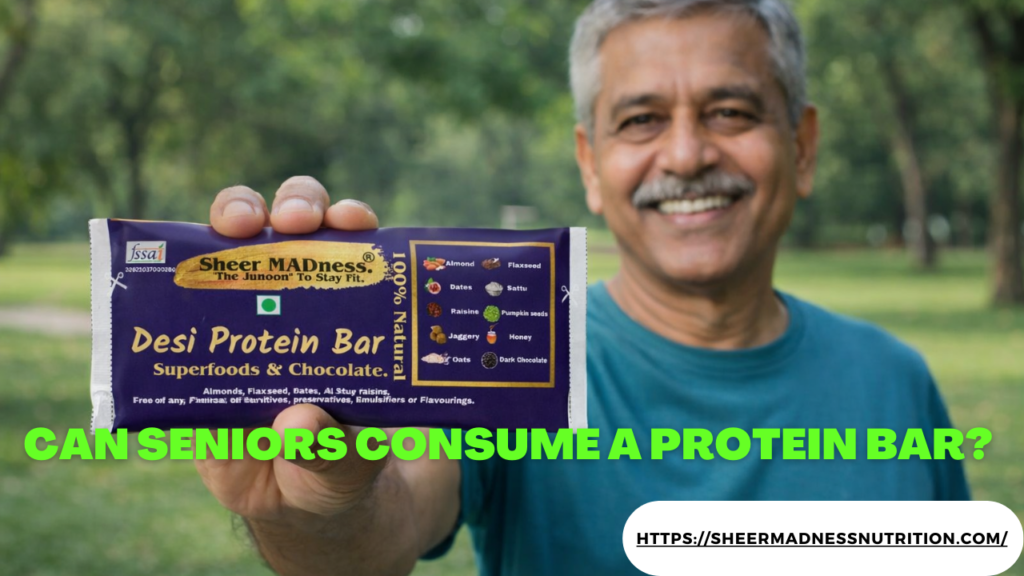
Sheer MADness Protein Bars and Energy Bars address every senior-specific concern through ingredient choices and formulation philosophy.
Every gram of protein in Sheer MADness bars comes from sattu, almonds, oats, flaxseed, pumpkin seeds, and melon seeds. Not one dairy ingredient appears in any Sheer MADness bar.
Sattu specifically — roasted Bengal gram flour — has been consumed by Indian adults across all age groups for centuries without digestive issues. It digests through gentle enzymatic breakdown appropriate for the reduced digestive enzyme production that seniors experience. Its low glycaemic index of 28 to 35 means blood sugar rises gradually — important for seniors managing blood sugar regulation.
Leucine is the essential amino acid most directly responsible for triggering muscle protein synthesis. Research confirms that seniors need higher leucine intake per meal to overcome anabolic resistance and trigger adequate muscle protein synthesis.
Almonds, sattu, and oats all contribute leucine alongside their full amino acid profiles. The combination of these three plant protein sources in one bar provides a leucine contribution that, alongside meals, supports the higher leucine threshold that senior muscle protein synthesis requires.
Furthermore, the natural fats from almonds and flaxseed slow protein digestion — extending the period over which amino acids enter the bloodstream. This extended amino acid availability is specifically beneficial for seniors, whose muscles respond better to slower, sustained amino acid delivery than to the rapid spike from fast-digesting isolates.
Constipation affects approximately 30 to 40 percent of Indian seniors. The causes are multiple — reduced gut motility, reduced physical activity, reduced dietary fibre intake, medication side effects, and reduced fluid intake.
Dietary fibre is the primary intervention for managing age-related constipation. Oat beta-glucan adds bulk to stool and feeds beneficial gut bacteria that support gut motility. Flaxseed mucilage lubricates the gut lining and softens stool. Almond prebiotic fibre feeds Lactobacillus species that support gut transit. Sattu’s natural fibre adds bulk.
Together, the 3 to 5 grams of whole-food fibre per Sheer MADness bar specifically addresses the gut motility challenge that makes constipation so prevalent among Indian seniors. A daily bar actively supports bowel regularity — the opposite of what maltitol-sweetened commercial bars produce.
Diabetes and impaired glucose tolerance are extremely common among Indian seniors. The International Diabetes Federation estimates that India has over 100 million adults with diabetes — predominantly in the older age groups.
Natural sweeteners from dates and jaggery in Sheer MADness bars come packaged with fibre that blunts their glycaemic impact significantly. The bar’s overall glycaemic response is moderated by oat beta-glucan, flaxseed fibre, and almond healthy fats — all working together to slow glucose absorption.
This combination produces a measured, gradual blood glucose rise rather than a spike. For seniors managing blood sugar — whether with medication or through diet — this makes Sheer MADness bars significantly more appropriate than bars sweetened with refined sugar or glucose syrup.
Seniors with diagnosed diabetes should monitor their individual blood sugar response to any new food and consult their doctor for personalised guidance. However, the ingredient profile of Sheer MADness bars is specifically more diabetes-appropriate than most commercial alternatives.
Sheer MADness uses oxygen absorbers rather than BHA, BHT, or any chemical preservative. The physical environment around the food changes. The chemistry of the food never changes.
For seniors whose liver and kidney function is naturally reduced, this means daily bar consumption adds zero synthetic chemical processing burden. The ageing organ systems process only the whole-food ingredients — the same compounds Indian bodies have metabolised comfortably for generations.
Vitamin E from almonds is specifically important for cognitive health in ageing. A 2024 review published in Nutrients on antioxidants and cognitive decline confirmed that Vitamin E intake is associated with reduced risk of age-related cognitive decline. The protective mechanism is Vitamin E’s antioxidant action on brain cell membranes — reducing the oxidative damage that accumulates in neuronal tissue with age.
Furthermore, almonds provide calcium and magnesium for bone density maintenance. Post-menopausal women and older men both face accelerated bone density loss. Calcium and magnesium from almonds — alongside Vitamin D from sunlight — support the bone mineralisation that reduces fracture risk in older adults.
Omega-3 fatty acids from flaxseed specifically reduce the joint inflammation that causes arthritis pain — one of the most common and debilitating conditions in Indian seniors. Research published in the Journal of the American College of Nutrition confirmed that omega-3 supplementation significantly reduces inflammatory markers associated with arthritis.
Furthermore, flaxseed omega-3 supports cardiovascular health — directly relevant to Indian seniors whose cardiovascular risk increases significantly after sixty. The anti-inflammatory action reduces the atherosclerotic plaque progression that cardiovascular disease requires.
Oat beta-glucan is one of the few dietary compounds with an established regulatory-approved health claim for cholesterol reduction. Multiple randomised controlled trials confirm that 3 grams of beta-glucan daily reduces LDL cholesterol by 5 to 10 percent. This is directly relevant to Indian seniors managing cardiovascular risk through diet.
Furthermore, oats provide sustained energy from slow-releasing carbohydrates — preventing the energy dips that affect seniors who eat carbohydrate-dominant meals that spike and crash blood glucose.
Sattu has a traditional Ayurvedic reputation as a cooling, easily digestible food — specifically appropriate for older bodies that experience heat sensitivity, digestive sluggishness, and reduced enzyme production. Modern nutritional science supports these traditional observations. Sattu’s roasting reduces anti-nutritional factors present in raw chickpeas, improving protein digestibility. Its low glycaemic index supports blood sugar management. Its iron content supports haemoglobin production — relevant to anaemia that affects many Indian seniors.
Zinc from pumpkin seeds supports immune function — particularly important for seniors whose immune response weakens with age. Zinc specifically supports T-cell function and the immune surveillance that protects against infections that seniors are disproportionately vulnerable to.
Furthermore, pumpkin seed phytosterols have been studied for their role in reducing benign prostatic hyperplasia symptoms in older men — the urinary frequency and discomfort that many Indian men above sixty experience. This is a benefit unique to this ingredient and specifically relevant to the senior male demographic.
Iron deficiency affects many Indian seniors — particularly women — contributing to the chronic fatigue and reduced cognitive function that many attribute simply to “getting older.” Jaggery provides iron at approximately 11 milligrams per 100 grams alongside potassium and magnesium.
Furthermore, jaggery has a traditional use in Indian households as a post-meal digestive aid — consumed in small amounts after meals to support bowel movement. This traditional use is consistent with its mild molasses content, which supports gut motility in a gentle, food-level way specifically appropriate for seniors managing digestive slowdown.
Dark chocolate provides antioxidant flavonoids — specifically epicatechin — that reduce neuronal oxidative stress. Research published in Frontiers in Nutrition confirmed that dark chocolate flavonoid consumption is associated with improved cognitive function scores in older adults, particularly in working memory and processing speed tasks.
Furthermore, dark chocolate contains tryptophan — the amino acid precursor to serotonin. Declining serotonin production contributes to the mood changes, sleep difficulties, and appetite reduction common in older adults. Daily tryptophan from dark chocolate alongside the magnesium that supports sleep quality provides mild, food-level mood and sleep support through natural mechanisms.
Half to one bar daily is appropriate for most healthy Indian seniors. This contributes 4 to 10 grams of whole-food protein, 1.5 to 5 grams of fibre, and meaningful mineral contribution — without overwhelming daily caloric requirements or protein limits.
Seniors with advanced kidney disease should not add protein from any source without medical guidance. The ESPEN 2023 guidelines specifically note that seniors with chronic kidney disease require individually managed protein intake under nephrologist supervision.
Mid-morning — between 10am and 12pm — is the most beneficial timing for seniors. It bridges the protein gap between breakfast and lunch, provides sustained energy across the mid-morning hours when cognitive function is typically sharpest, and prevents the hunger that drives poor snack choices.
Mid-afternoon — between 3pm and 5pm — provides a second protein distribution point and prevents the energy dip that many seniors experience in the late afternoon.
Post-walk or after light exercise — within 30 minutes — provides protein for muscle recovery from whatever physical activity the senior performs. Even a 30-minute walk causes muscle use that benefits from protein availability during recovery.
When appetite is low — which is common among seniors and is one of the primary drivers of inadequate daily nutrition — a small bar is easier to consume than a full meal. Half a bar alongside a cup of warm milk or chai provides accessible nutrition when a complete meal feels unmanageable.
Sheer MADness bars are soft, chewy, and date-bound — not the hard, crumbly, or brittle texture of many commercial protein bars. Dates and honey act as natural binders creating a texture that most seniors find comfortable to eat without discomfort.
For seniors with very sensitive teeth or dental prosthetics, cutting the bar into smaller pieces before eating makes consumption easier. The bar can also be briefly warmed — 10 to 15 seconds in a microwave — which softens it further if needed.
Seniors on blood thinners, thyroid medication, diabetes medication, or kidney disease management should discuss adding any new daily food with their doctor. This is not a concern specific to Sheer MADness bars — it applies to any dietary addition when managing multiple medications.
The specific caution for seniors on levothyroxine: calcium-containing foods can reduce levothyroxine absorption. Consume a Sheer MADness bar at least two hours after morning thyroid medication to avoid any potential absorption interaction.
This section addresses a practical reality — most protein bar purchases for seniors are made by their adult children.
The questions to ask are simple. Is every ingredient a recognisable food? Does the label contain any INS codes? What is the shelf life, and how is it achieved? Does the bar contain any dairy protein — relevant if the parent is lactose intolerant?
Since 2021, Sheer MADness displays every ingredient with its own image on the front of every pack. A family member can look at the front of a Sheer MADness pack and see oats, almonds, sattu, flaxseed, pumpkin seeds, melon seeds, dates, raisins, jaggery, honey, and dark chocolate — the complete ingredient list, transparently displayed, before the pack is even opened.
No INS code hides anything. Nor any synthetic preservative that requires decoding. No chemical name requires a chemistry degree. This transparency is the most important trust signal for families choosing daily nutrition for elderly parents.
Sheer MADness holds a registered trademark under the Government of India. The Natural Plant Protein formula is patent published under Patent No. 202331036733, searchable on Intellectual Property India. The brand holds a valid FSSAI licence and GSTIN registration.
| Feature | Sheer MADness | Typical Commercial Bar |
|---|---|---|
| Protein source | Sattu, almonds, oats — dairy-free whole food | Whey protein concentrate — dairy, lactose risk |
| Protein per bar | 8 to 10g — appropriate for senior kidney capacity | 15 to 25g — concentrated nitrogen load |
| Lactose | Zero — completely dairy-free | Present in whey concentrate |
| Fibre | 3 to 5g — supports senior gut motility | Often 1 to 2g, sometimes isolated inulin |
| Sweetener | Dates, jaggery, honey, raisins — natural | Maltitol, sucralose — fermentation and gut disruption |
| Constipation risk | Zero — whole-food fibre actively supports regularity | High — maltitol worsens constipation |
| Chemical preservatives | None — oxygen absorbers | BHA, BHT — liver processing load |
| Artificial sweeteners | None | Sucralose, maltitol — gut microbiome disruption |
| Texture for seniors | Soft, chewy, date-bound | Often hard, crumbly, or brittle |
| Blood sugar impact | Low GI — oat buffered, sattu based | Variable — often high GI sweeteners |
| Kidney load | Low — moderate whole-food protein | Higher — concentrated isolate nitrogen |
| Ingredient transparency | Every ingredient on front label since 2021 | INS codes in small print on back |
| Price per bar | ₹60 | ₹80 to ₹150 |
Can seniors consume protein bars safely?
Yes — whole-food protein bars built from oats, almonds, sattu, flaxseed, dates, and jaggery are safe and beneficial for healthy seniors. They support muscle preservation through daily protein distribution, gut health through whole-food fibre, bone density through calcium and magnesium from almonds, and cognitive health through Vitamin E and antioxidant flavonoids from dark chocolate.
How much protein do seniors need?
The ESPEN 2023 guidelines recommend a minimum of 1.2 grams of protein per kilogram of body weight daily for healthy older adults — rising to 1.5 grams for seniors with illness or malnutrition. This is significantly higher than the 0.8 grams recommended for younger adults — specifically because ageing causes anabolic resistance that reduces muscle protein synthesis efficiency per gram of dietary protein.
Are protein bars safe for seniors with diabetes?
Whole-food bars with low-GI protein from sattu (GI 28 to 35), oat beta-glucan, and natural sweeteners packaged with fibre produce a measured, gradual blood glucose response. Seniors with diagnosed diabetes should monitor their individual blood sugar response and consult their doctor for personalised guidance.
Are protein bars safe for seniors with kidney disease?
Seniors with diagnosed chronic kidney disease should not add any protein supplement — bar or powder — without guidance from their nephrologist. Protein requirements and limits are individually managed in kidney disease. For healthy seniors without kidney disease, the 8 to 10 grams of whole-food protein per Sheer MADness bar is within appropriate daily protein snack range.
Commercial bars with maltitol and sorbitol worsen constipation significantly in seniors. Sheer MADness bars contain no sugar alcohols. Their 3 to 5 grams of whole-food fibre from oats, flaxseed, almonds, and sattu actively supports bowel regularity — the opposite effect.
How many protein bars should a senior eat daily?
Half to one bar daily is appropriate for most healthy seniors consuming adequate protein from meals. One bar daily split across morning and afternoon — half bar mid-morning, half bar mid-afternoon — provides sustained protein distribution while remaining within appropriate daily limits.
Are Sheer MADness bars easy to chew for seniors?
Yes. Sheer MADness bars are soft and chewy — bound with dates and honey rather than pressed hard or baked to crispness. For seniors with dental sensitivity, cutting the bar into smaller pieces or briefly warming it makes consumption comfortable.
Which Sheer MADness bar is best for seniors?
The Protein Bar suits seniors prioritising muscle preservation and satiety from higher protein content. The Energy Bar suits seniors who walk, practise yoga, or do light exercise and need balanced energy alongside protein. The Millet Bar suits seniors who want to incorporate traditional Indian grains — jowar and bajra — alongside their regular diet for gut health and micronutrient variety.
Seniors can and should consume protein bars — specifically whole-food bars that deliver protein alongside fibre, minerals, and antioxidants in forms that ageing digestive systems handle comfortably.
The case for protein bars for seniors is not about fitness culture or muscle building as younger adults understand it. It is about maintaining functional strength, preventing falls, preserving cognitive function, supporting gut health, and providing accessible daily nutrition at a life stage when appetite, cooking capacity, and dietary diversity all naturally decline.
Sheer MADness bars deliver dairy-free whole-food protein from sattu and almonds — appropriate for the anabolic resistance of ageing and gentle on reduced kidney capacity. They deliver whole-food fibre that specifically supports the gut motility challenge of senior digestive health. These bars also deliver calcium, magnesium, and Vitamin E for bone and brain protection. They deliver iron from jaggery for energy and haemoglobin support. They deliver omega-3 from flaxseed for joint and cardiovascular health. And they deliver all of this with zero chemical preservatives, zero artificial sweeteners, and zero synthetic additives that ageing liver and kidney systems would need to process.
At ₹60 per bar — affordable for most Indian families and seniors — this is genuinely the most nutritionally appropriate daily protein bar option available for Indian seniors today.
I would also request you to kindly read my previous post about “Healthiest Protein Bar in India“.
a) Everyone is an individual, so what suits me may not suit the next person.
b) If a person has a medical condition, a doctor’s advice and prescribed medication will only help. Seniors with multiple medical conditions, kidney disease, or complex medication regimens should discuss any dietary addition with their doctor before beginning.
c) While buying any protein bar from the market, read the labels carefully. Watch out for INS 320 (BHA), INS 321 (BHT), INS 551 (silicon dioxide), maltitol, sorbitol, sucralose, whey protein concentrate, and other chemicals that quietly appear on most commercial labels — and that ageing organ systems are less equipped to manage.
If you are interested in buying chemical-free Natural Plant Protein Moringa, Health Drinks for Kids, or our delicious chemical-free Energy Bars, Protein Bars, and Millet Bars, shop at Sheer MADness.
You can also find us on Flipkart, Jio Mart, or ONDC in India.
d) Exercise is the key to fitness. Exercise and nutrition are two sides of the same coin and always go hand in hand.
e) Excess of anything is wrong, even the best whole-food snack. Consume only recommended quantities.
f) Rome was not built in a day. Discipline and consistency are the only keys to lasting health.
g) It is not only exercise and protein that builds health. A healthy gut, macro and micronutrients, body type, rest, and lifestyle all matter. Of all these, exercise and nutrition are within our control. Focus on these two primary aspects first.
h) The most important part of fitness is that nothing is better than exercise and a balanced meal.
Article by Chef Ashutosh Awasthi
Disclaimer: Our products are a source of HEALTHY NUTRIENTS and are COMPLETELY FREE OF ANY ADDED CHEMICALS. We do not claim to cure any medical condition. The content provided is informational. We do not claim to diagnose or treat a person with any specific medical condition.