
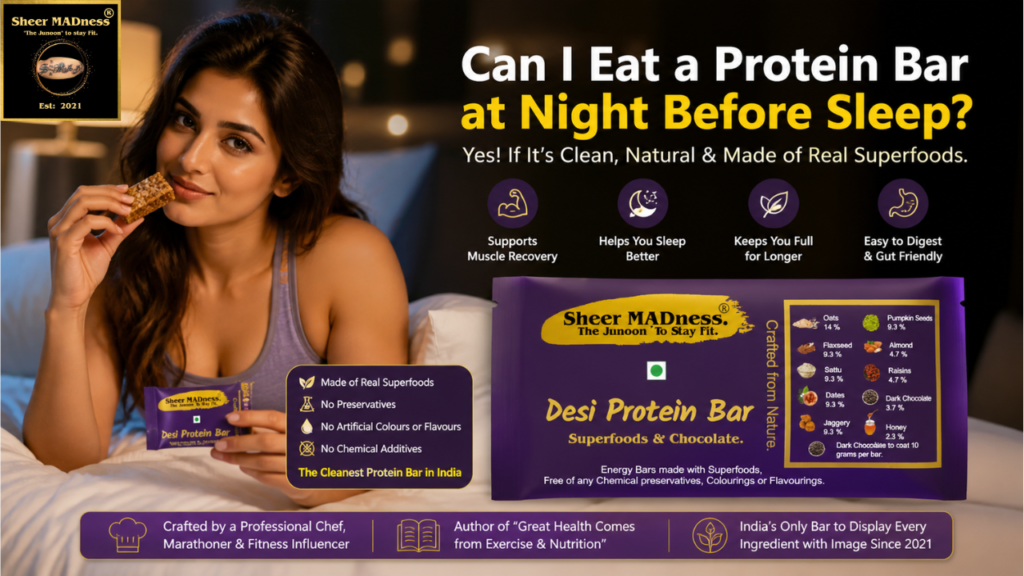
Direct answer: Yes — eating a protein bar at night is beneficial when the bar is built from whole foods. Pre-sleep protein supports overnight muscle repair, reduces late-night craving-driven poor food choices, and — if the bar contains magnesium from almonds and dark chocolate — actively improves sleep quality.
However, eating a commercial bar containing maltitol, artificial sweeteners, and chemical preservatives at night is worse than eating nothing. These compounds cause gut fermentation during sleep, disrupt gut-hormone signalling, and add synthetic chemical processing load to a body trying to rest and repair.
The bar determines whether eating at night helps or harms you.
I’m Chef Ashutosh Awasthi, founder of Sheer MADness, professional chef, marathon runner, and author of Great Health Comes from Exercise & Nutrition. I train for marathons. Night recovery nutrition is not abstract for me — it is a practical daily decision. Let me explain the sleep science clearly and tell you exactly what happens when you eat a protein bar at night.
Sleep is not passive rest. The body runs an intensive repair programme during the night.
Growth hormone secretion peaks during the first two to three hours of deep sleep — specifically during slow-wave sleep. This growth hormone pulse drives muscle protein synthesis, fat mobilisation, and tissue repair throughout the body.
A 2015 landmark study published in the Journal of Nutrition by Res and colleagues confirmed that protein consumed before sleep increases overnight muscle protein synthesis significantly. The study gave athletes 40 grams of casein protein before sleep and found a 22 percent increase in overnight muscle protein synthesis compared to a placebo.
A 2022 meta-analysis published in the British Journal of Nutrition analysed 13 studies on pre-sleep protein consumption. The analysis confirmed that pre-sleep protein consistently improved muscle protein synthesis rates overnight — with effects across both resistance-trained individuals and sedentary adults.
The research is clear. The body specifically uses dietary amino acids during the overnight repair period. Providing protein before sleep gives the body material to work with during its most intensive repair window.
However, the form of protein matters significantly. Casein protein digests slowly over six to eight hours — the original basis of the pre-sleep protein research. Whole-food plant protein from sattu, almonds, and oats also digests slowly compared to fast-digesting whey isolate. This slower digestion rate is specifically beneficial pre-sleep — amino acids enter the bloodstream gradually throughout the night rather than in a single rapid spike.
This is the section most protein bar content completely ignores — and it is the most relevant for nighttime consumption.
Magnesium is one of the most important minerals for sleep quality. It activates the parasympathetic nervous system — the “rest and digest” system that opposes the stress response. Specifically, magnesium supports GABA (gamma-aminobutyric acid) receptor activity. GABA is the primary inhibitory neurotransmitter in the brain. It reduces neuronal excitability and promotes the calm, relaxed state that precedes sleep.
A 2023 systematic review published in the BMC Psychiatry analysed magnesium’s effects on sleep quality across multiple randomised controlled trials. The review found that magnesium supplementation significantly improved sleep efficiency, sleep duration, sleep onset latency, and early morning awakening — particularly in adults with baseline magnesium insufficiency.
This matters specifically for Indian adults. The ICMR-NIN 2024 data shows that magnesium insufficiency is common in India — particularly among people whose diets rely heavily on processed grains with reduced magnesium content compared to whole grains.
Almonds in Sheer MADness bars provide 270 milligrams of magnesium per 100 grams. Dark chocolate adds additional magnesium. Oats contribute further. Together, these three whole-food sources deliver meaningful magnesium in one bar — specifically supporting the GABA receptor activity that promotes sleep quality.
A protein bar at night that contains this magnesium profile from whole-food sources is not just a protein source. It is a mild, food-level sleep support intervention.
Dark chocolate contains tryptophan — an amino acid that converts to serotonin and then to melatonin in the brain. Melatonin is the hormone that regulates sleep-wake cycles. Its production begins in the evening and peaks during the night.
Furthermore, dark chocolate provides theobromine — a mild stimulant related to caffeine, but slower-acting and lower in intensity. The theobromine in one Sheer MADness bar at reasonable timing (60 to 90 minutes before bed, not immediately before sleep) does not cause sleep disruption in most people. However, consuming the bar very close to bedtime — within 30 minutes — may cause mild alertness in caffeine-sensitive individuals.
The safe and beneficial window for a Sheer MADness bar at night is 60 to 90 minutes before your intended sleep time. This allows partial digestion, tryptophan conversion to begin, and the theobromine to clear mild stimulant activity before you lie down.
Oats contain complex carbohydrates that specifically support tryptophan uptake in the brain.
Tryptophan competes with other amino acids to cross the blood-brain barrier. When carbohydrates are consumed, insulin removes competing amino acids from the bloodstream. This leaves tryptophan — which insulin does not affect — with less competition to cross into the brain. More tryptophan enters the brain. More serotonin and melatonin are produced.
This carbohydrate-tryptophan-serotonin pathway is one of the mechanisms behind the common experience of feeling calm and sleepy after a carbohydrate-containing evening meal. Oats specifically support this pathway because their low-to-moderate glycaemic index from beta-glucan fibre produces a gentle, steady insulin response rather than a spike.
A protein bar at night containing oats therefore supports the serotonin pathway that leads to melatonin production and better sleep onset — through whole-food mechanisms that require no supplement or pharmaceutical intervention.
This is the section that explains why ingredient quality matters specifically more at night than during the day.
Maltitol in commercial bars ferments in the large intestine. This fermentation produces gas and causes abdominal discomfort. During the day, gut motility and movement mask some of this discomfort. During sleep, when the body is still and gut motility slows, this fermentation-induced gas accumulates.
Many people who eat a commercial bar before bed and then experience disturbed sleep, abdominal bloating on waking, or interrupted rest attribute the problem to “eating too late.” The real cause is often the maltitol in the bar they chose.
Sheer MADness bars contain no sugar alcohols. No fermentation occurs overnight. The gut stays calm during sleep.
Research published in Microbiome confirmed that sucralose and aspartame alter gut microbiome composition. The gut-brain axis — the bidirectional communication between gut bacteria and the brain — plays a significant role in sleep regulation through the production of neurotransmitters including serotonin. Over 90 percent of the body’s serotonin is produced in the gut.
Daily artificial sweetener consumption disrupts the gut bacteria that participate in this serotonin production pathway. For nighttime consumption specifically, this gut-brain disruption is most relevant — the overnight period when gut bacteria are most active and when serotonin-to-melatonin conversion is most important.
BHA and BHT are processed by the liver as xenobiotics — foreign chemical compounds. Liver activity during sleep focuses on metabolic housekeeping — detoxification, glycogen processing, and hormone regulation. Adding synthetic preservative processing to this overnight load is unnecessary when oxygen absorbers achieve the same shelf-life purpose without any chemistry entering the food.
For nightly bar consumers, this accumulated daily liver processing load from chemical preservatives is a meaningful reason to choose a preservative-free bar.
Refined sugar and high-GI sweeteners in commercial bars cause a blood glucose spike followed by a crash. During the day, physical activity and hormonal response moderate this cycle. During sleep, the body cannot moderate it as effectively.
A blood sugar crash during sleep can trigger cortisol release — the stress hormone that activates the hypothalamic-pituitary-adrenal axis to raise blood glucose. This cortisol release disrupts sleep architecture, reduces the quality of deep slow-wave sleep, and leaves people feeling unrestored in the morning.
Natural sweeteners from dates and jaggery in Sheer MADness bars produce a moderate, fibre-buffered glucose response. Blood sugar rises gently and stays stable. No overnight cortisol disruption occurs.
Sheer MADness Protein Bars address every nighttime-specific concern. Let me explain ingredient by ingredient.
Sattu provides 20 to 22 grams of protein per 100 grams with a glycaemic index of just 28 to 35. It digests slowly — releasing amino acids gradually over several hours rather than in a rapid spike.
This slow digestion profile matches exactly what pre-sleep protein research identifies as beneficial. The body receives a steady supply of amino acids throughout the overnight repair window — not a single front-loaded dose that clears before peak growth hormone activity.
Almonds provide magnesium that supports GABA receptor activity and sleep quality. They provide Vitamin E that protects muscle cell membranes from overnight oxidative damage during the repair process. Their healthy monounsaturated fats digest slowly — contributing to the satiety that prevents mid-night hunger.
Omega-3 fatty acids from flaxseed reduce the inflammatory cytokines — TNF-α and IL-6 — most associated with post-exercise muscle soreness. During sleep, this anti-inflammatory action supports the recovery process that growth hormone drives. A daily bar containing flaxseed provides cumulative overnight anti-inflammatory support that compounds beneficially across a training week.
As explained above, oat complex carbohydrates support tryptophan’s passage into the brain through the carbohydrate-insulin-tryptophan pathway. Their low-to-moderate GI from beta-glucan prevents the blood sugar crash that triggers overnight cortisol release.
Natural sugars from dates and raisins replenish any glycogen deficit from the day’s activity — providing the liver with sufficient glycogen to maintain stable blood glucose overnight without requiring cortisol-driven gluconeogenesis.
The fibre in dates slows natural sugar absorption. Blood glucose stays stable. The overnight metabolic environment remains calm and conducive to repair.
Dark chocolate contributes tryptophan for melatonin pathway support. It adds magnesium alongside almonds and oats. Its antioxidant flavonoids — specifically epicatechin — reduce oxidative stress in muscle tissue during the overnight repair window.
Iron from jaggery supports haemoglobin’s capacity to deliver oxygen to repairing tissue overnight. Trace minerals from jaggery — potassium, calcium, magnesium — support the enzymatic metabolic processes that run during sleep.
Timing the bar correctly makes a meaningful difference for sleep quality.
Eating the bar 60 to 90 minutes before sleep allows initial digestion. The stomach empties partially. Lying down on a full stomach is uncomfortable and increases acid reflux risk — the 60 to 90-minute gap reduces this risk significantly.
The natural sugars from dates and raisins absorb within this window. Blood glucose reaches a stable level before sleep onset. The tryptophan from dark chocolate and oats begins converting to serotonin. The magnesium from almonds begins supporting parasympathetic nervous system activity.
By the time you sleep, the bar is partially digested, blood sugar is stable, and the magnesium and tryptophan are at work.
Eating within 15 to 20 minutes of lying down increases the risk of acid reflux as lying horizontal brings stomach contents closer to the lower oesophageal sphincter. Furthermore, a full stomach when lying down creates physical discomfort that delays sleep onset.
A protein bar is a pre-sleep snack — approximately 180 to 200 kilocalories. It replaces the late-night junk food craving that many people experience. It is not an additional meal on top of a full dinner. For people who eat a complete dinner and are genuinely not hungry, adding a bar nightly adds unnecessary calories without meaningful additional benefit.
The bar works best for people who either ate dinner early and experience genuine hunger before sleep, trained in the evening and need post-workout recovery nutrition, or regularly experience late-night snack cravings that drive poor food choices.

Evening training leaves the body depleted when dinnertime arrives. Dinner alone may not provide adequate recovery nutrition. One bar within the 60 to 90-minute pre-sleep window adds the protein and mineral support that overnight muscle repair requires.
As a marathon runner myself, I understand night recovery nutrition at a practical level. Heavy training days deplete glycogen, damage muscle fibres, and elevate inflammatory markers. The overnight window is the most important single recovery period in the training cycle.
A pre-sleep bar with slow-digesting sattu protein, anti-inflammatory flaxseed omega-3, glycogen-restoring dates and oats, and magnesium from almonds specifically serves this recovery need.
Many Indian households eat dinner before 7pm. For people sleeping at 10pm to 11pm, a 7pm dinner leaves a four-hour gap before sleep. Genuine hunger develops. The wrong response is chips, biscuits, or a sugary dessert. The right response is a whole-food bar that provides protein for overnight synthesis and magnesium for sleep quality.
A protein bar before bed prevents the late-night snack binge that many people managing weight experience. Protein and fibre together — from sattu, almonds, oats, and flaxseed — produce satiety that biscuits and chips never provide.
A 200-calorie whole-food bar that prevents a 600-calorie late-night binge is a net calorie deficit, not an addition. This is the logical framework within which pre-sleep protein bar consumption supports weight management.
The magnesium from almonds and dark chocolate, the tryptophan from dark chocolate and oats, and the blood-sugar-stabilising effect of the whole-food carbohydrate combination all support sleep quality through food-level mechanisms.
For people experiencing difficulty sleeping, improving dietary magnesium intake from whole foods is among the most evidence-based non-pharmaceutical interventions. A nightly Sheer MADness bar contributes meaningfully to daily magnesium intake from three separate whole-food sources.
Do not eat the bar immediately before lying down. Give at least 60 minutes for initial digestion.
Do not use the bar as an additional meal. It replaces a poor snack choice or bridges a genuine pre-sleep hunger gap.
Do not choose commercial bars with maltitol, sucralose, or BHT for nighttime consumption. The gut fermentation, microbiome disruption, and liver processing load are specifically worse during sleep than during the day.
Do not exceed one bar nightly. One bar provides the nutritional support needed without pushing total daily calorie intake beyond requirements.
Since 2021, Sheer MADness displays every ingredient with its own image on the front of every pack. When you eat a bar 60 minutes before sleep, you know exactly what your body receives during the most important repair period of the day.
Oats for tryptophan and stable glucose. Almonds for magnesium and sleep quality. Sattu for slow-digesting overnight protein. Flaxseed for anti-inflammatory overnight recovery. Dark chocolate for tryptophan and antioxidants. Dates and jaggery for iron and stable blood sugar. Pumpkin seeds for zinc and immune support.
No INS code. No chemical preservatives or synthetic sweeteners. Every ingredient is a whole food your body processes as food — not chemistry — during sleep.
Sheer MADness holds a registered trademark under the Government of India. The Natural Plant Protein formula is patent published under Patent No. 202331036733, searchable on Intellectual Property India. The brand holds a valid FSSAI licence and GSTIN registration.
| Consideration | Day Consumption | Night Consumption |
|---|---|---|
| Key purpose | Energy and satiety | Overnight recovery and sleep support |
| Best protein type | Both fast and slow | Slow-digesting whole-food protein — sattu, almonds |
| Magnesium importance | Moderate | High — supports sleep quality |
| Tryptophan importance | Low | High — supports melatonin production |
| Blood sugar stability | Important | Critical — unstable blood sugar disrupts sleep |
| Gut fermentation risk | Uncomfortable | Disrupts sleep specifically |
| BHT processing burden | Liver handles daily | Overnight liver has competing metabolic demands |
| Ideal timing | Flexible | 60 to 90 minutes before sleep |
| Recommended variant | Any | Protein Bar — higher protein, magnesium from almonds |
Can I eat a protein bar at night?
Yes — specifically a whole-food bar at least 60 minutes before sleep. Pre-sleep protein supports overnight muscle repair. The magnesium in almonds supports GABA receptor activity and sleep quality. Avoid commercial bars with maltitol, sucralose, or chemical preservatives — these cause gut fermentation and liver processing load that specifically worsen overnight.
Will eating a protein bar at night cause weight gain?
No — if the bar is consumed in place of a higher-calorie late-night snack rather than in addition to a full dinner. Protein and fibre in a whole-food bar produce genuine satiety. One bar at night often prevents the binge-snacking that adds far more calories than the bar itself contains.
How close to bedtime can I eat a protein bar?
Eat the bar at least 60 minutes before your intended sleep time. This allows initial digestion, reduces acid reflux risk, and allows the tryptophan and magnesium to begin their sleep-supportive activity before you lie down.
Does eating a protein bar at night help muscle recovery?
Yes. Research published in the British Journal of Nutrition confirmed that pre-sleep protein consumption consistently improves overnight muscle protein synthesis. Slow-digesting plant protein from sattu and almonds provides amino acids throughout the night — aligned with the growth hormone pulse during deep sleep.
Why does eating a commercial protein bar at night cause bloating?
Commercial bars sweetened with maltitol or sorbitol ferment in the large intestine. During sleep, when gut motility slows and the body is still, this fermentation produces gas that accumulates rather than dispersing. The result is bloating and discomfort on waking. Sheer MADness bars contain no sugar alcohols — zero fermentation occurs.
Does dark chocolate in a protein bar keep you awake?
The theobromine in dark chocolate is a mild stimulant. In the amounts present in one Sheer MADness bar, consumed 60 to 90 minutes before sleep, most people experience no sleep disruption. However, people with high caffeine sensitivity may prefer to eat the bar 90 minutes before sleep rather than 60 minutes. Do not eat the bar immediately before lying down.
Are Sheer MADness bars good for overnight recovery?
Yes specifically. The combination of slow-digesting sattu protein, anti-inflammatory flaxseed omega-3, magnesium from almonds for sleep quality, tryptophan from dark chocolate and oats for melatonin support, and stable blood glucose from natural sweeteners creates a nutritional profile specifically supportive of overnight recovery — from both training and daily physical and cognitive demands.
Can I eat a protein bar at night for weight loss?
Yes — when it replaces higher-calorie late-night snack choices. Protein and fibre produce satiety that prevents binge eating. Natural sweeteners satisfy sweet cravings without refined sugar. One bar at night within a calorie-appropriate diet supports weight loss rather than undermining it.
Eating a protein bar at night is a genuinely good idea — when the bar is built from the right ingredients.
The right ingredients for nighttime are: slow-digesting plant protein from sattu and almonds for overnight muscle repair, magnesium from almonds, oats, and dark chocolate for sleep quality through GABA receptor support, tryptophan from dark chocolate and oats for melatonin pathway support, stable blood glucose from natural low-GI sweeteners to prevent overnight cortisol disruption, and anti-inflammatory omega-3 from flaxseed for overnight tissue repair.
Sheer MADness bars deliver all of these from whole-food sources at ₹60 per bar — consumed 60 to 90 minutes before sleep.
They deliver zero maltitol fermentation, zero artificial sweetener microbiome disruption, zero BHT liver processing burden, and zero blood sugar spike that triggers overnight cortisol release.
Since 2021, every ingredient is on the front of the pack where you can see it. What enters your body during its most important repair period is exactly what those ten whole-food ingredients provide. Nothing more. Nothing synthetic.
I would also request you to kindly read my previous post about “Healthiest Protein Bar in India“.
a) Everyone is an individual, so what suits me may not suit the next person.
b) If a person has a medical condition, a doctor’s advice and prescribed medication will only help.
c) While buying any protein bar from the market, read the labels carefully. Watch out for INS 320 (BHA), INS 321 (BHT), INS 551 (silicon dioxide), maltitol, sorbitol, sucralose, and other lab-made chemicals that quietly appear on most commercial labels.
If you are interested in buying chemical-free Natural Plant Protein Moringa, Health Drinks for Kids, or our delicious chemical-free Energy Bars, Protein Bars, and Millet Bars, shop at Sheer MADness.
You can also find us on Flipkart, Jio Mart, or ONDC in India.
d) Exercise is the key to fitness. Exercise and nutrition are two sides of the same coin and always go hand in hand.
e) Excess of anything is wrong, even the best whole-food snack. Consume only recommended quantities.
f) Rome was not built in a day. Discipline and consistency are the only keys to lasting health.
g) It is not only exercise and protein that builds health. A healthy gut, macro and micronutrients, body type, rest, and lifestyle all matter. Of all these, exercise and nutrition are within our control. Focus on these two primary aspects first.
h) The most important part of fitness is that nothing is better than exercise and a balanced meal.
Article by Chef Ashutosh Awasthi
Disclaimer: Our products are a source of HEALTHY NUTRIENTS and are COMPLETELY FREE OF ANY ADDED CHEMICALS. We do not claim to cure any medical condition. The content provided is informational. We do not claim to diagnose or treat a person with any specific medical condition.