
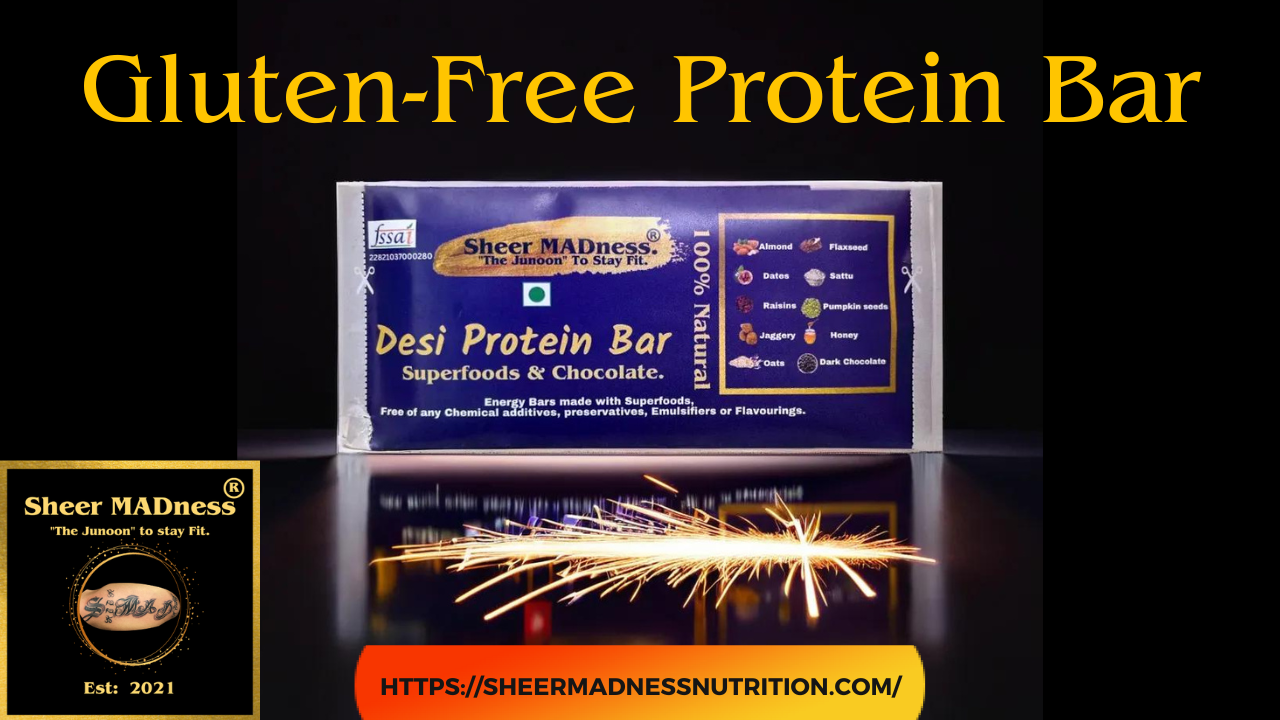
Direct answer: The best gluten-free protein bar in India is built from naturally gluten-free whole foods — sattu, almonds, flaxseed, pumpkin seeds, melon seeds, dates, raisins, jaggery, honey, and dark chocolate — with no wheat, no barley, no rye, and no hidden gluten-containing additives. Sheer MADness Protein Bars, Energy Bars, and Millet Bars contain no gluten-containing ingredient in their formulation.
There is one important nuance every Indian gluten-free consumer should know. Oats are naturally gluten-free — but oats grown, transported, and milled in India are frequently processed on shared equipment with wheat, creating cross-contamination risk for celiac patients. Sheer MADness bars contain oats. For people with non-celiac gluten sensitivity and those simply reducing gluten for wellness reasons, the bars are appropriate. For people with diagnosed celiac disease who are highly sensitive to trace cross-contamination, please read the oat cross-contamination section below carefully and consult your gastroenterologist.
I’m Chef Ashutosh Awasthi, founder of Sheer MADness, professional chef, marathon runner, and author of Great Health Comes from Exercise & Nutrition. I formulate every product with complete ingredient transparency. Let me give you the honest, complete guide to gluten-free protein bars in India.
The Indian gluten-free market serves several distinct populations — each with different sensitivity levels and different practical requirements.
Celiac disease is an autoimmune condition where gluten ingestion triggers immune damage to the small intestinal lining. Even trace amounts — as low as 10 to 20 milligrams of gluten per day — can trigger intestinal damage in highly sensitive celiac patients.
Celiac disease was historically considered rare in India but research has substantially revised this view. A 2015 study published in the American Journal of Gastroenterology estimated celiac disease prevalence in India at approximately 1 percent of the population — suggesting approximately 14 million Indians may have the condition, many of them undiagnosed. The Indian subcontinent has the second-highest prevalence of the HLA-DQ2 gene variant that predisposes individuals to celiac disease.
For celiac patients, gluten-free food selection requires strict attention not just to ingredients but to manufacturing processes, shared equipment, and supply chain contamination. A food made entirely from gluten-free ingredients can still cause celiac reactions if it was processed on shared equipment with wheat-containing products.
Non-celiac gluten sensitivity describes people who experience symptoms similar to celiac disease — bloating, brain fog, fatigue, digestive discomfort — when consuming gluten, but who test negative for celiac disease and wheat allergy.
This group is significantly larger than the celiac population. These individuals need to reduce or eliminate gluten for symptom management but can typically tolerate trace cross-contamination at levels that would trigger celiac patients. For non-celiac gluten-sensitive individuals, bars made from naturally gluten-free ingredients are appropriate.
Wheat allergy is an IgE-mediated immune response to wheat proteins — a different mechanism from celiac disease. Wheat-allergic individuals react to all wheat proteins, not specifically to gluten. For wheat allergy, avoiding wheat in any form is essential.
Many Indian consumers choose gluten-free eating as a wellness approach without having celiac disease, gluten sensitivity, or wheat allergy. For this group, naturally gluten-free bars are appropriate without the strict cross-contamination concerns of medically necessary avoidance.
This is the most important and most honest section of this post — and the one most gluten-free bar content in India completely ignores.
Oats are botanically gluten-free. Oats do not contain wheat, barley, or rye. The protein in oats — avenin — is different from gluten and is tolerated by most celiac patients.
However, oats are frequently contaminated with gluten through shared growing fields, shared transport, shared storage facilities, and shared milling equipment. In India specifically, oats and wheat are often processed in the same facilities — making certified “gluten-free oats” (processed on dedicated equipment) rare and expensive.
Research published in the Journal of the Canadian Dietetic Association found that standard commercial oats showed gluten contamination in a significant proportion of tested samples. The 20 parts per million (ppm) threshold — the Codex Alimentarius standard for gluten-free labelling — was exceeded in many commercially available oat products.
For Indian celiac patients, this is the most practically important piece of gluten information available. A bar made from oats grown and processed in India cannot guarantee gluten-free status at the trace contamination level that highly sensitive celiac patients require — unless the oats are specifically certified as gluten-free from dedicated equipment.
Sheer MADness bars contain oats. We are transparent about this because honesty serves our customers better than a blanket “gluten-free” claim that ignores this nuance.
For people with celiac disease: Consult your gastroenterologist about oat tolerance. Some celiac patients tolerate pure uncontaminated oats well — a condition called “oat-tolerant celiac.” Others react to avenin itself, independent of wheat contamination. Individual assessment is essential.
For people with non-celiac gluten sensitivity, wheat allergy without oat allergy, and wellness-based gluten reduction: Sheer MADness bars are appropriate — every other ingredient is naturally gluten-free, and the oat content is from natural whole rolled oats without wheat-derived additives.
Understanding the two distinct requirements — ingredient formulation and manufacturing process — helps evaluate any bar’s gluten-free claim.
The primary requirement is that every ingredient in the bar is free of wheat, barley, rye, and their derivatives. Obvious gluten sources — wheat protein, wheat starch, wheat flour, barley malt, rye flour — are straightforward to identify. Hidden gluten sources require more careful label reading.
Hidden gluten sources in commercial protein bars to watch for:
Malt extract or malt flavouring — derived from barley and contains gluten. This appears in some commercial bars as a flavour enhancer.
Glucose syrup from wheat — while highly processed glucose syrup may contain very low levels of wheat protein, strict celiac guidelines recommend avoiding wheat-derived glucose syrup.
Soy sauce or flavourings derived from wheat — appears in some flavoured protein bars as part of artificial flavour systems.
Modified starch — often derived from wheat unless specifically stated otherwise.
Oats without a gluten-free certification — as discussed above, the primary oat cross-contamination concern.
Thickeners and stabilisers from wheat derivatives — maltodextrin from wheat and wheat-derived thickeners occasionally appear in processed bars.
For celiac disease specifically, a bar made from gluten-free ingredients can still cause reactions if manufactured on shared equipment with wheat-containing products. This is why certified gluten-free labelling — which requires testing at under 20ppm gluten — differs from “gluten-free ingredients” formulation.
Sheer MADness bars are formulated from naturally gluten-free ingredients. However, we do not carry a third-party celiac certification specifically certifying under-20ppm gluten at the manufacturing level. For highly sensitive celiac patients, this is the relevant information to discuss with their gastroenterologist.
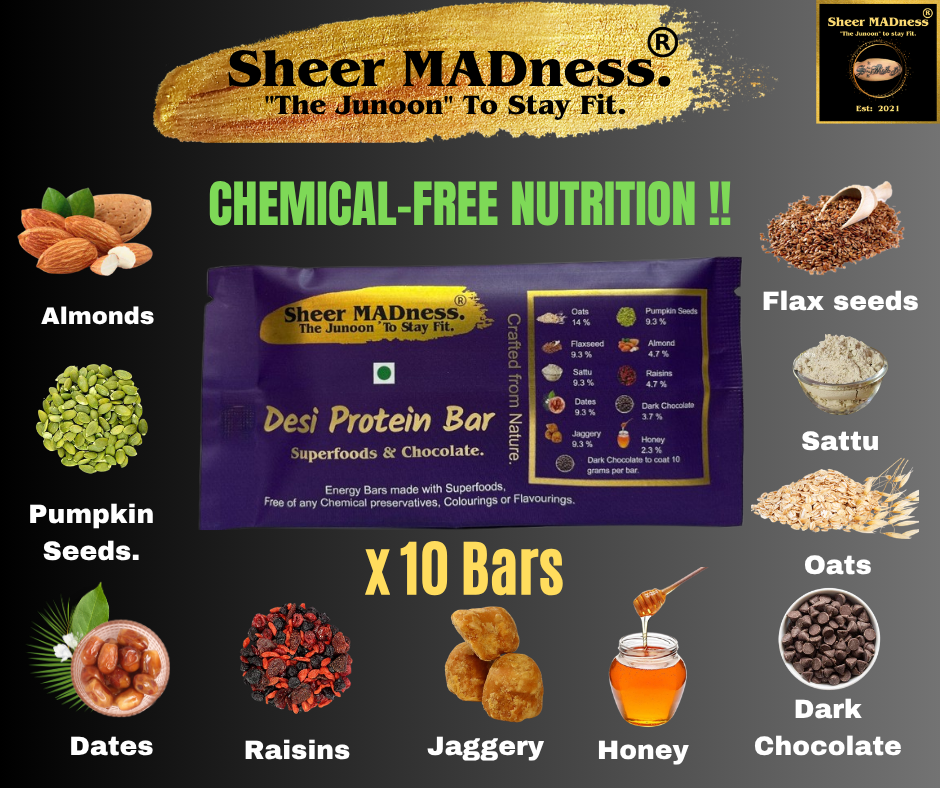
Let me go through every ingredient specifically from a gluten perspective.
Sattu — roasted Bengal gram flour from chickpeas. Chickpeas are naturally gluten-free. Sattu contains no wheat, barley, or rye protein. Naturally gluten-free.
Almonds — tree nuts. Naturally gluten-free. No gluten-containing protein present.
Flaxseed — seeds from the flax plant. Naturally gluten-free. No gluten protein present.
Pumpkin seeds — seeds from the pumpkin. Naturally gluten-free.
Melon seeds — seeds from melon. Naturally gluten-free.
Dates — fruit. Naturally gluten-free.
Raisins — dried grapes. Naturally gluten-free.
Jaggery — unrefined cane sugar. Naturally gluten-free.
Honey — naturally gluten-free.
Dark chocolate — pure dark chocolate from cacao without wheat additives. Naturally gluten-free. Note: some commercial chocolate contains wheat-derived emulsifiers — Sheer MADness uses pure dark chocolate without such additives.
Oats — naturally gluten-free as a botanical species. The cross-contamination caveat discussed above applies specifically to this ingredient.
Nine of the eleven ingredients are completely and unequivocally gluten-free with zero contamination concern. The oat question is the one specific nuance requiring individual assessment for celiac patients.
Sheer MADness Protein Bars, Energy Bars, and Millet Bars are the most nutritionally complete naturally gluten-free protein bars available in India for the large majority of people avoiding gluten — those with non-celiac gluten sensitivity, wheat allergy, or wellness-based gluten reduction.
Many commercial protein bars that appear gluten-free contain hidden gluten sources — malt extract for flavour, wheat-derived glucose syrup for sweetness, or modified starch from wheat. Sheer MADness bars contain none of these.
Every ingredient is a recognisable whole food. No flavour additive introduces wheat. No sweetener contains barley malt, nor is any thickener or stabiliser wheat-derived. The complete absence of synthetic additives and flavour systems means the complete absence of the hidden wheat derivatives that those systems frequently contain.
Many celiac patients follow a dairy-free diet alongside gluten-free eating — because intestinal damage from celiac disease temporarily impairs lactase production, and dairy sensitivity frequently accompanies untreated or recently treated celiac disease. Sheer MADness bars are completely dairy-free. Every protein source is plant-based. This makes them specifically appropriate for the celiac patient population that also avoids dairy.
Strict gluten-free diets frequently have nutritional gaps — specifically in B vitamins, iron, zinc, and dietary fiber — because the gluten-free alternatives to wheat-based foods (rice flour, tapioca starch, potato flour) are nutritionally poor substitutes.
Sheer MADness bars specifically address these gaps. Iron from jaggery, sattu, and raisins. Zinc from pumpkin seeds. Folate and B vitamins from sattu and oats. Dietary fiber from oats, flaxseed, almonds, and sattu.
A 2016 review published in the British Medical Journal confirmed that gluten-free diets are frequently deficient in iron, calcium, fiber, folate, and B vitamins — nutrients that Sheer MADness bars provide naturally from whole-food sources. This makes them specifically valuable as a daily snack for people on gluten-free diets.
The Sheer MADness Millet Bar specifically deserves attention for the gluten-free audience. Jowar (sorghum) and bajra (pearl millet) are both naturally gluten-free ancient Indian grains. The United Nations declared 2023 the International Year of Millets specifically acknowledging their superior nutritional profile over refined wheat.
For Indian consumers wanting to both reduce gluten and restore traditional grain diversity — the pattern that most supports both gut health and cultural food reconnection — the Millet Bar provides jowar and bajra-based whole-grain energy alongside the same complementary plant protein and zero-additive formulation as the other variants.
This section addresses a specific challenge in the Indian gluten-free market.
Many commercial gluten-free protein bars replace wheat-based ingredients with highly processed alternatives — rice protein isolate, tapioca starch, potato flour, rice syrup. These are gluten-free. They are also nutritionally poor — low in fiber, low in micronutrients, and high on the glycaemic index.
Replacing gluten with processed starches and rice-based isolates produces a gluten-free bar that is nutritionally inferior to a good wheat-containing product. This is the “nutritional poverty trap” that many gluten-free processed foods fall into.
Sheer MADness avoids this trap entirely. We don’t replace wheat with processed alternatives. We don’t use wheat in the first place. The bar’s protein comes from sattu, almonds, and oats — whole plant foods that were never wheat-dependent. The fiber comes from flaxseed, almonds, and oats — not from rice flour. The sweetness comes from dates, jaggery, and raisins — not from glucose syrup.
This is gluten-free eating without nutritional compromise — because the formulation never relied on wheat to begin with.
This section helps Indian consumers understand the broader market context.
Most protein bars available in India use wheat-based ingredients in some form — either as wheat flour in the bar base, wheat-derived glucose syrup as sweetener, or malt extract from barley as flavouring. This makes genuinely gluten-free options significantly rarer in the Indian market than in Western countries where gluten-free certification is more prevalent.
The few commercial bars marketed as “gluten-free” in India typically achieve this by using rice protein isolate or pea protein isolate as protein sources and tapioca or potato starch as base ingredients — the nutritionally impoverished approach discussed above.
Sheer MADness represents the alternative: naturally gluten-free whole-food formulation that provides superior nutrition alongside gluten-free status — without the nutritional poverty trap of starch-based gluten-free alternatives.
For Indian consumers with gluten sensitivities evaluating any protein bar, this checklist provides complete verification.
Step 1 — Check for explicit gluten sources: wheat, wheat flour, wheat starch, wheat protein, barley, barley malt, malt extract, rye. If any appear, the bar is not gluten-free.
Step 2 — Check for hidden wheat derivatives: glucose syrup (check source — wheat-derived glucose syrup is common), modified starch (source must be non-wheat), maltodextrin (wheat-derived version exists), “natural flavour” (may contain barley malt), dextrose (source must be confirmed).
Step 3 — Check for oat cross-contamination labelling: oats are naturally gluten-free but frequently contaminated. Look for “gluten-free oats” or “purity protocol oats” if you are highly sensitive. For celiac disease, discuss oat inclusion with your gastroenterologist.
Step 4 — Verify dairy status if needed: celiac patients frequently also avoid dairy — check for whey, casein, milk powder, and milk solids.
Step 5 — Check for front-label transparency: since 2021, Sheer MADness displays every ingredient with its own image on the front of every pack. This makes verification instant — you see every ingredient before opening the bar.
Sheer MADness holds a registered trademark under the Government of India. The Natural Plant Protein formula is patent published under Patent No. 202331036733, searchable on Intellectual Property India. The brand holds a valid FSSAI licence and GSTIN registration.
| Feature | Sheer MADness | Typical Rice Protein GF Bar | Whey-Based Non-GF Bar |
|---|---|---|---|
| Contains wheat | No | No | Sometimes |
| Contains barley/rye | No | No | Sometimes (malt) |
| Contains oats | Yes — natural, not certified GF | Sometimes | Sometimes |
| Protein source | Sattu, almonds, oats — whole food | Rice protein isolate | Whey — dairy |
| Nutritional profile | High — iron, zinc, B vitamins, fiber | Low — typical starch-based GF poverty | Variable |
| Fiber | 3 to 5g from whole foods | Often low — 1 to 2g from starches | Usually low |
| Iron for GF diet deficiency | Yes — jaggery, sattu, raisins | Usually absent | Usually absent |
| Dairy-free | Yes | Usually | No |
| Chemical preservatives | None — oxygen absorbers | Often BHA, BHT | BHA, BHT common |
| Suitable for celiac | Discuss with gastroenterologist re oats | Verify manufacturing cross-contamination | Usually not GF |
| Suitable for NCGS | Yes | Yes | No |
| Nutritional gap filling for GF diet | High — addresses B vitamins, iron, zinc, fiber | Low | Not applicable |
| Price per bar | ₹60 | ₹150 to ₹300 | ₹80 to ₹150 |
Are Sheer MADness bars gluten-free?
Sheer MADness bars are formulated from naturally gluten-free ingredients — sattu, almonds, flaxseed, pumpkin seeds, melon seeds, dates, raisins, jaggery, honey, and dark chocolate are all naturally gluten-free. The bars contain oats, which are botanically gluten-free but may be subject to cross-contamination during Indian processing. For non-celiac gluten sensitivity and wellness-based gluten reduction, the bars are appropriate. For diagnosed celiac disease, discuss oat tolerance with your gastroenterologist.
What is the difference between celiac disease and gluten sensitivity?
Celiac disease is an autoimmune condition causing intestinal damage from gluten — even trace amounts can trigger reactions. Non-celiac gluten sensitivity describes gluten-related symptoms without the autoimmune mechanism — less severe and not associated with intestinal damage. Celiac patients require strict avoidance of even cross-contaminated products. Gluten-sensitive individuals typically tolerate naturally gluten-free ingredients without the same concern about trace contamination.
Are oats safe for celiac disease?
Oats contain avenin, not gluten — many celiac patients tolerate pure uncontaminated oats. However, commercial oats in India are frequently processed on shared equipment with wheat — creating cross-contamination. Certified gluten-free oats from dedicated facilities are the safe option for celiac patients. Sheer MADness bars use natural rolled oats without a gluten-free certification. Celiac patients should discuss individual oat tolerance with their gastroenterologist.
Why do gluten-free diets often lack nutrients?
Gluten-free diets that replace wheat with refined starches — rice flour, tapioca, potato starch — lose the iron, B vitamins, zinc, and fiber that whole wheat provides. Sheer MADness bars address this gap specifically — iron from jaggery and sattu, B vitamins from sattu and oats, zinc from pumpkin seeds, fiber from oats and flaxseed. Research confirms these are the nutrients most commonly deficient in gluten-free diets.
Can people with wheat allergy eat Sheer MADness bars?
Yes — Sheer MADness bars contain no wheat protein of any kind. All protein sources are plant-based non-wheat foods. The bars are appropriate for wheat-allergic individuals, noting that the oats may be processed near wheat in India — individual sensitivity levels determine whether this cross-contamination level is relevant for specific wheat allergy cases.
The Sheer MADness Millet Bar features jowar and bajra — both naturally and unambiguously gluten-free ancient Indian grains with no cross-contamination concern. The bar also contains oats, with the same cross-contamination nuance as other variants. For people specifically seeking to avoid oats as well, the Millet Bar still contains oats — but the primary grain energy comes from gluten-free millets.
What should celiac patients look for in a protein bar?
Celiac patients need certified gluten-free labelling — confirming under-20ppm gluten through third-party testing. They should look for bars that explicitly state certified gluten-free manufacturing, confirm oats are certified gluten-free or oat-free, and carry a recognised celiac organisation certification. Sheer MADness bars do not currently carry this certification and are therefore most appropriate for the non-celiac gluten-free audience.
Why don’t more Indian protein bars carry gluten-free certification?
Gluten-free certification requires dedicated manufacturing equipment, regular testing at under-20ppm, and certification body fees. The Indian protein bar market has not yet developed the same certification infrastructure as Western markets. Most Indian bars either use wheat-containing ingredients, use naturally gluten-free ingredients without formal certification, or are certified by industry bodies with varying standards. Sheer MADness offers complete ingredient transparency — every ingredient visible on the front label — as its most honest assurance.
The best gluten-free protein bar in India for most people avoiding gluten is one built entirely from naturally gluten-free whole foods — with no hidden wheat derivatives, no malt extract, no modified wheat starch, and no nutritionally impoverished starch-based alternatives replacing the nutrition that whole-grain foods provide.
Sheer MADness bars meet this standard for people with non-celiac gluten sensitivity, wheat allergy, and wellness-based gluten reduction — nine of eleven ingredients are completely and unambiguously gluten-free, and the bars deliver superior nutrition compared to starch-based gluten-free alternatives.
For people with diagnosed celiac disease — who require certified gluten-free processing at the manufacturing level — honest guidance means acknowledging that the oat cross-contamination question requires individual medical assessment. Celiac patients should discuss with their gastroenterologist whether Sheer MADness bars are appropriate for their specific sensitivity level.
This honesty is not a weakness. It is the standard of transparency that every gluten-free protein bar brand in India should apply — and that almost none currently do. Since 2021, Sheer MADness has displayed every ingredient on the front of every pack where you can see it before purchasing. That transparency is available to every consumer making an informed gluten-free choice.
I would also request you to kindly read my previous post about “Healthiest Protein Bar in India“.
a) Everyone is an individual, so what suits me may not suit the next person.
b) If a person has a medical condition, a doctor’s advice and prescribed medication will only help. People with celiac disease should consult their gastroenterologist before adding any new food to their strict gluten-free diet.
c) While buying any protein bar from the market, read the labels carefully. Watch out for malt extract, wheat-derived glucose syrup, modified starch from wheat, INS 320 (BHA), INS 321 (BHT), maltitol, sorbitol, sucralose, and other lab-made chemicals that quietly appear on most commercial labels.
If you are interested in buying chemical-free Natural Plant Protein Moringa, Health Drinks for Kids, or our delicious chemical-free Energy Bars, Protein Bars, and Millet Bars, shop at Sheer MADness.
You can also find us on Flipkart, Jio Mart, or ONDC in India.
d) Exercise is the key to fitness. Exercise and nutrition are two sides of the same coin and always go hand in hand.
e) Excess of anything is wrong, even the best whole-food snack. Consume only recommended quantities.
f) Rome was not built in a day. Discipline and consistency are the only keys to lasting health.
g) It is not only exercise and protein that builds health. A healthy gut, macro and micronutrients, body type, rest, and lifestyle all matter. Of all these, exercise and nutrition are within our control. Focus on these two primary aspects first.
h) The most important part of fitness is that nothing is better than exercise and a balanced meal.
Article by Chef Ashutosh Awasthi
Disclaimer: Our products are a source of HEALTHY NUTRIENTS and are COMPLETELY FREE OF ANY ADDED CHEMICALS. We do not claim to cure any medical condition. The content provided is informational. We do not claim to diagnose or treat a person with any specific medical condition.