
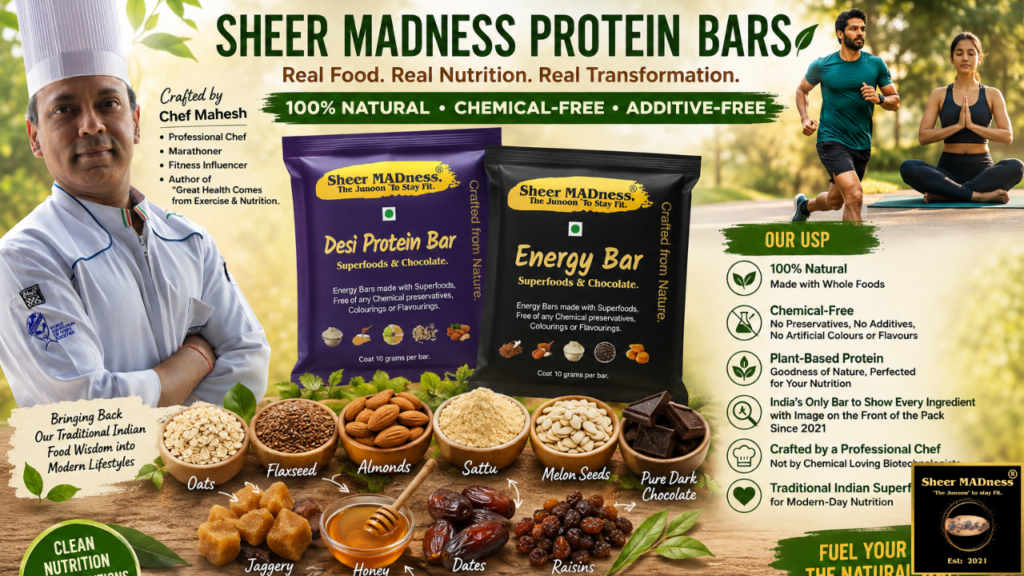
Direct answer: Yes — genuinely good protein bars under ₹100 exist in India. Sheer MADness Protein Bars cost ₹60 per bar. The Energy Bars also cost ₹60 per bar. Sheer MADness Millet Bars cost ₹57.50 per bar. Every bar contains only whole-food ingredients — oats, sattu, almonds, flaxseed, pumpkin seeds, melon seeds, dates, raisins, jaggery, honey, and pure dark chocolate. Zero chemical preservatives. No artificial sweeteners. Zero INS codes of any kind.
Most protein bars under ₹100 in India compromise heavily on ingredient quality to hit the price point. They use cheap protein isolates, maltitol, and chemical preservatives — all of which cost less than real whole foods. Sheer MADness achieves the same price point differently — by eliminating the marketing overhead, the expensive branding budgets, and the inflated retail margins that drive most commercial bar prices above ₹80 to ₹150.
I’m Chef Ashutosh Awasthi, founder of Sheer MADness, professional chef, marathon runner, and author of Great Health Comes from Exercise & Nutrition. I built this brand on one principle — real food, real price, nothing hidden. Let me show you exactly what you get for ₹60 and how to evaluate any bar under ₹100 before you buy it.
Price matters. But cost-per-nutrition matters more.
A ₹50 bar built on whey protein isolate, maltitol, and chemical preservatives delivers protein — and essentially nothing else nutritionally. It also delivers daily gut fermentation from the maltitol, daily chemical preservative residues, and a fast-digesting isolated protein that places more kidney strain than whole-food protein does.
A ₹60 bar built on oats, sattu, almonds, flaxseed, dates, jaggery, and dark chocolate delivers protein alongside 3 to 5 grams of dietary fibre, omega-3 fatty acids, iron, magnesium, zinc, Vitamin E, potassium, and antioxidant flavonoids. It delivers all of this with zero gut fermentation risk, zero chemical preservatives, and zero synthetic additives.
The ₹10 difference isn’t a cost question. It’s a nutrition question.
Furthermore, most “protein bars under ₹100” that appear in Indian search results are not actually under ₹100. They are the cheapest option from a brand whose standard bar costs ₹120 to ₹150 — manufactured with cheaper ingredients to hit a lower price tier.
Sheer MADness doesn’t have a “budget tier.” Every bar costs ₹57.50 to ₹60. Every bar uses the same whole-food ingredients. There is no cheaper version with inferior ingredients.
This is the section most brands selling cheap bars hope you never read.
Whey protein isolate and soy protein concentrate cost manufacturers approximately ₹15 to ₹25 per 10 grams of protein. This is significantly cheaper than sourcing 10 grams of protein from whole almonds, sattu, and oats combined.
Using a protein isolate allows manufacturers to hit a high protein number on the label at low ingredient cost. The nutritional trade-off is significant. Isolates strip away fibre, micronutrients, and the natural food matrix that makes whole-food protein beneficial beyond its protein content.
For the consumer, a bar with 20 grams of isolate protein and ₹50 price tag sounds like value. However, that protein comes with zero fibre, zero mineral contribution, zero omega-3, and potential daily gut disruption from the sugar alcohols that sweeten it.
Maltitol is the cheapest mass-market sugar substitute available to bar manufacturers. It is substantially cheaper than dates or jaggery as a sweetening ingredient. It also has the worst gut profile of any common sweetener — fermenting in the large intestine and causing gas, bloating, and loose stools in a significant percentage of daily consumers.
Many protein bars under ₹100 in India use maltitol specifically because it reduces the ingredient cost while maintaining a “no added sugar” or “low sugar” front-label claim. The back label tells the real story.
Achieving a 12 to 18-month shelf life through chemistry costs manufacturers very little. BHA and BHT are cheap synthetic antioxidants. INS 551 (silicon dioxide) is one of the cheapest anti-caking agents available. Using these chemicals eliminates the need for oxygen absorbers — which cost more than the chemicals they replace.
A bar under ₹100 with an 18-month shelf life and no stated preservation method almost certainly achieves that shelf life through BHA, BHT, or INS 202 (potassium sorbate). These preservatives enter the food and pass through the consumer’s body daily as synthetic chemical residues.
Let me be completely specific about what ₹60 buys in a Sheer MADness bar. This is the transparency that every protein bar brand under ₹100 should provide — and almost none do.
Whole almonds cost significantly more per kilogram than almond protein isolate. Medjool-quality dates cost more per kilogram than maltitol. Oxygen absorber packaging costs more than BHA or BHT. Natural cocoa and pure dark chocolate cost more than alkali-processed cocoa with synthetic emulsifiers.
Sheer MADness absorbs these higher ingredient costs by operating differently from commercial brands. We sell directly to consumers with free shipping rather than through retail distribution chains that demand 30 to 40 per cent margins. The operation is a lean kitchen model rather than an industrial manufacturing facility. We spend on ingredient quality rather than on advertising.
The result is a bar that costs manufacturers more per unit to produce — but costs the consumer ₹60 rather than ₹150.
| Nutrient | Amount | Source in Bar |
|---|---|---|
| Protein | 8 to 10g | Sattu, almonds, oats, flaxseed, pumpkin seeds |
| Dietary Fibre | 3 to 5g | Oats, flaxseed, almonds, dates |
| Omega-3 Fatty Acids | 1 to 2g | Flaxseed |
| Iron | Meaningful natural contribution | Jaggery, sattu, raisins |
| Magnesium | Meaningful natural contribution | Almonds, dark chocolate, oats |
| Zinc | Meaningful natural contribution | Pumpkin seeds, melon seeds |
| Vitamin E | Meaningful natural contribution | Almonds |
| Potassium | Meaningful natural contribution | Dates, raisins |
| Antioxidant Flavonoids | Present naturally | Dark chocolate, raisins |
| Chemical Preservatives | Zero | Oxygen absorbers used |
| Artificial Sweeteners | Zero | Dates, jaggery, honey, raisins |
| INS Codes | Zero | No synthetic additives |
No protein bar under ₹100 in India delivers this nutritional profile from whole-food sources. Most deliver protein, a sweetener, and a chemical preservative — at a lower or similar price.
Here is the most important comparison on this page — the one that actually matters for value assessment.
A typical commercial protein bar under ₹100 delivers approximately 10 to 15 grams of protein from isolate, zero meaningful fibre, zero omega-3, zero natural minerals, and a daily dose of maltitol, BHT, and INS 551.
Cost per gram of isolate protein: approximately ₹6 to ₹8.
Cost per gram of chemical additive consumed: included in the price whether you want it or not.
Total daily nutritional value beyond protein: minimal.
A Sheer MADness bar at ₹60 delivers 8 to 10 grams of whole-food protein, 3 to 5 grams of fibre, 1 to 2 grams of omega-3, natural iron, magnesium, zinc, Vitamin E, and potassium.
Cost per gram of whole-food protein: approximately ₹6 to ₹7.
Cost per gram of chemical additive consumed: zero — because there are none.
Total daily nutritional value beyond protein: significant and measurable.
The price per gram of protein is similar. The nutrition delivered per rupee is dramatically different.

This is a fair question. If whole-food ingredients cost more, how does Sheer MADness maintain ₹60?
The answer has three parts.
Sheer MADness sells directly to customers through the website with free shipping, and through Flipkart, Jio Mart, and ONDC. We don’t sell through general retail stores that demand 30 to 40 percent distribution margins. This margin saving goes directly into ingredient quality rather than into retail shelf space.
Sheer MADness operates from Kolkata in a kitchen-scale production model. This costs more per unit than industrial factory production — but it maintains the ingredient integrity that industrial processing compromises. We don’t produce millions of bars per month with machinery that requires chemical preservatives to manage the production cycle.
Sheer MADness spends nothing on celebrity brand ambassador contracts, TV commercials, or large-scale print advertising. The brand grows through genuine customer experience, repeat purchases, and word-of-mouth. Every rupee that other brands spend on advertising, we spend on ingredients.
These three choices together allow ₹60 pricing for a genuinely whole-food, preservative-free bar.
Use this checklist before buying any bar claiming to be good value under ₹100.
Many brands state a box price — “₹599 for 6 bars” — which makes the per-bar price ₹99.83. That’s technically under ₹100 per bar but significantly more expensive per gram of nutrition than Sheer MADness at ₹60 per bar. Always calculate price per bar, not box price.
If the first or second ingredient is “whey protein isolate,” “soy protein concentrate,” or “protein blend” — the protein comes from chemical extraction. Compare this to oats, sattu, almonds, and flaxseed — whole-food protein sources that deliver nutrition beyond just protein.
Maltitol, sorbitol, erythritol, sucralose, and acesulfame-K are all red flags. These sweeteners reduce manufacturing cost but cause gut fermentation, microbiome disruption, and — in the case of erythritol — emerging cardiovascular concern in recent research. Natural sweeteners are dates, jaggery, honey, and raisins. A bar with natural sweeteners typically costs more to produce — which is why most bars under ₹100 don’t use them.
INS 320 (BHA), INS 321 (BHT), INS 202 (potassium sorbate), INS 551 (silicon dioxide), INS 471 (emulsifier), INS 322 (soy lecithin) — any of these in the ingredient list means the bar uses chemical additives regardless of front-label natural claims.
A bar under ₹100 lasting 12 to 18 months without stating its preservation method uses chemical preservatives. A genuinely preservative-free bar states specifically — “preserved with oxygen absorbers” or “vacuum packed” — and has a shelf life of 4 to 6 months.
A genuinely whole-food bar under ₹100 should have 8 to 12 recognisable whole-food ingredients. A bar with 20 to 30 ingredients contains processing aids, binders, stabilisers, and preservatives beyond its stated food ingredients.
Sheer MADness passes every one of these six checks. ₹60 per bar. 10 to 11 whole-food ingredients. Natural sweeteners only. Zero INS codes. 4 to 6-month shelf life achieved through oxygen absorbers. Stated on every pack.
Sheer MADness uses whole oats that provide intact beta-glucan soluble fibre. Many cheaper bars use oat flour — cheaper, more easily processed, but with significantly reduced beta-glucan content and a higher glycaemic index. The whole oat difference costs more. It delivers meaningfully better sustained energy and gut health.
Sattu provides 20 to 22 grams of protein per 100 grams with 7.6 grams of fibre and a glycaemic index of 28 to 35. Soy protein concentrate provides higher protein percentage per gram but zero fibre, higher isoflavone content concerning for thyroid patients, and significantly worse digestive compatibility for Indian consumers. Sattu costs more per unit of protein. It delivers far more nutrition beyond protein.
Whole almonds provide Vitamin E, magnesium, calcium, prebiotic fibre, and healthy monounsaturated fats alongside their protein content. Almond protein powder — produced by pressing oil from almonds and grinding the remainder — contains the protein fraction but strips away most of the Vitamin E and healthy fat content. Whole almonds cost more. They deliver more.
Whole dates provide natural fructose and glucose packaged with 6 to 8 grams of fibre per 100 grams, iron, potassium, and antioxidant polyphenols. Maltitol provides sweetness without the fibre, iron, or polyphenols — and causes gut fermentation. Dates cost more than maltitol per unit of sweetness. They cause zero gut fermentation and provide genuine nutritional value.
Jaggery retains iron at 11 milligrams per 100 grams, potassium at 1050 milligrams per 100 grams, and magnesium at 70 to 90 milligrams per 100 grams. Refined sugar provides none of these minerals. Jaggery costs slightly more than refined sugar. It delivers minerals rather than empty calories.
Pure dark chocolate retains over 400 naturally occurring flavour and antioxidant compounds including epicatechin and catechin. Alkali-processed cocoa destroys a significant portion of these compounds during processing while producing a darker colour and smoother taste that requires less additional flavouring. Natural dark chocolate costs more. It delivers genuine antioxidant benefit.
Oxygen absorbers remove oxygen from inside the packaging, preventing oxidation without adding any chemical to the food. BHA and BHT prevent oxidation by entering the food chemically. Oxygen absorbers cost more per unit. They leave zero chemical residue in the food.
For people eating one or two bars daily for months or years, ingredient quality determines cumulative health impact. A ₹60 whole-food bar consumed daily for a year delivers 365 days of whole-food nutrition with zero chemical additive accumulation. A ₹60 chemical-laden bar delivers 365 days of maltitol fermentation, BHT residues, and INS 551 consumption alongside the protein.
The cumulative difference over a year makes the daily ₹10 to ₹15 saving on a cheaper bar look very different from a health perspective.
Students and young professionals represent the largest buyer group for protein bars under ₹100 in India. They need sustained energy for long study and work sessions, genuine protein for active growing bodies, and a snack that fits a tight budget without compromising daily health.
One Sheer MADness bar mid-morning and one mid-afternoon provides consistent whole-food nutrition for approximately ₹120 to ₹150 per day in bars — less than most office canteen meals and dramatically better nutritionally than biscuits, chips, and processed snacks.
Gym memberships, sportswear, and training gear already consume fitness budgets. Most active adults cannot consistently spend ₹100 to ₹150 per bar. At ₹60, Sheer MADness makes clean whole-food protein bar consumption sustainable on any Indian fitness budget — without the chemical compromises that most cheap bars require.
A box of 10 Sheer MADness bars costs ₹600 to ₹575 — providing the entire family with protein-bar access for a week at ₹60 per bar. For families with active children and working parents all sharing bars, volume buying at ₹60 makes genuine nutritional access feasible at a household budget level.
Since 2021, Sheer MADness displays every ingredient with its own image on the front of every pack. At ₹60, this is the only protein bar in India that simultaneously achieves this level of ingredient transparency.
The confidence to put everything on the front label comes from having nothing to hide. When your bar is oats, almonds, sattu, flaxseed, dates, jaggery, pumpkin seeds, melon seeds, raisins, honey, and dark chocolate — you display it proudly at ₹60. When your bar is whey isolate, maltitol, BHT, and INS 551 — you hide it in small print on the back at whatever price you charge.
Sheer MADness holds a registered trademark under the Government of India. The Natural Plant Protein formula is patent published under Patent No. 202331036733, searchable on Intellectual Property India. The brand holds a valid FSSAI licence and GSTIN registration. Every certification appears publicly on the website and on the product label.
| Feature | Sheer MADness (₹57.50-₹60) | Typical Commercial Bar (₹80-₹100) |
|---|---|---|
| Protein source | Sattu, almonds, oats — whole foods | Whey isolate or soy concentrate |
| Protein per bar | 8 to 10g from whole foods | 10 to 20g from isolates |
| Sweetener | Dates, jaggery, honey, raisins | Maltitol, sucralose, or refined sugar |
| Preservatives | None — oxygen absorbers | BHA, BHT, potassium sorbate |
| Additives | Zero INS codes | INS 551, INS 471, INS 322 common |
| Fibre per bar | 3 to 5g from whole foods | 0 to 2g, often absent |
| Omega-3 | From flaxseed — cumulative benefit | Absent in almost all |
| Gut fermentation risk | Zero | High — maltitol and sorbitol |
| Shelf life method | Oxygen absorbers — stated | Often chemical — unstated |
| Ingredient transparency | Every ingredient on front label | INS codes in small print on back |
| Chemical residue daily | Zero | BHT, maltitol metabolites, INS 551 |
| Made in India | Yes — Kolkata | Varies |
| Value per rupee | Highest — whole-food nutrition | Lower — protein plus chemicals |
What is the best protein bar under ₹100 in India?
Sheer MADness Protein Bars and Energy Bars at ₹60 per bar are genuinely the best protein bars under ₹100 in India. They use only whole-food ingredients — oats, sattu, almonds, flaxseed, dates, jaggery, pumpkin seeds, melon seeds, raisins, honey, and dark chocolate — with zero chemical preservatives, zero artificial sweeteners, and zero INS-coded additives.
Are cheap protein bars safe to eat daily?
Cheap protein bars built on maltitol, whey isolate, and chemical preservatives are safe in the regulatory sense — approved additives are used. However, daily consumption accumulates gut fermentation from maltitol, chemical preservative residues from BHT, and the nutritional limitations of isolate-based protein without fibre or micronutrients. For daily consumption, ingredient quality matters more than one-time safety.
Why are most protein bars so expensive in India?
Most Indian protein bars carry the cost of celebrity endorsements, mass advertising campaigns, retail distribution margins of 30 to 40 percent, and imported ingredient costs for whey and soy isolates. Sheer MADness eliminates all four — selling directly to consumers, using zero advertising celebrity contracts, and sourcing Indian whole-food ingredients. This is how ₹60 per whole-food bar is achievable.
Yes — if the brand makes the right cost decisions. Sheer MADness makes them. Higher ingredient quality absorbed through lower marketing and distribution overhead produces a bar at ₹60 that delivers more genuine nutrition per rupee than most bars priced at ₹120 to ₹150.
How many Sheer MADness bars come in a box?
Each box contains 10 bars. The Protein Bar and Energy Bar boxes cost ₹600 (₹60 per bar). The Millet Bar box costs ₹575 (₹57.50 per bar). Free shipping applies across India. COD is available.
Are Sheer MADness bars available on Amazon or Flipkart?
Yes. Sheer MADness bars are available on Flipkart and ONDC in India, in addition to direct purchase through the Sheer MADness website with free shipping. Direct website purchase provides the most reliable freshness since bars ship directly from the kitchen.
Can I buy Sheer MADness bars in bulk for better value?
Yes. Combo deals are available on the Sheer MADness website — buying two or more boxes provides better per-bar pricing. Check the current combo offers at the shop page for updated bulk deal pricing.
What makes a protein bar genuinely worth its price?
A protein bar justifies its price when it delivers whole-food protein alongside meaningful fibre, minerals, omega-3 fatty acids, and natural sweeteners — without chemical preservatives, sugar alcohols, or synthetic additives. The price per bar matters. The nutrition delivered per rupee matters more.
The best protein bar under ₹100 in India is not simply the cheapest one. It’s the one that delivers the most genuine nutrition per rupee — whole-food protein, natural fibre, minerals, omega-3, and natural sweeteners — without the chemical additives that compromise daily health.
At ₹60 per bar, Sheer MADness delivers all of this. Furthermore, it does so with zero chemical preservatives, zero artificial sweeteners, zero INS codes, and complete ingredient transparency since 2021.
Most protein bars under ₹100 in India cut ingredient quality to hit the price. Sheer MADness cuts overhead instead. The difference lands in your body — one way or the other — every single day you eat the bar.
Choose the difference you want in your body.
I would also request you to kindly read my previous post about “Healthiest Protein Bar in India“.
a) Everyone is an individual, so what suits me may not suit the next person.
b) If a person has a medical condition, a doctor’s advice and prescribed medication will only help.
c) While buying any protein bar from the market, read the labels carefully. Watch out for INS codes — INS 320 (BHA), INS 321 (BHT), INS 551 (silicon dioxide), INS 202 (potassium sorbate), maltitol, sorbitol, sucralose, and other lab-made chemicals that quietly appear on most commercial labels.
If you are interested in buying chemical-free Natural Plant Protein Moringa, Health Drinks for Kids, or our delicious chemical-free Energy Bars, Protein Bars, and Millet Bars, shop at Sheer MADness.
You can also find us on Flipkart, Jio Mart, or ONDC in India.
d) Exercise is the key to fitness. Exercise and nutrition are two sides of the same coin and always go hand in hand.
e) Excess of anything is wrong, even the best whole-food snack. Consume only recommended quantities.
f) Rome was not built in a day. Discipline and consistency are the only keys to lasting health.
g) It is not only exercise and protein that builds health. A healthy gut, macro and micronutrients, body type, rest, and lifestyle all matter. Of all these, exercise and nutrition are within our control. Focus on these two primary aspects first.
h) The most important part of fitness is that nothing is better than exercise and a balanced meal.
Article by Chef Ashutosh Awasthi
Disclaimer: Our products are a source of HEALTHY NUTRIENTS and are COMPLETELY FREE OF ANY ADDED CHEMICALS. We do not claim to cure any medical condition. The content provided is informational. We do not claim to diagnose or treat a person with any specific medical condition.