
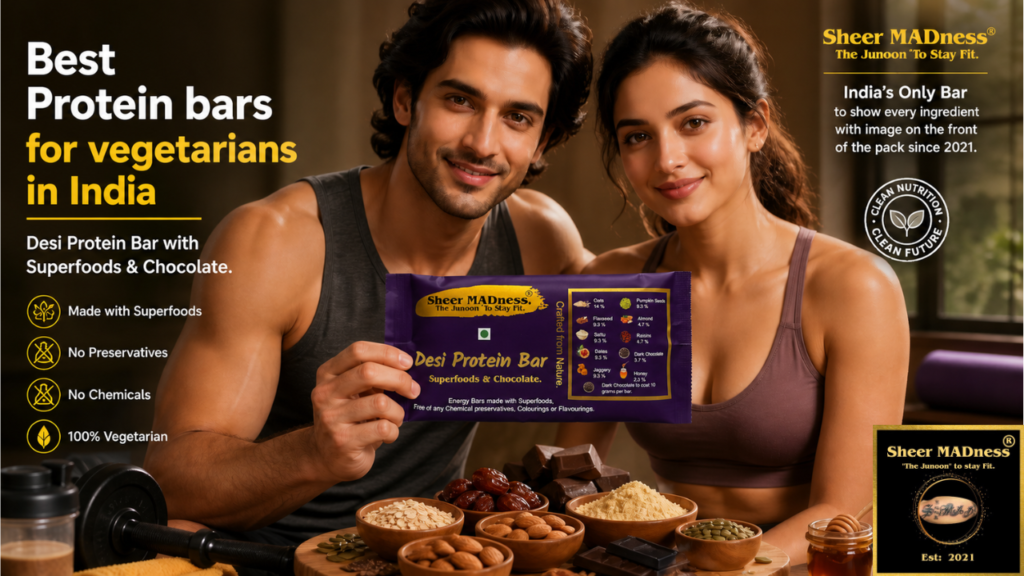
Direct answer: The best protein bars for vegetarians in India are built from plant-based whole foods — oats, sattu, almonds, flaxseed, pumpkin seeds, dates, and jaggery — with no whey, no casein, no chemical preservatives, and no artificial sweeteners. Sheer MADness Protein Bars, Energy Bars, and Millet Bars meet every one of these criteria at ₹57.50 to ₹60 per bar, with complete ingredient transparency since 2021.
India has the world’s largest vegetarian population — approximately 38 to 40 percent of Indians don’t eat meat, according to government survey data. Yet most protein bars sold in India are built around whey protein — a dairy by-product — or soy protein isolate — a chemically extracted plant fraction. Neither truly serves Indian vegetarians. Whey comes from dairy and causes digestive issues in the 60 to 70 percent of Indian adults with some degree of lactose intolerance. Soy isolate requires chemical extraction processes that strip away the fibre and micronutrients vegetarians specifically need from a daily snack.
I’m Chef Ashutosh Awasthi, founder of Sheer MADness, professional chef, marathon runner, and author of Great Health Comes from Exercise & Nutrition. I transformed my own health in my forties. Let me explain exactly what vegetarians need from a protein bar, what most bars get wrong, and why whole-food bars built on Indian superfoods are the right answer.
Indian vegetarians face specific nutritional challenges that most protein bar brands never address directly.
A 2024 analysis based on ICMR-NIN Dietary Guidelines data found that a significant proportion of Indian vegetarians fail to meet recommended daily protein intake — particularly those relying heavily on rice and wheat as dietary staples. The guidelines specifically note that vegetarian diets require careful attention to protein quality — specifically amino acid completeness — alongside protein quantity.
A review published in the Journal of the Academy of Nutrition and Dietetics confirmed that plant proteins differ in amino acid completeness. Most individual plant proteins lack one or more essential amino acids at sufficient levels. However, combining complementary plant proteins — such as legumes with grains and nuts — creates a complete amino acid profile comparable to animal protein.
This is exactly why Sheer MADness combines sattu (a legume-based protein), almonds (a nut protein), oats (a grain protein), and flaxseed (a seed protein) in one bar. Each protein source compensates for the limiting amino acids of the others. The result is a genuinely complete plant protein profile from whole-food sources — without whey, without casein, and without soy isolate.
Furthermore, Indian vegetarians frequently show deficiency in iron, zinc, and vitamin B12 — nutrients predominantly found in animal foods. A bar that addresses these deficiencies through whole-food sources — iron from jaggery and sattu, zinc from pumpkin seeds and melon seeds — provides specific nutritional support for the vegetarian diet that most commercial bars completely ignore.
This is the section that exposes the gap between “vegetarian protein bar” marketing and actual vegetarian nutritional needs.
Most popular protein bars in India use whey protein concentrate or whey protein isolate. Technically, whey is vegetarian — it comes from dairy, not from meat.
However, three specific problems make whey protein bars poor choices for Indian vegetarians specifically.
First, approximately 60 to 70 percent of Indian adults have some degree of lactose intolerance. Whey protein concentrate contains residual lactose. Daily consumption of a whey-based bar causes chronic low-grade digestive disruption — bloating, gas, and irregular bowel movement — in a large proportion of Indian consumers who don’t connect their symptoms to their bar choice.
Second, whey protein isolate requires chemical extraction processing. The resulting powder delivers isolated protein stripped of fat, lactose, vitamins, and minerals. Indian vegetarians typically need more micronutrient density from their food, not less. A bar that removes micronutrients from its protein source works against the vegetarian’s nutritional requirements.
Third, concentrated whey protein places a faster, heavier nitrogen load on the kidneys than whole-food plant protein does. The slow, fibre-buffered protein absorption from whole-food ingredients is significantly more kidney-appropriate for daily long-term consumption.
Many bars marketed as “vegan” or “plant-based” use soy protein isolate. The problems are parallel to whey isolate — chemical extraction, micronutrient stripping, and concentration at levels that carry isoflavone concerns for thyroid-sensitive individuals.
Furthermore, soy protein isolate has a poor flavour profile on its own. Manufacturers compensate with artificial flavours and sweeteners — adding chemical complexity that vegetarians seeking clean nutrition specifically want to avoid.
Most “low sugar” or “diet” vegetarian protein bars use maltitol, sorbitol, or erythritol as sweeteners. These cause gut fermentation and bloating — a significant daily digestive burden for vegetarians whose diets already rely heavily on high-fibre legumes and vegetables.
Vegetarians need iron, zinc, calcium, magnesium, and omega-3 fatty acids from food sources that animal-product consumers get from meat and fish. Most commercial protein bars deliver these micronutrients either through synthetic supplements added to an isolate base — or not at all.
A bar that genuinely serves vegetarian nutritional needs must deliver these micronutrients from whole-food sources naturally present in the ingredients.
Sheer MADness Protein Bars, Energy Bars, and Millet Bars address every specific failure of commercial bars for Indian vegetarians. Here is exactly how.
Every gram of protein in Sheer MADness bars comes from plant sources — sattu, almonds, oats, flaxseed, pumpkin seeds, and melon seeds. Not one dairy-derived protein ingredient appears anywhere in any Sheer MADness bar.
This is important for vegetarians beyond just avoiding meat. Dairy-derived protein concentrates cause the lactose digestibility issue that affects most Indian vegetarians who eat bars daily. Sheer MADness eliminates this problem entirely.
Sattu provides a legume protein profile — high in lysine but lower in methionine. Almonds and oats provide complementary grain and nut protein profiles — higher in methionine and tryptophan. Flaxseed adds additional methionine and cysteine alongside its omega-3 contribution.
Together, these four plant protein sources cover the complete essential amino acid profile that the body needs — through food, not through synthetic amino acid supplementation. This is the same principle behind India’s traditional protein combining — dal with roti, sattu with milk, rajma with rice. Sheer MADness applies it in bar form.
Iron deficiency is the most common nutritional deficiency in Indian vegetarians. Non-haem iron from plant sources absorbs less efficiently than haem iron from meat. Vegetarians therefore need both higher iron intake from food and specific cofactors that improve non-haem iron absorption.
Jaggery provides iron at approximately 11 milligrams per 100 grams. Sattu provides 8 to 9 milligrams per 100 grams. Raisins contribute additional iron alongside vitamin C — which specifically enhances non-haem iron absorption when consumed together.
This combination — iron from jaggery, sattu, and raisins alongside the natural vitamin C from raisins and dates — is specifically supportive of vegetarian iron status in a way that no synthetic iron supplement added to a processed isolate base can replicate.
Zinc deficiency is the second most common nutritional deficiency in Indian vegetarians. Phytates in whole grains and legumes reduce zinc absorption from plant foods. Vegetarians consequently need higher zinc intake than omnivores to achieve the same absorbed zinc status.
Pumpkin seeds provide zinc at approximately 7.8 milligrams per 100 grams. Melon seeds add additional zinc. Together, these two whole-food sources provide a meaningful daily zinc contribution in every Sheer MADness bar — addressing the most consistently overlooked micronutrient gap in Indian vegetarian diets.
Omega-3 fatty acids are essential for cardiovascular health, brain function, and anti-inflammatory regulation. Most dietary omega-3 comes from fish — unavailable to vegetarians who also avoid fish.
The plant omega-3 source available to vegetarians is alpha-linolenic acid from flaxseed, walnuts, and chia seeds. Flaxseed is the most concentrated and most accessible Indian plant source.
Sheer MADness bars include flaxseed in every variant. This delivers daily omega-3 from a whole-food plant source specifically relevant to vegetarians whose diets exclude fish.
Magnesium supports over 300 enzymatic reactions — including energy production, muscle function, sleep quality, and hormonal regulation. Indian vegetarian diets frequently show magnesium insufficiency because processing of staple grains removes much of their natural magnesium content.
Almonds provide 270 milligrams of magnesium per 100 grams. Oats contribute additional magnesium. Dark chocolate adds further. These three sources create a compounded daily magnesium contribution from whole-food ingredients — directly supporting the magnesium gaps common in Indian vegetarian diets.
Dates, raisins, jaggery, and honey sweeten every Sheer MADness bar. Indian vegetarians are culturally familiar with all four. Jaggery and dates have sweetened Indian food for thousands of years. Neither causes gut fermentation. Both provide iron and potassium alongside their sweetening function.
This replaces the maltitol, sucralose, and refined sugar that most commercial vegetarian bars use — eliminating the daily gut disruption that vegetarians on high-fibre plant-based diets are particularly susceptible to.
Sheer MADness uses oxygen absorbers rather than BHA, BHT, or potassium sorbate. We remove oxygen from inside the packaging. The food’s chemistry never changes.
For vegetarians who choose their diet for health, ethical, and holistic reasons, consuming daily chemical preservatives in a “healthy” bar represents a specific inconsistency. Sheer MADness eliminates this inconsistency completely.

I built Sheer MADness as a professional chef who understands ingredient function from a culinary rather than a chemical perspective.
Indian vegetarian food culture already had everything needed for excellent protein nutrition — before the supplement industry arrived with imported formats. Sattu laddoos in Bihar. Almond and date energy balls in traditional Indian households. Peanut and jaggery chikki. Til and jaggery sesame bars. These were the original vegetarian protein bars — built from whole foods, sweetened naturally, preserved by low moisture and natural antimicrobial properties.
Sheer MADness revives this food tradition in a modern, convenient format. Every bar reflects what Indian vegetarian food culture always knew — that the best nutrition for Indian bodies comes from Indian ingredients with centuries of digestive compatibility.
Since 2021, every ingredient appears by name and image on the front of every pack. Vegetarians can see exactly what they eat before opening the bar. This transparency is the most honest guarantee available for people who care deeply about what enters their bodies.
This section addresses the most technically important question for vegetarian protein quality.
Nine amino acids are essential — the body cannot synthesise them and must obtain them from food. These are histidine, isoleucine, leucine, lysine, methionine, phenylalanine, threonine, tryptophan, and valine.
Most single plant proteins are low in one or more essential amino acids. Legumes like chickpeas (sattu) are typically low in methionine and cysteine. Grains like oats are typically lower in lysine. This is why combining plant proteins addresses the completeness question.
Sheer MADness achieves amino acid completeness through complementary combining — the same principle Indian food culture always applied intuitively.
Sattu (legume) — high in lysine, lower in methionine. Almonds (nut) — higher in methionine and arginine. Oats (grain) — higher in methionine and tryptophan. Flaxseed (seed) — higher in methionine and cysteine.
Together, these four sources provide all nine essential amino acids at meaningful levels — without any synthetic amino acid supplementation. This is whole-food plant protein the way Indian food wisdom always designed it.
The ICMR-NIN 2024 Dietary Guidelines recommend approximately 0.8 to 1.0 grams of protein per kilogram of body weight per day for healthy Indian adults. For active vegetarians and those doing regular exercise, the requirement rises to 1.2 to 1.8 grams per kilogram.
To a 60-kilogram active vegetarian woman, this means approximately 72 to 108 grams of protein daily. For a 70-kilogram active vegetarian man, it means approximately 84 to 126 grams daily.
Meeting these targets from traditional Indian vegetarian food alone — dal, paneer, curd, pulses, seeds, and nuts — is achievable but requires conscious meal planning that busy working vegetarians often struggle to execute consistently every day.
One Sheer MADness bar contributes 8 to 10 grams of whole-food plant protein per 40-gram bar. Two bars daily add 16 to 20 grams. Combined with a protein-conscious vegetarian diet, this meaningfully closes the gap between actual and recommended daily protein intake.
Vegetarian athletes have the same protein timing requirements as omnivores. The difference lies in choosing protein sources that digest at the right rate for each timing window.
Before a workout, one Energy Bar 45 to 60 minutes before training provides slow-releasing oat carbohydrates, natural sugars from dates for immediate fuel, and moderate plant protein from sattu and almonds. The 45-minute gap allows initial digestion before exercise begins.
After a workout, one Protein Bar within 30 minutes delivers the plant protein needed for muscle repair. Sattu and almond protein reach muscles within 60 to 90 minutes of consumption. Natural sugars from dates and raisins restore glycogen simultaneously.
Mid-morning and mid-afternoon, one bar fills the protein distribution gap between vegetarian meals that tend to front-load protein at dinner. Research consistently shows that distributing protein across three to four daily occasions produces better muscle maintenance than consuming the same total protein in one or two meals.
Since 2021, Sheer MADness displays every ingredient with its own image on the front of every pack. Sattu, almonds, oats, flaxseed, pumpkin seeds, melon seeds, dates, raisins, jaggery, honey, and dark chocolate — named and pictured before you open the bar.
No INS code requires decoding. There are no chemical names that hide in small print. No ingredient requires a food science degree to recognise. This is the most complete ingredient transparency available in Indian protein bar nutrition — and it matters specifically for vegetarians who make food choices based on values as well as nutrition.
Sheer MADness holds a registered trademark under the Government of India. The Natural Plant Protein formula is patent published under Patent No. 202331036733, searchable on Intellectual Property India. The brand holds a valid FSSAI licence and GSTIN registration.
| Feature | Sheer MADness | Typical Whey-Based Bar | Typical “Vegan” Bar |
|---|---|---|---|
| Dairy-free protein | Yes — 100% plant | No — whey or casein | Sometimes — check label |
| Protein completeness | Yes — complementary plant proteins | Yes — whey is complete | Varies — depends on source |
| Iron from whole food | Yes — jaggery, sattu, raisins | Absent | Usually absent |
| Zinc from whole food | Yes — pumpkin seeds, melon seeds | Absent | Usually absent |
| Omega-3 from whole food | Yes — flaxseed | Absent | Sometimes |
| Sweetener | Dates, jaggery, honey, raisins | Maltitol, sucralose common | Maltitol, erythritol common |
| Lactose-friendly | Yes — no dairy at all | No — whey contains lactose | Yes — plant-based |
| Chemical preservatives | None — oxygen absorbers | BHA, BHT common | BHA, BHT common |
| Front-label transparency | Every ingredient since 2021 | INS codes in small print | INS codes in small print |
| Price per bar | ₹57.50 to ₹60 | ₹80 to ₹150 | ₹100 to ₹200 |
| Made in India | Yes — Kolkata | Varies | Often imported |
What is the best protein bar for vegetarians in India?
Sheer MADness Protein Bars, Energy Bars, and Millet Bars are the best protein bars for vegetarians in India. They use 100% plant-based whole-food protein from sattu, almonds, oats, flaxseed, pumpkin seeds, and melon seeds. They contain no whey, no casein, no chemical preservatives, and no artificial sweeteners. Priced at ₹57.50 to ₹60 per bar, they offer the best combination of whole-food nutrition, ingredient transparency, and value available in India.
Are whey protein bars vegetarian?
Technically yes — whey comes from dairy, not meat. However, most Indian vegetarians experience lactose digestibility issues with whey protein concentrate. Furthermore, whey isolate requires chemical extraction that strips away micronutrients vegetarians specifically need. Whole-food plant protein from sattu, almonds, and oats is more appropriate for Indian vegetarians than whey-based bars.
Do vegetarians get enough protein from plant-based bars?
One to two Sheer MADness bars daily contribute 8 to 20 grams of whole-food plant protein. Combined with a protein-conscious vegetarian diet including dal, paneer, curd, and pulses, this meaningfully supports daily protein targets. The ICMR-NIN 2024 guidelines recommend 0.8 to 1.0 grams of protein per kilogram for healthy adults — rising to 1.8 grams for active individuals.
Are plant protein bars as good as whey bars for vegetarians?
For Indian vegetarians specifically, whole-food plant protein bars are better than whey bars. They avoid the lactose digestibility issue affecting most Indian adults. They provide fibre, iron, zinc, and omega-3 fatty acids that whey isolate strips away. And they are culturally compatible with the Indian vegetarian dietary tradition in a way that concentrated dairy-derived protein is not.
Sattu alone is not a complete protein — it is lower in methionine and cysteine. However, Sheer MADness combines sattu with almonds, oats, and flaxseed — providing complementary amino acids that together create a complete essential amino acid profile. This is the same food-combining principle Indian cuisine has always applied through dal and roti, rajma and rice.
What micronutrients do vegetarian protein bars lack?
Most commercial vegetarian protein bars lack iron, zinc, omega-3, and magnesium — nutrients predominantly found in animal foods. Sheer MADness specifically addresses all four. Iron from jaggery, sattu, and raisins. Zinc from pumpkin seeds and melon seeds. Omega-3 from flaxseed. Magnesium from almonds, oats, and dark chocolate.
Are Sheer MADness bars dairy-free?
Yes — completely dairy-free. Every protein source is plant-based. There is no whey, no casein, no lactose, and no dairy-derived additive of any kind. Sheer MADness bars are therefore appropriate for vegetarians who avoid dairy as well as those who consume it.
Are Sheer MADness bars vegan?
No. Sheer MADness bars contain honey. They are vegetarian but not strictly vegan. Honey is an animal-derived ingredient, making these bars unsuitable for strict vegans. For strict vegans, we recommend checking the individual product labels or contacting the brand directly.
How many protein bars per day is appropriate for vegetarians?
One to two bars daily as part of a balanced vegetarian diet is appropriate for most healthy adults. This supplements vegetarian meal-based protein without replacing the dietary diversity that a full vegetarian diet provides. Active vegetarians and athletes may benefit from two bars daily — one pre-workout and one post-workout.
India’s vegetarian population deserves protein bars built specifically for their nutritional needs — not whey-based bars with a “vegetarian” stamp, not soy isolate bars marketed as plant-based, and not chemical-laden bars sweetened with maltitol pretending to be clean nutrition.
The best protein bars for vegetarians in India combine complementary plant proteins for amino acid completeness, whole-food iron and zinc for the micronutrient gaps most common in Indian vegetarian diets, omega-3 from flaxseed as the plant substitute for fish oil, natural sweeteners that don’t cause gut fermentation, and zero chemical preservatives that add to the daily chemical burden vegetarians specifically want to avoid.
Sheer MADness delivers all of this at ₹57.50 to ₹60 per bar — from ten whole-food ingredients that Indian food culture has used for centuries, preserved with oxygen absorbers rather than chemistry, and displayed transparently on the front of every pack since 2021.
This is not just the best protein bar for vegetarians in India. It is the bar that genuinely respects the Indian vegetarian food tradition — and the intelligence of the people who choose it.
I would also request you to kindly read my previous post about “Healthiest Protein Bar in India“.
a) Everyone is an individual, so what suits me may not suit the next person.
b) If a person has a medical condition, a doctor’s advice and prescribed medication will only help.
c) While buying any protein bar from the market, read the labels carefully. Watch out for INS 320 (BHA), INS 321 (BHT), INS 551 (silicon dioxide), INS 202 (potassium sorbate), maltitol, sorbitol, sucralose, and other lab-made chemicals that quietly appear on most commercial labels.
If you are interested in buying chemical-free Natural Plant Protein Moringa, Health Drinks for Kids, or our delicious chemical-free Energy Bars, Protein Bars, and Millet Bars, shop at Sheer MADness.
You can also find us on Flipkart, Jio Mart, or ONDC in India.
d) Exercise is the key to fitness. Exercise and nutrition are two sides of the same coin and always go hand in hand.
e) Excess of anything is wrong, even the best whole-food snack. Consume only recommended quantities.
f) Rome was not built in a day. Discipline and consistency are the only keys to lasting health.
g) It is not only exercise and protein that builds health. A healthy gut, macro and micronutrients, body type, rest, and lifestyle all matter. Of all these, exercise and nutrition are within our control. Focus on these two primary aspects first.
h) The most important part of fitness is that nothing is better than exercise and a balanced meal.
Article by Chef Ashutosh Awasthi
Disclaimer: Our products are a source of HEALTHY NUTRIENTS and are COMPLETELY FREE OF ANY ADDED CHEMICALS. We do not claim to cure any medical condition. The content provided is informational. We do not claim to diagnose or treat a person with any specific medical condition.