
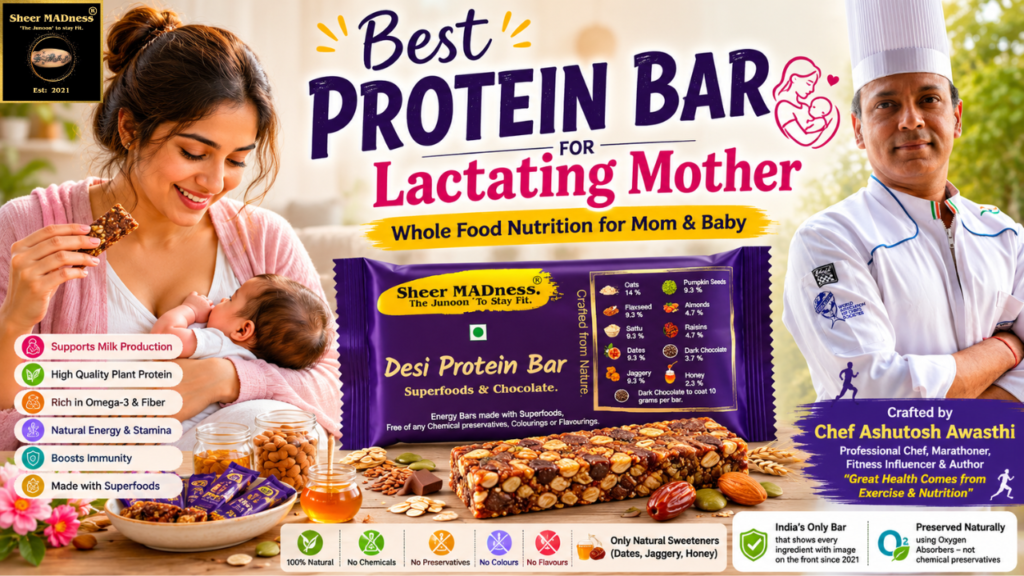
Direct answer: The best protein bar for a lactating mother is one made entirely from whole foods — oats, almonds, flaxseed, sattu, dates, and jaggery — with zero protein isolates, zero artificial sweeteners, and zero chemical preservatives.
During breastfeeding, a mother’s body is doing something extraordinary. It is producing 700 to 800 millilitres of nutrient-rich milk daily while simultaneously recovering from childbirth. Every chemical a mother consumes passes, to some degree, into her breast milk. Therefore, the ingredient list of any food she eats daily matters more during this phase than at almost any other point in her life.
Most protein bars on the market are not built for this reality. They are built for adult athletes seeking maximum protein at minimum cost. However, a protein bar for a lactating mother needs something different — whole-food nutrition that supports her recovery, sustains her energy through broken sleep and frequent feeds, and delivers clean nourishment that she can feel genuinely comfortable sharing with her baby through her milk.
I’m Chef Ashutosh Awasthi, founder of Sheer MADness, professional chef, marathon runner, and author of Great Health Comes from Exercise & Nutrition. I transformed my own health in my forties. I understand what real food does inside the body — and what chemistry does. Let me explain the difference for every new mother reading this.

Understanding protein requirements during breastfeeding helps clarify why a protein bar for lactating mothers needs to be formulated differently from a standard athlete’s bar.
Research published in ScienceDirect found that protein requirements for exclusively breastfeeding women are higher than current recommendations suggest — approximately 1.7 to 1.9 grams of protein per kilogram of body weight per day — significantly above the previously estimated 1.05 grams per kilogram per day. clinicaltrials
For a 60-kilogram breastfeeding mother, this translates to approximately 100 to 115 grams of protein per day. This is a substantial amount — well above what most Indian vegetarian diets provide without conscious effort.
Furthermore, mothers producing 700 to 800 millilitres of breast milk daily require roughly an additional 500 to 640 kilocalories per day alongside increased micronutrient intake. When dietary intake is inadequate, maternal nutrient stores deplete — leading to diminished breast milk quality and quantity, which adversely affects both maternal and infant health. nih
This is why a protein bar for a lactating mother must deliver more than a protein number. It must deliver energy, fibre, iron, calcium, magnesium, zinc, and healthy fats alongside the protein — nutrients that support both the mother’s recovery and the nutritional quality of her milk.
This is the conversation most protein bar brands don’t want you to have.
Walk into any pharmacy or supermarket and pick up the most popular protein bars. Turn them over and read the ingredient label. You will almost certainly find one or more of the following.
Whey protein isolate, soy protein isolate, and casein concentrate are the most common protein sources in commercial bars. These are produced through industrial chemical extraction — using acid washing, alkaline processing, and various solvents to strip protein away from the whole food source.
The result is a powder that delivers high protein per gram. However, it strips away the fibre, fat, vitamins, and minerals that the whole food naturally contained. Moreover, for a breastfeeding mother whose digestive system is still recovering postpartum, concentrated protein isolates place a heavier, faster-digesting nitrogen load on her system than whole-food protein does.
Sucralose, maltitol, sorbitol, and erythritol are standard sweeteners in most commercial protein bars. Sugar alcohols pass largely undigested through the small intestine and ferment in the large intestine, causing gas, bloating, and loose stools — particularly problematic for a postpartum body already managing hormonal shifts and digestive changes.
Additionally, certain artificial sweeteners have been studied for their ability to pass through breast milk. While research is ongoing, many lactation specialists recommend erring on the side of caution during breastfeeding by avoiding synthetic sweeteners in regular daily food.
INS 551 (silicon dioxide), BHA (butylated hydroxyanisole), BHT (butylated hydroxytoluene), carrageenan, and various emulsifiers appear across most commercial protein bars. These compounds extend shelf life and improve texture but pass through the digestive system daily as chemical residues.
For a lactating mother eating one bar daily for several months, this represents a consistent daily chemical load that her body — already under the significant nutritional demand of milk production — has to additionally process and excrete.
The principle is simple: every chemical that doesn’t need to be in the food shouldn’t be, especially during breastfeeding.
The best protein bar for a lactating mother mirrors what traditional Indian households have always fed new mothers — real, nourishing whole foods that support recovery, milk production, and sustained energy.
Clinical Nutrition ESPEN’s 2024 review confirmed that during lactation, calorie intake should be increased by focusing specifically on protein and healthy fats, and that a balanced diet rich in nutrient-dense foods including whole grains, legumes, and nuts is essential for maternal and infant health outcomes.
Let’s look at what genuinely earns a place in the best protein bar for a lactating mother.
Oats are one of the most recommended foods for breastfeeding mothers across Indian and international nutrition traditions alike. Their beta-glucan content — a specific type of soluble fibre — slows glucose absorption and provides sustained energy over several hours.
For a mother waking multiple times a night for feeds and managing the constant physical demands of breastfeeding, sustained energy from slow-digesting whole grains is significantly more valuable than the quick spike-and-crash of refined carbohydrates.
Furthermore, oats are naturally high in iron. Iron deficiency is one of the most common postpartum nutritional issues for Indian women. A bar that delivers iron naturally from oats, rather than from a synthetic iron supplement added to a sugar base, supports haemoglobin recovery in a form the body absorbs more comfortably.
Indian households have always given new mothers almonds. “Doodh Badam” — warm almond milk — has been the traditional postpartum recovery drink in Indian culture for generations. This wasn’t folklore. It was applied nutritional wisdom.
Almonds deliver Vitamin E, which supports immune function and skin repair postpartum. They provide magnesium, which supports sleep quality and muscle relaxation — two things every new mother desperately needs. They contribute healthy monounsaturated fats that support the absorption of fat-soluble vitamins including Vitamin D, which most Indian women are deficient in.
Additionally, the calcium in almonds supports bone density during a phase when breastfeeding draws calcium from maternal stores to supply infant needs.
Flaxseed is one of the richest plant sources of alpha-linolenic acid — the omega-3 fatty acid most important for brain and neurological development. During lactation, the composition of breast milk adapts to provide necessary nutrients for infant growth — including essential fatty acids that support cognitive development.
A mother who consumes adequate omega-3 through her diet — including from flaxseed — directly supports the DHA content of her breast milk, which influences her infant’s brain development during the critical early months.
Furthermore, flaxseed lignans support hormonal rebalancing postpartum. The soluble and insoluble fibre in flaxseed supports bowel regularity — a common challenge in the weeks and months after childbirth.
Sattu is roasted chickpea flour. It has been used in Bihar, Bengal, and Uttar Pradesh for centuries as a postpartum recovery food. Indian dai maas (midwives) and grandmothers gave sattu-based foods to new mothers specifically because of its high protein content, its cooling digestive quality, and its slow-release energy profile.
This is the original high-protein food for new Indian mothers — not whey isolate, not soy concentrate, not any imported supplement. Sattu. The same ingredient their grandmothers ate for recovery, in the form their digestive systems have handled comfortably for generations.
Dates and jaggery are two of the most important traditional postpartum foods in Indian culture. Both are rich in iron, provide natural energy. Both are given to new mothers specifically for recovery and strength across multiple Indian regional traditions.
Moreover, dates contain natural sorbitol in whole-food form — packaged with fibre and water — which supports bowel regularity without the fermentation issues that synthetic sorbitol causes. Their natural fructose and glucose provide quick energy for night feeds, while their fibre slows overall absorption.
Jaggery contributes molasses-rich iron and trace minerals alongside its sweetening function. Unlike refined sugar that delivers empty calories, jaggery gives a mother trace nutrients with every gram of sweetness.
Pumpkin seeds are rich in zinc, magnesium, and iron — three minerals particularly important during postpartum recovery. Zinc specifically supports immune function, wound healing, and the hormonal rebalancing that occurs after delivery. Iron from pumpkin seeds complements the iron from oats and jaggery, making a bar containing all three a meaningful daily iron contribution.
Sheer MADness Protein Bars and Sheer MADness Energy Bars are built on every ingredient discussed above — and nothing else.
The complete ingredient list is oats, sattu, flaxseed, almonds, pumpkin seeds, melon seeds, dates, raisins, jaggery, honey, and pure dark chocolate. That is the full list.
No whey protein isolate or soy protein concentrate or sucralose or maltitol or INS 551 or BHA or BHT or carrageenan. There is no emulsifier or chemical preservative of any kind.
Sheer MADness bars use oxygen absorbers rather than chemical preservatives. We remove oxygen from inside the packaging entirely. No oxygen means no oxidation and no microbial growth — without changing the chemistry of the bar itself.
Consequently, a lactating mother eating a Sheer MADness bar is consuming nothing beyond the ten whole-food ingredients she can read, recognise, and explain in plain language. No hidden chemical residues. No synthetic compounds. Just food.
Since 2021, Sheer MADness has displayed every ingredient with its own image on the front of every pack. No other Indian nutrition bar brand does this consistently. Therefore, a mother can look at the front of a Sheer MADness pack and confirm every single ingredient before she feeds it to her own body during breastfeeding.
This is the standard of transparency that every protein bar for a lactating mother should be held to.
I formulated Sheer MADness as a professional chef — not as a food scientist trained to maximise protein extraction efficiency. My question was the same one Indian grandmothers have always answered: what real food nourishes a woman during recovery?
The answer was always the same. Almonds. Oats. Sattu. Flaxseed. Dates. Jaggery. The same foods Indian households gave new mothers for centuries — because they worked. Sheer MADness packages them in a format that fits a modern, busy new mother’s life.
Knowing when to eat a protein bar for a lactating mother matters as much as knowing which bar to choose.
New mothers frequently skip breakfast during the chaos of early morning feeds, nappy changes, and settling a baby. A protein bar paired with a glass of milk or a cup of chai provides quick, balanced nourishment when a proper meal isn’t immediately possible.
Breastfeeding increases hunger noticeably. Mid-morning hunger between breakfast and lunch is genuine — the body is burning additional calories producing milk. A whole-food bar at this point prevents the energy dip that drives poor snack choices.
After a walk, a yoga session, or simply after an extended feed, a protein bar provides the natural sugars from dates and raisins for glycogen replenishment and the whole-food protein from sattu and almonds for tissue support.
Night feeds are an unavoidable reality of new parenthood. A bar on the bedside table provides accessible, chemical-free nourishment when a mother is hungry at 2am but cannot prepare a meal.
Outings with a newborn are logistically complex. Having a Sheer MADness bar in the nappy bag ensures a clean, whole-food nutrition option is always available regardless of what food is accessible in the environment.
This is the checklist every new mother should run through before buying any packaged bar.
Avoid any bar containing protein isolate or concentrate — whey, soy, or casein. These are chemically processed and provide concentrated nitrogen loads without the fibre and micronutrients whole foods provide.
Avoid bars sweetened with maltitol, sorbitol, or sucralose. Sugar alcohols cause digestive distress. Artificial sweeteners are best avoided during breastfeeding out of an abundance of caution.
Avoid bars with INS codes anywhere on the label. INS 551, INS 471, INS 322 — these are all synthetic additives that pass through the digestive system as chemical residues daily.
Avoid bars with “natural flavour” on the label. This term legally covers dozens of synthetic compounds derived from natural sources through chemical extraction. It is not the same as an actual natural food ingredient.
Avoid bars with a shelf life of more than six months that contain no stated preservative method. If the bar lasts 18 months and doesn’t disclose how it achieves that, the answer is almost certainly chemical preservatives.
Yes, provided the bar is made entirely from whole-food ingredients with no chemical additives, artificial sweeteners, or protein isolates. One Sheer MADness bar per day is safe for daily consumption during breastfeeding and provides meaningful protein, fibre, iron, and healthy fats alongside its natural energy.
Whey protein in moderate whole-food amounts (from dairy) is generally safe. However, whey protein isolate — the chemically extracted, concentrated powder used in most commercial bars — delivers a concentrated protein load without fibre or micronutrients. Many lactation specialists prefer whole-food protein sources for breastfeeding mothers over isolated protein supplements.
Oats, almonds, flaxseed, methi (fenugreek), garlic, and sattu are the most commonly recommended Indian foods for supporting milk supply and postpartum recovery. All of these — except methi and garlic — are present in Sheer MADness bars. Indian food wisdom around postpartum nutrition has a longer evidence base than most modern supplements.
Approximately 500 additional calories per day above normal maintenance requirements, according to established nutritional guidelines. One Sheer MADness bar at 180 to 200 kilocalories contributes a meaningful portion of this additional requirement through whole-food sources.
Can protein bars affect breast milk quality?
What a mother eats directly influences her breast milk composition. Bars with chemical additives, artificial sweeteners, and synthetic preservatives pass compounds into breast milk. Bars made from whole foods contribute the nutrients — omega-3s, Vitamin E, iron, calcium — that support both milk quality and the mother’s nutritional status.
Yes, in food-level amounts. Flaxseed’s omega-3 content is beneficial for breast milk composition and supports the infant’s neurological development. Flaxseed lignans support postpartum hormonal rebalancing. Very high doses of flaxseed concentrate supplements are a different matter — but whole-food flaxseed in a bar at normal serving amounts is safe and beneficial.
Three things. First, every ingredient is a recognisable whole food — oats, sattu, almonds, flaxseed, dates, jaggery, honey, pumpkin seeds, and dark chocolate. Second, there is zero chemical additive of any kind — no isolate, no artificial sweetener, no preservative, no INS code. Third, it is preserved using oxygen absorbers rather than chemistry, so nothing is added to the food itself for shelf life purposes. Combined, these factors make Sheer MADness the cleanest, most nutritionally complete bar available for breastfeeding mothers in India.
The best protein bar for a lactating mother is not the one with the highest protein number on the front of the pack. It is the one with the cleanest, most complete ingredient list on the back.
During breastfeeding, everything a mother eats matters more than at almost any other time. A daily bar built on whole foods — oats, sattu, almonds, flaxseed, dates, jaggery, and pumpkin seeds — supports her recovery, her energy, her milk quality, and her long-term nutritional status simultaneously.
A daily bar built on protein isolates, sugar alcohols, and chemical preservatives does none of these things as well — and adds a chemical load her body shouldn’t be managing during one of its most demanding phases.
Sheer MADness exists precisely because this difference matters. Real food. No chemistry. Every ingredient on the front of the pack since 2021. That is the standard a protein bar for a lactating mother should meet.
I would also request you to kindly read my previous post about “Healthiest Protein Bar in India“.
a) Everyone is an individual, so what suits me may not suit the next person.
b) If a person has a medical condition, a doctor’s advice and prescribed medication will only help.
c) While buying any protein bar from the market, read the labels carefully. Watch out for codes and words like Anti-caking agent, INS 551 (Silicon dioxide), BHA (Butylated hydroxyanisole), BHT (Butylated hydroxytoluene), maltitol, sorbitol, sucralose, and other lab-made chemicals that quietly appear on most commercial labels.
If you are interested in buying chemical-free Natural Plant Protein Moringa, Health Drinks for Kids, or our delicious chemical-free Energy Bars, Protein Bars, and Millet Bars, shop at Sheer MADness.
You can also find us on Flipkart, Jio Mart, or ONDC in India.
d) Exercise is the key to fitness. Exercise and nutrition are two sides of the same coin and always go hand in hand.
e) Excess of anything is wrong, even the best whole-food snack. Consume only recommended quantities.
f) Rome was not built in a day. Discipline and consistency are the only keys to lasting health.
g) It is not only exercise and protein that builds health. A healthy gut, macro and micronutrients, body type, rest, and lifestyle all matter. Of all these, exercise and nutrition are within our control. Focus on these two primary aspects first.
Article by Chef Ashutosh Awasthi
Disclaimer: Our products are a source of HEALTHY NUTRIENTS and are COMPLETELY FREE OF ANY ADDED CHEMICALS. We do not claim to cure any medical condition. The content provided is informational. We do not claim to diagnose or treat a person with any specific medical condition.