
Direct answer: India’s best high protein snacks range from traditional whole foods like sattu, roasted chana, and peanut chikki to modern whole-food protein bars. The highest-quality options are those that deliver protein alongside fibre, minerals, and healthy fats — not just an isolated protein fraction. The best packaged high protein snack in India is a whole-food bar made from oats, sattu, almonds, flaxseed, dates, jaggery, pumpkin seeds, and dark chocolate with zero chemical additives.
India has always had excellent high protein snacks. We just forgot about most of them when imported whey supplements arrived and redefined what “protein food” looked like.
I’m Chef Ashutosh Awasthi, founder of Sheer MADness, professional chef, marathon runner, and author of Great Health Comes from Exercise & Nutrition. I transformed my health in my forties. My understanding of high protein snacks comes from both the kitchen and the marathon course. Let me give you the complete, honest guide to the best high protein snacks in India — traditional and modern.
Most Indians eat three meals a day. Many skip breakfast or eat a carbohydrate-heavy one. The snacking window — mid-morning and mid-afternoon — fills with biscuits, chips, namkeen, or sweet chai accompaniments.
These snacks provide calories. They provide very little protein.
A 2024 review published in Nutrients confirmed that protein increases satiety more effectively than carbohydrates or fats. The review also found that protein distribution across the day — rather than consuming most protein in one meal — produces better muscle maintenance and body composition outcomes.
This is why the snacking window matters specifically for protein. Adding 8 to 15 grams of genuine protein at mid-morning and mid-afternoon improves daily protein distribution meaningfully. It reduces overeating at lunch and dinner. It supports muscle maintenance throughout a busy day.
However, protein snacking only works if the protein comes from real food rather than chemical isolates. The Nutrients review specifically found that whole-food protein sources outperform ultra-processed alternatives for long-term health outcomes — because whole foods deliver fibre, micronutrients, and food synergy that isolated protein fractions cannot.
Before packaged bars and protein powders, Indian food culture had remarkable high protein snacks. Let me cover each honestly — with actual protein content — because most people significantly underestimate what Indian whole foods deliver.
Sattu is roasted chickpea flour. It provides approximately 20 to 22 grams of protein per 100 grams. Its glycaemic index sits at just 28 to 35. It delivers 7.6 grams of dietary fibre per 100 grams alongside iron, magnesium, potassium, and folate.
A sattu sharbat — sattu mixed with water, lemon, and salt or jaggery — delivers 10 to 12 grams of protein per serving with zero chemical additives. Indian farmers, wrestlers, and labourers consumed this before every long physical effort for centuries.
For modern snacking, sattu works as a drink, in rotis, or as the protein base in whole-food bars like Sheer MADness. It is the most genuinely Indian high-protein snack ingredient available.
Roasted chickpeas provide approximately 19 grams of protein per 100 grams. They also deliver 17 grams of dietary fibre — making them one of the most fibre-dense snacks available in India.
A 30-gram serving of roasted chana — a small handful — provides approximately 6 grams of protein and 5 grams of fibre. This combination supports satiety for two to three hours. The low glycaemic index of chickpeas means blood sugar stays stable.
Roasted chana is cheap, portable, widely available, and nutritionally excellent. It is also completely free of chemical additives when bought as a whole food rather than a flavoured packaged product.
Peanuts provide approximately 25 grams of protein per 100 grams. They deliver healthy monounsaturated fats alongside this protein. A 30-gram serving — one small handful — provides about 7.5 grams of protein.
Raw or dry-roasted peanuts without added oil or artificial flavours are one of the best value high protein snacks in India. They are available across every market, railway station, and street corner. They require no preparation and no refrigeration.
The one caveat: flavoured and packaged peanut products frequently add salt, synthetic flavours, and artificial coatings. Plain roasted peanuts are the right choice for clean protein snacking.
Peanut chikki — peanuts bound with jaggery — provides approximately 12 to 15 grams of protein per 100 grams. It also provides iron from the jaggery, magnesium, and potassium alongside natural energy.
Traditional chikki made with jaggery rather than refined sugar or glucose syrup is a genuinely nutritious high protein snack. The jaggery provides iron and trace minerals alongside its sweetening function.
However, most commercial chikki today uses glucose syrup rather than jaggery. Read the label. Traditional jaggery-based chikki from local makers is far superior nutritionally to factory-made glucose syrup versions.
A 30-gram mix of almonds, pumpkin seeds, and flaxseed provides approximately 7 to 9 grams of protein alongside omega-3 fatty acids from flaxseed, zinc from pumpkin seeds, magnesium from almonds, and Vitamin E from almonds.
This combination delivers more micronutrient density per gram than any single nut or seed alone. Indian grandmothers assembled this mix intuitively — “trail mix” was not an imported concept. It was the everyday pre-exercise or pre-long-journey snack that Indian households always prepared.
Plain, unsalted, uncoated mixed nuts with seeds are one of the best high protein snacks in India for people who don’t need packaged convenience.
Boiled eggs provide approximately 6 grams of protein per egg with a complete amino acid profile. Two boiled eggs deliver 12 grams of highly bioavailable protein alongside choline, Vitamin D, Vitamin B12, and selenium.
Boiled eggs are the most protein-dense, most bioavailable, and most affordable animal-protein snack available to Indian consumers. They require minimal preparation. They are portable for short durations.
For vegetarians and vegans, the plant-based alternatives above provide comparable protein with additional fibre and phytonutrient benefits.
Hung curd — curd strained through a muslin cloth to remove whey — concentrates the protein in regular dahi. 100 grams of hung curd provides approximately 10 to 12 grams of protein compared to 3 to 4 grams in regular curd.
Add a handful of roasted chana or seeds to hung curd and you have a high protein snack with 15 to 18 grams of complete nutrition. This is the Indian version of what the West markets as “protein yogurt parfait” — without the artificial flavours and added sugar.
This section is important before discussing packaged options. India’s packaged high protein snack market is full of misleading claims.
Many packaged snacks claim “high protein” on the front label while delivering that protein through whey isolate or soy protein concentrate — chemically extracted protein fractions stripped of fibre, micronutrients, and natural food synergy.
A bar with “20 grams of protein” from whey isolate alongside maltitol, BHA, and INS 551 delivers protein plus daily chemical residues. The protein number is real. The nutritional value beyond protein is minimal. The daily chemical load is invisible on the front label.
Many packaged protein snacks appear affordable at ₹40 to ₹60. However, they achieve this price by using the cheapest possible protein source (soy isolate), the cheapest sweetener (maltitol), and the cheapest preservation method (BHA and BHT chemical preservatives).
The consumer pays a low monetary price. The body pays a daily chemical price that doesn’t appear anywhere on the label.
INS 320 (BHA), INS 321 (BHT), INS 551 (silicon dioxide), INS 202 (potassium sorbate), INS 471 (emulsifier), and INS 322 (soy lecithin) appear in the ingredient lists of most commercial high protein snacks in India. Most consumers read these codes and move on without understanding what they mean.
BHA (INS 320) carries a US National Toxicology Program classification as “reasonably anticipated to be a human carcinogen.” INS 551 is silicon dioxide — the same compound found in sand — used as an anti-caking agent. These are daily consumption items in most commercial protein bars.
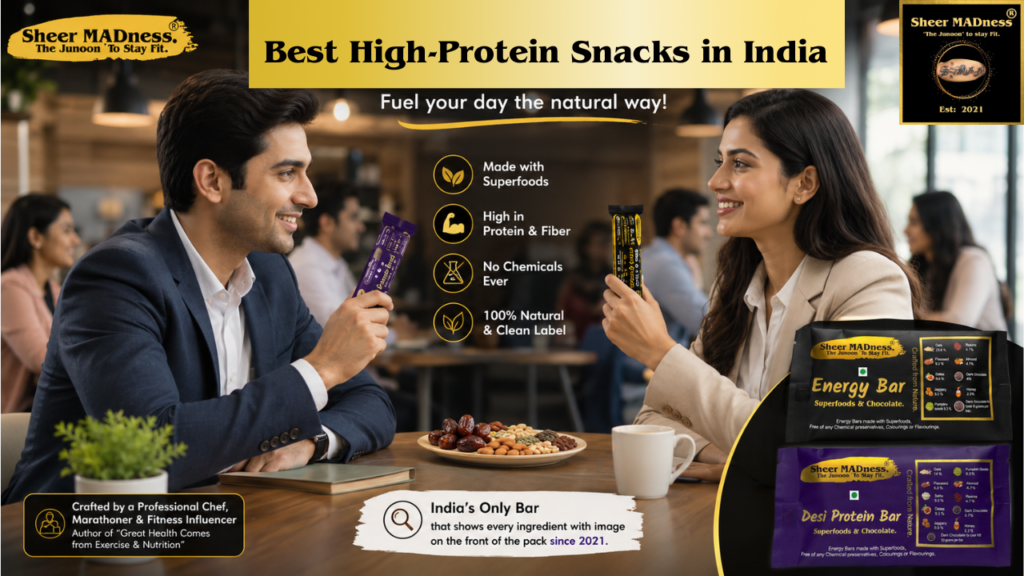
Sheer MADness Protein Bars, Energy Bars, and Millet Bars address every problem identified above. They are the only packaged high protein snack in India that simultaneously delivers whole-food protein, natural sweeteners, zero chemical preservatives, and complete front-label ingredient transparency.
Sattu provides the protein backbone — 20 to 22 grams per 100 grams at a glycaemic index of 28 to 35. Almonds add Vitamin E, magnesium, and prebiotic fibre. Oats contribute beta-glucan for gut health and sustained energy. Flaxseed delivers omega-3 fatty acids and lignans. Pumpkin seeds and melon seeds provide zinc and magnesium.
Together, these ingredients deliver 8 to 10 grams of protein per bar alongside 3 to 5 grams of fibre, 1 to 2 grams of omega-3, and meaningful contributions of iron, zinc, magnesium, and Vitamin E.
Dates, raisins, jaggery, and honey sweeten every Sheer MADness bar. These are the same sweeteners in India’s original peanut chikki, sattu laddoos, and traditional nut-and-date energy balls. They cause zero gut fermentation. They provide iron, potassium, and antioxidant polyphenols alongside their sweetening function.
Sheer MADness uses oxygen absorbers rather than BHA, BHT, or potassium sorbate. The physical environment around the food changes. The chemistry of the food never does. What leaves the kitchen is exactly what enters your body.
At ₹60 per bar, Sheer MADness competes directly with the ₹50 to ₹70 range of most commercial packaged protein snacks — while delivering dramatically superior ingredient quality. Furthermore, compared to preparing a sattu sharbat and assembling a nut-and-seed mix every day, a Sheer MADness bar requires zero preparation.
It is traditional Indian nutrition in portable, convenient bar form — at the price of a cup of café coffee.
| Snack | Protein per serving | Fibre | Whole food | Chemical additives | Portable | Cost |
|---|---|---|---|---|---|---|
| Sattu sharbat (30g sattu) | 6 to 7g | High | Yes | None | Requires prep | ₹5 to ₹10 |
| Roasted chana (30g) | 6g | Very high | Yes | None | Yes | ₹5 to ₹10 |
| Peanuts plain (30g) | 7.5g | Moderate | Yes | None | Yes | ₹10 to ₹15 |
| Peanut chikki jaggery (40g) | 6g | Moderate | Yes (if jaggery) | None if traditional | Yes | ₹15 to ₹20 |
| Mixed nuts and seeds (30g) | 7 to 9g | Moderate | Yes | None | Yes | ₹30 to ₹50 |
| Boiled eggs (2 eggs) | 12g | None | Yes | None | Requires prep | ₹20 to ₹30 |
| Hung curd with chana (100g) | 15 to 18g | Moderate | Yes | None if homemade | Requires prep | ₹20 to ₹30 |
| Sheer MADness bar (40g) | 8 to 10g | 3 to 5g | Yes — all whole food | Zero INS codes | Yes — packaged | ₹57.50 to ₹60 |
| Typical commercial protein bar | 10 to 20g | 0 to 2g | No — isolates used | BHA, BHT, INS 551 | Yes | ₹80 to ₹150 |
The table makes the picture clear. Traditional Indian whole foods deliver excellent high protein snack nutrition at very low cost. Sheer MADness bars deliver comparable nutrition in a fully packaged, portable format — at a reasonable premium over DIY traditional snacks, and at a significant cost and quality advantage over commercial chemical-laden bars.
The goal is to distribute protein across the day rather than consuming it all in one meal. Here is a practical routine that works for most Indian adults.
Start with a protein-rich breakfast — eggs, curd, sprouts, or a sattu drink alongside regular breakfast. Aim for 15 to 20 grams of protein at breakfast.
One Sheer MADness Protein Bar or a 30-gram handful of mixed nuts and seeds provides 7 to 10 grams of protein to bridge from breakfast to lunch. This reduces lunch portion size and prevents the overeating that comes from arriving at lunch genuinely hungry.
Dal, sabzi, roti, and curd provide another 15 to 20 grams of protein. Include sprouted legumes or paneer for additional protein density.
One bar or a serving of roasted chana provides another 6 to 10 grams. This prevents the 4pm energy crash and reduces dinner portion size.
Evening meals complete the daily protein target through dal, eggs, chicken, or paneer — whatever suits your dietary preferences.
This distribution across five eating occasions — rather than concentrating protein in two meals — is specifically what research identifies as optimal for muscle maintenance and body composition in adults.
Long work hours with inconsistent meal access create protein gaps. Mid-morning and mid-afternoon high protein snacks fill these gaps without significant calorie addition. Furthermore, protein specifically supports sustained cognitive function — directly beneficial for focus-intensive professional work.
Training without adequate protein distribution leads to slower muscle recovery and limited progress. High protein snacks in the pre-workout and post-workout windows directly support the muscle repair process.
Students frequently snack on biscuits, chips, and processed foods during study sessions. Replacing these with high protein snacks improves concentration, reduces hunger-driven distraction, and provides better sustained energy for long study periods.
Indian women are statistically underfed on protein — particularly vegetarian women whose diets rely heavily on carbohydrate staples. High protein snacking addresses this gap directly. Furthermore, many protein-supportive nutrients for women — iron, calcium, magnesium — appear naturally in the traditional high protein snacks listed above.
Muscle loss accelerates significantly after age 60 in sedentary adults. Adequate protein intake — including from high protein snacks across the day — is the most evidence-based dietary intervention for maintaining muscle mass in older adults. Furthermore, the whole-food ingredients in traditional and Sheer MADness bars specifically support bone density, gut health, and immune function relevant to seniors.
Healthy high protein snacks replace the biscuits, chips, and commercial sweets that dominate children’s snacking in India. Sheer MADness bars specifically suit children above 6 years — every ingredient is a recognisable whole food with no chemical additive of any kind.

As a professional chef, I evaluate snacks differently from a food scientist or a fitness coach.
Food scientists ask: what is the protein percentage? What is the shelf life? What is the manufacturing cost per unit?
I ask: does this food taste like food? Does it leave you satisfied or still craving something? Does it use real ingredients or does it use a chemistry set? Would my grandmother recognise every ingredient in it?
By these questions, the best high protein snacks in India are exactly what Indian food culture always produced. Sattu. Roasted chana. Mixed nuts and seeds. Peanut chikki with jaggery. Traditional ladoos made with sesame and jaggery. These snacks taste genuine. They satisfy genuinely. Every ingredient is recognisable.
Sheer MADness bars apply this same philosophy to a packaged format. The bar tastes like the sum of its ingredients — because it is. Dark chocolate, almonds, dates, and sattu produce a genuine, satisfying taste profile because every one of those ingredients naturally tastes good.
This is what the best high protein snacks in India share — whether traditional or modern. They are real food, experienced as real food.
Since 2021, Sheer MADness displays every ingredient with its own image on the front of every pack. This is the only packaged high protein snack in India doing this consistently. You see oats, almonds, sattu, flaxseed, pumpkin seeds, melon seeds, dates, raisins, jaggery, honey, and dark chocolate on the front label before you open the bar.
This transparency is possible because there is nothing to hide. Every ingredient is a whole food that earns its place by nutritional function — not by cost efficiency or processing convenience.
Sheer MADness holds a registered trademark under the Government of India. The Natural Plant Protein formula is patent published under Patent No. 202331036733, searchable on Intellectual Property India. The brand holds a valid FSSAI licence and GSTIN registration.
What are the best high protein snacks in India?
The best high protein snacks in India combine traditional whole-food options — roasted chana, sattu sharbat, peanuts, mixed nuts and seeds, peanut chikki with jaggery — with modern packaged options like Sheer MADness bars. All of these deliver protein alongside fibre, minerals, and natural sweeteners without chemical additives.
Which Indian snack has the most protein?
Peanuts provide approximately 25 grams of protein per 100 grams — the highest among common Indian snack foods. Sattu provides 20 to 22 grams per 100 grams. Roasted chana provides approximately 19 grams. For packaged bars, Sheer MADness delivers 8 to 10 grams per 40-gram bar — equivalent to 20 to 25 grams per 100 grams when calculated comparably.
Are protein bars better than traditional Indian high protein snacks?
Neither is universally superior. Traditional whole-food snacks — sattu, roasted chana, mixed nuts — are cheaper, require no packaging, and are equally nutritious. Packaged bars like Sheer MADness offer portability, consistency, and convenience that traditional preparations don’t. The best approach combines both — traditional whole-food snacks at home and whole-food bars when away from home.
What makes a high protein snack genuinely healthy?
A genuinely healthy high protein snack delivers protein alongside dietary fibre, natural minerals, and healthy fats — without chemical preservatives, artificial sweeteners, or synthetic additives. Traditional Indian whole foods and Sheer MADness bars both meet this standard. Most commercial packaged protein snacks do not.
Sattu is the most nutritionally complete traditional Indian protein snack. It provides 20 to 22 grams of protein per 100 grams with a glycaemic index of just 28 to 35, 7.6 grams of fibre, and meaningful contributions of iron, magnesium, and potassium. In terms of protein density, fibre content, and cultural appropriateness for Indian digestive systems, sattu has no peer among traditional Indian protein foods.
Can high protein snacks replace meals?
No. High protein snacks supplement meals — they don’t replace them. A complete meal provides the full spectrum of macronutrients, vitamins, and dietary diversity that a snack cannot. Protein snacks work best in the mid-morning and mid-afternoon windows between meals.
How much protein should a snack have?
For most adults, 6 to 15 grams of protein per snack is appropriate. This supplements meals without replacing them and contributes meaningfully to daily protein distribution. One Sheer MADness bar (8 to 10g), a 30g handful of peanuts (7.5g), or a sattu drink (6 to 7g) all fall within this range.
Are Sheer MADness bars suitable for vegetarians?
Yes. All Sheer MADness bars are vegetarian. They contain honey and are therefore not suitable for strict vegans. They contain no dairy, no eggs, no whey, and no casein.
India has always had excellent high protein snacks. Sattu, roasted chana, peanuts, peanut chikki, and mixed nuts are traditional foods that deliver genuine protein alongside fibre, minerals, and cultural compatibility with Indian digestive physiology — at very low cost.
The modern packaged snack market has largely obscured these options with chemical-laden, isolate-based products that deliver protein numbers but poor overall nutrition.
Sheer MADness bridges the traditional and modern worlds. It takes the Indian high protein snack tradition — sattu, almonds, flaxseed, dates, jaggery, seeds — and packages it in bar form with zero chemical additives, zero artificial sweeteners, and complete front-label transparency since 2021.
The best high protein snack for you depends on your lifestyle. At home with preparation time — sattu sharbat, roasted chana, and mixed nuts are excellent and inexpensive. On the move, at the office, or during travel — a Sheer MADness bar provides the same whole-food nutrition without any preparation.
Either way, the answer is real food. Not chemistry.
I would also request you to kindly read my previous post about “Healthiest Protein Bar in India“.
a) Everyone is an individual, so what suits me may not suit the next person.
b) If a person has a medical condition, a doctor’s advice and prescribed medication will only help.
c) While buying any packaged high protein snack from the market, read the labels carefully. Watch out for INS 320 (BHA), INS 321 (BHT), INS 551 (silicon dioxide), INS 202 (potassium sorbate), maltitol, sorbitol, sucralose, and other lab-made chemicals that quietly appear on most commercial labels.
If you are interested in buying chemical-free Natural Plant Protein Moringa, Health Drinks for Kids, or our delicious chemical-free Energy Bars, Protein Bars, and Millet Bars, shop at Sheer MADness.
You can also find us on Flipkart, Jio Mart, or ONDC in India.
d) Exercise is the key to fitness. Exercise and nutrition are two sides of the same coin and always go hand in hand.
e) Excess of anything is wrong, even the best whole-food snack. Consume only recommended quantities.
f) Rome was not built in a day. Discipline and consistency are the only keys to lasting health.
g) It is not only exercise and protein that builds health. A healthy gut, macro and micronutrients, body type, rest, and lifestyle all matter. Of all these, exercise and nutrition are within our control. Focus on these two primary aspects first.
h) The most important part of fitness is that nothing is better than exercise and a balanced meal.
Article by Chef Ashutosh Awasthi
Disclaimer: Our products are a source of HEALTHY NUTRIENTS and are COMPLETELY FREE OF ANY ADDED CHEMICALS. We do not claim to cure any medical condition. The content provided is informational. We do not claim to diagnose or treat a person with any specific medical condition.