
Direct answer: Protein bars are safe for teens when made from whole foods — oats, almonds, sattu, dates, jaggery, and flaxseed — with no protein isolates, no artificial sweeteners, no sugar alcohols, and no chemical preservatives. Protein bars built on whey isolate, maltitol, and BHT are not appropriate for regular teen consumption — their developing organ systems, gut microbiomes, and endocrine systems are more sensitive to synthetic chemical exposure than adult systems.
The more important question is whether a specific teenager needs a protein bar at all. Most Indian teens who eat reasonably balanced meals already meet their protein requirements from food. A protein bar is beneficial as a snack upgrade when a teen is regularly skipping breakfast, eating primarily carbohydrates between meals, or physically active in sports.
I’m Chef Ashutosh Awasthi, founder of Sheer MADness, professional chef, marathon runner, and author of Great Health Comes from Exercise & Nutrition. I formulate every product for my own family first. This guide gives parents and teens the honest, research-backed information needed to make the right decision.
Understanding protein requirements for teenagers prevents both underconsumption and overconsumption — both of which matter for this age group.
The Institute of Medicine’s Recommended Dietary Allowance for protein in teenagers is 34 grams per day for 13-year-olds, 46 grams per day for 14 to 18-year-old girls, and 52 grams per day for 14 to 18-year-old boys.
These requirements are meaningfully lower than adult athletic protein targets — which commonly reach 80 to 120 grams per day. Most teens who eat reasonably varied diets — dal, milk, curd, eggs, or paneer at meals — already meet these requirements from food alone.
A 2025 NPR report citing University of Michigan C.S. Mott Children’s Hospital noted that the vast majority of teens already get enough protein in their diet without supplements. A teen who has a glass of milk (8g protein), a bowl of dal (10g), and an egg (6g) in a day has already consumed 24 grams — almost 50 to 70 percent of their daily requirement from meals alone.
This reality is important context. A protein bar is a useful daily addition for teens who regularly skip breakfast, eat primarily carbohydrate snacks between meals, or train intensively for sports. It is not necessary for most Indian teens eating regular home meals. Parents should assess their specific teenager’s diet before assuming a protein bar is needed.
Medical authorities have raised specific concerns about commercial protein supplements for teenagers. Understanding these concerns helps parents evaluate both the category and individual bar choices.
Commercial protein bars with 20 to 25 grams of whey protein isolate per bar create a specific overconsumption risk for teens. A 14-year-old girl eating one such bar alongside a normal diet could easily exceed her 46-gram daily protein requirement significantly — particularly if she consumes it with a meal that already contains protein.
Consistently excessive protein intake from concentrated isolates places an unnecessary nitrogen filtration burden on the kidneys. Developing kidneys in teenagers handle this load less efficiently than adult kidneys. Over months of daily high-protein supplement use, this cumulative nitrogen load is an unnecessary and avoidable stress on developing renal systems.
Whole-food bars with 8 to 10 grams of protein per bar — from sattu, almonds, and oats — provide a moderate, appropriate daily protein addition that complements meals without risk of overconsumption in most teen diets.
This is the concern that medical authorities most specifically raise about teen protein supplement use — and the one most protein bar content completely ignores.
Research published in JAMA Pediatrics and reported through multiple pediatric medicine channels has documented a significant association between protein supplement use in adolescents and disordered eating behaviours. The University of California San Francisco pediatrician Dr. Jason Nagata specifically flagged this concern — protein supplement use in teens, particularly boys, is associated with increased risk of muscle dysmorphia and orthorexic eating patterns.
The concern is not that protein bars directly cause eating disorders. The concern is that framing food primarily through the lens of protein content and supplement use can distort a teenager’s relationship with food — teaching them to see eating as supplementation rather than as nourishment.
For Indian teens specifically — where academic pressure already creates enormous stress, and where body image concerns are increasingly prevalent — this psychological context matters. Parents should frame protein bar use for their teenagers as “a nutritious snack that contains real food” rather than as “a protein supplement for performance.” This framing difference shapes the psychological relationship a teenager develops with food and nutrition.
The gut microbiome is still developing significantly through adolescence. Research confirms that the composition and diversity established during childhood and teenage years has lasting effects on adult health — including immune function, metabolic efficiency, and mental health outcomes through the gut-brain axis.
Research published in Gut Microbes in 2021 confirmed that sucralose specifically reduced beneficial Lactobacillus and Bifidobacterium populations. For teenagers whose gut microbiomes are still developing, daily artificial sweetener exposure from commercial bars represents a more significant and more lasting disruption than the same exposure would cause in a mature adult gut.
Sugar alcohols compound this through gut fermentation disruption — causing the gas, bloating, and loose stools that make a teenager’s school day uncomfortable, while simultaneously disrupting the developing gut microbiome composition that will influence their adult health.
Adolescence is the most hormonally dynamic period in human life. The endocrine system undergoes the most profound changes of any life stage — puberty, growth hormone surges, the establishment of the reproductive hormonal axis, and the development of the stress-hormone regulation system.
BHA (INS 320) and BHT (INS 321) are potential endocrine disruptors. For adults, daily low-level endocrine disruptor exposure represents a manageable additional burden on established hormonal systems. For teenagers in the most sensitive phase of endocrine development, daily exposure to compounds that interfere with hormonal receptor signalling is an unnecessary risk.
Sheer MADness contains zero BHA, zero BHT, zero artificial sweeteners, and zero chemical preservative of any type. For teenage consumers, this zero-chemical formulation is not just a general health benefit — it is specifically protective during the most sensitive phase of hormonal development.
The “protein bar” framing can narrow the focus to protein alone — which misses what teenagers actually need most.
Adolescence is the critical window for peak bone mass accumulation. The bone density built between ages 12 and 25 largely determines lifelong fracture risk and osteoporosis risk. Calcium and magnesium are the primary nutritional requirements for this bone-building process — alongside Vitamin D from sunlight. Almonds in Sheer MADness bars provide calcium at approximately 264 milligrams per 100 grams alongside magnesium at 270 milligrams per 100 grams — both directly supporting the bone density building that adolescence specifically prioritises.
Iron requirements increase significantly during adolescence — particularly for girls after menarche. Iron deficiency anaemia is the most common nutritional deficiency in Indian teenage girls, with direct consequences for cognitive performance, energy levels, immune function, and exercise capacity. Jaggery, sattu, and raisins in Sheer MADness bars collectively provide meaningful daily iron from three whole-food sources.
Zinc supports the immune function that intensive study, sleep deprivation, and social crowding in Indian schools and coaching institutes challenges daily. It also participates in the hormonal enzyme activity that puberty specifically requires. Pumpkin seeds in Sheer MADness bars provide zinc at approximately 7.8 milligrams per 100 grams.
Omega-3 from flaxseed supports the brain development and synaptic plasticity that underpins learning and memory — directly relevant to the academic demands of Indian teenagers preparing for board examinations.
A genuinely good protein bar for teens is therefore not simply “a bar with adequate protein.” It is a bar that delivers protein alongside calcium, magnesium, iron, zinc, and omega-3 from whole-food sources — addressing the full nutritional demands of adolescent development.
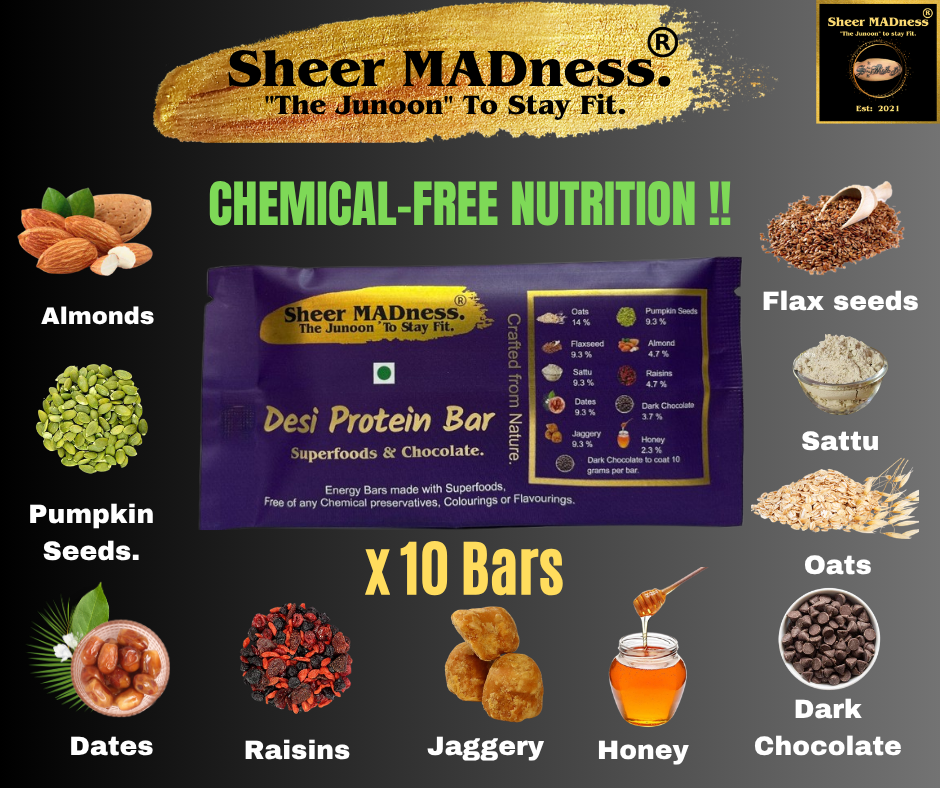
Sheer MADness Protein Bars and Energy Bars are specifically appropriate for Indian teenagers for reasons that go ingredient by ingredient.
Eight to ten grams of whole-food protein per bar from sattu, almonds, oats, and seeds complements teen meal-based protein without risking overconsumption. This is specifically different from 20 to 25-gram isolate bars that can push total daily protein significantly above teen requirements when added to normal meals.
Furthermore, the protein sources — sattu, almonds, and oats — are foods that Indian teenagers’ digestive systems recognise and process efficiently. Sattu has been an Indian food for centuries. Almonds have been given to Indian children for generations. Oats are a staple of contemporary Indian breakfast culture. None of these require the digestive adaptation that foreign protein concentrates demand.
The most important single reason Sheer MADness bars are appropriate for teens is the complete absence of BHA, BHT, maltitol, sucralose, and every other synthetic chemical additive.
Developing organ systems — kidneys, liver, gut, endocrine glands — process synthetic chemical compounds less efficiently than mature adult systems. Every day a teenager consumes a bar with BHT residues, maltitol fermentation by-products, and sucralose-driven microbiome disruption, their developing systems manage an additional synthetic load they were not evolved to handle.
Sheer MADness removes this problem entirely. The only compounds entering a teenager’s body from a Sheer MADness bar are the natural food compounds in oats, almonds, sattu, flaxseed, pumpkin seeds, melon seeds, dates, raisins, jaggery, honey, and dark chocolate — foods that human bodies have metabolised comfortably for thousands of years.
Calcium and magnesium from almonds directly support the peak bone mass accumulation that adolescence specifically prioritises. No commercial bar built on protein isolate delivers calcium and magnesium from whole-food sources alongside its protein. Sheer MADness delivers both — through almonds that provide them naturally rather than as synthetic supplements added to a processed base.
Iron deficiency is the most direct nutritional impairment to cognitive performance in Indian teenage girls. The oxygen supply to the brain that iron-dependent haemoglobin provides determines attention, working memory, and the sustained concentration that board examination preparation demands.
Jaggery, sattu, and raisins provide daily iron from three complementary whole-food sources in every Sheer MADness bar — alongside the natural vitamin C from raisins and dates that specifically enhances non-haem iron absorption.
Flaxseed omega-3 supports the synaptic plasticity that underlies learning — the cellular mechanism by which neural connections strengthen through repeated cognitive engagement. For a teenager studying 8 to 12 hours daily for competitive examinations, consistent daily omega-3 from a whole-food bar provides a genuine neurological support that most snack alternatives do not.
Oat beta-glucan specifically slows glucose absorption and provides sustained blood glucose over two to three hours. For Indian teenagers in coaching classes or study sessions that run from 9am to 9pm with limited breaks, sustained blood glucose from a mid-morning or mid-afternoon bar provides the cognitive fuel that refined carbohydrate snacks cannot.
Dates and jaggery provide natural energy alongside iron and minerals — rather than the refined sugar energy followed by a crash that most commercial snacks deliver.
Specific scenarios make protein bars a genuinely useful addition to a teen’s daily nutrition.
Many Indian teenagers skip breakfast — particularly during exam season when waking up and getting to school or coaching institute leaves no time for a morning meal. A Sheer MADness bar eaten on the commute provides more genuine nutrition than biscuits or no breakfast — protein, fibre, iron, and sustained energy from oat beta-glucan.
Teenagers who train seriously — cricket, football, athletics, swimming, basketball — have elevated protein and micronutrient requirements. Post-training protein from sattu and almonds within 30 minutes of finishing practice supports muscle repair. Iron and zinc from jaggery, pumpkin seeds, and raisins support the oxygen delivery and immune function that intensive training demands.
Indian teenagers in competitive exam preparation frequently attend coaching institutes from morning to evening, returning home depleted for dinner. A bar at mid-morning and mid-afternoon prevents the energy depletion that leads to poor concentration in later coaching sessions — and reduces the late-evening hunger that drives poor dinner food choices.
Vegetarian Indian teenagers who eat minimal dal, avoid paneer, and skip eggs may have genuine protein gaps. A whole-food bar contributes 8 to 10 grams of complementary plant protein daily — supporting the protein diversity that a narrow vegetarian diet otherwise lacks.
This section is important — honest guidance for parents includes knowing when a bar is unnecessary.
A teen who eats three balanced meals daily including dal, milk or curd, and some form of legume or egg does not need supplementary protein. Adding a bar on top of adequate dietary protein adds unnecessary calories without proportionate nutritional benefit.
A teen who is not physically active and is managing weight does not need the additional 180 to 200 kilocalories from a daily bar without a specific nutritional gap to address.
A teen showing signs of obsessive focus on protein, supplement use, or body composition should be guided toward conversation with a parent, doctor, or counsellor rather than toward additional supplement use. The psychological relationship with food during adolescence is as important as the nutritional relationship.
A teen under 13 years should not consume protein bars unless recommended by a paediatrician. Below age 13, nutritional needs are best met through age-appropriate whole foods rather than packaged snack supplements.
When choosing a protein bar for a teenager, parents should evaluate five specific things.
Check the protein quantity first. Eight to twelve grams per bar is appropriate for teens. Bars with 20 to 25 grams are designed for adult athletes and create overconsumption risk when added to normal teen diets.
Check the protein source. If whey protein isolate or soy protein concentrate appears first or second in the ingredient list, the protein comes from chemical extraction. Whole-food sources — oats, almonds, sattu, seeds — are always preferable for developing digestive systems.
Check the sweetener. Maltitol, sorbitol, sucralose, aspartame — any of these means daily gut fermentation disruption or microbiome alteration in a developing gut that cannot afford either.
Check for INS codes. INS 320 (BHA), INS 321 (BHT), INS 551 — any number-coded additive represents a synthetic chemical compound entering your teenager’s developing body daily.
Check the shelf life and preservation method. A bar lasting 18 months without stating oxygen absorbers or vacuum packing uses chemical preservatives. A genuinely clean bar states its preservation method clearly and has a shelf life of 4 to 6 months.
Sheer MADness passes every one of these checks. Eight to ten grams of whole-food protein. Oats, sattu, almonds as protein sources. Dates, jaggery, honey, raisins as sweeteners. Zero INS codes anywhere. Oxygen absorbers as stated preservation method. Four to six-month shelf life.
Since 2021, every ingredient is displayed with its own image on the front of every Sheer MADness pack — the most complete label transparency available from any Indian bar brand. Parents can see exactly what their teenager eats before the bar is opened.
This is the most important practical section in this post — and the one most protein bar content omits entirely.
Before giving a teenager a protein bar, frame the conversation correctly.
Do not say: “This is a protein supplement to help you build muscle or perform better.”
Do say: “This is a nutritious snack made from almonds, oats, sattu, dates, and dark chocolate — real food that gives you sustained energy, iron, and good nutrients for your school day.”
The first framing teaches a teenager to see food as supplementation — a mindset that can develop into an unhealthy relationship with eating, body image, and performance. The second framing teaches them to see food as nourishment — that genuinely good food is genuinely enjoyable food made from real ingredients.
Sheer MADness bars support the second framing precisely because they are real food. Every ingredient is something a teenager can see, name, and understand. The bar tastes like its ingredients — dark chocolate, almonds, and dates — because it is its ingredients. There is no synthetic flavour system masking an unpleasant protein isolate base.
This is the bar that earns a teenager’s trust through taste and earns a parent’s trust through ingredient transparency.
Sheer MADness holds a registered trademark under the Government of India. The Natural Plant Protein formula is patent published under Patent No. 202331036733, searchable on Intellectual Property India. The brand holds a valid FSSAI licence and GSTIN registration.
| Feature | Sheer MADness | Typical Commercial Bar |
|---|---|---|
| Protein quantity for teens | 8 to 10g — appropriate | 15 to 25g — overconsumption risk |
| Protein source | Sattu, almonds, oats — whole food | Whey isolate — lactose, concentrated nitrogen |
| Gut microbiome impact | Positive — no sweetener disruption | Negative — maltitol and sucralose |
| Endocrine disruptor risk | Zero — no BHA or BHT | Present — BHA, BHT potential disruptors |
| Bone-building minerals | Yes — calcium, magnesium from almonds | Usually absent or synthetic |
| Iron for teen girls | Yes — jaggery, sattu, raisins | Usually absent |
| Omega-3 for brain | Yes — flaxseed daily | Absent in most bars |
| Chemical preservatives | None — oxygen absorbers | BHA, BHT common |
| Artificial sweeteners | None | Sucralose, maltitol common |
| Eating disorder framing risk | Low — real food framing | Higher — supplement performance framing |
| Front-label transparency | Every ingredient named and pictured | INS codes in small print |
| Price per bar | ₹60 | ₹80 to ₹150 |
| Appropriate age | Above 13 years | Most marketed to adults 18+ |
Are protein bars safe for teens?
Yes — whole-food protein bars with 8 to 12 grams of protein from oats, almonds, and sattu, sweetened with dates and jaggery, and preserved with oxygen absorbers are safe for teenagers above 13 years. Commercial bars with 20 to 25 grams of protein isolate, maltitol, BHA, and BHT raise specific concerns for developing organ systems and gut microbiomes.
What age can teens start eating protein bars?
Thirteen years is the appropriate minimum age for protein bars as a daily snack. Below thirteen, whole-food nutrition from meals and natural snacks — fruit, nuts, curd — is preferable. For teenagers above thirteen, one bar daily as a snack replacement is appropriate when dietary protein gaps exist.
Do Indian teens need protein bars?
Most Indian teens who eat balanced meals do not need supplementary protein. A teen who regularly skips breakfast, eats primarily carbohydrate snacks between meals, or trains intensively in sports may benefit from one daily whole-food protein bar to address genuine nutritional gaps.
Can protein bars cause problems for teens?
Commercial bars with whey protein isolate, maltitol, artificial sweeteners, and chemical preservatives raise specific concerns for teens. High protein isolate doses risk overconsumption above teen requirements. Sugar alcohols disrupt the developing gut microbiome. Artificial sweeteners alter gut motility and microbiome composition. BHA and BHT are potential endocrine disruptors. Whole-food bars without these ingredients do not raise these concerns.
Medical research has documented an association between protein supplement use and disordered eating patterns in some adolescents — particularly muscle dysmorphia in teen boys. This concern is specifically about supplement-focused framing of food rather than about whole-food protein bars per se. Parents should frame bar consumption as “nutritious real-food snacking” rather than “protein supplementation.”
Can teenage girls eat Sheer MADness bars?
Yes — Sheer MADness bars are specifically appropriate for Indian teenage girls because they deliver iron from jaggery, sattu, and raisins for menstrual iron replacement, calcium and magnesium from almonds for bone density, omega-3 from flaxseed for anti-inflammatory hormonal support, and whole-food protein for muscle maintenance — all in one bar, from whole-food sources.
How many protein bars should a teen eat per day?
One bar per day as a snack replacement — mid-morning or mid-afternoon — is appropriate for most teens. Two bars per day is appropriate for athletes in intensive training. Exceeding two bars daily without a specific medical or athletic rationale pushes protein above teen requirements unnecessarily.
Are Sheer MADness bars suitable for teen athletes?
Yes. Post-training protein from sattu and almonds within 30 minutes of finishing practice supports muscle repair. Iron from jaggery, sattu, and raisins supports haemoglobin production and oxygen delivery to working muscles. Zinc from pumpkin seeds supports immune function during intensive training periods.
Protein bars are safe for teens when the bar is built from real food — whole-food protein at appropriate quantities, natural sweeteners, complete absence of chemical preservatives and endocrine disruptors, and ingredients that support the specific nutritional priorities of adolescent development.
The right bar for a teenager is not the bar with the highest protein number. It is the bar that delivers 8 to 12 grams of whole-food protein alongside calcium and magnesium for bone density, iron for cognitive and menstrual health, omega-3 for brain development, and zinc for immunity — without the synthetic chemical additives that developing organ systems and endocrine systems are specifically more vulnerable to than adult ones.
Sheer MADness bars deliver every one of these nutrients from ten whole-food ingredients — at ₹60 per bar, with every ingredient displayed on the front of the pack since 2021.
Furthermore, the conversation parents have with their teenagers about these bars matters as much as the ingredients themselves. Frame the bar as real food that provides genuine nourishment. Not as a supplement for performance or body composition. The teenager who grows up seeing food as nourishment — not as supplementation — builds a healthier, more sustainable relationship with eating that serves them for life.
I would also request you to kindly read my previous post about “Healthiest Protein Bar in India“.
a) Everyone is an individual, so what suits me may not suit the next person.
b) If a person has a medical condition, a doctor’s advice and prescribed medication will only help. Parents of teenagers with specific medical conditions, eating disorder histories, or metabolic conditions should consult a paediatrician before introducing any supplementary snack food.
c) While buying any protein bar for a teenager, read the labels carefully. Watch out for INS 320 (BHA), INS 321 (BHT), INS 551 (silicon dioxide), maltitol, sorbitol, sucralose, and whey protein concentrate — all of which raise specific concerns for developing teenage bodies and should be avoided.
If you are interested in buying chemical-free Natural Plant Protein Moringa, Health Drinks for Kids, or our delicious chemical-free Energy Bars, Protein Bars, and Millet Bars, shop at Sheer MADness.
You can also find us on Flipkart, Jio Mart, or ONDC in India.
d) Exercise is the key to fitness. Exercise and nutrition are two sides of the same coin and always go hand in hand.
e) Excess of anything is wrong, even the best whole-food snack. Consume only recommended quantities.
f) Rome was not built in a day. Discipline and consistency are the only keys to lasting health.
g) It is not only exercise and protein that builds health. A healthy gut, macro and micronutrients, body type, rest, and lifestyle all matter. Of all these, exercise and nutrition are within our control. Focus on these two primary aspects first.
h) The most important part of fitness is that nothing is better than exercise and a balanced meal.
Article by Chef Ashutosh Awasthi
Disclaimer: Our products are a source of HEALTHY NUTRIENTS and are COMPLETELY FREE OF ANY ADDED CHEMICALS. We do not claim to cure any medical condition. The content provided is informational. We do not claim to diagnose or treat a person with any specific medical condition.