

Direct answer: Yes — but only if the bar is made from the right ingredients.
Protein bars made from whole foods — oats, almonds, sattu, dates, and jaggery — are safe and nutritious for children above 6 years of age. However, protein bars made from protein isolates, artificial sweeteners, sugar alcohols, and chemical preservatives are not appropriate for children and should be avoided.
The difference between a bar that nourishes your child and one that harms them is entirely in the ingredient list. Most parents don’t know what to look for. This article tells you exactly what to check.
I’m Chef Ashutosh Awasthi, founder of Sheer MADness, professional chef, marathon runner, and author of Great Health Comes from Exercise & Nutrition. I transformed my own health in my forties. I formulate every product I sell for my own family first. Let me explain this the way a chef, a parent, and a fitness professional would.

Before deciding whether protein bars for kids are appropriate, it helps to understand how much protein a child actually needs.
The ICMR 2024 Recommended Dietary Allowances specify digestible protein thresholds that standard Indian meals of sabzi and roti sometimes miss — particularly during rapid growth spurts between ages 7 and 12. Fromthestartnutrition
As a general guide, children need approximately 0.95 grams of protein per kilogram of body weight per day. A 25-kilogram child aged 8 to 10 therefore needs roughly 24 grams of protein per day. A 40-kilogram teenager needs roughly 38 grams per day.
Most Indian children who eat a balanced diet with dal, eggs, dairy, and pulses meet these requirements through food alone. However, picky eaters, active children who play sport regularly, and vegetarian children who skip dal and pulses regularly may have gaps.
Furthermore, protein supplements only work effectively when paired with an active lifestyle and healthy sleep habits. High-quality kids’ nutrition should deliver critical daily micronutrients — not just protein numbers. Fromthestartnutrition
This is the most important starting point. Protein bars for kids should bridge a nutritional gap, not replace real food. They should complement a balanced diet, not become the diet itself.
The honest answer is that protein bars for kids are safe when they are made correctly and dangerous when they are not.
Here is precisely what makes the difference.
These are the most common protein source in commercial bars. Whey protein isolate, soy protein concentrate, and casein isolate are produced through industrial chemical extraction processes.
Too much protein — particularly from protein supplements — can put extra strain on a child’s kidneys. It can also cause a child to fill up and miss out on other important nutrients. Isolated protein hits a child’s system faster and more intensely than whole-food protein because the fibre, fat, and water that would normally slow absorption have been stripped away. Consequently, isolates are significantly harder on developing kidneys than whole-food protein sources. Sheer MADness
Artificial sweeteners including sucralose, aspartame, and acesulfame-K are common in commercial protein bars. Nutrition research has shown that limiting artificial flavours, colours, preservatives, and additives can improve behaviours and neurological outcomes for children affected by ADHD and Autism. Furthermore, these sweeteners alter gut bacteria composition in ways that are particularly concerning during the developmental years when a child’s microbiome is still being established. Sheer MADness
Sugar alcohols including maltitol, sorbitol, and erythritol pass through the small intestine undigested. In the large intestine, gut bacteria ferment them rapidly. The result is gas, bloating, and loose stools — a common experience for children who eat commercial protein bars regularly. Parents often don’t connect the symptoms to the ingredient.
Anti-caking agents like INS 551 (silicon dioxide) and chemical preservatives like BHA and BHT are present in most commercial protein bars. These compounds pass through your child’s digestive system daily if the bar is consumed regularly. A child’s developing gut, liver, and kidneys process these chemical residues every single day.
This is another concern. Most commercial protein bars are designed for adult athletes and deliver 15 to 20 grams of protein per bar. For a child who needs only 24 grams of protein for the entire day, one bar provides 60 to 80 percent of their daily protein in a single serving. Additionally, this leaves little room for protein from meals — pushing overall intake to levels that strain developing kidneys.
A safe protein bar for kids has a short, recognisable ingredient list. Every ingredient should be something you could buy at a grocery store and explain to a ten-year-old without difficulty.
The protein source should be a whole food — oats, almonds, sattu, seeds, or millets. Not a concentrate or isolate.
The sweetener should be natural — dates, jaggery, honey, or raisins. Not refined sugar, not maltitol, not sucralose.
The protein content should be moderate — 5 to 10 grams per bar is appropriate for children. This supplements meals without replacing them or overwhelming a child’s daily protein threshold.
There should be no INS codes anywhere on the label. No numbers that require a chemistry degree to decode. No ingredients you cannot explain in plain language.
Most parents read the big numbers on the front of a bar — protein grams, calorie count, price. However, the ingredients list on the back is what actually matters for your child’s health.
Look specifically for these on any bar before giving it to a child.
Protein isolate or protein concentrate as a primary ingredient — this means the bar’s protein comes from chemical extraction, not whole food.
Maltitol, sorbitol, xylitol, or erythritol — these are sugar alcohols that cause gut fermentation and digestive distress in children.
INS 551 — silicon dioxide, an anti-caking agent. The same compound found in sand.
BHA and BHT — butylated hydroxyanisole and butylated hydroxytoluene, synthetic antioxidant preservatives.
Sucralose, aspartame, or acesulfame-K — artificial sweeteners with documented effects on gut bacteria and neurological function in sensitive children.
“Natural flavour” — this term legally covers dozens of synthetic compounds derived from natural sources through chemical extraction. It is not the same as natural food.
Whole food ingredients listed first — oats, almonds, dates, sattu, pumpkin seeds, millets.
Natural sweeteners clearly named — dates, jaggery, honey, raisins. Not “natural sweetener” as a vague catch-all.
Moderate protein content — 5 to 10 grams per bar from whole food sources.
Fibre content of 3 grams or more per bar — this indicates whole food ingredients rather than refined isolates.
No INS codes anywhere on the label — if you see INS followed by a number, something synthetic is in the bar.
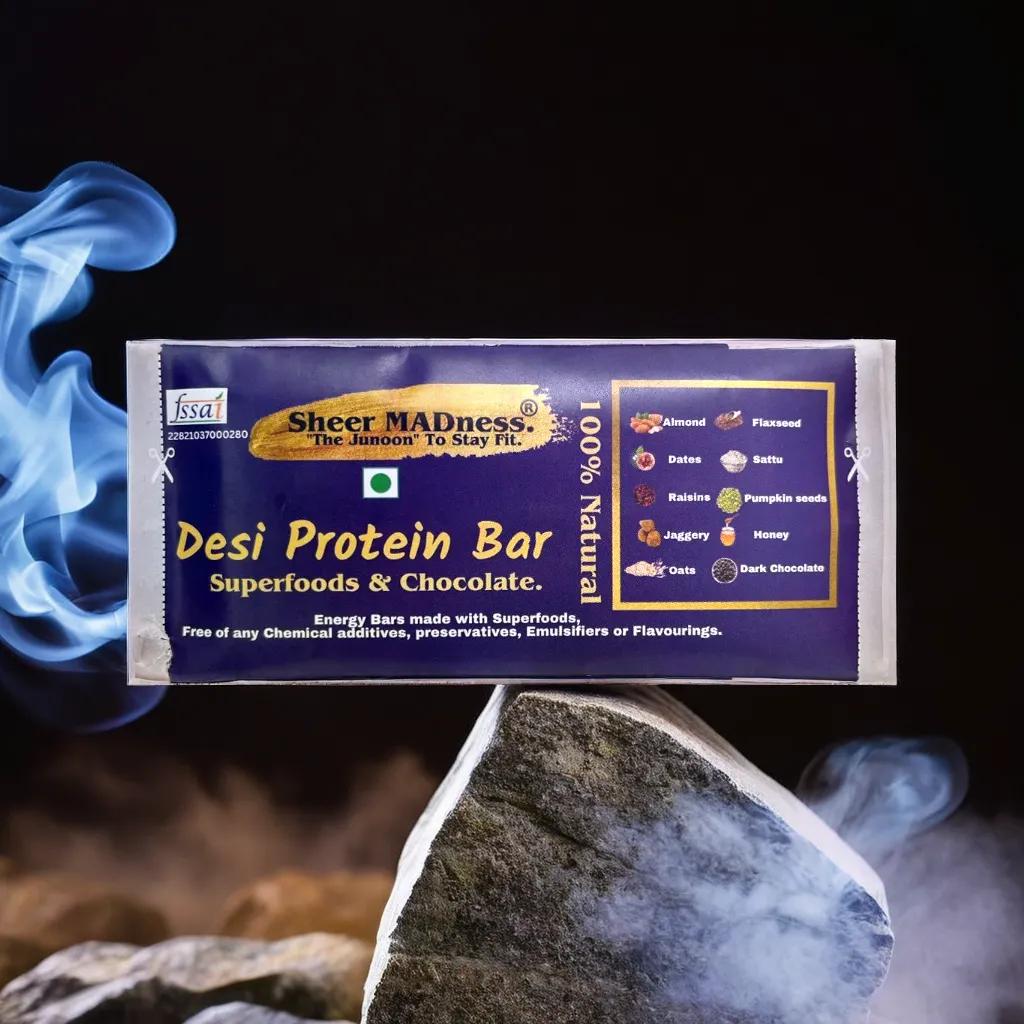
Front-of-pack ingredient transparency — since 2021, Sheer MADness has displayed every ingredient with its own image on the front of every pack. No other Indian bar brand does this. Pick up a Sheer MADness bar and you see exactly what is inside it before you open it.
Sheer MADness Protein Bars, Energy Bars, and Millet Bars are the only completely chemical-free bars in India that are safe for regular consumption by children above 6 years.
Here is exactly what makes them different.
The protein in every Sheer MADness bar comes from oats, sattu (roasted chickpea flour), almonds, pumpkin seeds, and millet — depending on the variant. Not one bar uses a protein isolate or concentrate of any kind.
Sattu specifically is worth highlighting. It is roasted chickpea flour — one of the oldest Indian protein foods, consumed in Bihar, Bengal, and Uttar Pradesh for centuries by children and adults alike for sustained energy and easy digestion. Indian children’s bodies have handled sattu comfortably for generations. The same cannot be said of imported whey isolate.
Sheer MADness bars are sweetened with dates, raisins, jaggery, and honey. No refined sugar or maltitol. No sucralose, or sorbitol.
The natural sugars in dates and raisins come packaged with fibre. Consequently, they release energy gradually rather than causing the blood sugar spike and crash that refined sugar causes in children — the cycle that drives hyperactivity followed by fatigue that parents often see mid-morning and mid-afternoon.
Sheer MADness bars use oxygen absorbers to extend shelf life. We remove oxygen from inside the packaging entirely. No oxygen means no oxidation and no microbial growth — without a single preservative chemical.
Therefore, a child eating a Sheer MADness bar is not consuming BHA, BHT, INS 551, or any other chemical compound daily. Their gut, liver, and developing kidneys process only real food.
Every Sheer MADness bar delivers 3 to 5 grams of dietary fibre per 40-gram bar. This fibre comes entirely from whole-food sources — oats, flaxseed, almonds, sattu, and pumpkin seeds.
Dietary fibre is critical for children’s gut health. It feeds beneficial gut bacteria, supports regular bowel movement, and prevents the constipation that many commercial protein bars cause through their sugar alcohol content. Moreover, a healthy gut microbiome in childhood is increasingly linked to better immune function, mood regulation, and cognitive development.
Protein bars for kids work best in specific situations. Here are the scenarios where they genuinely help.
A whole-food bar in a school tiffin provides sustained mid-morning or mid-afternoon energy from balanced carbohydrates, healthy fats, and protein. Furthermore, it prevents the hunger and energy crash that drives children to reach for crisps, biscuits, and other low-nutrition packaged foods.
Active children who play sport, attend dance class, or participate in physical activity regularly have higher energy and protein needs than sedentary children. A whole-food bar within 30 minutes of activity replenishes glycogen stores and provides the protein needed for muscle repair without overwhelming daily protein requirements.
Indian vegetarian diets rely heavily on dal, rajma, chana, and eggs for protein. Children who routinely refuse these foods may have genuine protein gaps. In this case, a bar containing sattu and almonds bridges that gap in a form children actually enjoy eating.
Oxygen-absorbed packaging means Sheer MADness bars don’t need refrigeration for normal travel durations. They are a reliable, chemical-free option for long car journeys, train travel, or family outings when nutritious food is difficult to access.
It is equally important to be honest about when protein bars are the wrong choice for children.
Protein bars should not replace meals. A bar is a snack — not a substitute for breakfast, lunch, or dinner. Children need the full spectrum of nutrients that a balanced meal provides, including vitamins and minerals that even the best whole-food bar cannot fully replicate.
Additionally, protein bars are not appropriate for children under 6 years of age. Young children’s nutritional needs are best met through breast milk, formula, and whole foods appropriate to their developmental stage.
Furthermore, protein bars are not appropriate as a daily multiple-serving habit. One bar per day as part of a balanced diet is the right approach. Three bars per day as a convenience-driven meal substitute is not.
Finally, always check the allergen information. Sheer MADness bars contain almonds — not suitable for children with tree nut allergies. They also contain oats — those with diagnosed Coeliac disease should consult their doctor.
This is the honest question most parents are actually asking. The answer is nuanced.
A whole-food snack — a handful of almonds and dates, or a small bowl of sattu mixed with jaggery and water — is nutritionally equivalent or superior to a bar. Moreover, it is cheaper and has zero packaging.
However, the practical reality of modern Indian family life is that whole-food snacks are not always available, prepared, or accepted by children. A bar that contains exactly those ingredients — almonds, dates, sattu, jaggery — in a convenient, sealed, palatable format solves the real-world problem without nutritional compromise.
This is precisely why Sheer MADness bars exist. They are not superior to real food. They are real food in a portable format — nothing more, nothing less.
Follow these practical guidelines to use protein bars for kids appropriately.
Give one bar per day maximum for children between 6 and 12 years. This supplements the diet without pushing protein intake to excessive levels.
Always pair with water or milk. Fibre from whole-food bars needs adequate hydration to work properly in the digestive system.
Use bars as snacks, not meal replacements. Pack alongside fruit, vegetables, and a proper lunch — not instead of them.
Read every label every time before giving any bar to a child. Formulations change. Always confirm there are no new additives, sweeteners, or chemical ingredients added in a product reformulation.
Introduce gradually. Give any new food to children gradually to monitor for allergic reactions, particularly to nuts, seeds, and oats.
Store correctly. Whole-food bars without chemical preservatives have a shorter shelf life than commercial bars. Check the best-before date and refrigerate after opening the pack.
Yes, when made from whole-food ingredients with no protein isolates, no artificial sweeteners, no sugar alcohols, and no chemical preservatives. Whole-food bars made from oats, almonds, sattu, dates, and jaggery are safe for children above 6 years at one bar per day.
Safe for children above 6 years of age. For ages 6 to 12, one 40-gram bar per day is appropriate. For teenagers above 12, one to two bars per day as part of a balanced diet is suitable.
Approximately 0.95 grams of protein per kilogram of body weight per day as per ICMR 2024 guidelines. A 25-kilogram child needs roughly 24 grams daily. A 40-kilogram teenager needs roughly 38 grams. One Sheer MADness bar provides 8 to 10 grams of protein supplements meals appropriately without exceeding daily requirements.
No. Protein bars supplement meals — they do not replace them. Children need the full range of nutrients that balanced meals provide. Bars work best as mid-morning or mid-afternoon snacks alongside proper breakfast, lunch, and dinner.
Avoid whey or soy protein isolate, maltitol, sorbitol, sucralose, aspartame, INS 551 (silicon dioxide), BHA, BHT, and “natural flavour” as a catch-all. All of these are common in commercial bars and none are appropriate for regular daily consumption by children.
Yes. One Sheer MADness bar per day for children above 6 years is safe for daily use. Every ingredient is a recognisable whole food with no chemical additive of any kind. However, always check allergen information — our bars contain almonds and oats.
Yes. Sheer MADness bars contain no dairy ingredients. They are completely dairy-free in their ingredient base — safe for lactose-intolerant children.
No. Sheer MADness bars contain almonds and are not suitable for children with tree nut allergies.
No. All sweetness in Sheer MADness bars comes from dates, raisins, jaggery, and honey — natural whole-food sweeteners with nutritional value. No refined sugar is added.
Protein bars for kids are safe — but only if they are made from whole foods, sweetened naturally, and completely free of chemical additives.
The question is never simply “are protein bars okay for kids?” The better question is always “what is actually in this bar?” Read the label. Look for whole-food ingredients in plain language. Reject INS codes, isolates, and artificial sweeteners.
Whole-food protein from oats, sattu, and almonds. Natural sweeteners from dates, jaggery, and honey. Zero preservatives. Zero INS codes. Every ingredient named and pictured on the front of the pack since 2021.
That is the standard every protein bar for kids should meet. Currently in India, only one brand consistently meets it.
a) Everyone is an individual, so what suits me may not suit the next person.
b) If a person has a medical condition, a doctor’s advice and prescribed medication will only help.
c) While buying any protein bar from the market, read the labels carefully. Watch out for codes and words like Anti-caking agent, INS 551 (Silicon dioxide), BHA (Butylated hydroxyanisole), BHT (Butylated hydroxytoluene), maltitol, sorbitol, sucralose, and other lab-made chemicals that quietly appear on most commercial labels.
If you are interested in buying chemical-free Natural Plant Protein Moringa, Health Drinks for Kids, or our delicious chemical-free Energy Bars, Protein Bars, and Millet Bars, shop at Sheer MADness.
d) Exercise is the key to fitness. Exercise and nutrition are two sides of the same coin and always go hand in hand.
e) Excess of anything is wrong, even the best whole-food snack. Consume only recommended quantities.
f) Rome was not built in a day. Discipline and consistency are the only keys to lasting health.
g) It is not only exercise and protein that builds health. Numerous factors matter — a healthy gut, macro and micronutrients, body type, rest, and lifestyle. Of all these, exercise and nutrition are within our control. Focus on these two primary aspects first.
Article by Chef Ashutosh Awasthi
Disclaimer: Our products are a source of HEALTHY NUTRIENTS and are COMPLETELY FREE OF ANY ADDED CHEMICALS. We do not claim to cure any medical condition. The content provided is informational. We do not claim to diagnose or treat a person with any specific medical condition.