
Direct answer: Yes — protein bars are excellent for trekking when built from whole foods that deliver sustained energy, portable protein, natural iron and electrolytes, and dietary fibre that supports digestion in conditions where normal meals are impossible. They must also be preserved without chemistry — because chemical preservatives perform worse in the heat, sun exposure, and physical stress of trail conditions than oxygen-absorber-preserved whole-food bars do.
The wrong bar — built on maltitol, whey isolate, and BHT — is actively worse for trekking than no bar at all. Sugar alcohol fermentation causes severe digestive distress at altitude, where gut motility is already compromised. Whey protein places a concentrated nitrogen load on kidneys that are already managing dehydration stress on the trail.
I’m Chef Ashutosh Awasthi, founder of Sheer MADness, professional chef, marathon runner, and author of Great Health Comes from Exercise & Nutrition. I understand sustained physical performance nutrition from direct experience as a marathon runner. Trekking and long-distance running share the same fundamental nutrition challenges — and the same solutions. Let me explain exactly what trekking demands nutritionally and why whole-food bars are the most practical solution available.
Trekking is one of the most energy-intensive sustained activities most people do. Understanding the specific demands explains why nutrition matters so much on the trail.
A trekker burns approximately 3,000 to 5,000 kilocalories per day on a moderate to difficult Himalayan or Western Ghats trek — depending on altitude, terrain, pack weight, and individual body size. This is two to three times the caloric requirement of a sedentary day. The body draws on three energy systems simultaneously to meet this demand.
Carbohydrates provide the primary quick energy for muscle contraction during climbing. Healthy fats provide the sustained background energy that powers hours of continuous movement — particularly important for treks lasting 6 to 10 hours daily. Protein prevents muscle breakdown during prolonged physical effort — when glycogen stores decline, the body can begin catabolising muscle protein for fuel.
Electrolytes — sodium, potassium, magnesium — are lost through sweat continuously. At altitude, sweat rates decrease but electrolyte losses continue. Magnesium specifically is lost through sweat and urine at higher rates during physical exertion, and low magnesium causes the muscle cramps that affect many trekkers in the later hours of a long day.
Iron supports haemoglobin’s capacity to carry oxygen in red blood cells. At altitude, where atmospheric oxygen pressure is lower, iron becomes even more important — the body attempts to compensate for lower oxygen availability by producing more red blood cells, a process that depends on adequate iron.
A food that delivers carbohydrates for quick energy, fats for sustained energy, protein for muscle protection, electrolytes for cramping prevention, and iron for oxygen delivery in one portable, non-perishable package — is the ideal trekking food. Sheer MADness bars deliver all five.
Indian trekking culture centres on some of the most dramatically varied altitude environments in the world.
The Himalayas — Kedarnath, Hemkund Sahib, Roopkund, Pin Parvati Pass, and dozens of others — take trekkers from 2,000 to 5,000-plus metres above sea level. At these altitudes, atmospheric oxygen pressure is 50 to 70 percent of sea level oxygen. The body responds by increasing respiratory rate, elevating heart rate, and beginning to produce more red blood cells.
The Western Ghats — Harishchandragad, Kalsubai, Rajmachi — are lower altitude but present different challenges: high humidity, dense vegetation, and long ascents through variable terrain.
Altitude creates two specific nutrition challenges that flat-terrain exercise does not.
The first is appetite suppression. Research published in the Journal of Applied Physiology confirmed that appetite decreases significantly at altitudes above 3,000 metres — a phenomenon driven by changes in leptin and ghrelin signalling at altitude. Trekkers in the Himalayas often find that they cannot eat a full meal even when they know they need to, and that their usual hunger cues are absent. This makes calorie-dense, easily consumed, small-volume foods specifically valuable — exactly what a well-formulated protein bar provides.
The second is increased gut sensitivity. Altitude increases gut permeability through mechanisms involving oxidative stress and reduced splanchnic blood flow. This makes the gut more reactive to food irritants than at sea level. Sugar alcohols — the maltitol and sorbitol in most commercial bars — are significantly more problematic at altitude than at sea level. The fermentation-driven gas and cramping they cause on flat terrain becomes severe abdominal distress on a steep ascent at 4,000 metres.
A research review published in the British Journal of Sports Medicine on gastrointestinal function at altitude confirmed that gut symptoms are among the most common and most performance-limiting complaints among high-altitude trekkers and mountaineers. Choosing foods that cause zero gut fermentation is not a preference at altitude — it is a functional performance requirement.
At 180 to 200 kilocalories per 40-gram bar, Sheer MADness bars provide meaningful energy density in a package that weighs less than 50 grams with wrapping. For trekkers managing pack weight on multi-day treks, calorie-per-gram is one of the most important food selection criteria.
One box of 10 Sheer MADness bars provides 1,800 to 2,000 kilocalories — approximately 40 to 65 percent of a trekker’s daily energy requirement — in 400 grams of total weight including packaging. This energy-to-weight ratio is comparable to purpose-built trekking foods and significantly better than most fresh food alternatives.
Research published in Sports Medicine on fuel utilisation during prolonged moderate-intensity exercise confirmed that the optimal macronutrient ratio for endurance activities like trekking combines carbohydrates for quick energy with fats for sustained background energy — exactly the combination that natural dates and oats alongside almond and flaxseed fats provide.
Oat beta-glucan specifically provides the slow-releasing carbohydrate energy that powers sustained uphill effort over 2 to 4 hours without the blood sugar spike and crash that refined sugar provides. The natural fats from almonds extend the energy window beyond the carbohydrate burn — providing sustained fuel for the final hours of a long day when glycogen stores are depleted.
The 8 to 10 grams of protein from sattu, almonds, and oats prevents the muscle protein breakdown that occurs when glycogen runs low during a very long day — specifically relevant for the 8 to 10-hour trekking days that challenging routes demand.
Magnesium from almonds and dark chocolate supports the muscle contraction and relaxation cycle that trekking continuously demands. Potassium from dates and raisins replaces the potassium lost through sweat — the mineral most associated with muscle cramping when depleted. Sodium from jaggery’s natural mineral content contributes modest sodium replacement alongside these other electrolytes.
Commercial bars with synthetic electrolyte supplements added to a processed base deliver electrolytes in a less bioavailable form than whole-food sources provide. The electrolytes from almonds and dates arrive packaged with the cofactors and food matrices that the body processes efficiently — not as standalone minerals added to a protein powder mix.
At altitude, the body attempts to compensate for lower atmospheric oxygen pressure by producing more red blood cells — the process called altitude acclimatisation. This process requires iron. Trekkers with suboptimal iron status acclimatise more slowly and experience more severe altitude symptoms than those with adequate iron.
Jaggery provides iron at approximately 11 milligrams per 100 grams. Sattu provides 8 to 9 milligrams per 100 grams. Raisins add additional iron alongside natural vitamin C. Together, three whole-food iron sources in one bar provide a meaningful daily iron contribution — directly supporting the acclimatisation process that altitude trekking demands.
This iron benefit is unique to Sheer MADness among Indian protein bars. No commercial bar built on whey protein isolate delivers meaningful iron from whole-food sources.
As discussed above, altitude increases gut sensitivity. The last thing a trekker at 4,500 metres needs is a bar containing maltitol that will ferment in their colon during a steep climb.
Sheer MADness bars contain zero sugar alcohols. Zero artificial sweeteners. Zero synthetic emulsifiers. The digestive simplicity of whole foods — oats, almonds, dates, sattu — is specifically valuable at altitude where gut chemistry is already challenged.
Dates and jaggery provide natural sugars that absorb normally through the small intestine without reaching the large intestine in quantities that ferment. Oat beta-glucan forms a gut-soothing gel that actually protects against the increased gut permeability of altitude. Flaxseed mucilage soothes the gut lining rather than irritating it.
This section explains why ingredient quality matters even more during trekking than during daily consumption.
Sugar alcohols ferment in the large intestine regardless of altitude. However, the gas produced by this fermentation expands at altitude — because lower atmospheric pressure allows gases to expand to greater volumes inside the gut. What causes bloating and mild discomfort at sea level causes significant abdominal pain and cramping at altitude.
Research on mountaineers and high-altitude trekkers consistently identifies gastrointestinal distress as one of the most common causes of trek abandonment and reduced performance at altitude. Choosing bars with zero sugar alcohols specifically reduces this risk.
Most trekkers are mildly dehydrated during the day — particularly at altitude where increased respiratory rate causes continuous moisture loss from breathing. The kidneys of a mildly dehydrated trekker are managing fluid conservation while also processing the nitrogen from protein metabolism.
Adding BHT and BHA chemical preservative residues to this kidney load — from a commercial bar consumed for energy — is unnecessary when oxygen absorbers achieve the same shelf-life function without any chemistry entering the food. A dehydrated kidney processing synthetic chemical residues alongside nitrogen from protein and altitude-driven physiological stress is an unnecessary combined burden.
Temperature varies dramatically during a trekking day — from cold mornings to warm afternoons to cold evenings. Chemical preservatives like BHT are incorporated into food specifically to prevent fat oxidation. However, at the temperature fluctuations typical of Himalayan treks, the stability of these synthetic antioxidants is challenged.
Oxygen absorbers, by contrast, work entirely independently of temperature — they remove oxygen from the sealed package regardless of external temperature. The food inside a Sheer MADness bar remains chemically identical across the temperature range of a trekking day because no oxygen is present to initiate oxidation, regardless of temperature.
Sheer MADness Protein Bars and Energy Bars are specifically suited to Indian trekking for reasons that go beyond generic “clean label” marketing.
The ingredients in Sheer MADness bars — oats, almonds, sattu, dates, jaggery, flaxseed, pumpkin seeds — are all foods that Indian trekkers’ digestive systems have processed comfortably for generations. There is no foreign food adaptation required. Indian trekkers’ guts handle sattu, almonds, and jaggery-based foods efficiently because these are culturally familiar whole foods, not foreign protein concentrates.
This matters specifically at altitude, where digestive sensitivity increases. The gut at 4,000 metres handles familiar whole-food compounds more efficiently than foreign protein concentrates — reducing the risk of the digestive distress that is already elevated by altitude conditions.
Himalayan trekking logistics are challenging. Porters carry food for multi-day treks. Tea houses provide limited food options at altitude. Reliable access to fresh protein sources — eggs, dal, paneer — becomes increasingly uncertain above 3,500 metres.
Sheer MADness bars require no refrigeration and remain stable for 4 to 6 months from manufacturing. The oxygen absorber packaging that achieves this shelf stability performs across the temperature range of Himalayan trekking — from sub-zero nights to warm midday sun — without requiring any chemical preservative contact with the food.
Each Sheer MADness bar weighs approximately 40 to 45 grams including wrapping. A supply of 5 bars for a day’s trekking weighs 200 to 225 grams — less than a medium apple and a banana combined, while delivering 900 to 1,000 kilocalories alongside meaningful protein, iron, magnesium, and potassium.
Sheer MADness bars are soft and chewy — bound with dates and honey rather than baked or pressed hard. This texture remains consistent across the temperature variations of a trekking day. Cold morning temperatures firm the bar slightly. Warm afternoon temperatures soften it slightly. Neither extreme makes the bar unusable — it simply adapts to ambient temperature without melting or hardening to inedibility.
Understanding when to eat on the trail maximises the energy benefit from each bar. I approach this from the same nutritional timing philosophy that informs my marathon training.
Eat one bar 30 to 45 minutes before beginning the day’s trekking. This allows partial digestion before the physical effort begins. The oat beta-glucan begins slowing glucose absorption. The natural sugars from dates and raisins enter the bloodstream. The healthy fats from almonds begin providing sustained background energy.
Eating immediately before a steep climb risks the stitch and nausea that undigested food causes during intense uphill effort. The 30 to 45-minute gap prevents this entirely.
Eat one bar between two and three hours into the day’s trekking. By this point, the energy from breakfast and the morning’s bar is declining. Glycogen stores are partially depleted. The mid-morning bar refuels the sustained energy system before the depletion that causes the “bonk” — the sudden fatigue that occurs when glycogen runs critically low.
At altitude, this timing is even more important because appetite signals are suppressed. Eating before you feel hungry at altitude prevents the glycogen depletion that hunger signals would otherwise warn you about at sea level.
At tea houses and lunch spots, eat whatever warm food is available — dal bhat, roti, thukpa, or whatever the location provides. The protein bar is not a meal replacement on the trail. It bridges the gaps between proper meals when the terrain or timing makes meal stops impractical.
Eat one bar one to two hours before reaching camp for the day. This provides the sustained energy needed for the final climb to camp — often the most demanding section of the day when fatigue has accumulated. The protein in sattu and almonds at this point also begins supporting the overnight muscle repair that the next day’s trekking depends on.
One bar at camp after reaching the destination provides protein for muscle recovery, natural sugars for glycogen restoration, and magnesium from almonds and dark chocolate for the muscle relaxation that allows quality recovery sleep.
Multi-day Himalayan treks require careful food planning. Here is a practical packing framework.
For a 3-day trek of moderate difficulty, pack 12 to 15 bars — 4 to 5 per day. This provides morning pre-trek fuel, two mid-trail refuelling points, and an evening recovery bar each day, while leaving room for tea house meals.
For a 5-day trek, pack 20 to 25 bars. Distribute them evenly across days, keeping 2 to 3 bars in the top accessible section of your day pack for trail access without stopping to open the main pack.
Carry each day’s bars in the outer hip belt pocket or top lid pocket of your trekking pack. The individual wrapping protects each bar from physical damage during the day. Do not remove bars from their individual packaging until ready to eat — the packaging maintains freshness between uses on multi-day treks where the full box is not opened daily.
For international trekking destinations, check customs food import regulations for your destination. FSSAI-certified commercially packaged food products are generally accepted for personal use.
Different Indian trekking destinations create different nutritional demands.
Kedarnath, Hemkund Sahib, Roopkund, Rupin Pass, and similar high-altitude routes create the most demanding nutritional environment. Altitude-suppressed appetite makes calorie-dense, small-volume bars essential. Iron for acclimatisation is critical. Zero gut-fermenting ingredients are non-negotiable.
Pack a higher ratio of Energy Bars — with slightly higher carbohydrate content — for high-altitude routes where quick accessible energy is the primary requirement during altitude acclimatisation.
Valley of Flowers, Kuari Pass, Chopta Tungnath, and similar moderate-altitude routes have better appetite and more accessible tea house food. The balance of Energy Bars and Protein Bars is appropriate here — energy bars for the sustained climbing effort and protein bars for recovery.
Harishchandragad, Kalsubai, Rajmachi, and similar lower-altitude but high-humidity routes create different demands. Electrolyte replacement is more critical in the high humidity. Potassium from dates and raisins alongside magnesium from almonds specifically addresses the heat and humidity-driven electrolyte losses these routes produce.
The Western Ghats’ reliable tea house access at many stops means bars serve primarily as between-stop fuel rather than the primary caloric source they become on remote Himalayan routes.
Since 2021, Sheer MADness displays every ingredient with its own image on the front of every pack. On a multi-day trek where carrying supplementary food is carefully considered and every item in the pack has earned its place, knowing exactly what you are eating from a single glance at the packaging matters.
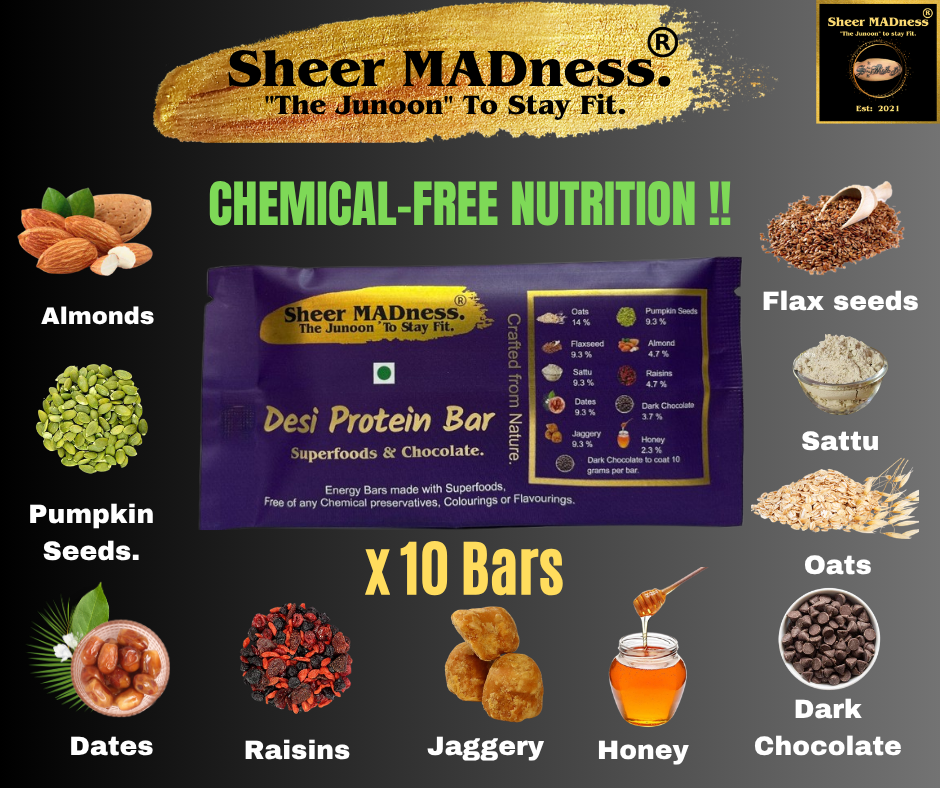
You see oats, almonds, sattu, flaxseed, pumpkin seeds, melon seeds, dates, raisins, jaggery, honey, and dark chocolate on the front before opening the bar. No INS code requires decoding. No chemical name hides in small print. Every ingredient is a whole food that Indian trekkers recognise and trust.
Sheer MADness holds a registered trademark under the Government of India. The Natural Plant Protein formula is patent published under Patent No. 202331036733, searchable on Intellectual Property India. The brand holds a valid FSSAI licence and GSTIN registration.
| Feature | Sheer MADness | Typical Commercial Bar |
|---|---|---|
| Altitude gut safety | High — zero sugar alcohols | Low — maltitol fermentation worsens at altitude |
| Sustained energy | High — oat beta-glucan + almond fats | Variable — often refined sugar spike |
| Iron for acclimatisation | Yes — jaggery, sattu, raisins | Usually absent |
| Electrolytes | Yes — magnesium, potassium from almonds and dates | Often synthetic, not from whole food |
| Chemical preservatives | None — oxygen absorbers | BHA, BHT — dehydration compounds processing |
| Altitude temperature stability | High — oxygen absorbers work at all temps | Variable — chemical preservatives temp-dependent |
| Refrigeration required | No | No |
| Shelf life method | Oxygen absorbers — stated clearly | Chemical preservatives — often unstated |
| Shelf life | 4 to 6 months | 12 to 18 months |
| Weight per bar | 40 to 45g | 40 to 80g |
| Calories per bar | 180 to 200 kcal | 150 to 400 kcal |
| Gut-friendly at altitude | Yes — no fermentation triggers | No — multiple fermentation risk ingredients |
| Price per bar | ₹60 | ₹80 to ₹200 |
Are protein bars good for trekking?
Yes — whole-food protein bars with balanced macronutrients, natural sweeteners, meaningful iron and electrolytes, and zero chemical preservatives are excellent trekking food. They provide portable energy density, muscle protection protein, electrolyte replacement, and iron for altitude acclimatisation in one lightweight package.
How many protein bars should I carry for a trek?
Four to five bars per day is appropriate for moderate to difficult trekking where tea house meals are available. For remote routes with limited food access, increase to 5 to 7 bars per day. A 3-day moderate Himalayan trek requires 12 to 15 bars. A 5-day trek requires 20 to 25 bars.
Why are sugar alcohols specifically bad for trekking?
Sugar alcohols like maltitol and sorbitol ferment in the large intestine, producing gas. At altitude, lower atmospheric pressure allows gut gases to expand to greater volumes than at sea level — turning mild bloating into severe abdominal pain and cramping during uphill effort. Choosing zero-sugar-alcohol bars eliminates this altitude-specific risk entirely.
Not directly — altitude sickness management requires acclimatisation, hydration, and in severe cases medical intervention. However, iron from whole-food bars supports the red blood cell production that altitude acclimatisation requires. Adequate magnesium reduces the muscle cramping associated with altitude exertion. And calorie-dense bars help prevent the glycogen depletion that altitude-suppressed appetite can cause when trekkers cannot eat adequate food.
Can I eat protein bars instead of meals during a trek?
No — bars supplement meals, they don’t replace them. At tea houses, eat the full dal bhat, thali, or roti that is available — these provide the caloric density, sodium, and dietary diversity that sustained multi-day trekking requires. Bars fill the energy gaps between proper meal stops, not the meals themselves.
Do protein bars melt or spoil in Himalayan conditions?
Sheer MADness bars are soft and date-bound — they soften in warmth and firm in cold but do not melt or spoil within their shelf life period under normal trekking conditions. The oxygen absorber packaging maintains freshness across temperature fluctuations. Do not expose bars to sustained temperatures above 40 degrees Celsius for extended periods.
Is whey protein appropriate for trekking at altitude?
Whey protein concentrate contains lactose — problematic for the 60 to 70 percent of Indian adults with some lactose intolerance, particularly at altitude where gut sensitivity increases. Furthermore, concentrated whey protein places a higher nitrogen filtration load on kidneys already managing dehydration stress at altitude. Whole-food plant protein from sattu and almonds places a gentler, slower nitrogen load that is more appropriate for altitude hydration management.
Which Sheer MADness bar is best for trekking?
The Energy Bar suits high-output climbing days where carbohydrate energy is the primary requirement. Its slightly higher carbohydrate profile from oats and natural sugars provides the quick accessible fuel that steep sustained climbing demands. The Protein Bar suits rest days, recovery evenings at camp, and lower-intensity trekking days where sustained protein delivery for muscle recovery is the priority.
Protein bars are genuinely excellent for trekking — when they are built from the right ingredients for the specific demands of trail conditions.
Trekking demands calorie density in lightweight packages. Sheer MADness bars deliver 180 to 200 kilocalories per 40-gram bar. Trekking demands sustained energy over 6 to 10-hour days. Oat beta-glucan and almond healthy fats provide this. Trekking demands iron for altitude acclimatisation. Jaggery, sattu, and raisins provide it from three whole-food sources. Trekking demands electrolytes. Almonds and dates provide magnesium and potassium. Trekking demands zero gut fermentation. Sheer MADness contains no sugar alcohols whatsoever.
Commercial bars with maltitol, BHA, and whey isolate fail specifically in trekking conditions — altitude amplifies gut sensitivity, dehydration amplifies kidney chemical load, and temperature fluctuations challenge chemical preservative stability.
Sheer MADness uses oxygen absorbers. The bars remain chemically unchanged across temperature ranges. The ingredients are whole foods that Indian digestive systems process efficiently under trail conditions. Every ingredient is on the front of the pack since 2021.
Pack your Sheer MADness bars. Drink your water. Eat your dal bhat when the tea house provides it. And walk the mountain.
I would also request you to kindly read my previous post about “Healthiest Protein Bar in India“.
a) Everyone is an individual, so what suits me may not suit the next person.
b) If a person has a medical condition, a doctor’s advice and prescribed medication will only help. Individuals with heart conditions, altitude-related medical history, or metabolic conditions should consult a doctor before undertaking high-altitude trekking.
c) While buying any protein bar for trekking from the market, read the labels carefully. Watch out for INS 320 (BHA), INS 321 (BHT), INS 551 (silicon dioxide), maltitol, sorbitol, sucralose, and other chemicals — especially important at altitude where gut sensitivity is heightened.
If you are interested in buying chemical-free Natural Plant Protein Moringa, Health Drinks for Kids, or our delicious chemical-free Energy Bars, Protein Bars, and Millet Bars, shop at Sheer MADness.
You can also find us on Flipkart, Jio Mart, or ONDC in India.
d) Exercise is the key to fitness. Exercise and nutrition are two sides of the same coin and always go hand in hand.
e) Excess of anything is wrong, even the best whole-food snack. Consume only recommended quantities.
f) Rome was not built in a day. Discipline and consistency are the only keys to lasting health.
g) It is not only exercise and protein that builds health. A healthy gut, macro and micronutrients, body type, rest, and lifestyle all matter. Of all these, exercise and nutrition are within our control. Focus on these two primary aspects first.
h) The most important part of fitness is that nothing is better than exercise and a balanced meal.
Article by Chef Ashutosh Awasthi
Disclaimer: Our products are a source of HEALTHY NUTRIENTS and are COMPLETELY FREE OF ANY ADDED CHEMICALS. We do not claim to cure any medical condition. The content provided is informational. We do not claim to diagnose or treat a person with any specific medical condition.