

Direct answer: Some protein bars are a genuinely good source of nutrition. Most are not. The difference is entirely in the ingredients. A bar built from oats, sattu, almonds, flaxseed, dates, jaggery, and dark chocolate delivers protein, fibre, healthy fats, iron, magnesium, zinc, omega-3, and antioxidants from whole-food sources. A bar built on protein isolates, maltitol, and BHT delivers protein — and almost nothing else of genuine nutritional value.
The question “are protein bars a good source of nutrition” is therefore not a yes or no question about bars as a category. It is a question about specific bars, built from specific ingredients, evaluated against a complete nutritional standard — not just a protein gram count.
I’m Chef Ashutosh Awasthi, founder of Sheer MADness, professional chef, marathon runner, and author of Great Health Comes from Exercise & Nutrition. I transformed my own health in my forties through real-food nutrition and consistent exercise. Let me give you the most complete and honest answer to this question available from any Indian protein bar brand.
Before evaluating protein bars as a source of nutrition, defining what good nutrition actually requires is essential — because most of the industry evaluates bars only on protein content and ignores everything else.
Good nutrition from a daily snack requires several things simultaneously. It requires protein — adequate amino acids for muscle repair, immune function, enzyme production, and hormonal synthesis. The same requires dietary fibre — for gut microbiome health, blood sugar stability, and sustained satiety. It requires healthy fats — for fat-soluble vitamin absorption, hormonal health, and brain function. It requires micronutrients — the vitamins and minerals that protein and fibre cannot function without. And it requires the absence of compounds that actively undermine health — chemical preservatives, endocrine-disrupting additives, and gut-disrupting synthetic sweeteners.
A bar that delivers protein but fails on fibre, healthy fats, micronutrients, and chemical safety is not a good source of nutrition. It is a protein delivery system with nutritional limitations and potential daily health costs.
This five-part standard — protein, fibre, healthy fats, micronutrients, and clean ingredients — is how Sheer MADness was formulated. And it is the standard against which any honest evaluation of protein bar nutrition should proceed.
This research is important and new — and directly relevant to the honest answer about protein bar nutrition.
A March 2025 study published in Scientific Reports analysed the protein quality of 1,641 protein bars from the OpenFoodFacts database. The researchers mimicked the human digestion process in laboratory simulations to determine actual protein digestibility — how much of the bar’s stated protein the human body can actually absorb and use.
The findings are striking. While 81 percent of the bars contained enough protein to be labelled “high in protein” under EU standards, protein digestibility varied enormously — ranging from 86 percent digestibility in the best bars down to as low as 47 percent in the worst.
A bar with 20 grams of protein but 47 percent digestibility delivers approximately 9.4 grams of actually usable protein — less than Sheer MADness bars provide from whole-food sources with meaningfully higher digestibility.
Furthermore, the study found that bars with the lowest protein quality were the entirely plant-based bars built on pea protein isolate and rice protein isolate. Isolated plant proteins — stripped of their natural food matrix through chemical extraction — showed the poorest digestibility. The bars with highest protein quality were those built on protein sources in more complete food forms.
This research makes two specific points that directly support the Sheer MADness whole-food approach. First, the protein number on the label does not equal the protein your body actually uses. Digestibility determines the nutritional reality. Second, protein isolates — particularly plant isolates — perform worse on digestibility than whole-food protein sources in the natural food matrix that human digestion evolved to process.
Sattu, almonds, and oats — the protein sources in Sheer MADness bars — are whole foods that the human gut processes through natural enzymatic digestion. Their protein arrives in the food matrix that evolution designed for, alongside the cofactors that digestive enzymes need. The digestibility of whole-food protein from these sources consistently exceeds the digestibility of isolated protein fractions from chemical extraction.
The 2025 Scientific Reports study reveals a specific nutritional misleading that the commercial protein bar industry depends on most consumers never examining.
The industry measures and markets protein by quantity — grams per bar. However, nutritional science evaluates protein by quality — specifically by DIAAS (Digestible Indispensable Amino Acid Score), which measures how much of the protein is actually bioavailable and whether it provides all essential amino acids in proportions the body needs.
A bar with 25 grams of pea protein isolate and a DIAAS of 0.47 provides the body with the equivalent of approximately 11.75 grams of usable protein — less than a 40-gram Sheer MADness bar provides from complementary whole-food sources with a meaningfully higher digestibility score.
Furthermore, isolated protein — whether from whey, pea, soy, or rice — is stripped of the fibre, fats, and micronutrients the original food contained. It delivers protein and nothing else nutritionally. The protein gram count looks impressive on the label. The nutritional contribution beyond that single number is minimal.
Registered dietitian Whitney Linsenmeyer, spokesperson for the Academy of Nutrition and Dietetics, frames protein bars most accurately as a “hangry hero” — useful in a pinch for preventing hunger-driven poor choices. However, she and colleagues consistently emphasise that bars should supplement — not replace — whole-food nutrition.
Sheer MADness Protein Bars and Energy Bars meet all five criteria of genuine nutritional quality. Here is the specific evidence for each.
Every gram of protein in Sheer MADness bars comes from sattu, almonds, oats, flaxseed, pumpkin seeds, and melon seeds — whole plant foods that the human digestive system has processed for generations. These protein sources arrive in their natural food matrix with the cofactors, fibre, and companion compounds that support enzymatic digestion.
Sattu provides 20 to 22 grams of protein per 100 grams alongside 7.6 grams of dietary fibre. Almonds provide approximately 21 grams per 100 grams alongside Vitamin E, magnesium, calcium, and healthy monounsaturated fats. Together, these whole-food protein sources provide complementary amino acid profiles that create a complete essential amino acid coverage without any protein isolate.
The 8 to 10 grams of protein per Sheer MADness bar may appear lower than commercial bars claiming 20 to 25 grams. However, given the digestibility findings from the 2025 Scientific Reports study — that isolate-based bars may deliver only 47 to 70 percent of their stated protein as usable nutrition — the practical difference in actual usable protein between a Sheer MADness bar and a 20-gram isolate bar may be significantly smaller than the label numbers suggest.
The Academy of Nutrition and Dietetics specifically recommends checking for at least 3 grams of fibre in a protein bar as a minimum quality signal. Sheer MADness bars deliver 3 to 5 grams of dietary fibre from whole-food sources — oats, flaxseed, almonds, and sattu.
This fibre is not isolated inulin or chicory root fibre added separately to boost a number. It is naturally present fibre from the whole foods themselves — arriving in the food matrix that determines how effectively it feeds beneficial gut bacteria, slows glucose absorption, and supports bowel regularity.
Oat beta-glucan specifically — the soluble fibre in oats — has the strongest evidence base of any dietary fibre compound for cardiovascular benefit, glycaemic control, and gut microbiome support. Commercial protein bars built on isolates typically deliver zero to 2 grams of fibre per bar. The fibre difference between Sheer MADness bars and isolate bars represents a significant daily nutritional gap when consumed over months and years.
Almonds provide healthy monounsaturated fats — the fats most consistently associated with cardiovascular protection in the research literature. These fats also serve as the absorption matrix for fat-soluble vitamins — Vitamin E, Vitamin A, Vitamin D, and Vitamin K — ensuring that the fat-soluble micronutrients present in the bar are actually absorbed.
Flaxseed provides omega-3 polyunsaturated fatty acids — specifically ALA, delivering 1.1 to 1.8 grams per bar. For Indian vegetarians who consume no fish, this daily plant omega-3 represents the most practical dietary source available for the anti-inflammatory support that omega-3 provides.
Commercial bars built on protein isolates typically provide zero omega-3 and minimal healthy fat. The fat that does appear — often from palm oil added for texture — is predominantly saturated rather than cardioprotective monounsaturated or anti-inflammatory polyunsaturated.
Sheer MADness bars deliver Vitamin E from almonds, iron from jaggery and sattu and raisins, magnesium from almonds and dark chocolate and oats, zinc from pumpkin seeds and melon seeds, potassium from dates and raisins, calcium from almonds, folate from sattu, and antioxidant flavonoids from dark chocolate — all from whole-food sources with natural food matrix bioavailability.
This micronutrient profile maps onto India’s most prevalent nutritional deficiencies — iron (57% of Indian women), zinc (prevalent in vegetarian adults), magnesium (insufficiency common from refined grain diets), and folate (risk for vegetarian women).
A bar that addresses these specific deficiencies through whole-food sources while providing protein and fibre is genuinely a good source of nutrition in the most complete sense of the phrase.
Good nutrition is not only about what a food adds. It is equally about what it does not add.
Sheer MADness bars add zero BHA, zero BHT, zero maltitol, zero sorbitol, zero sucralose, zero carrageenan, zero soy lecithin in large quantities, and zero synthetic additive of any kind. The absence of these compounds means the bar’s nutritional contributions are not offset by daily chemical load on the liver, gut disruption from sugar alcohol fermentation, endocrine disruption from preservatives, or gut microbiome damage from artificial sweeteners.
A bar that adds protein while simultaneously disrupting gut health through maltitol fermentation is not a good source of nutrition in net terms. The protein contribution is real. The gut disruption cost is also real. Net nutritional value requires accounting for both.
Harvard Health Blog published a widely-cited article titled “Are protein bars really just candy bars in disguise?” — a question that identifies the most important quality distinction in the commercial bar market.
The Harvard analysis found that many commercial protein bars contain comparable sugar levels to candy bars, equivalent total calories to chocolate confectionery, and similar ingredient complexity to processed food products — while marketing themselves as health food.
The specific bars that fail this test most dramatically are those built on refined sugar or glucose syrup as a primary ingredient, containing 15 to 20 grams of added sugar per bar, with chemical preservatives and artificial flavours making up the remainder. These bars deliver a protein number that looks impressive alongside a nutritional reality that would be unacceptable if consumers read the full label.
Sheer MADness bars contain no refined sugar. Every source of sweetness is a whole food with nutritional value — dates, raisins, jaggery, and honey. The total sugar in a Sheer MADness bar comes from natural fruit sugars packaged with fibre — not from processed sugar syrup added to inflate palatability. This specific distinction is what separates bars that are genuinely nutritious from those that are candy bars with protein powder added.
Understanding the specific contexts in which protein bars are genuinely nutritious helps set honest expectations.
A protein bar is a good source of nutrition when it replaces a nutritionally inferior snack choice. The mid-morning biscuit packet, the afternoon chips, the evening processed namkeen — replacing these with a whole-food protein bar meaningfully improves the nutritional quality of the daily diet.
A protein bar is a good source of nutrition when it bridges a genuine meal gap. Long commutes, work meetings that prevent meal breaks, travel days with poor food access — a bar in these contexts provides nutrition that would otherwise be absent.
A protein bar is a good source of nutrition for active adults and athletes who need additional protein distribution across the day. Research consistently confirms that distributing protein across four to five daily eating occasions produces better muscle maintenance than concentrating the same protein in two or three meals.
A protein bar is a good source of nutrition for people with specific micronutrient gaps — iron-deficient women, zinc-deficient vegetarians, magnesium-insufficient urban adults — when the bar specifically addresses those gaps through whole-food ingredients rather than synthetic fortification.
Equal honesty requires acknowledging when bars are not the right nutritional choice.
A protein bar is not a good source of nutrition when consumed in addition to three complete meals without addressing a specific nutritional gap — it simply adds 180 to 200 calories without proportionate nutritional benefit.
Protein bar is not a good source of nutrition when it is the primary or sole meal — bars cannot provide the full dietary diversity of a complete meal including vegetables, whole grains, and the full spectrum of vitamins that a varied diet provides.
A protein bar is not a good source of nutrition when it contains more chemical additives than food — when the ingredient list is longer than the arm and most entries require chemistry knowledge to interpret.
A protein bar built on protein isolates, sugar alcohols, chemical preservatives, and synthetic sweeteners is not a good source of nutrition regardless of its protein content — because the chemical daily cost offsets the protein nutritional benefit.
For consumers evaluating whether a specific protein bar is a good source of nutrition, these three questions provide clarity faster than reading every ingredient.
Question 1 — Can you explain every ingredient in plain language? If yes, the bar is built from real food. If no — if “maltitol,” “INS 551,” “pyridoxine hydrochloride,” and “sucralose” appear and require explanation — the bar is built around processed chemistry.
Question 2 — Does the bar contain meaningful fibre from whole foods? Three grams or more from oats, seeds, nuts, or legumes — not from isolated inulin or chicory root added to boost a number. Fibre is the most reliable indicator of whole-food ingredient quality.
Question 3 — Is the protein digestibility likely to be high? Whole-food protein from recognised food ingredients in their natural form has consistently better digestibility than isolated protein concentrates — as the 2025 Scientific Reports study confirmed. A bar where “oats,” “sattu,” and “almonds” lead the protein sources scores better than one where “whey protein isolate” or “pea protein isolate” leads.
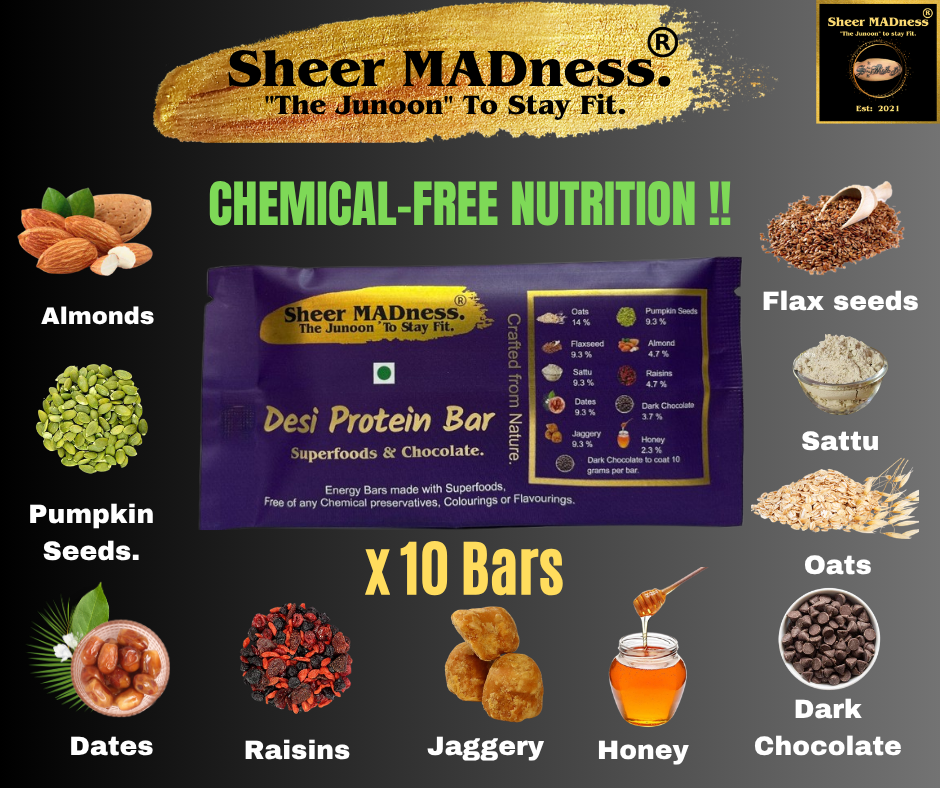
Sheer MADness bars answer yes to all three questions. Since 2021, every ingredient is displayed by name and image on the front of every pack — the most direct possible answer to Question 1.
Since 2021, Sheer MADness displays every ingredient with its own image on the front of every pack. No INS code. No chemical name, nor any synthetic compound. Every ingredient is a whole food that earns its place through its specific nutritional contribution.
This transparency is not just marketing. It is the most honest answer to the question “are protein bars a good source of nutrition” that any brand can provide. When every ingredient is visible before purchase, consumers can evaluate the nutritional quality themselves — not rely on the brand’s claims.
Sheer MADness holds a registered trademark under the Government of India. The Natural Plant Protein formula is patent published under Patent No. 202331036733, searchable on Intellectual Property India. The brand holds a valid FSSAI licence and GSTIN registration.
| Nutritional Standard | Sheer MADness | Typical Isolate Bar |
|---|---|---|
| Protein digestibility | High — whole-food matrix | Variable — 47 to 86% per 2025 Scientific Reports |
| Protein source | Sattu, almonds, oats — complete food | Isolate — stripped of food matrix |
| Dietary fibre | 3 to 5g from whole foods | 0 to 2g, often isolated |
| Healthy fat | Omega-3 from flaxseed, MUFA from almonds | Often palm oil saturated fat |
| Iron | Yes — jaggery, sattu, raisins | Usually absent |
| Magnesium | Yes — almonds, dark chocolate, oats | Usually absent |
| Zinc | Yes — pumpkin seeds, melon seeds | Usually absent |
| Antioxidants | Yes — dark chocolate, raisins | Usually absent |
| Chemical preservatives | None | BHA, BHT common |
| Artificial sweeteners | None | Sucralose, maltitol common |
| Gut fermentation risk | Zero | Moderate to high |
| Candy bar test | Passes — whole food sweeteners | Fails — glucose syrup or sugar common |
| Label transparency | Every ingredient on front label | INS codes in small print |
| Price per bar | ₹60 | ₹80 to ₹200 |
Are protein bars a good source of nutrition?
Some are. Bars built from whole foods — oats, almonds, sattu, flaxseed, dates, jaggery, seeds, and dark chocolate — deliver protein, fibre, healthy fats, and micronutrients from genuinely nutritious ingredients. Bars built on protein isolates, maltitol, and chemical preservatives deliver protein and little else of nutritional value, while adding daily chemical exposure that offsets their protein benefit.
How much protein do I actually get from a protein bar?
Less than the label suggests for most commercial bars. A 2025 Scientific Reports study on 1,641 bars found protein digestibility ranging from 47 to 86 percent — meaning a bar claiming 20 grams may deliver as little as 9.4 grams of usable protein. Whole-food protein from oats, sattu, and almonds in their natural food matrix has consistently better digestibility than isolated protein concentrates.
Three grams or more of whole-food fibre. Protein from recognisable whole-food ingredients (oats, nuts, legumes). Healthy fats from almonds, seeds, or flaxseed. Micronutrients delivered naturally — not as a synthetic vitamin premix. Zero sugar alcohols (maltitol, sorbitol) and zero artificial sweeteners. Zero chemical preservatives. Every ingredient explainable in plain language.
Are protein bars a meal replacement?
No — protein bars supplement meals but cannot replace them. A complete meal provides dietary diversity, fresh vegetables, the full vitamin spectrum, and caloric adequacy that no bar can fully replicate. The Academy of Nutrition and Dietetics recommends bars as a “hangry hero” for convenience gaps rather than as systematic meal replacements.
Are protein bars nutritious for daily consumption?
Whole-food bars consumed as daily snack replacements — substituting for biscuits, chips, or missed mid-morning nutrition — are genuinely nutritious for daily use. Chemical-laden bars with daily BHA, BHT, and sugar alcohol exposure accumulate nutritional costs over months that offset their protein value. Sheer MADness bars are specifically designed for safe and beneficial daily consumption.
Harvard Health Blog specifically identified bars with refined sugar as primary ingredients and equivalent calorie-to-candy profiles as “candy bars in disguise.” A genuinely nutritious bar has no refined sugar, whole-food sweeteners with fibre, protein from real food ingredients, meaningful dietary fibre, and a short recognisable ingredient list. A candy bar in disguise has glucose syrup or refined sugar as a primary ingredient, long ingredient lists with INS codes, and protein from isolates added to what is fundamentally a confectionery product.
Is a bar with 20g of protein better than one with 10g?
Not necessarily. If the 20g comes from protein isolate with 50 percent digestibility, the usable protein is 10 grams — equivalent to a whole-food bar’s 10 grams with better digestibility. Furthermore, the 20g isolate bar typically delivers zero fibre, zero omega-3, zero whole-food iron or magnesium, and daily chemical additives. The 10g whole-food bar delivers protein alongside fibre, omega-3, iron, magnesium, zinc, and zero synthetic chemical. Total nutritional value, not protein quantity alone, determines which bar serves your health better.
Can protein bars help with weight management?
Yes — when used correctly. Whole-food bars with 8 to 10 grams of protein and 3 to 5 grams of fibre produce genuine satiety for two to three hours, reducing total daily caloric intake by preventing the hunger that drives poor food choices. This satiety effect is more important than the bar’s calorie count. A 200-calorie whole-food bar that prevents a 500-calorie biscuit-and-chai mid-morning represents net caloric reduction — not addition.
The question “are protein bars a good source of nutrition” deserves an honest, nuanced answer rather than a simple yes or no.
Some protein bars are genuinely good sources of nutrition. These are bars built from whole foods that deliver protein alongside fibre, healthy fats, and micronutrients — with no synthetic chemical additives that offset the nutritional benefits through gut disruption, endocrine effects, or daily chemical accumulation.
Most protein bars are not good sources of nutrition in any complete sense. They deliver protein — in quantities that the 2025 Scientific Reports study confirmed are often less usable than the label states — alongside chemical additives, synthetic sweeteners, and zero fibre from natural sources. Their nutritional value is narrow and their chemical cost is real.
Sheer MADness bars are specifically built to the five-criteria nutritional standard — whole-food protein, whole-food fibre, healthy fats, whole-food micronutrients, and zero chemical additives. At ₹60 per bar, with every ingredient displayed transparently on the front label since 2021, they represent the most complete nutritional answer to this question available in the Indian market.
Real food. Complete nutrition. Nothing hidden. That is what a genuinely nutritious protein bar looks like.
I would also request you to kindly read my previous post about “Healthiest Protein Bar in India“.
a) Everyone is an individual, so what suits me may not suit the next person.
b) If a person has a medical condition, a doctor’s advice and prescribed medication will only help.
c) While buying any protein bar from the market, read the labels carefully. Watch out for INS 320 (BHA), INS 321 (BHT), INS 551 (silicon dioxide), maltitol, sorbitol, sucralose, and other lab-made chemicals that quietly appear on most commercial labels.
If you are interested in buying chemical-free Natural Plant Protein Moringa, Health Drinks for Kids, or our delicious chemical-free Energy Bars, Protein Bars, and Millet Bars, shop at Sheer MADness.
You can also find us on Flipkart, Jio Mart, or ONDC in India.
d) Exercise is the key to fitness. Exercise and nutrition are two sides of the same coin and always go hand in hand.
e) Excess of anything is wrong, even the best whole-food snack. Consume only recommended quantities.
f) Rome was not built in a day. Discipline and consistency are the only keys to lasting health.
g) It is not only exercise and protein that builds health. A healthy gut, macro and micronutrients, body type, rest, and lifestyle all matter. Of all these, exercise and nutrition are within our control. Focus on these two primary aspects first.
h) The most important part of fitness is that nothing is better than exercise and a balanced meal.
Article by Chef Ashutosh Awasthi
Disclaimer: Our products are a source of HEALTHY NUTRIENTS and are COMPLETELY FREE OF ANY ADDED CHEMICALS. We do not claim to cure any medical condition. The content provided is informational. We do not claim to diagnose or treat a person with any specific medical condition.