

Direct answer: Some protein bars are a genuinely good source of fiber. Most are not. The critical distinction is not how many grams the label shows — it is where that fiber comes from. Whole-food fiber from oats, flaxseed, almonds, and sattu supports gut microbiome health, regulates blood sugar, and prevents constipation. Isolated fiber — inulin, chicory root extract, corn soluble fiber — is added to processed bars to inflate the label number and frequently causes the digestive distress it was supposed to prevent.
Sheer MADness bars deliver 3 to 5 grams of dietary fiber per bar entirely from whole-food sources. No isolated fiber additive appears anywhere in any Sheer MADness product. The fiber you see in the nutrition panel comes from the oats, flaxseed, almonds, and sattu that you can see on the front of the pack.
I’m Chef Ashutosh Awasthi, founder of Sheer MADness, professional chef, marathon runner, and author of Great Health Comes from Exercise & Nutrition. Let me explain the fiber science behind protein bars — and why the number on the label is only half the story.
India has a significant dietary fiber gap. Most Indian adults consume 15 to 20 grams of dietary fiber daily — well below the ICMR-NIN 2024 recommendation of 25 to 40 grams per day for healthy adults.
This gap has real health consequences. Inadequate fiber intake is associated with constipation, impaired gut microbiome diversity, poor blood sugar management, elevated LDL cholesterol, increased colorectal cancer risk, and reduced satiety leading to overeating.
Furthermore, India’s shift from traditional whole-grain diets — which included millet, legumes, and unrefined grains rich in natural fiber — toward refined rice, maida, and processed snacks has specifically reduced the whole-food fiber that once dominated Indian dietary patterns. The ICMR-NIN 2024 Dietary Guidelines specifically call for restoring dietary fiber intake through pulses, whole grains, vegetables, and fruits.
A daily protein bar that contributes 3 to 5 grams of genuine whole-food fiber adds 10 to 20 percent of daily fiber requirements in one convenient snack — a meaningful daily contribution toward closing India’s fiber gap. However, this benefit only applies when the fiber comes from whole foods — not from isolated fiber additives that many commercial bars use to create impressive label numbers.
This is the most important distinction in this entire post. Most fiber content about protein bars treats all fiber as equivalent. It is not.
Whole-food fiber comes embedded in the natural food matrix of the ingredient containing it. Oat beta-glucan exists within the cellular structure of the oat grain — surrounded by the protein, starch, vitamins, and minerals that co-evolved with it. Flaxseed mucilage is the soluble gel layer that surrounds the flaxseed oil — inseparable from the lignans, omega-3, and phytoestrogens present in the same seed. Almond fiber is the prebiotic compound embedded in the almond’s cell walls — arriving alongside the healthy fats, Vitamin E, and magnesium.
Whole-food fiber arrives in the human gut with cofactors, companion compounds, and structural complexity that affects how slowly it ferments, which bacteria it feeds, and what metabolic products result. This complexity is why whole-food fiber consistently outperforms isolated fiber in research on gut microbiome outcomes and satiety.
Isolated fiber is fiber extracted from a natural source and added separately to processed foods. The most common isolated fibers in commercial protein bars are inulin, chicory root fiber, fructooligosaccharides (FOS), isomaltooligosaccharides (IMO), soluble corn fiber, and psyllium husk powder.
These fibers are not inherently harmful — they do contribute to fiber intake and some support beneficial gut bacteria. However, several specific problems arise when they are used primarily to inflate fiber label numbers in highly processed bars.
Rapid fermentation and digestive distress is the most common problem. Inulin and FOS ferment very rapidly in the large intestine — significantly faster than whole-food fibers. For sensitive individuals, this rapid fermentation produces severe gas, bloating, and cramping. The Healthline review specifically notes that isolated fibers like psyllium husk and chicory root may cause digestive discomfort, particularly when consumed by people not accustomed to high fiber intake.
The Quest Nutrition controversy is the most publicly documented example of isolated fiber problems in the protein bar industry. Quest bars received significant criticism in 2014 specifically for their use of isomaltooligosaccharide as a fiber source — consumers reported significant indigestion. Quest was forced to reformulate in 2016, replacing IMO with corn soluble fiber. The controversy illustrated that fiber quantity on a label means very little if the fiber source causes the digestive symptoms it was supposed to prevent.
Reduced microbiome benefit compared to whole-food fiber is the most functionally significant problem. A 2021 review published in Nutrients comparing isolated versus whole-food fiber sources confirmed that whole-food fibers consistently produce superior gut microbiome diversity outcomes compared to equivalent amounts of isolated fiber — because the food matrix context determines which bacteria species are fed and how efficiently they produce the short-chain fatty acids that confer metabolic benefit.
Understanding what fiber actually does explains why source quality matters as much as quantity.
Soluble fiber dissolves in water and forms a gel in the gut. This gel slows gastric emptying — the rate at which food leaves the stomach — and slows glucose absorption from the small intestine. The result is a blunted post-meal blood glucose rise and a more gradual, sustained energy release.
This mechanism is why dietitians consistently recommend checking for fiber content when evaluating protein bars — specifically alongside the bar’s carbohydrate and sugar profile. A bar with 20 grams of carbohydrate and zero fiber produces a different blood glucose response than the same 20 grams of carbohydrate alongside 4 grams of soluble fiber. The fiber changes the metabolic response entirely.
Oat beta-glucan is the most extensively researched soluble fiber for blood glucose management. Multiple randomised controlled trials and meta-analyses confirm that 3 grams of beta-glucan daily significantly reduces post-meal blood glucose peaks. The European Food Safety Authority has approved a specific health claim for oat beta-glucan and glycaemic control based on this evidence base.
Soluble fiber specifically reduces LDL cholesterol through bile acid sequestration. Soluble fiber binds bile acids in the gut and prevents their reabsorption. The liver then uses LDL cholesterol to produce replacement bile acids — progressively reducing circulating LDL.
The US FDA and European Food Safety Authority both recognise oat beta-glucan’s LDL-reducing health claim based on consistent clinical evidence. A daily bar providing meaningful oat beta-glucan contributes to this LDL-reducing effect cumulatively over daily consumption.
Dietary fiber is the primary food source for the gut microbiome — the trillions of bacteria that live in the large intestine and influence immune function, metabolic efficiency, mood, cognitive function, and hormonal regulation.
Not all fiber feeds the same bacteria. Oat beta-glucan specifically feeds Lactobacillus and Bifidobacterium species — the bacteria most consistently associated with immune health and metabolic wellbeing. Flaxseed’s soluble fiber specifically supports Akkermansia muciniphila — a beneficial species associated with reduced gut permeability and improved metabolic function. Almond’s prebiotic fiber selectively feeds Lactobacillus acidophilus and increases Bifidobacterium populations.
This specificity matters because the gut microbiome benefits of fiber come from the specific bacterial species fed — and different fiber types feed different species. Whole-food fibers from oats, flaxseed, and almonds feed the most beneficial and most studied bacterial populations. Isolated inulin and FOS, while prebiotic, feed a narrower range of bacterial species and ferment more rapidly than the research-backed whole-food sources.
Insoluble fiber — the structural fiber that doesn’t dissolve in water — adds bulk to stool, speeds intestinal transit, and prevents the constipation that sedentary modern lifestyles and low-fiber diets cause.
Flaxseed provides both soluble fiber (as mucilage) and insoluble fiber (as the structural seed hull material). Almonds provide predominantly insoluble fiber from their cell walls. Sattu provides both soluble and insoluble fiber from the chickpea’s natural fiber content.
The combination of soluble fiber from oats and flaxseed and insoluble fiber from almonds, flaxseed, and sattu in Sheer MADness bars addresses both aspects of digestive regularity simultaneously — blood sugar stabilisation from soluble, and bowel regularity support from insoluble.
Registered dietitian Brooke Snyder, quoted in multiple nutrition publications, recommends looking for bars with at least 3 grams of fiber per serving as a minimum quality signal. Whitney Linsenmeyer, spokesperson for the Academy of Nutrition and Dietetics, specifically recommends looking for bars that contain fiber alongside their protein — noting that people who eat high-protein diets frequently struggle to get enough fiber.
Registered dietitian Susie recommends no more than 12 to 13 grams of fiber in a protein bar — noting that very high isolated fiber content in bars can cause digestive discomfort for people not accustomed to high fiber intake. This upper limit specifically addresses the isolated fiber inflation problem — bars with 12 to 15 grams of chicory root fiber per bar frequently cause severe bloating precisely because the rapid fermentation of isolated fiber is more disruptive than the gradual fermentation of whole-food fiber.
The sweet spot is 3 to 6 grams of fiber per bar from whole-food sources. Sheer MADness bars deliver 3 to 5 grams from oats, flaxseed, almonds, and sattu — within the optimal range recommended by multiple registered dietitians and without the isolated fiber excesses that cause digestive problems.
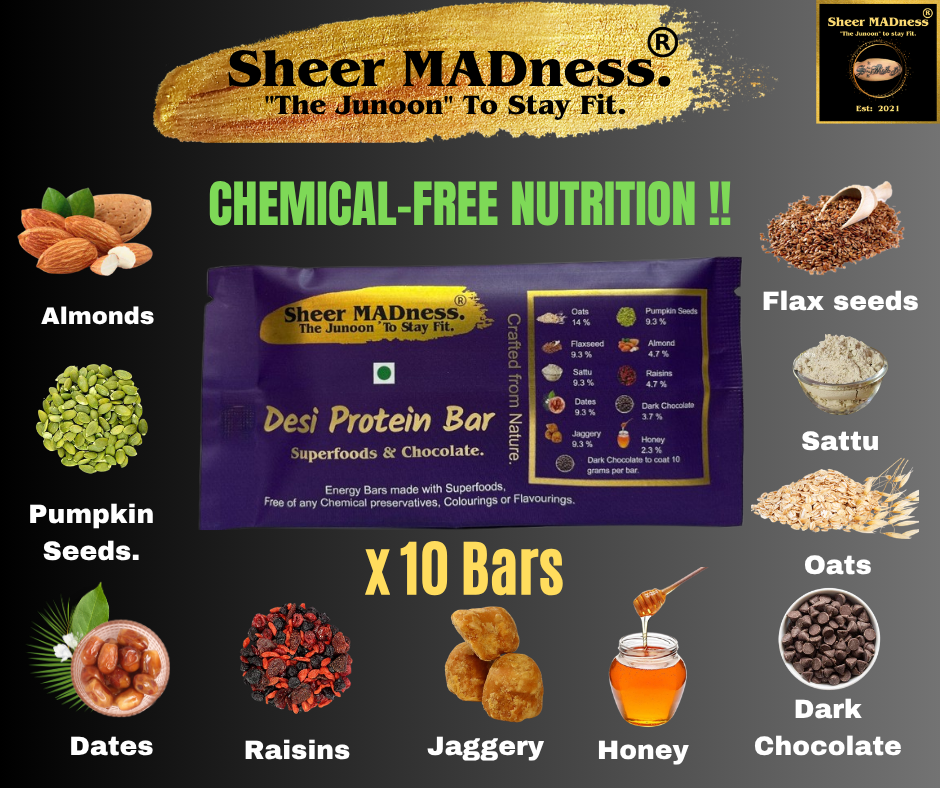
Sheer MADness Protein Bars and Energy Bars deliver fiber from four separate whole-food sources simultaneously. Each contributes a different fiber type with specific, research-backed benefits.
Oat beta-glucan is the most evidence-based dietary fiber compound available. It is the only fiber with US FDA-approved health claims for both LDL cholesterol reduction and glycaemic improvement. The mechanism — forming a viscous gel in the gut that slows gastric emptying and glucose absorption — is consistent across over 50 randomised controlled trials.
In Sheer MADness bars, oats provide beta-glucan as part of the whole grain structure. This is fundamentally different from isolated oat beta-glucan powder added to a processed bar base — the whole grain context provides the starch, protein, and mineral companions that modulate how the beta-glucan ferments and how it interacts with the gut microbiome.
Flaxseed is uniquely valuable because it provides both fiber types in one ingredient. The soluble fiber — flaxseed mucilage — forms a protective gel that soothes the gut lining and slows glucose absorption. The insoluble fiber — from the seed’s structural hull — adds bulk to stool and speeds intestinal transit.
Furthermore, flaxseed’s fiber specifically supports Akkermansia muciniphila — a gut bacterial species associated with reduced gut permeability, improved metabolic function, and reduced inflammation. A 2022 research review confirmed that flaxseed consumption specifically increases Akkermansia populations in human gut microbiome studies.
Flaxseed mucilage has an additional property particularly relevant to Sheer MADness bars — it acts as a natural binder that helps hold the bar’s ingredients together without any synthetic emulsifier. The flaxseed fiber serves both a nutritional function and a food-processing function simultaneously.
Almond fiber is predominantly insoluble but contains specific prebiotic compounds that selectively feed beneficial bacterial populations. Research published in the Journal of Nutritional Biochemistry confirmed that almond consumption specifically increases Lactobacillus acidophilus and Bifidobacterium populations in human gut microbiome studies — the same bacterial species most associated with immune health and digestive wellbeing.
Furthermore, almond fiber arrives alongside Vitamin E, magnesium, and healthy monounsaturated fats — the food matrix context that gives whole-food fiber its advantage over isolated fiber additives that arrive without companion compounds.
Sattu — roasted Bengal gram flour — provides dietary fiber at approximately 7.6 grams per 100 grams — a high whole-food fiber density. Legume fiber has well-established prebiotic properties, specifically feeding Bifidobacterium and Faecalibacterium prausnitzii — bacteria associated with reduced intestinal inflammation and improved gut barrier function.
Furthermore, sattu’s fiber arrives alongside 20 to 22 grams of protein per 100 grams — the combination that makes sattu specifically useful for people who eat high-protein diets and struggle to get enough fiber. The fiber and protein arrive packaged together in the same whole food — exactly the combination that dietitians recommend looking for when evaluating protein bars.
This section is specifically relevant for Indian consumers evaluating locally available protein bars.
Several Indian protein bars add isolated fibers — inulin, chicory root extract, or psyllium husk — to boost their fiber label numbers without using meaningful whole-food fiber sources. These bars can show 6 to 10 grams of fiber on the label while deriving most of that fiber from chicory root extract rather than from recognisable whole-food ingredients.
The practical consequence for consumers is that the label number significantly overstates the digestive benefit. Chicory root extract at 5 to 8 grams per bar — the typical “high fiber” bar dosage — frequently causes significant bloating and cramping in consumers who aren’t accustomed to high prebiotic fiber intake. This is the exact experience that drove Quest Nutrition’s 2014-2016 reformulation controversy in the global market.
Furthermore, isolated fiber additives appear in an ingredient list as technical names — “chicory root extract,” “inulin,” “soluble corn fiber” — that are easy to overlook when scanning a bar’s label. Many consumers eating a “high fiber” bar are unaware that most of the fiber came from an additive rather than from the bar’s food ingredients.
Sheer MADness bars contain no isolated fiber additives of any kind. The complete fiber content — 3 to 5 grams per bar — comes entirely from oats, flaxseed, almonds, and sattu. These are the same ingredients displayed on the front of the pack, named and pictured before the bar is opened.
The majority of urban Indian adults consuming refined rice, maida-based breads, and processed snacks fall significantly below recommended daily fiber intake. A daily Sheer MADness bar contributes 3 to 5 grams of whole-food fiber toward closing this gap — without requiring any change to meal patterns.
Dietitian Whitney Linsenmeyer specifically notes that people who eat high-protein diets frequently struggle to get enough fiber — because protein-dense foods from animal sources and protein isolates contain essentially no fiber. A protein bar that delivers fiber alongside protein specifically addresses this gap.
Oat beta-glucan’s blood glucose regulatory effect is most practically relevant for people actively managing blood sugar — those with prediabetes, type 2 diabetes risk factors, or general blood sugar sensitivity. A daily bar providing consistent beta-glucan intake supports the gradual glucose absorption that blood sugar management requires.
The insoluble fiber from almonds, flaxseed, and sattu — alongside the gut-lubricating mucilage from flaxseed — specifically addresses the bowel regularity challenges that sedentary Indian adults commonly experience. A daily bar providing consistent whole-food fibre from multiple sources is a practical, food-based intervention for mild constipation.
Dietary fiber intake frequently declines with age — both because appetite decreases and because cooking for one reduces dietary variety. Older adults with reduced appetite specifically benefit from fiber-dense snack formats that deliver meaningful fiber in small volumes.
For consumers evaluating protein bars for fiber quality, this guide identifies what to look for and what to avoid.
Look for whole-food fiber sources in the ingredient list. Oats, almonds, flaxseed, sattu, seeds, dates, and other whole plant foods indicate whole-food fiber. These should appear in the first eight to ten ingredients.
Be cautious with isolated fiber additives. Inulin, chicory root extract, chicory root fiber, fructooligosaccharides (FOS), isomaltooligosaccharides (IMO), soluble corn fiber, and psyllium husk powder indicate isolated fiber additions. These are not inherently harmful but frequently cause digestive distress at the doses used in high-fiber-labelled bars.
Check the fiber-to-ingredient ratio. A bar with 5 grams of fiber and only oats, almonds, and flaxseed as fiber sources is nutritionally superior to a bar with 8 grams of fiber where 6 grams come from chicory root extract and 2 grams from whole foods.
Apply the dietitian standard. Three grams or more of fiber per bar from whole-food sources is the quality threshold. Below 3 grams suggests inadequate whole-food fiber. Above 12 grams suggests excessive isolated fiber that may cause digestive discomfort.
Look at the full context. Fiber works best when accompanied by adequate hydration. The Healthline review specifically notes that drinking enough water promotes bowel regularity alongside fiber bar consumption. Always pair fiber-rich bars with water.
Sheer MADness holds a registered trademark under the Government of India. The Natural Plant Protein formula is patent published under Patent No. 202331036733, searchable on Intellectual Property India. The brand holds a valid FSSAI licence and GSTIN registration.
| Feature | Sheer MADness | High-Fiber Isolate Bar | Low-Fiber Isolate Bar |
|---|---|---|---|
| Fiber per bar | 3 to 5g | 8 to 15g | 0 to 2g |
| Fiber source | Oats, flaxseed, almonds, sattu — whole food | Chicory root extract, inulin — isolated | None or minimal |
| Gut microbiome benefit | High — diverse whole-food prebiotic species | Moderate — narrower bacterial species | Minimal |
| Digestive distress risk | Low — slow fermenting whole-food fiber | High — rapid fermentation of isolated fiber | Constipation risk from no fiber |
| Blood sugar benefit | High — oat beta-glucan regulatory mechanism | Moderate — some isolated fibers regulate blood sugar | Absent |
| Cholesterol benefit | Yes — oat beta-glucan LDL reduction | Variable — depends on fiber type | Absent |
| Label inflation risk | None — all fiber from visible whole foods | High — fiber numbers inflated by isolates | Not applicable |
| Dietitian recommended | Yes — 3 to 5g from whole foods | Caution — 12g+ from isolates causes distress | No — below 3g threshold |
| Price per bar | ₹60 | ₹100 to ₹200 | ₹80 to ₹150 |
Are protein bars a good source of fiber?
Some are. Bars built from whole-food ingredients — oats, flaxseed, almonds, sattu — that contain 3 to 5 grams of naturally occurring fiber are a genuinely good source. Bars built on protein isolates with isolated fiber additives like chicory root extract provide fiber by label number but frequently cause digestive distress and provide inferior gut microbiome benefit compared to whole-food fiber sources.
How much fiber should a protein bar have?
Registered dietitians recommend at least 3 grams of fiber per bar as a minimum quality signal. Dietitian Susie specifically recommends no more than 12 to 13 grams — noting that very high isolated fiber content causes digestive discomfort. Sheer MADness bars deliver 3 to 5 grams from whole-food sources — within the optimal range.
What is the difference between whole-food fiber and isolated fiber in protein bars?
Whole-food fiber comes embedded in the natural food matrix of the ingredient — oat beta-glucan within the whole oat grain, flaxseed mucilage within the whole flaxseed. Isolated fiber is extracted from a natural source and added separately — chicory root extract, inulin, IMO. Whole-food fiber ferments more slowly, feeds a more diverse range of beneficial gut bacteria, and causes significantly less digestive distress than isolated fiber at equivalent doses.
Why does inulin in some protein bars cause bloating?
Inulin and other isolated prebiotic fibers ferment very rapidly in the large intestine. This rapid fermentation produces gas — hydrogen, carbon dioxide, and methane — at a rate that outpaces the gut’s ability to manage it comfortably. The result is significant bloating, cramping, and flatulence. Whole-food fibers ferment more gradually — giving the gut and its bacteria more time to manage the fermentation process without disruptive gas buildup.
Yes — specifically through oat beta-glucan. Beta-glucan forms a viscous gel in the gut that slows gastric emptying and glucose absorption. Multiple randomised controlled trials and two regulatory-body health claims confirm this mechanism for LDL cholesterol and glycaemic control. The 3 to 5 grams of whole-food fiber in Sheer MADness bars includes a meaningful beta-glucan contribution from oats.
Can protein bars replace fiber from vegetables and fruits?
No. A protein bar contributes meaningfully to daily fiber intake — 3 to 5 grams toward the 25 to 40 gram daily recommendation — but cannot provide the dietary diversity of fiber types, phytonutrients, vitamins, and minerals that vegetables and fruits deliver. Bars supplement dietary fiber — they don’t replace whole-food fiber sources.
Is flaxseed the best fiber source in a protein bar?
Flaxseed is uniquely valuable because it provides both soluble fiber (as mucilage) and insoluble fiber (as structural hull material) in one ingredient. It specifically supports Akkermansia muciniphila — a highly beneficial gut bacterium associated with reduced gut permeability. No other single fiber source in Indian protein bars provides this dual-type, Akkermansia-supporting combination.
Does drinking water improve fiber’s effectiveness in a protein bar?
Yes — significantly. Soluble fiber needs water to form the gel that moderates glucose absorption and gut transit. Insoluble fiber needs water to add effective bulk to stool. The Healthline review and multiple dietitian recommendations specifically note that adequate hydration is essential for fiber bars to provide their digestive benefits. Always drink water with and after eating a fiber-containing bar.
Protein bars can be a genuinely good source of fiber — but only when the fiber comes from whole foods rather than from isolated fiber additives added to boost label numbers.
The Quest Nutrition controversy of 2014 illustrated this specifically. A bar can show impressive fiber numbers on its label while causing significant digestive distress because the fiber comes from rapidly fermenting isolated additives rather than from slow-fermenting whole-food sources. The number on the label is not the measure of quality. The source of the fiber is.
Sheer MADness bars deliver 3 to 5 grams of dietary fiber per bar entirely from oats, flaxseed, almonds, and sattu. These are the whole-food fiber sources that feed the most beneficial gut bacterial populations, provide oat beta-glucan for blood sugar and cholesterol regulation, support bowel regularity through balanced soluble and insoluble fiber, and ferment gradually enough to support digestive comfort rather than causing the bloating that isolated inulin-heavy bars are notorious for.
India’s fiber gap is real. Most urban Indian adults consume significantly less fiber than recommended. A daily bar that contributes 3 to 5 grams of genuine whole-food fiber helps close that gap — one bar at a time, every day, from ingredients you can see on the front of the pack.
I would also request you to kindly read my previous post about “Healthiest Protein Bar in India“.
a) Everyone is an individual, so what suits me may not suit the next person.
b) If a person has a medical condition, a doctor’s advice and prescribed medication will only help.
c) While buying any protein bar from the market, read the labels carefully. Watch out for inulin, chicory root extract, isomaltooligosaccharides, soluble corn fiber, and other isolated fiber additives that inflate fiber label numbers while causing digestive distress — alongside INS 320 (BHA), INS 321 (BHT), maltitol, sorbitol, and sucralose.
If you are interested in buying chemical-free Natural Plant Protein Moringa, Health Drinks for Kids, or our delicious chemical-free Energy Bars, Protein Bars, and Millet Bars, shop at Sheer MADness.
You can also find us on Flipkart, Jio Mart, or ONDC in India.
d) Exercise is the key to fitness. Exercise and nutrition are two sides of the same coin and always go hand in hand.
e) Excess of anything is wrong, even the best whole-food snack. Consume only recommended quantities.
f) Rome was not built in a day. Discipline and consistency are the only keys to lasting health.
g) It is not only exercise and protein that builds health. A healthy gut, macro and micronutrients, body type, rest, and lifestyle all matter. Of all these, exercise and nutrition are within our control. Focus on these two primary aspects first.
h) The most important part of fitness is that nothing is better than exercise and a balanced meal.
Article by Chef Ashutosh Awasthi
Disclaimer: Our products are a source of HEALTHY NUTRIENTS and are COMPLETELY FREE OF ANY ADDED CHEMICALS. We do not claim to cure any medical condition. The content provided is informational. We do not claim to diagnose or treat a person with any specific medical condition.