

Direct answer: Yes — moringa plant protein is specifically well-suited for weight training, and for reasons that go beyond its protein content. Weight training creates three simultaneous biological demands that moringa specifically addresses: muscle protein synthesis requiring complete essential amino acids including leucine for mTOR activation, connective tissue repair requiring Vitamin C for collagen synthesis in tendons and ligaments stressed by heavy compound lifts, and hormonal support requiring zinc and magnesium for testosterone production and ATP synthesis. Sheer MADness Plant Protein Moringa delivers all three through its moringa-almond-flaxseed-turmeric-cardamom blend — from whole-food sources, with zero chemical additive, in a formulation that Indian weight trainers can use daily without the lactose digestibility problem of whey protein.
I am Chef Ashutosh Awasthi, founder of Sheer MADness, professional chef, marathon runner, and author of Great Health Comes from Exercise & Nutrition. While I am primarily an endurance athlete, I understand resistance training physiology as deeply as endurance physiology — because the nutritional foundation for both is built on the same principles: adequate protein, micronutrient sufficiency, anti-inflammatory support, and hormonal health. Let me explain the complete weight training case for moringa.
Understanding what weight training demands from the body explains precisely where moringa’s nutritional support is most relevant.
Weight training produces muscle hypertrophy through mechanical tension — the primary stimulus for muscle growth. When muscle fibres are subjected to sufficient tension during resistance exercise, mechanosensors on the muscle cell surface activate signalling cascades that converge on the mTOR pathway. mTOR upregulates protein synthesis, triggering the satellite cell activation, myofibril protein production, and muscle fibre enlargement that constitute hypertrophy.
This mechanical tension stimulus is the non-negotiable foundation of weight training adaptation. No supplement provides this stimulus — only progressive mechanical loading does. What nutrition provides is the substrate and the micronutrient environment in which the mechanical stimulus translates into maximal muscle protein synthesis.
Weight training also specifically stresses connective tissue — tendons, ligaments, and joint cartilage — in ways that aerobic exercise does not. Heavy compound lifts like squats, deadlifts, and overhead press apply peak forces of three to five times bodyweight to the knee, hip, shoulder, and spinal joints. Tendons must transmit these forces from muscle to bone without injury. Ligaments must stabilise joints through the full range of motion under load. This connective tissue demand creates a specific nutritional requirement — collagen synthesis — that most weight training nutrition discussions completely overlook.
Furthermore, heavy resistance training acutely elevates testosterone and growth hormone levels in the hours following training. These anabolic hormonal responses require zinc (for testosterone synthesis) and magnesium (for growth hormone regulation and sleep quality that determines nocturnal growth hormone release) as essential mineral cofactors. Inadequate zinc or magnesium blunts the hormonal response to training — reducing the anabolic signal that mechanical tension generates.
Moringa leaf powder provides approximately 25 to 30 grams of protein per 100 grams dry weight — a protein density comparable to many legumes and significantly higher than most vegetables on a gram-for-gram basis. More importantly, moringa’s protein is complete — providing all nine essential amino acids including leucine, isoleucine, and valine (the branched-chain amino acids) at meaningful concentrations.
Leucine is the most important single amino acid for weight training nutrition. Research published in the Journal of the International Society of Sports Nutrition confirmed that leucine acts as the primary activator of mTORC1 — the cellular protein complex that drives muscle protein synthesis. Intracellular leucine must reach approximately 2 to 3 grams per meal to achieve near-maximum mTOR activation.
Moringa provides leucine at approximately 6.5 to 7.5 grams per 100 grams of protein — a meaningful concentration. When Sheer MADness Plant Protein Moringa is mixed with dairy or plant milk containing additional protein, the combined leucine contribution per serving approaches the mTOR activation threshold more effectively than moringa alone. This is the correct framing for moringa as a weight training protein supplement — as a complementary protein source within a complete daily diet, not as a standalone high-protein product.
The Sheer MADness Plant Protein Moringa blend provides complementary amino acid combining across its three protein sources. Moringa provides leucine and lysine. Almonds contribute methionine and arginine — the conditionally essential amino acid that nitric oxide synthase uses to produce nitric oxide during resistance training, improving muscle pump and oxygen delivery. Flaxseed adds methionine and cysteine.
Together, these three whole-food protein sources create a more complete essential amino acid spectrum than any single source alone — the complementary combining principle behind traditional Indian dal and roti that Sheer MADness formalises in powder form.
This section covers the most important and most neglected weight training nutrition topic — and the one where moringa’s nutritional profile is most specifically and uniquely relevant.
Every experienced weight trainer knows the phenomenon: muscle strength outpaces connective tissue adaptation. After months of progressive overload, the muscles can generate more force than the tendons and ligaments can safely transmit. Tendon injuries — rotator cuff tears, patellar tendinopathy, Achilles tendinopathy, biceps tendon tears — are the most common weight training injuries. They occur specifically because tendon collagen adaptation lags behind muscle hypertrophy.
Tendons are primarily composed of type I collagen — the same collagen as skin, ligaments, and bone matrix. Collagen synthesis in tendons requires Vitamin C as the mandatory cofactor for prolyl hydroxylase — the enzyme that converts proline to hydroxyproline in the collagen triple helix. Without adequate Vitamin C, prolyl hydroxylase cannot function and collagen synthesis stalls.
Moringa leaf provides Vitamin C at approximately 17 times the concentration in oranges gram for gram — the highest plant-food Vitamin C concentration widely available. This exceptional Vitamin C content specifically supports the collagen synthesis in tendons and ligaments that weight training progressively stresses.
Research published in the American Journal of Clinical Nutrition specifically on Vitamin C and connective tissue adaptation to exercise confirmed that adequate Vitamin C status is associated with better tendon collagen synthesis rates in response to mechanical loading. This is the specific research basis for the claim that moringa’s Vitamin C supports connective tissue adaptation to weight training.
Collagen is composed of a repeating glycine-X-Y tripeptide sequence where glycine must occupy every third position. Approximately one-third of collagen’s amino acid composition is glycine — making glycine the most abundant single amino acid in connective tissue. The body’s ability to synthesise collagen depends substantially on adequate dietary glycine availability.
Moringa’s complete protein provides glycine as part of its amino acid profile. This glycine contribution specifically supports the collagen synthesis in tendons, ligaments, and joint cartilage that heavy compound lifts demand. No whey protein concentrate provides meaningful glycine contribution to connective tissue synthesis — whey is glycine-poor by composition. Moringa’s plant protein provides meaningful glycine alongside its Vitamin C collagen cofactor — a uniquely complete connective tissue support combination.
Weight training’s hormonal benefits — the acute testosterone and growth hormone elevation following heavy resistance exercise — require zinc and magnesium as their mineral cofactors.
Zinc deficiency reduces testosterone synthesis by impairing Leydig cell function in the testes — the cells that produce testosterone from cholesterol. Research published in Nutrition confirmed that zinc supplementation increased testosterone levels in zinc-deficient men — confirming zinc’s specific role in testosterone biosynthesis.
Indian vegetarian weight trainers face a specific zinc challenge. Phytate — present in high concentrations in grains, legumes, and seeds — binds zinc in the gut and reduces absorption efficiency. Despite consuming zinc from plant foods, many Indian vegetarians absorb insufficient zinc due to phytate inhibition. The result is zinc insufficiency that specifically blunts the testosterone response to weight training.
Sheer MADness Plant Protein Moringa provides zinc from moringa leaf — approximately 0.6 milligrams per 100 grams — alongside the Vitamin C that improves zinc bioavailability by reducing phytate-zinc complex formation. The pre-workout moringa drink specifically provides zinc availability in the hours when testosterone synthesis rates are elevated.
Magnesium is required as an ATPase cofactor for every ATP-dependent muscle contraction during weight training. Each squat, deadlift, and bench press repetition consumes ATP that requires magnesium for its regeneration. Magnesium deficiency reduces ATP regeneration efficiency — reducing strength output per repetition and increasing the perceived effort of each set.
Furthermore, magnesium supports the quality of sleep that determines nocturnal growth hormone secretion — the primary growth hormone pulse of the day. Growth hormone drives the overnight muscle protein synthesis that converts the day’s training stimulus into actual hypertrophy. Poor sleep quality from magnesium deficiency reduces this nocturnal growth hormone pulse and blunts the training adaptation.
Almond magnesium in Sheer MADness Plant Protein Moringa — at 270 milligrams per 100 grams — compounds the moringa leaf magnesium contribution. Daily consumption provides consistent magnesium that addresses both the intra-workout ATP efficiency and the post-workout sleep quality and hormonal aspects of weight training adaptation.
Weight training is not purely anaerobic. Moderate-intensity sets of 8 to 15 repetitions use significant aerobic ATP contribution during and between sets. Haemoglobin concentration — determined by iron status — affects the aerobic contribution during set performance and the inter-set recovery rate.
Iron-deficient non-anaemic weight trainers show measurably reduced working capacity — they fatigue faster within sets and recover more slowly between sets — without being clinically anaemic. This sub-clinical iron insufficiency reduces training volume per session and therefore reduces the total weekly mechanical tension stimulus for hypertrophy.
Moringa’s iron — at approximately 28 milligrams per 100 grams dry weight — combined with its Vitamin C for non-haem iron absorption enhancement specifically addresses this sub-clinical iron insufficiency. For Indian women weight trainers — among whom 57 percent have sub-optimal iron status from NFHS-5 data — moringa’s iron alongside Vitamin C provides the most practically important single nutritional contribution from this blend for their specific weight training performance context.
Weight training adaptation requires training continuity — the ability to train again before the previous session’s inflammatory response has fully subsided. The weight trainer who can recover between sessions in 24 to 48 hours trains more frequently and accumulates more weekly mechanical tension stimulus than the one who needs 72 to 96 hours between sessions.
Moringa’s quercetin reduces the inflammatory cytokines — TNF-α, IL-6 — that drive the prolonged post-training inflammatory response. Turmeric curcumin in Sheer MADness Plant Protein Moringa specifically reduces DOMS (delayed onset muscle soreness) through NF-κB pathway inhibition — the anti-inflammatory mechanism confirmed in multiple controlled exercise trials including the 2015 European Journal of Applied Physiology RCT that demonstrated significant DOMS reduction at 24, 48, and 72 hours post-exercise.
Flaxseed omega-3 reduces the leukotriene B4 and prostaglandin E2 that sustain the inflammatory phase of muscle damage repair. The cumulative anti-inflammatory effect from daily moringa-turmeric-flaxseed consumption reduces training recovery time over weeks of consistent use — allowing the higher training frequency that produces better hypertrophy outcomes.
Sheer MADness Plant Protein Moringa addresses the specific nutritional context of Indian weight trainers through a formulation that commercial alternatives consistently miss.
Sixty to seventy percent of Indian adults have some degree of lactose intolerance. Whey protein concentrate — the most widely used weight training supplement in India — contains residual lactose that causes gut disruption in this majority. Post-training bloating, gas, and loose stools from whey bars and shakes are reported consistently by Indian gym-goers — symptoms that impair the post-training recovery window and reduce the nutritional benefit of the supplement.
Sheer MADness Plant Protein Moringa is 100 percent dairy-free. Every gram of protein comes from moringa leaf, almonds, and flaxseed. No lactose, no dairy, no digestive disruption during the critical post-training recovery window. The body’s metabolic resources in the post-training period focus entirely on muscle repair rather than digestive discomfort management.
Indian vegetarian weight trainers on phytate-heavy grain and legume diets face specific zinc and magnesium insufficiency. Moringa leaf provides both, alongside the Vitamin C that reduces phytate inhibition of mineral absorption. This is the most practically important differentiation from whey protein — which provides protein but contributes no zinc or magnesium toward the specific deficiencies most affecting Indian vegetarian weight trainers’ hormonal response to training.
No commercial whey protein product provides meaningful Vitamin C. Whey is a dairy protein extract — its Vitamin C content is negligible. Moringa’s Vitamin C at 17 times orange concentration gram for gram provides the collagen synthesis cofactor that heavy compound lifts specifically demand for tendon and ligament adaptation. This connective tissue support dimension is completely absent from whey-based weight training supplements and is among the most important long-term weight training nutrition benefits available from moringa.
Mix two tablespoons of Sheer MADness Plant Protein Moringa in 250ml of warm milk or plant milk 45 to 60 minutes before training. This provides the moringa amino acids for pre-loading protein availability, the quercetin antioxidant preparation for the training-generated oxidative stress, the Vitamin C for connective tissue protection during heavy loading, and the theobromine from cardamom’s natural aromatic compounds for mild sustained alertness.
Mix two to three tablespoons into warm milk within 30 minutes of completing training. This is the most critical window: the post-training period where mTOR is maximally activated, insulin sensitivity is elevated, and the connective tissue synthetic rate is highest in the hours following mechanical loading. The moringa amino acids, Vitamin C for tendon collagen, quercetin for oxidative stress, and turmeric curcumin for DOMS reduction all contribute to recovery at the most receptive biological moment.
The connective tissue, zinc, magnesium, and iron benefits of moringa are cumulative rather than acute. Daily consistent consumption builds the zinc status that supports testosterone synthesis, the magnesium that supports ATP efficiency and sleep quality, the iron that supports haemoglobin and inter-set recovery, and the Vitamin C-supported collagen synthesis rate that adapts tendons and ligaments ahead of injury thresholds.
This is the most important practical guidance for weight trainers using moringa: consistency is more important than timing. One month of daily moringa consumption produces more meaningful connective tissue adaptation and mineral status improvement than intermittent high-dose use.
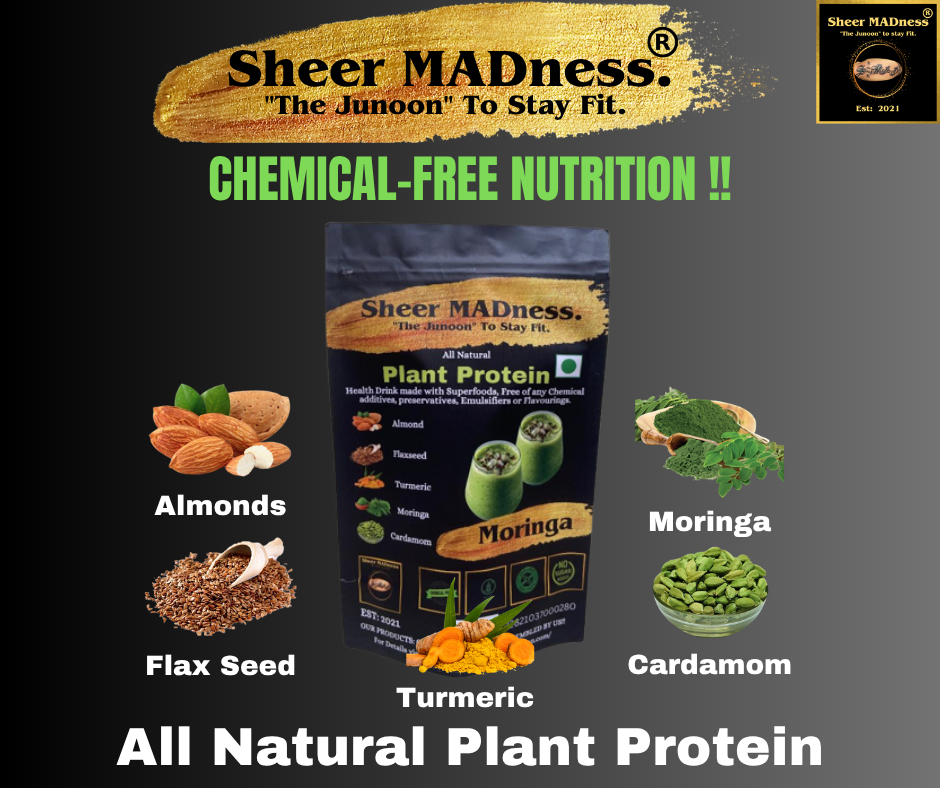
Sheer MADness holds a registered trademark under the Government of India. The Natural Plant Protein formula is patent published under Patent No. 202331036733, searchable on Intellectual Property India. The brand holds a valid FSSAI licence and GSTIN registration.
| Weight Training Need | Nutrient | Source | Specific Mechanism |
|---|---|---|---|
| Muscle protein synthesis (mTOR activation) | Leucine — 6.5-7.5g/100g protein | Moringa leaf | mTORC1 activation threshold for MPS |
| Amino acid completeness | Complete EAA profile | Moringa + almonds + flaxseed | Complementary combining covers all 9 EAAs |
| Tendon collagen synthesis | Vitamin C — 17x oranges | Moringa leaf | Prolyl hydroxylase activation for collagen triple helix |
| Tendon collagen structure | Glycine | Moringa protein | Collagen tripeptide Gly-X-Y repeating unit |
| Testosterone synthesis | Zinc | Moringa leaf + pumpkin seeds* | Leydig cell steroidogenesis cofactor |
| ATP synthesis efficiency | Magnesium — 368mg/100g | Moringa leaf + almonds | ATPase cofactor for every contraction |
| Sleep quality / GH release | Magnesium | Almonds — 270mg/100g | Ca²⁺ channel modulation → sleep depth |
| Haemoglobin for inter-set recovery | Iron — 28mg/100g | Moringa leaf | Haemoglobin aerobic contribution to resistance training |
| Iron absorption enhancement | Vitamin C | Moringa leaf | Ferric → ferrous conversion for DMT-1 |
| DOMS reduction (training continuity) | Curcumin | Turmeric | NF-κB → IL-6, TNF-α → DOMS 24-72h |
| Inflammatory cytokine reduction | Quercetin | Moringa leaf | Direct cytokine suppression |
| Cumulative anti-inflammatory | Omega-3 ALA | Flaxseed | PGE2 and LTB4 reduction |
| Nitric oxide for muscle pump | Arginine | Almonds | eNOS substrate → training blood flow |
| Free radical protection during sets | Quercetin, kaempferol | Moringa leaf | ROS scavenging during metabolic stress |
*Note: Pumpkin seeds are in Sheer MADness protein bars; moringa powder’s zinc comes from the moringa leaf itself at approximately 0.6mg/100g.
Is moringa good for weight training?
Yes — for three specific reasons beyond its protein content. Moringa provides Vitamin C for tendon and ligament collagen synthesis that heavy lifting demands. It provides zinc and magnesium for the hormonal response (testosterone) and energy system (ATP) that weight training requires. Its anti-inflammatory quercetin and turmeric curcumin reduce DOMS and enable higher training frequency. As a protein source, its complete amino acid profile including leucine supports mTOR-mediated muscle protein synthesis.
Can moringa replace whey protein for weight training?
For Indian weight trainers with lactose intolerance — the majority — moringa is specifically preferable to whey protein concentrate. It provides complete plant protein without lactose digestive disruption. The same provides connective tissue Vitamin C that whey lacks. It provides zinc and magnesium that whey’s isolation process removes. The protein per serving is lower than whey, so combine with milk or plant milk to increase total protein per preparation. As a total nutritional package for Indian weight trainers, moringa outperforms whey in multiple dimensions despite lower protein concentration.
Moringa provides Vitamin C at approximately 17 times orange concentration gram for gram. Vitamin C is the mandatory cofactor for prolyl hydroxylase — the enzyme that converts proline to hydroxyproline in collagen’s triple helix structure. Without adequate Vitamin C, tendons and ligaments cannot synthesise new collagen at rates that match the mechanical damage of heavy compound lifts. Daily moringa consumption provides consistent Vitamin C for collagen synthesis — specifically supporting the connective tissue adaptation that prevents training injuries.
Does moringa help with testosterone for weight training?
Moringa provides zinc — required for Leydig cell testosterone synthesis — alongside Vitamin C that improves zinc absorption by reducing phytate inhibition. Almond magnesium supports sleep quality and the nocturnal growth hormone pulse. Together, these mineral contributions support the hormonal environment that maximises the anabolic response to weight training. They support, not replace, the testosterone produced by consistent heavy resistance training itself.
When should I take moringa for weight training?
45 to 60 minutes before training for pre-loading amino acids, antioxidant preparation, and connective tissue Vitamin C. Within 30 minutes post-training for mTOR window protein contribution, DOMS-reducing curcumin, and connective tissue repair Vitamin C. Daily morning consumption for cumulative zinc, magnesium, iron, and connective tissue collagen adaptation — the benefits that require consistent daily intake rather than acute timing.
Two to three tablespoons of Sheer MADness Plant Protein Moringa per serving — mixed in 250ml of milk or plant milk. This delivers the amino acids, Vitamin C, zinc, magnesium, iron, and anti-inflammatory compounds that weight training specifically requires. Two servings per day — pre and post-training — is appropriate for high-volume training days. One serving per day is appropriate for maintenance and lighter training days.
Is moringa safe to use daily for weight training?
Yes. The whole-food ingredients in Sheer MADness Plant Protein Moringa — moringa leaf, almonds, flaxseed, turmeric, cardamom — are safe for daily consumption in recommended serving quantities. The connective tissue, zinc status, and magnesium status benefits specifically require daily consistent intake to accumulate. People on medications should consult their physician — moringa’s Vitamin K may affect anticoagulant dosing, and its potassium may add to antihypertensive effects.
Why is moringa specifically better for Indian weight trainers than imported supplements?
Indian weight trainers typically face three specific nutritional challenges that imported supplements address poorly: lactose intolerance making whey concentrate inappropriate, phytate-driven zinc and magnesium insufficiency from grain-heavy diets, and the sub-clinical iron deficiency affecting a large proportion of Indian adults (especially women). Moringa specifically addresses all three — it is dairy-free, it provides zinc and magnesium from whole-food sources with Vitamin C to offset phytate inhibition, and it provides iron at the highest plant-food density alongside Vitamin C for absorption. Imported whey supplements address none of these three.

Moringa is good for weight training — and its most distinctive contributions go beyond the protein content that most training supplements lead with.
The Vitamin C for tendon and ligament collagen synthesis is the most overlooked nutritional dimension of weight training — and the one where progressive heavy lifting most frequently breaks down. The zinc and magnesium for testosterone and ATP synthesis address the specific mineral deficiencies most prevalent in Indian vegetarian weight training diets. The iron for haemoglobin and inter-set aerobic recovery specifically addresses the iron insufficiency affecting the majority of Indian women who weight train. The quercetin, curcumin, and omega-3 anti-inflammatory complex reduces DOMS and enables the training frequency that determines total weekly mechanical tension stimulus.
Sheer MADness Plant Protein Moringa delivers all five of these weight training nutritional dimensions from five whole-food ingredients — dairy-free, zero chemical additive, vacuum packed, every ingredient on the front of every pack since 2021.
This is moringa for weight training done completely — not just protein, but the full nutritional infrastructure that progressive mechanical overload demands.
I would also request you to please read my previous post: Benefits of Moringa Plant protein, the versatile Superfood powerhouse.
a) Everyone is an individual, so what suits me may not suit the next person.
b) If a person has a medical condition, a doctor’s advice and prescribed medication will only help.
c) While buying any protein powder from the market, read the labels carefully. Watch out for INS codes, Anti-caking agent, INS 551 (Silicon dioxide), BHA (Butylated hydroxyanisole), BHT (Butylated hydroxytoluene), whey protein concentrate and its residual lactose, and other processed ingredients that burden the gut during the critical post-training recovery window.
If you are interested in buying chemical-free Natural Plant Protein Moringa, Health Drinks for Kids, or our delicious chemical-free Energy Bars, Protein Bars, and Millet Bars, shop at Sheer MADness.
You can also find us on Flipkart, Jio Mart, or ONDC in India.
d) Exercise is the key to fitness. Exercise and nutrition are two sides of the same coin and always go hand in hand.
e) Excess of anything is wrong, even the best whole-food superfood. Consume only recommended quantities.
f) Rome was not built in a day. Discipline and consistency are the only keys to lasting health.
g) It is not only exercise and protein that builds health. A healthy gut, macro and micronutrients, body type, rest, and lifestyle all matter. Of all these, exercise and nutrition are within our control. Focus on these two primary aspects first.
h) The most important part of fitness is that nothing is better than exercise and a balanced meal.
Article by Chef Ashutosh Awasthi
Disclaimer: Our products are a source of HEALTHY NUTRIENTS and are COMPLETELY FREE OF ANY ADDED CHEMICALS. We do not claim to cure any medical condition. The content provided is informational. We do not claim to diagnose or treat a person with any specific medical condition.