

Direct answer: Yes — moringa plant protein supports muscle building through five specific physiological mechanisms. Its leucine content activates the mTOR-S6K1-4EBP1 pathway — the molecular machinery that initiates muscle protein synthesis at the ribosomal level. Moringa’s complete essential amino acid profile provides all building blocks required for myofibrillar protein assembly. Its Nrf2-mediated antioxidant protection specifically preserves satellite cell function — the muscle stem cells that add permanent new myonuclei to growing fibres. Its anti-inflammatory compounds reduce muscle protein breakdown (MPB) — improving the net MPS vs MPB balance that determines whether muscle mass grows or stays static. Furthermore, its zinc, magnesium, and iron profile supports the hormonal and physiological environment — testosterone, IGF-1, and oxygen delivery — in which resistance training’s muscle-building signal is maximally amplified.
I am Chef Ashutosh Awasthi, founder of Sheer MADness, professional chef, marathon runner, and author of Great Health Comes from Exercise & Nutrition. I ran my first marathon in my forties. Consequently, I understand muscle building not as theory but as lived physiology. This post explains the complete molecular science of how moringa supports the muscle-building process — going far deeper than any standard “moringa for bodybuilding” article.
Most nutrition content for muscle building skips the biology and goes straight to “take protein after training.” However, understanding the molecular machinery of muscle protein synthesis explains precisely where moringa’s compounds intervene — and why those intervention points matter.
Skeletal muscle grows through three simultaneous processes working together. First, mechanical overload from resistance training activates the muscle protein synthesis (MPS) machinery — increasing production of contractile proteins (myosin, actin, titin). Second, satellite cell activation adds new myonuclei to growing muscle fibres — permanently expanding their protein synthesis capacity. Third, net protein balance — MPS exceeding muscle protein breakdown (MPB) over time — allows the additional protein produced to accumulate as new muscle tissue.
Nutrition, specifically protein and its amino acid composition, directly drives all three processes. Furthermore, the hormonal and inflammatory environment — testosterone, IGF-1, cortisol, inflammatory cytokines — modulates how efficiently the training stimulus converts into actual muscle growth. Therefore, moringa’s nutritional contribution to muscle building operates across all three hypertrophy mechanisms simultaneously.
mTOR (mechanistic target of rapamycin complex 1) is the master regulator of muscle protein synthesis. Understanding its activation sequence explains why leucine — moringa’s primary MPS-triggering amino acid — is so specifically important for muscle building.
When blood leucine rises after protein consumption, leucine enters muscle cells through the LAT1 amino acid transporter. Inside the cell, leucine activates Sestrin2, which then activates the Rag GTPase complex — specifically RagA-RagB in their GTP-loaded state and RagC-RagD in their GDP-loaded state. This activated Rag complex recruits mTORC1 from the cytoplasm to the lysosomal surface. At the lysosomal surface, the Rheb GTPase — itself activated by the PI3K-Akt-TSC1/2 pathway stimulated by insulin and IGF-1 — directly activates mTORC1.
Activated mTORC1 then phosphorylates its two primary substrates simultaneously. First, it phosphorylates S6K1 (ribosomal S6 kinase 1) — which activates ribosomal S6 protein and eIF4B, increasing ribosomal RNA biogenesis and the cell’s overall protein synthesis capacity. Second, it phosphorylates 4EBP1 (eIF4E-binding protein 1) — releasing eIF4E to join the eIF4F cap-binding complex that initiates cap-dependent mRNA translation. Consequently, both the rate and capacity of protein synthesis increase simultaneously from a single leucine-driven activation event.
Research consistently shows that mTOR activation requires reaching a minimum leucine concentration threshold in muscle cells. Specifically, a meal must provide approximately 2.5 to 3 grams of leucine to produce near-maximal mTOR activation in young adults. Meals below this threshold produce submaximal MPS responses — regardless of total protein quantity consumed.
This leucine threshold is the scientific basis for protein distribution recommendations. Specifically, consuming 5 to 6 protein meals per day — each providing sufficient leucine — produces greater MPS than consuming the same total daily protein in 1 to 2 large meals. One large meal may exceed the leucine threshold once, while several moderately-sized meals each exceed it independently — producing more total mTOR activation across the day.
Moringa leaf protein contains leucine at 6.5 to 7.5 grams per 100 grams of protein. A 25-gram serving of Sheer MADness Plant Protein Moringa provides approximately 7.5 grams of combined protein from moringa, almond, and flaxseed. Consequently, consumed alongside milk (which adds approximately 8 grams of protein including 0.8g leucine per 250ml), the total leucine contribution from one preparation approaches the per-meal mTOR activation threshold — particularly valuable as a between-meal protein distribution occasion.
Satellite cells are the component of muscle hypertrophy that most nutrition content ignores. Yet they are the mechanism that produces the permanent increases in a muscle fibre’s protein synthesis capacity that determine long-term bodybuilding progress.
Satellite cells are muscle stem cells that reside between the basal lamina and the sarcolemma of muscle fibres. Under basal conditions, they remain quiescent. When mechanical overload from resistance training causes micro-tears in muscle fibres, damaged fibres release IGF-1 (insulin-like growth factor 1) and hepatocyte growth factor (HGF). These signals activate the satellite cells — triggering them to exit quiescence, proliferate, differentiate into myoblasts, and fuse with the damaged muscle fibre.
Critically, when a myoblast fuses with a muscle fibre, it donates its nucleus to the fibre — adding a permanent new myonucleus. Each myonucleus governs protein synthesis in a defined volume of cytoplasm around it (the myonuclear domain). Consequently, more myonuclei mean more simultaneous protein synthesis capacity. Furthermore, myonuclei added through satellite cell fusion are permanent — they persist even through periods of detraining, creating the “muscle memory” effect where previously trained muscle regains mass faster after returning to training.
Intense resistance training generates significant ROS (reactive oxygen species) in and around damaged muscle fibres. Moderate ROS levels actually signal satellite cell activation — they are a necessary part of the muscle repair process. However, excessive ROS specifically impairs satellite cell proliferation and differentiation through oxidative DNA damage and membrane lipid peroxidation. Consequently, too much post-training oxidative stress reduces the satellite cell response that produces myonuclei addition.
Moringa’s Nrf2 activation — through isothiocyanates triggering Keap1 modification — upregulates glutathione peroxidase, superoxide dismutase, and catalase in satellite cells. This specifically neutralises excessive post-training ROS while allowing the moderate ROS that drives satellite cell activation to function normally. Research in Frontiers in Pharmacology 2020 confirmed moringa’s adaptogenic properties specifically protect against excessive oxidative stress without blunting normal physiological stress responses. Consequently, moringa specifically improves the satellite cell response quality — more myonuclei addition from each training session — rather than blunting the training stimulus itself.
Muscle mass changes according to a simple equation: net muscle growth = MPS rate minus MPB rate. Most nutrition content focuses only on increasing MPS. However, reducing MPB is equally important — and frequently overlooked by vegetarian athletes who focus solely on consuming enough protein.
Muscle protein breakdown (MPB) is driven by two primary activators. First, the ubiquitin-proteasome system (UPS) — specifically the muscle-specific E3 ubiquitin ligases MuRF-1 and atrogin-1 (MAFbx) — tags myofibrillar proteins for proteasomal degradation. MuRF-1 specifically degrades myosin heavy chain — the primary contractile protein of Type II muscle fibres. Inflammatory NF-κB activation drives MuRF-1 and atrogin-1 expression. Consequently, chronic systemic inflammation specifically accelerates muscle protein breakdown — undermining muscle gains even when protein intake and MPS are adequate.
Second, cortisol — released during training and chronic stress — activates glucocorticoid receptors in muscle tissue, driving MuRF-1 and REDD1 expression. REDD1 specifically inhibits mTORC1 signalling — simultaneously increasing MPB and decreasing MPS from the same cortisol signal.
Moringa’s isothiocyanates and curcumin (from turmeric in Sheer MADness) inhibit NF-κB through four simultaneous mechanisms established in the inflammation post. This NF-κB inhibition specifically reduces MuRF-1 and atrogin-1 expression — reducing the ubiquitin-proteasome-driven myofibrillar protein degradation that counteracts training-driven MPS.
Additionally, moringa’s AMPK activation through chlorogenic acid and quercetin specifically inhibits REDD1 through AMPK-mTOR crosstalk. Active AMPK phosphorylates TSC2 at sites that specifically reduce REDD1’s mTORC1 inhibitory effect — partially protecting mTORC1 from cortisol-driven suppression. Consequently, moringa’s compounds improve the net MPS vs MPB balance from both directions simultaneously: increasing the MPS rate through leucine-mTOR activation and reducing the MPB rate through NF-κB-MuRF-1 inhibition.
Muscle protein synthesis occurs at maximum efficiency only within an appropriate hormonal environment. Three minerals from Sheer MADness Plant Protein Moringa specifically support this environment.
As established in the testosterone post, zinc supports the LH-Leydig cell testosterone synthesis pathway. However, zinc’s direct muscle-building action goes further than testosterone production. Zinc is a cofactor for androgen receptor (AR) structure — the receptor that testosterone binds to in muscle cells. Specifically, zinc coordinates the AR’s zinc finger DNA-binding domains that allow the testosterone-AR complex to bind androgen response elements (AREs) in the promoters of muscle-building genes — including myosin heavy chain IIa, myogenin, and IGF-1. Without adequate zinc, the testosterone signal cannot efficiently reach the genome even when testosterone itself is present. Consequently, zinc deficiency specifically impairs the muscle gene expression response to testosterone — making zinc sufficiency a prerequisite for full anabolic hormonal response. Research in Biological Trace Element Research confirmed that zinc-supplemented athletes showed significantly better muscle strength gains over training periods compared to zinc-deficient controls.
Every resistance training repetition requires ATP (adenosine triphosphate) for myosin ATPase activity — the molecular motor that drives muscle contraction. Specifically, the biologically active form of ATP is Mg-ATP (magnesium-complexed ATP). Free Mg²⁺ coordinates ATP’s phosphate groups into the configuration that myosin ATPase can hydrolyse for mechanical work. Without adequate magnesium, ATP is less efficiently utilised for muscle contraction. Consequently, magnesium deficiency reduces the mechanical output achievable per training set — limiting the mechanical overload stimulus that drives satellite cell activation and mTOR signalling.
Furthermore, magnesium activates creatine kinase — the enzyme that regenerates ATP from ADP and phosphocreatine during high-intensity sets. Adequate magnesium therefore directly supports the repeated-sprint quality of resistance training sets. Almond magnesium at 270 milligrams per 100 grams in Sheer MADness Plant Protein Moringa provides meaningful magnesium contribution toward the training performance and recovery requirements of regular resistance training.
Working muscle fibres during resistance training require continuous oxygen for mitochondrial ATP regeneration between sets and for the aerobic metabolism that sustains training volume. Iron is the central atom of haem in haemoglobin (oxygen transport) and myoglobin (oxygen storage in muscle fibres). Iron deficiency reduces haemoglobin and myoglobin levels — specifically reducing the oxygen delivery capacity and oxygen storage in the muscle fibres performing work. Consequently, iron-deficient trainees experience earlier fatigue, reduced training volume capacity, and suboptimal intra-set recovery — all directly limiting the training stimulus available to drive hypertrophy.
Moringa provides iron at 28 milligrams per 100 grams — the highest plant-food iron density available from a conventional food source. Furthermore, moringa’s Vitamin C (approximately 17 times orange gram for gram) enhances non-haem iron absorption two to four times at the same meal. Consequently, Sheer MADness Plant Protein Moringa consumed daily provides the most iron-absorption-optimised plant preparation available — specifically supporting the haemoglobin and myoglobin levels that allow maximum training volume and intensity.
Indian vegetarians pursuing muscle building face a specific and well-documented nutritional challenge. The ICMR-NIN 2024 recommends 1.6 to 2.2 grams of protein per kilogram of body weight daily for individuals engaged in regular resistance training — the ISSN (International Society of Sports Nutrition) position paper recommends similar ranges. For a 70-kilogram Indian vegetarian man training three to five times per week, this is 112 to 154 grams of protein daily.
Most Indian vegetarian diets — dal, roti, sabzi, rice, with occasional paneer or curd — provide 45 to 65 grams of protein daily. Furthermore, the protein from rice and wheat (the caloric base of most Indian diets) is limiting in lysine — the essential amino acid required for muscle protein synthesis at the translation level. Consequently, Indian vegetarian bodybuilders face both a protein quantity gap and a protein quality gap simultaneously.
Moringa specifically addresses the quality gap. As the only plant food providing all nine essential amino acids including adequate lysine, moringa complements the lysine-deficient cereal-dominant Indian diet — filling the specific amino acid gap that limits MPS in grain-based protein patterns. Furthermore, the complementary amino acid combining of moringa-almond-flaxseed in Sheer MADness improves the methionine availability that moringa alone does not fully optimise — producing a more complete amino acid profile than any single-ingredient plant protein.
Two daily servings of Sheer MADness Plant Protein Moringa contribute 15 grams of complementary-combined complete protein daily — plus meaningful zinc, magnesium, iron, and leucine toward each of the hormonal and physiological mechanisms established above. Together with improved meal planning from the Indian vegetarian diet base, this contribution specifically closes the protein quality and quantity gaps most limiting Indian vegetarian muscle building.
Muscle building requires months to years of consistent daily supplementation. Consequently, the daily chemical additive load of a supplement matters more for muscle-building consumers than for anyone else — they are the heaviest and most sustained users.
BHA (INS 320) and BHT (INS 321) in commercial protein products require daily hepatic P450 processing — adding to the metabolic burden on the liver that is simultaneously processing the elevated protein intake of a bodybuilding diet. Furthermore, sucralose in daily protein supplements progressively reduces gut microbiome beneficial bacteria — specifically impairing the gut microbiome that regulates inflammation and MPS-supporting growth hormone signalling.
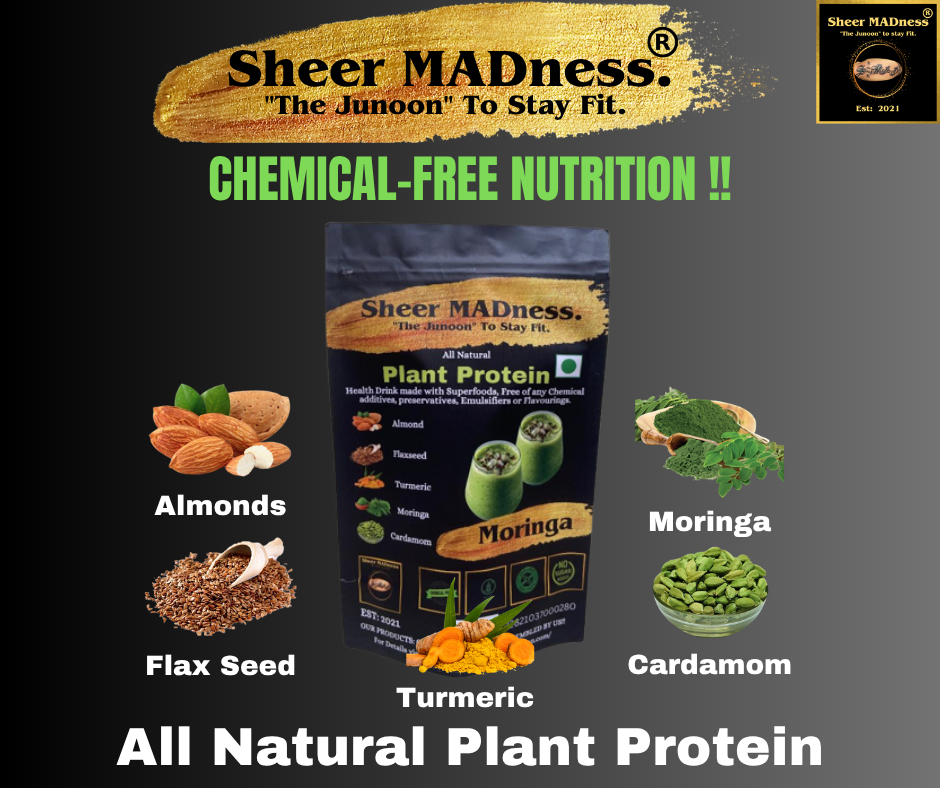
Sheer MADness Plant Protein Moringa contains zero synthetic chemical additive. Five whole-food ingredients. Vacuum packed without any chemical preservative. Since 2021, every ingredient appears on the front of every pack — giving athletes the ingredient transparency that serious training demands.
Sheer MADness holds a registered trademark under the Government of India. The Natural Plant Protein formula is patent published under Patent No. 202331036733, searchable on Intellectual Property India. The brand holds a valid FSSAI licence and GSTIN registration.
| Muscle Building Factor | Moringa Mechanism | Compound | Evidence Level |
|---|---|---|---|
| mTOR activation (MPS initiation) | Leucine → Rag GTPase → lysosomal mTORC1 recruitment | Leucine (moringa 6.5-7.5g/100g protein) | Strong — mTOR mechanism well-established |
| 4EBP1 phosphorylation (translation initiation) | mTORC1 → 4EBP1 → eIF4E release | Leucine → mTORC1 | Strong — mechanism confirmed |
| S6K1 activation (ribosomal capacity) | mTORC1 → S6K1 → ribosomal S6 + eIF4B | Leucine → mTORC1 | Strong — mechanism confirmed |
| Satellite cell protection | Nrf2 → GPx/SOD/catalase → ROS neutralisation | Isothiocyanates → Nrf2 | Moderate — Frontiers Pharmacology 2020 |
| MPB reduction (MuRF-1 inhibition) | NF-κB inhibition → reduced MuRF-1 expression | Isothiocyanates + curcumin | Moderate — mechanism confirmed |
| REDD1 suppression (mTOR protection from cortisol) | AMPK crosstalk → reduced REDD1-TSC2 inhibition | Chlorogenic acid + quercetin | Moderate — mechanism confirmed |
| Testosterone-AR gene expression | Zinc → AR zinc finger domain integrity | Zinc (moringa + almond) | Moderate — Biol Trace Elem Res |
| ATP availability for training | Magnesium as Mg-ATP complex cofactor | Magnesium (almonds 270mg/100g) | Strong — biochemical mechanism |
| Oxygen delivery to working muscle | Iron → haemoglobin + myoglobin | Iron 28mg/100g + Vitamin C | Strong — iron-MPS connection confirmed |
| Indian diet lysine gap correction | Complete EAA profile including lysine | Moringa complete protein | Strong — lysine-MPS limitation confirmed |

Is moringa good for building muscles?
Yes — moringa supports muscle building through five specific mechanisms: leucine-driven mTOR activation initiating muscle protein synthesis, Nrf2 protection of satellite cells that add permanent myonuclei to growing fibres, NF-κB inhibition reducing muscle protein breakdown, and zinc-magnesium-iron provision supporting the hormonal and physiological environment for maximum training response. These mechanisms are supported by established molecular biology. Consistent daily moringa combined with progressive resistance training and adequate total protein intake represents the most complete plant-based muscle-building nutritional approach available.
What is mTOR and why does leucine in moringa activate it?
mTOR (mechanistic target of rapamycin) is the master regulator of muscle protein synthesis. Leucine activates Rag GTPases that recruit mTORC1 to the lysosomal surface where Rheb activates it. Active mTORC1 then phosphorylates S6K1 (increasing ribosomal protein synthesis capacity) and 4EBP1 (releasing eIF4E to initiate mRNA translation). Together, these increase both the rate and capacity of muscle protein production. Moringa leaf protein provides leucine at 6.5 to 7.5 grams per 100 grams of protein — sufficient to contribute meaningfully toward the per-meal leucine threshold required for mTOR activation.
What are satellite cells and how does moringa support them?
Satellite cells are muscle stem cells that activate during training-induced muscle damage. They proliferate, differentiate into myoblasts, and fuse with muscle fibres — donating permanent new myonuclei that expand the fibre’s protein synthesis capacity. More myonuclei mean more simultaneous MPS — producing greater long-term muscle growth. Excessive post-training ROS impairs satellite cell function. Moringa’s Nrf2 activation specifically neutralises excessive ROS while allowing the moderate ROS that signals satellite cell activation to function normally — improving the quality of myonuclei addition per training session.
What is the difference between MPS and MPB and how does moringa affect both?
MPS (muscle protein synthesis) is the rate of new muscle protein production. MPB (muscle protein breakdown) is the rate of existing muscle protein degradation. Net muscle growth requires MPS to exceed MPB consistently over time. Most protein nutrition advice focuses only on increasing MPS. However, moringa also reduces MPB — specifically through NF-κB inhibition reducing MuRF-1 and atrogin-1 expression (the ubiquitin ligases that degrade myofibrillar proteins) and through AMPK-mediated REDD1 suppression that partially protects mTOR from cortisol-driven breakdown signalling. Consequently, moringa improves the net MPS vs MPB balance from both directions.
Why is the lysine gap a specific problem for Indian vegetarian bodybuilders?
Rice and wheat — the caloric base of most Indian vegetarian diets — are limiting in lysine, an essential amino acid required for muscle protein synthesis. When lysine is insufficient, MPS cannot proceed at full rate regardless of total protein intake. Moringa provides all nine essential amino acids including adequate lysine — making it one of the very few plant foods that corrects the specific amino acid deficiency most limiting muscle building in grain-dominant Indian vegetarian diets. Furthermore, moringa’s leucine content provides the mTOR activation trigger that grain proteins cannot.
How does zinc in moringa support muscle building beyond testosterone?
Zinc is a structural cofactor for the androgen receptor’s zinc finger DNA-binding domains. Without adequate zinc, the testosterone-AR complex cannot efficiently bind androgen response elements in muscle gene promoters — including myosin heavy chain and IGF-1 genes. Consequently, zinc deficiency specifically impairs the muscle gene expression response to testosterone even when testosterone itself is adequate. Research confirmed that zinc-supplemented athletes showed significantly better training strength gains compared to zinc-deficient controls. Moringa and almonds in Sheer MADness both contribute dietary zinc toward this muscle gene expression mechanism.
How does moringa’s iron contribute to training performance?
Iron is the central atom of haemoglobin (blood oxygen transport) and myoglobin (muscle oxygen storage). Iron deficiency specifically reduces oxygen delivery capacity to working muscle — causing earlier fatigue, reduced training volume, and suboptimal intra-set recovery. All of these directly limit the mechanical overload stimulus that drives hypertrophy. Moringa provides iron at 28 milligrams per 100 grams — the highest plant-food iron density available. Furthermore, moringa’s simultaneous Vitamin C content enhances non-haem iron absorption two to four times. Consequently, daily Sheer MADness Plant Protein Moringa provides the most iron-absorption-optimised plant preparation specifically supporting training performance.
How much Sheer MADness Plant Protein Moringa should I take for muscle building?
For muscle building specifically, protein distribution matters as much as total quantity. Two servings of Sheer MADness Plant Protein Moringa daily — one in the morning and one post-training — provides 15 grams of complementary-combined complete protein across two separate MPS activation occasions. Consumed alongside milk (approximately 8 grams protein per 250ml), each preparation provides approximately 15 to 17 grams of total protein including meaningful leucine contribution toward the per-meal mTOR activation threshold. Total daily protein from all sources should target 1.6 to 2.2 grams per kilogram of body weight as recommended by the ISSN for resistance-trained individuals.
Muscle building is molecular biology. It requires leucine to activate the mTOR pathway that initiates protein synthesis. Muscle requires satellite cell activation and myonuclei addition to permanently expand the muscle fibre’s synthesis capacity. It requires MPS to consistently exceed MPB over time — which means both driving synthesis and reducing breakdown. Furthermore, it requires the hormonal and physiological environment — testosterone, IGF-1, adequate ATP, adequate oxygen — in which the training stimulus is maximally converted into anabolic signalling.
Moringa addresses every one of these requirements. Its leucine provides mTOR activation. Its Nrf2 activation protects satellite cells from excessive post-training ROS. Moringa’s NF-κB inhibition reduces MuRF-1-driven MPB. Its zinc supports testosterone-AR muscle gene expression. Moringa’s magnesium supports Mg-ATP mechanical output and creatine kinase function. Its iron and Vitamin C combination maximises haemoglobin and myoglobin for oxygen delivery to working muscle.
For Indian vegetarian bodybuilders specifically — facing a simultaneous protein quantity gap and lysine quality gap from grain-dominant diets — moringa corrects the specific amino acid limitation most restricting plant-based muscle protein synthesis.
Sheer MADness Plant Protein Moringa delivers all of this from five whole-food ingredients. Zero synthetic additive. Every ingredient on the front of every pack since 2021. The muscle-building machinery is in the ingredients.
I would also request you to please read my previous post: Benefits of Moringa Plant protein, the versatile Superfood powerhouse.
a) Everyone is an individual, so what suits me may not suit the next person.
b) If a person has a medical condition, a doctor’s advice and prescribed medication will only help. Specific conditions affecting kidneys, liver, or hormonal function require physician guidance on protein intake and supplementation before beginning any muscle-building programme.
c) While buying any protein powder from the market, read the labels carefully. Watch out for INS codes, Anti-caking agent, INS 551 (Silicon dioxide), BHA (Butylated hydroxyanisole), BHT (Butylated hydroxytoluene), and sucralose. For bodybuilders consuming protein supplements daily, the cumulative daily chemical additive load over months and years is specifically worth minimising.
If you are interested in buying chemical-free Natural Plant Protein Moringa, Health Drinks for Kids, or our delicious chemical-free Energy Bars, Protein Bars, and Millet Bars, shop at Sheer MADness.
You can also find us on Flipkart, Jio Mart, or ONDC in India.
d) Exercise is the key to fitness. Exercise and nutrition are two sides of the same coin and always go hand in hand. For muscle building specifically, progressive overload resistance training is the non-negotiable mechanical stimulus. Moringa provides the nutritional environment in which that training stimulus maximally converts to muscle growth — it does not replace the training itself.
e) Excess of anything is wrong, even the best whole-food superfood. Consume only recommended quantities.
f) Rome was not built in a day. Discipline and consistency are the only keys to lasting health.
g) It is not only exercise and protein that builds muscles. A healthy gut, macro and micronutrients, body type, DNA, rest, and lifestyle all matter. Of all these, exercise and nutrition are within our control. Focus on these two primary aspects first.
h) The most important part of fitness is that nothing is better than exercise and a balanced meal.
Article by Chef Ashutosh Awasthi
Disclaimer: Our products are a source of HEALTHY NUTRIENTS and are COMPLETELY FREE OF ANY ADDED CHEMICALS. We do not claim to cure any medical condition. The content provided is informational. We do not claim to diagnose or treat a person with any specific medical condition.