

Direct answer: Yes — bodybuilders eat protein bars, and for reasons specific to their training demands that differ from general athletes. Bodybuilders require higher daily protein than most athletes — 1.6 to 2.2 grams per kilogram of body weight during bulking phases — and must distribute this protein precisely across six to eight eating occasions per day to maximise muscle protein synthesis rates. Protein bars solve the specific logistical problem of hitting protein targets at every eating window throughout a demanding training day when cooking six full meals is impossible. However, bodybuilders also have more specific ingredient requirements than general athletes — and the wrong bar, consumed multiple times daily throughout a bodybuilding season, compounds its shortcomings significantly.
This post is differentiated from the general athletes post we have already published. It covers the science specific to bodybuilding nutrition — the bulking and cutting phase distinctions, the hypertrophy-specific protein timing research, the micronutrient demands of heavy resistance training, and why Indian bodybuilders specifically benefit from whole-food bars over isolated protein concentrates.
I’m Chef Ashutosh Awasthi, founder of Sheer MADness, professional chef, marathon runner, and author of Great Health Comes from Exercise & Nutrition. Let me give you the complete, research-backed, India-specific answer to protein bars for bodybuilders.
Bodybuilding is a sport of intentional body composition manipulation — deliberately adding muscle mass during bulking phases and deliberately reducing body fat while preserving muscle during cutting phases. This cyclical approach to nutrition creates specific requirements that distinguish bodybuilding from general fitness training.
The International Society of Sports Nutrition 2017 position paper on protein and exercise — the most comprehensive scientific review on this topic — confirmed that protein intakes of 1.6 to 2.2 grams per kilogram of body weight per day maximise muscle protein synthesis for trained bodybuilders. This is significantly higher than the 0.8 to 1.0 grams per kilogram recommended for sedentary adults and higher than the 1.2 to 1.6 grams recommended for general fitness athletes.
For a 75-kilogram Indian bodybuilder training five days per week, this means 120 to 165 grams of protein daily. Most Indian dietary patterns — even protein-conscious ones — deliver 60 to 90 grams daily from meals. The gap between dietary protein from meals and the bodybuilding protein requirement is specifically where protein bars serve their most valuable function.
Two Sheer MADness bars daily contribute 16 to 20 grams toward this target from whole-food sources — approximately 10 to 15 percent of the daily bodybuilding protein requirement from two convenient snacks between meals.
Research published in the Journal of Nutrition specifically on protein distribution and muscle protein synthesis in resistance-trained athletes confirmed that distributing protein across six eating occasions per day — rather than three — produces significantly better muscle protein synthesis outcomes at the same total daily protein intake.
The mechanism is specific: each protein feeding activates the mTOR pathway for approximately 3 to 4 hours. Six protein feedings therefore maintain elevated mTOR signalling for approximately 18 to 24 hours continuously — approaching the ideal of near-continuous muscle protein synthesis activation during hypertrophy training phases.
Cooking six protein-rich meals per day is logistically impossible for most Indian bodybuilders managing careers, families, and commutes alongside their training. Protein bars specifically solve the mid-morning, mid-afternoon, and post-workout eating windows where meals are most difficult to prepare and consume.
Bodybuilders train in distinct phases that require different nutritional approaches — and protein bar selection should reflect these phases.
Bulking phase goals: maximum muscle protein synthesis, caloric surplus, generous carbohydrate intake for glycogen and insulin-mediated anabolism. During bulking, the higher natural carbohydrate content of Sheer MADness bars — from oats, dates, and raisins — is specifically appropriate alongside their protein. The natural carbohydrates stimulate insulin, which has mild anabolic properties at the cellular level and supports glycogen replenishment for the next training session.
Cutting phase goals: preserving muscle mass while reducing body fat through caloric deficit. During cutting, protein becomes even more critical — because caloric restriction increases the risk of muscle catabolism as the body seeks energy from protein stores when caloric intake is insufficient. Research confirmed in the ISSN position paper that higher protein intake during cutting phases specifically preserves lean mass better than lower protein intake at the same caloric deficit.
Sheer MADness bars at 180 to 200 kilocalories each are specifically appropriate for cutting phases — providing 8 to 10 grams of whole-food protein at a moderate caloric cost, supporting the high-protein, calorie-controlled approach that preserves muscle during deficit phases.
Understanding the molecular basis of hypertrophy explains why protein source quality, amino acid profile, and leucine content specifically matter for bodybuilders in ways that don’t apply equally to casual gym-goers.
Muscle protein synthesis is activated at the cellular level through the mTORC1 signalling pathway. Research published in the Journal of the International Society of Sports Nutrition confirmed that leucine acts as the primary trigger for mTOR activation — intracellular leucine must reach a threshold concentration of approximately 2 to 3 grams per meal to achieve near-maximum mTOR signalling.
This leucine threshold is critical for bodybuilders. It means that protein doses below the mTOR activation threshold — even if technically providing protein — produce suboptimal muscle protein synthesis responses. Each protein feeding must reach the leucine threshold to fully activate the anabolic machinery.
Sheer MADness bars provide leucine from sattu, almonds, and oats combined. At 8 to 10 grams of total protein per bar, the leucine content approaches 0.5 to 0.7 grams — below the 2 to 3-gram single-meal threshold. However, this is appropriate in context. The bar is not replacing a protein shake or a meal. It is a between-meal protein feeding that contributes to cumulative daily leucine availability. Across six daily protein feedings including three meals with higher protein content, the cumulative leucine readily exceeds the daily requirements for mTOR activation.
For bodybuilders wanting higher leucine per bar, consuming two bars simultaneously delivers 1.0 to 1.4 grams of leucine — approaching the activation threshold from a bar-only feeding.
Beyond mTOR signalling, muscle hypertrophy requires satellite cell activation — the muscle stem cells that fuse with damaged muscle fibres during repair, contributing new nuclei that support greater protein synthesis capacity. Satellite cell activation requires adequate growth factors, zinc for metalloprotease activity, and omega-3 fatty acids that reduce the inflammatory environment suppressing satellite cell function.
Zinc from pumpkin seeds in Sheer MADness bars specifically supports the metalloprotease-dependent satellite cell migration and fusion. Omega-3 from flaxseed specifically reduces the excessive inflammation that impairs satellite cell activity when training volume is very high. These micronutrient contributions to hypertrophy biology distinguish Sheer MADness bars from protein isolate bars that deliver protein and essentially nothing else relevant to the complete hypertrophy biology.
Testosterone is the primary anabolic hormone driving muscle protein synthesis in male bodybuilders and contributing to anabolic processes in female bodybuilders. Two minerals are specifically critical for testosterone synthesis: zinc and magnesium.
Zinc deficiency — prevalent in Indian adults on phytate-heavy grain diets — directly reduces testosterone synthesis by impairing the Leydig cell function that produces testosterone. Magnesium deficiency — also common in India due to refined grain processing that strips magnesium — reduces free testosterone by increasing sex hormone-binding globulin (SHBG) activity.
Sheer MADness bars provide zinc from pumpkin seeds and melon seeds (7.8mg/100g) and magnesium from almonds (270mg/100g), dark chocolate, and oats. These are the specific minerals that bodybuilders — particularly Indian vegetarian bodybuilders on phytate-high diets — most commonly lack and most specifically need for optimal testosterone support.
No commercial bar built on whey protein isolate delivers meaningful zinc and magnesium from whole-food sources alongside its protein. These minerals are removed during whey isolation processing.
India’s bodybuilding culture is growing rapidly. State and national-level bodybuilding competitions are proliferating. Urban gyms are filling with serious strength training enthusiasts. The demand for clean, effective bodybuilding nutrition specifically for Indian bodies is increasing faster than the market has responded.
However, most bodybuilding nutrition products available in India are designed for Western markets and Western bodies — specifically built around whey protein derived from dairy, at protein concentrations that exceed what most Indian digestive systems manage comfortably.
Indian bodybuilders face a specific challenge. Sixty to seventy percent of Indian adults have some degree of lactose intolerance. Whey protein concentrate — the basis of most commercial protein bars — causes digestive disruption in this majority. Post-training bloating, loose stools, and cramping from whey bar consumption are reported consistently by Indian bodybuilders — symptoms attributed to “detox” or “adjustment” that are actually lactose fermentation in an intolerant gut.
Furthermore, most Indian bodybuilders are vegetarian. Their protein sources from meals are predominantly dairy-based — paneer, curd, milk — for animal protein, and dal and pulses for plant protein. Adding concentrated whey protein from commercial bars on top of already-dairy-heavy diets compounds the lactose load in a gut that may already be managing dairy with difficulty.
Indian bodybuilding has a long tradition — specifically the Kushti wrestling tradition that has produced world-class athletes for centuries from Varanasi, Kolkata, Pune, and across the subcontinent. The nutritional tradition of Indian wrestlers is directly relevant to the bodybuilding protein bar discussion.
Kushti wrestlers historically consumed sattu laddoos — roasted gram flour combined with ghee and jaggery — as primary protein-carbohydrate recovery food. They consumed almond milk for strength, energy, and hormonal health. Used milk with turmeric after intense training for recovery. They incorporated flaxseed in their cooking for its beneficial oils.
This is the traditional Indian bodybuilding nutrition — whole foods, no chemical extraction, culturally appropriate ingredients that Indian digestive systems have processed comfortably for generations. Sheer MADness Protein Bars formalise this tradition in convenient bar form — sattu for protein and iron, almonds for healthy fats and Vitamin E, flaxseed for omega-3, oats for sustained glycogen, dark chocolate for magnesium and tryptophan. The same whole-food ingredients, packaged for the modern Indian bodybuilder who trains before work and needs immediate post-training nutrition without meal preparation.
Sheer MADness Protein Bars and Energy Bars address the specific nutritional requirements of Indian bodybuilders through ingredient choices that commercial bars consistently miss.
Every gram of protein in Sheer MADness bars comes from whole plant sources — sattu, almonds, oats, flaxseed, pumpkin seeds, and melon seeds. Zero dairy. Zero lactose. The post-training digestive distress that most Indian bodybuilders attribute to “too much protein” from whey bars disappears when switching to a genuinely dairy-free whole-food bar. Recovery improves when the gut is not simultaneously managing lactose fermentation alongside the physiological demands of post-training recovery.
As detailed above, zinc and magnesium are the two minerals most directly supportive of testosterone synthesis. Both are commonly insufficient in Indian vegetarian diets. Sheer MADness bars provide both from multiple whole-food sources — pumpkin seeds and melon seeds for zinc, almonds and dark chocolate and oats for magnesium. The bodybuilder consuming two Sheer MADness bars daily receives a meaningful daily zinc and magnesium contribution that no whey isolate bar provides.
Bodybuilders in the hypertrophy phase typically train 5 to 6 days per week with high volume — large numbers of sets and repetitions targeting progressive muscle damage and repair. This high volume creates significant exercise-induced inflammation that must be managed for recovery to proceed efficiently between sessions.
Flaxseed omega-3 ALA in Sheer MADness bars reduces the inflammatory cytokines — TNF-α, IL-6 — that elevated post-training inflammation generates. Cumulative daily omega-3 over weeks of bodybuilding training progressively reduces baseline inflammation, improving recovery between high-volume sessions. No commercial whey bar provides any omega-3. Sheer MADness delivers 1.1 to 1.8 grams of ALA per bar from whole flaxseed.
Bodybuilders in bulking phases need carbohydrates alongside protein for optimal anabolism. The mild insulin response to natural carbohydrates supports glucose uptake into muscle cells and creates a mildly anabolic hormonal environment. The oat beta-glucan and dates in Sheer MADness bars provide natural carbohydrates with a moderate, sustained glycaemic response — supporting glycogen replenishment without the blood sugar spike and crash that refined sugar in commercial bars creates.
High-volume resistance training increases red blood cell turnover and iron requirements beyond sedentary baseline. Bodybuilders training intensively without adequate iron face reduced haemoglobin capacity — less oxygen delivery to working muscles, reduced training intensity, slower recovery.
Jaggery provides iron at 11 milligrams per 100 grams. Sattu provides 8 to 9 milligrams per 100 grams. Raisins add additional iron alongside natural vitamin C that enhances absorption. For Indian bodybuilders — particularly women bodybuilders for whom iron loss from menstruation adds to training-related iron demands — this daily iron from three whole-food sources in one bar is a specifically meaningful bodybuilding nutrition contribution.
During bulking, the goal is maximum muscle protein synthesis with a caloric surplus. Consume one Sheer MADness bar as a mid-morning snack between breakfast and the pre-workout meal, and one bar immediately post-training within 30 minutes of finishing the session. On heavy training days, consider two bars post-training for additional protein and carbohydrate support for glycogen restoration.
The natural carbohydrates from oats and dates specifically support the insulin-mediated glycogen uptake and mild anabolic insulin response that bulking protocols benefit from. The magnesium from almonds and dark chocolate supports ATP synthesis for the next training session. The zinc from pumpkin seeds supports testosterone maintenance through a high-volume training phase.
During cutting, the goal is preserving muscle while losing fat through caloric restriction. Sheer MADness bars at 180 to 200 kilocalories each are specifically appropriate as calorie-controlled protein feedings. One bar mid-morning and one mid-afternoon replaces higher-calorie snack alternatives while providing protein to preserve lean mass during the caloric deficit.
The oat beta-glucan provides sustained satiety — reducing hunger between meals during a cut when caloric restriction creates hunger pressure. The protein from sattu and almonds at the mid-morning and mid-afternoon windows specifically counteracts muscle catabolism during the long gaps between meals on restricted caloric intake.
The absence of refined sugar, maltitol, and glucose syrup in Sheer MADness bars is specifically advantageous during cutting — where blood sugar stability determines insulin levels and fat oxidation efficiency.
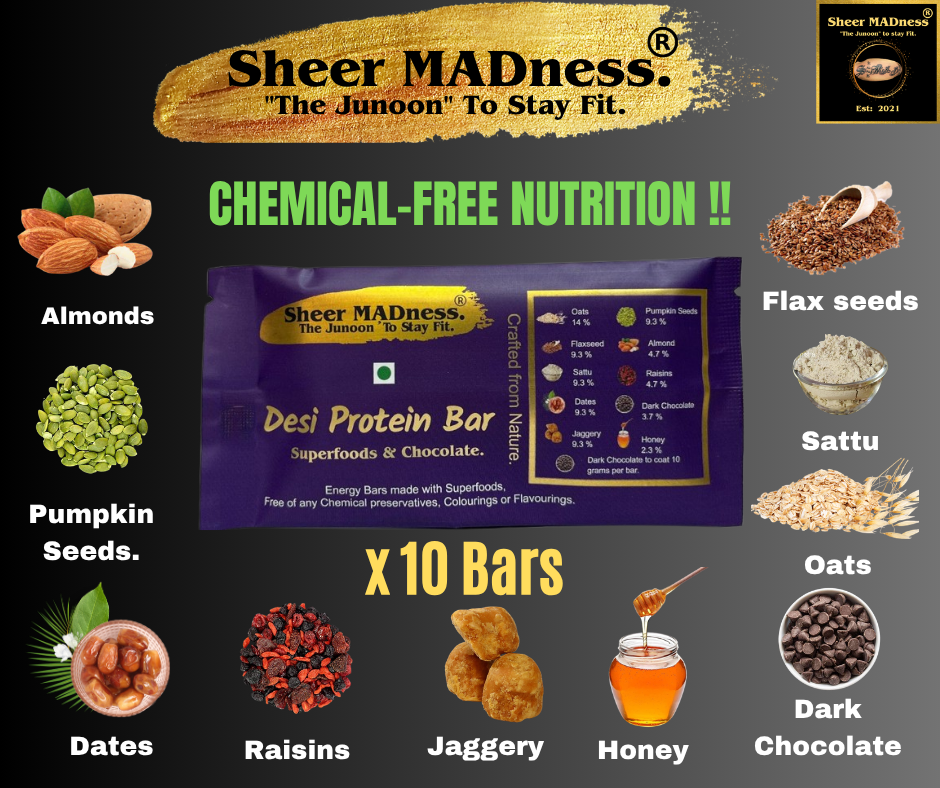
Serious bodybuilders read ingredient labels. They know that what goes into the bar determines what the bar does for their physiology. Since 2021, Sheer MADness has been the only Indian protein bar brand displaying every ingredient with its own image on the front of every pack.
Oats, almonds, sattu, flaxseed, pumpkin seeds, melon seeds, dates, raisins, jaggery, honey, and dark chocolate — visible before opening. No “protein blend” hiding multiple isolate sources. Zero INS code requiring interpretation. No chemical preservative obscured by small print. Every bodybuilding-relevant nutrient — zinc, magnesium, iron, omega-3, leucine — traceable to its specific visible whole-food ingredient source.
Sheer MADness holds a registered trademark under the Government of India. The Natural Plant Protein formula is patent published under Patent No. 202331036733, searchable on Intellectual Property India. The brand holds a valid FSSAI licence and GSTIN registration.
| Bodybuilding Requirement | Sheer MADness | Typical Commercial Protein Bar |
|---|---|---|
| Protein per bar | 8 to 10g whole-food | 15 to 25g isolate-based |
| Leucine for mTOR | Moderate — complementary sources | Higher — but digestibility-dependent |
| Lactose-free (Indian bodybuilders) | Yes — 100% dairy-free | No — whey protein typical |
| Zinc for testosterone | Yes — pumpkin seeds and melon seeds | Usually absent |
| Magnesium for ATP | Yes — almonds, oats, dark chocolate | Usually absent |
| Iron for training capacity | Yes — jaggery, sattu, raisins | Usually absent |
| Omega-3 for recovery | Yes — flaxseed ALA | Absent |
| Bulking carbohydrates | Natural — oats, dates, raisins | Often refined sweeteners |
| Cutting caloric control | 180-200 kcal per bar | Variable — often 250-400 kcal |
| Gut disruption | Zero — no sugar alcohols, no lactose | Moderate to high |
| Chemical preservatives | None — oxygen absorbers | BHA, BHT common |
| Daily use appropriateness | High — whole foods compound benefits | Variable — chemical accumulation |
| Indian dietary compatibility | High — sattu, almonds, jaggery culturally familiar | Low — imported protein formats |
| Price per bar | ₹60 | ₹80 to ₹250 |
Do bodybuilders eat protein bars?
Yes — protein bars solve the logistical problem of hitting 6 to 8 daily protein eating occasions for bodybuilders who require 1.6 to 2.2 grams of protein per kilogram per day. Bars provide protein at the mid-morning, mid-afternoon, and post-training windows where meal preparation is impossible. The bar’s ingredient quality determines whether it supports or undermines the bodybuilding nutrition programme.
How much protein do bodybuilders need daily?
The ISSN 2017 position paper confirms 1.6 to 2.2 grams per kilogram per day for maximising muscle protein synthesis in trained bodybuilders. For a 75-kilogram bodybuilder, this means 120 to 165 grams daily. Distributing this across six eating occasions per day — including bar snacks — produces better hypertrophy outcomes than concentrating the same protein in three meals.
Yes — specifically for Indian bodybuilders. The dairy-free whole-food protein eliminates the lactose digestion problem affecting most Indian adults who use whey bars. The zinc and magnesium from pumpkin seeds and almonds support testosterone synthesis and ATP production — the two most commonly deficient minerals in Indian vegetarian bodybuilding diets. The omega-3 from flaxseed reduces the exercise-induced inflammation that impairs recovery in high-volume bodybuilding training.
Should bodybuilders use bars during bulking or cutting?
Both phases benefit — for different reasons. During bulking, the natural carbohydrates from oats and dates support insulin-mediated glycogen replenishment and mild anabolic hormonal environment alongside the protein. During cutting, bars provide high-satiety protein at only 180 to 200 kilocalories — fitting precise caloric control while preventing the muscle catabolism that caloric restriction creates without adequate protein.
Are protein bars better than protein shakes for bodybuilders?
Both serve different purposes. Protein shakes — particularly fast-digesting whey post-workout — deliver amino acids rapidly during the acute post-training window. Protein bars provide protein with fibre, fats, and micronutrients, producing sustained amino acid delivery and satiety appropriate for between-meal protein feedings. For lactose-intolerant Indian bodybuilders who experience gut distress from whey shakes, whole-food bars are specifically advantageous.
One to two bars per day is appropriate for most bodybuilders using bars to supplement meal-based protein. Two bars contribute 16 to 20 grams of whole-food protein — approximately 10 to 15 percent of daily requirements for a 75-kilogram bodybuilder in the hypertrophy phase. Bars supplement meals rather than replacing them.
Why do Indian bodybuilders specifically benefit from sattu-based bars?
Sattu has been the foundation of Indian athletic nutrition for centuries — specifically because Indian bodies have processed it efficiently for generations. Sattu’s high lysine addresses the limiting amino acid of India’s grain-heavy dietary pattern. Its low glycaemic index (28-35) prevents the blood sugar disruption that refined sugar in commercial bars creates. Its iron content addresses the haemoglobin maintenance demands of high-volume resistance training.
Do bodybuilders need micronutrients beyond protein?
Yes — significantly. Muscle hypertrophy biology requires zinc for testosterone synthesis and satellite cell function, magnesium for ATP synthesis and muscle contraction, iron for haemoglobin and oxygen delivery during training, omega-3 for inflammation management between sessions, and Vitamin E for muscle cell membrane protection. Bars that deliver only protein miss the complete micronutrient support that hypertrophy biology requires.

Bodybuilders eat protein bars — and they should. The protein distribution demands of bodybuilding nutrition (six to eight daily feedings) and the specific protein requirements (1.6 to 2.2g/kg daily) make protein bars a practical necessity for serious Indian bodybuilders managing demanding schedules.
The right bar for Indian bodybuilders delivers complete whole-food protein addressing the leucine and lysine requirements of mTOR activation and muscle repair. It provides zinc and magnesium for testosterone and ATP synthesis — the two minerals most deficient in Indian vegetarian bodybuilding diets. The same provides omega-3 for the anti-inflammatory recovery support that high-volume training demands. It provides iron for the haemoglobin maintenance that training intensity depends on. And it contains zero lactose for the majority of Indian adults whose guts cannot process whey protein without disruption.
Sheer MADness bars deliver every one of these bodybuilding requirements. From eleven whole-food ingredients. Preserved with oxygen absorbers. Every ingredient on the front of the pack since 2021. At ₹60 per bar — accessible to Indian bodybuilders at every competitive level.
The sattu laddoos that Indian wrestlers ate for centuries were not superstition. They were whole-food bodybuilding nutrition that Indian athletic tradition had already figured out. Sheer MADness just made it convenient for 2026.
I would also request you to kindly read my previous post about “Healthiest Protein Bar in India“.
a) Everyone is an individual, so what suits me may not suit the next person.
b) If a person has a medical condition, a doctor’s advice and prescribed medication will only help.
c) While buying any protein bar from the market, read the labels carefully. Watch out for INS 320 (BHA), INS 321 (BHT), INS 551 (silicon dioxide), maltitol, sorbitol, sucralose, whey protein concentrate, and other ingredients that impair gut function and compound chemical exposure in a body already under significant physiological training stress.
If you are interested in buying chemical-free Natural Plant Protein Moringa, Health Drinks for Kids, or our delicious chemical-free Energy Bars, Protein Bars, and Millet Bars, shop at Sheer MADness.
You can also find us on Flipkart, Jio Mart, or ONDC in India.
d) Exercise is the key to fitness. Exercise and nutrition are two sides of the same coin and always go hand in hand.
e) Excess of anything is wrong, even the best whole-food snack. Consume only recommended quantities.
f) Rome was not built in a day. Discipline and consistency are the only keys to lasting health.
g) It is not only exercise and protein that builds health. A healthy gut, macro and micronutrients, body type, rest, and lifestyle all matter. Of all these, exercise and nutrition are within our control. Focus on these two primary aspects first.
h) The most important part of fitness is that nothing is better than exercise and a balanced meal.
Article by Chef Ashutosh Awasthi
Disclaimer: Our products are a source of HEALTHY NUTRIENTS and are COMPLETELY FREE OF ANY ADDED CHEMICALS. We do not claim to cure any medical condition. The content provided is informational. We do not claim to diagnose or treat a person with any specific medical condition.