

Direct answer: Yes — moringa protein powder not only can be taken with milk, it is nutritionally superior to moringa taken with water for most people. Milk fat creates the dietary lipid environment required for moringa’s fat-soluble micronutrients — beta-carotene, Vitamin K, and Vitamin E — to form intestinal micelles and absorb into the lymphatic system. Without adequate dietary fat, these fat-soluble nutrients pass through the intestine largely unabsorbed. Furthermore, milk’s casein and whey proteins complement moringa’s plant protein through amino acid combining — providing methionine that moringa’s protein is relatively lower in, while moringa provides lysine that grain-based Indian diets are most deficient in. Together, moringa-in-milk creates a protein preparation with better amino acid coverage and both immediate and sustained amino acid release than either provides alone.
I am Chef Ashutosh Awasthi, founder of Sheer MADness, professional chef, marathon runner, and author of Great Health Comes from Exercise & Nutrition. This post explains the science of why moringa and milk work better together — the fat-soluble absorption mechanism, the protein combining synergy, the Doodh Haldi cultural tradition, and the practical guidance on warm vs cold, dairy vs plant-based, and when to consume the moringa-milk preparation for maximum benefit.
Sheer MADness was founded on a specific mission: to bring back India’s own food culture. Doodh Badam — milk with almonds. Doodh Haldi — milk with turmeric. These are not ancient superstitions. They are traditional preparations that nutritional science now confirms were profoundly intelligent food combinations — whole-food nutrients in fat-soluble carriers, consumed warm, prepared by hand without chemical additives.
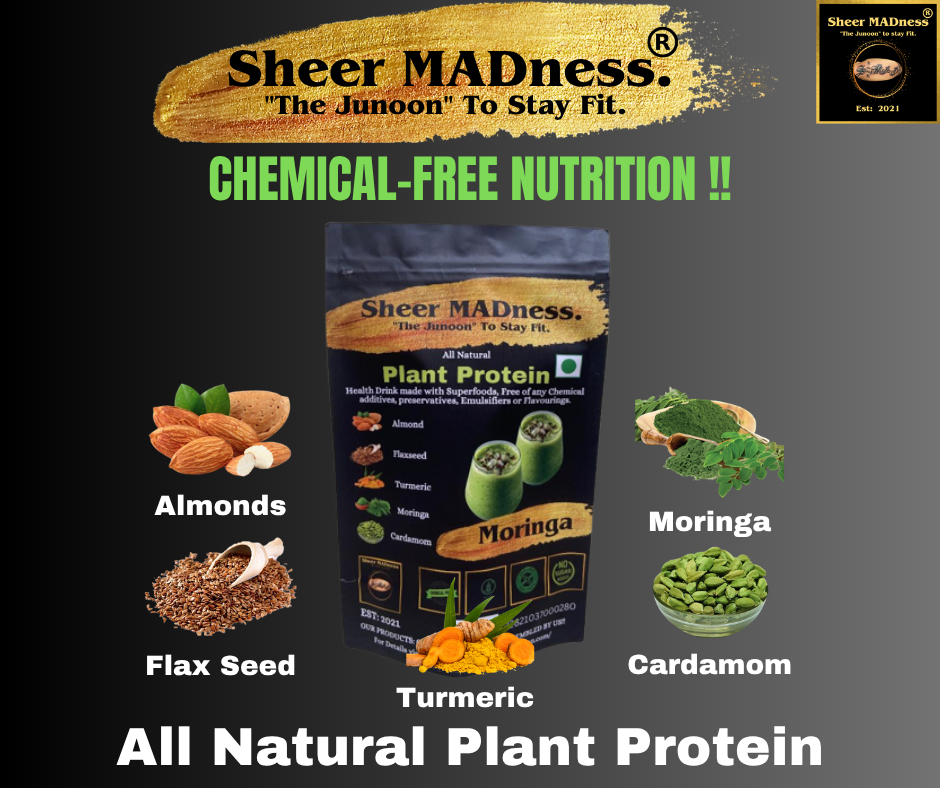
Sheer MADness Plant Protein Moringa contains moringa leaf, almonds, flaxseed, turmeric, and cardamom. When mixed into warm milk, it becomes a single preparation that delivers Doodh Badam (almond nutrition in warm milk), Doodh Haldi (turmeric curcumin in warm milk fat carrier), and now Doodh Moringa — the most nutritionally complete expression of this Indian food tradition available. This is not a foreign supplement. It is Indian food culture in its most concentrated, chemically clean, and scientifically validated form.
This is the single most important scientific reason to take moringa with milk rather than water — and the reason most completely absent from standard moringa-and-milk content.
Moringa’s most distinctive micronutrients — the ones that make it a uniquely nutritious food — include several fat-soluble compounds. Beta-carotene (provitamin A) is fat-soluble. Vitamin K (phylloquinone) is fat-soluble. Vitamin E (tocopherol) is fat-soluble. These compounds require dietary fat for absorption through a specific mechanism — micellar solubilisation.
Fat-soluble nutrients cannot dissolve in the watery environment of the small intestinal lumen. Consequently, they require incorporation into mixed micelles — small spherical structures formed from bile acids and dietary lipids — to reach the intestinal epithelial cell surface. Specifically, bile acids from the gallbladder emulsify dietary fats into micelles in the small intestine. Fat-soluble nutrients partition into these micelles. The micelles then carry the fat-soluble nutrients to the brush border membrane of enterocytes, where they are absorbed by passive diffusion. Without adequate dietary fat, insufficient micelle formation occurs. Consequently, fat-soluble nutrients pass through the intestine without absorption.
Research published in the American Journal of Clinical Nutrition confirmed that fat-soluble carotenoid absorption from plant foods increases several-fold when consumed with a small amount of dietary fat versus without. Specifically, the study found that beta-carotene absorption from a salad increased dramatically when avocado or full-fat dressing was added — with the effect entirely attributable to the fat content facilitating micelle formation. The same mechanism applies to moringa’s beta-carotene.
Whole milk provides approximately 3.5 grams of fat per 100 millilitres. A 250ml glass of whole milk therefore provides approximately 8.75 grams of fat alongside moringa’s powder. This fat is sufficient to drive maximal micelle formation for moringa’s fat-soluble micronutrients. Consequently, the beta-carotene, Vitamin K, and Vitamin E in moringa are substantially more bioavailable when dissolved in whole milk than when dissolved in water.
For moringa’s beta-carotene — converted to Vitamin A for immune function, skin health, and vision — the difference between fat-present and fat-absent consumption is not minor. Research consistently shows three to five times higher carotenoid absorption when dietary fat is present at the same meal. Consequently, taking Sheer MADness Plant Protein Moringa with 250ml of whole milk rather than water may deliver three to five times more Vitamin A activity from the same serving. Furthermore, Vitamin K from moringa — required for osteocalcin carboxylation in bone mineralisation, as established in the women’s health and seniors posts — similarly requires fat for absorption. Therefore, the bone health benefits of moringa’s Vitamin K are specifically delivered through the milk-fat carrier mechanism.
The protein quality argument for moringa-in-milk is the most practically important nutritional synergy for anyone consuming this preparation for protein purposes.
Moringa provides all nine essential amino acids — making it a complete plant protein. However, completeness does not mean equal distribution. Moringa’s protein is relatively lower in methionine — the sulphur-containing essential amino acid required for protein synthesis, glutathione production, and methylation reactions. Specifically, methionine is moringa’s relatively limiting amino acid compared to the reference amino acid scoring pattern. This is why moringa’s DIAAS against the adult reference pattern is 0.84 rather than 1.0.
Milk protein — approximately 80 percent casein and 20 percent whey — provides an exceptionally high methionine concentration. Casein’s methionine content is one of the highest of any dietary protein source. Consequently, when moringa protein and milk protein are consumed together in the same preparation, milk’s methionine supplements the amino acid that moringa provides less of. The combined protein profile has a better methionine-to-total-protein ratio than moringa alone.
Additionally, moringa provides lysine — the essential amino acid most deficient in India’s grain-dominant diets. Rice and wheat are low in lysine, making lysine the limiting amino acid in typical Indian vegetarian dietary protein quality. Milk provides moderate lysine but not at the concentrations moringa contributes. Together, moringa’s lysine and milk’s methionine produce a combined amino acid profile that specifically addresses the two most common limiting amino acids in Indian vegetarian protein nutrition simultaneously.
Milk protein’s 80 percent casein fraction forms a gel in the stomach under acidic conditions. This gel releases amino acids slowly over four to six hours — producing sustained blood amino acid elevation that prevents the rapid amino acid clearance that occurs after fast-absorbing proteins. Specifically, casein is known as a “slow protein” for its sustained amino acid release profile.
Moringa’s plant proteins — primarily albumins and globulins — are faster-absorbing than casein. They contribute to the rapid amino acid rise that initiates mTOR signalling in muscle after training or after overnight fasting. Consequently, moringa-in-milk provides both the rapid initial amino acid spike that triggers mTOR activation and the sustained casein-driven amino acid supply that maintains the elevated amino acid environment for hours afterward. Together, these proteins cover a wider anabolic window than either alone.
The question of warm versus cold milk for moringa is more nutritionally significant than it might appear. Warm milk is specifically superior for moringa consumption — for four distinct reasons.
Moringa’s fine protein particles and fat-soluble compounds dissolve more completely in warm liquid than in cold. Consequently, warm milk produces a more homogenous preparation with better nutrient distribution per sip. Cold milk can leave undissolved clumps, reducing the consistency of nutrient delivery.
Warmer temperatures specifically increase the rate of bile acid-lipid micelle formation in the small intestine. Consequently, warm milk slightly accelerates the micelle formation that drives fat-soluble micronutrient absorption. Furthermore, warm fat is less viscous — improving the rate at which moringa’s fat-soluble compounds partition into micelle structures.
Many people beginning moringa supplementation experience mild digestive sensitivity — particularly if they start with the full two-tablespoon serving. Warm milk relaxes gastric smooth muscle — specifically reducing the pyloric sphincter tension that slows gastric emptying. Consequently, the moringa-milk preparation moves through the stomach more gently when consumed warm, specifically reducing the mild cramping or bloating that fast gastric emptying of a concentrated moringa preparation can occasionally cause in sensitive individuals.
Milk’s tryptophan — the amino acid precursor to serotonin — produces a specific sleep-supporting effect when consumed warm at bedtime. Specifically, warm liquid increases body core temperature slightly, which the body then dissipates by dilating peripheral blood vessels — a process that produces the relaxed, sleepy sensation associated with warm milk before sleep. Furthermore, the insulin response from warm milk’s lactose improves tryptophan’s access to the blood-brain barrier by competing with branched-chain amino acids (BCAAs) for the LNAA transporter. Consequently, more tryptophan crosses into the brain, producing more serotonin and its downstream melatonin — supporting sleep onset. Cold milk produces this effect less consistently. Therefore, the moringa-in-warm-milk preparation at bedtime specifically combines moringa’s magnesium (from almonds — supporting sleep through NMDA receptor modulation) with milk’s tryptophan-serotonin effect for a comprehensive sleep-supporting evening preparation.
Doodh Haldi — warm milk with turmeric — is the most widely consumed traditional Indian health preparation. Its mechanism is now scientifically explained: turmeric curcumin is fat-soluble and specifically requires lipid carrier for intestinal absorption. Furthermore, curcumin’s absorption is further enhanced by piperine (from pepper) or by the specific casein micelles in milk that entrap curcumin in hydrophobic pockets.
Sheer MADness Plant Protein Moringa contains turmeric as one of its five ingredients. Therefore, the moringa-in-warm-milk preparation automatically reproduces Doodh Haldi alongside Doodh Moringa — delivering curcumin’s NF-κB-IKKβ anti-inflammatory mechanism with the fat-soluble absorption enhancement of milk fat. Furthermore, cardamom in the Sheer MADness blend adds its traditional digestive and flavour contribution — completing the warm spiced milk preparation that Indian tradition has valued for centuries.
The traditional preparation was not arbitrary. It was empirically derived from generations of observing which combinations produced the most consistently beneficial effects. The science now explains the mechanism: fat-soluble bioactives in a fat carrier, with complementary protein amino acids, consumed warm for maximum absorption and comfort. Sheer MADness Plant Protein Moringa in warm milk is the most nutritionally complete, scientifically validated expression of this Indian food tradition available.
| Feature | Moringa in Warm Milk | Moringa in Cold Milk |
|---|---|---|
| Powder dissolution | Complete, homogenous | May leave clumps |
| Fat-soluble micronutrient absorption | Enhanced — faster micelle formation | Good — slightly slower |
| Gastric comfort for new users | Better — relaxes gastric smooth muscle | Adequate for established users |
| Tryptophan-sleep benefit (bedtime) | Maximum — temperature drives the effect | Reduced |
| Cultural alignment | Doodh Haldi tradition | More like a cold shake |
| Taste | Richer, more aromatic | Refreshing, lighter |
| Best timing | Morning, bedtime | Post-workout, mid-day |
Approximately 60 to 70 percent of Indian adults have some degree of lactose intolerance. For these individuals, several alternatives preserve some or all of moringa’s milk-enhanced benefits.
A2 milk — A2 beta-casein milk (from A2 breeds) is tolerated by some lactose-sensitive individuals who react to A1 milk’s BCM-7 opioid peptide rather than lactose itself. If the intolerance is to A1 beta-casein rather than lactose, A2 milk provides all the fat-soluble absorption and protein combining benefits with better digestive tolerance.
Curd (yoghurt) mixed with warm water — curd’s lactose is substantially converted to lactic acid during fermentation, reducing lactose content. Thinned with warm water to a liquid consistency, curd provides milk-fat-equivalent lipid content for moringa’s fat-soluble absorption while being well-tolerated by most lactose-intolerant individuals. Furthermore, curd adds beneficial bacteria (Lactobacillus acidophilus, Streptococcus thermophilus) alongside moringa’s prebiotic fibres — specifically enhancing the gut microbiome support from each moringa serving.
Full-fat coconut milk — provides high fat content (approximately 20 to 24 grams per 100ml) that exceeds dairy milk for fat-soluble micronutrient absorption purposes. It is entirely lactose-free. However, it does not provide the casein-whey complementary protein combining benefit.
Almond milk (full-fat, unsweetened) — provides moderate fat content and is lactose-free. It does not add significant protein or the casein slow-release benefit. However, it is appropriate for moringa’s fat-soluble absorption purpose.
The recommendation — for full nutritional benefit from moringa-with-milk, whole dairy milk or A2 milk is the first choice. For lactose-intolerant individuals, full-fat curd thinned with warm water is the closest functional equivalent. For strictly dairy-free consumers, full-fat coconut milk provides the fat-soluble absorption benefit without the protein combining synergy.
A preparation of two tablespoons of Sheer MADness Plant Protein Moringa in 250ml of whole milk provides the following combined nutritional contribution:
Protein: approximately 7.5 grams from moringa-almond-flaxseed blend plus approximately 8 grams from milk — approximately 15.5 grams of complementary-combined complete protein per preparation. This combination spans rapid-absorbing moringa albumin/globulin proteins and slow-releasing casein — providing both the rapid mTOR activation trigger and the sustained amino acid supply.
Calcium: moringa’s calcium contribution plus milk’s approximately 300 milligrams per 250ml — providing a single preparation contribution of approximately 350 to 400 milligrams toward the 600 to 1,200 milligrams daily requirement depending on life stage.
Fat: approximately 8.75 grams from whole milk — providing the lipid carrier for moringa’s fat-soluble micronutrient absorption specifically.
Beta-carotene from moringa — absorbing at three to five times greater efficiency than from a water-based preparation due to milk fat micelle enhancement.
Vitamin K from moringa — absorbed with the milk fat carrier for osteocalcin bone mineralisation support.
Curcumin from turmeric in Sheer MADness — absorbing with the milk fat carrier in the Doodh Haldi mechanism.
Tryptophan from milk — supporting serotonin and melatonin production, specifically when consumed warm at bedtime.
Sheer MADness Plant Protein Moringa was formulated specifically as a warm milk preparation. The five ingredients — moringa, almond, flaxseed, turmeric, cardamom — are the exact ingredients of India’s most celebrated traditional warm milk preparations: Doodh Badam (almond in milk), Doodh Haldi (turmeric in milk), and now Doodh Moringa. All five are fat-soluble nutrition enhanced by the milk fat carrier.
Almonds in the blend contribute additional Vitamin E — also fat-soluble and therefore more bioavailable from this preparation in milk than in water. Flaxseed’s ALA omega-3 — while not fat-soluble in the strictest sense — incorporates into micelles alongside the fat-soluble nutrients and absorbs more completely in a lipid-rich digestive environment. Furthermore, cardamom’s volatile oil compounds — which provide the aromatic digestive benefit of traditional preparations — are fat-soluble and released into the preparation more completely in warm fat-containing milk.
The formulation is not accidental. It reflects Chef Awasthi’s professional understanding that these five ingredients belong together in warm milk — because that is precisely the preparation that Indian food tradition validated for centuries before nutritional science explained the mechanism.
Since 2021, every ingredient appears on the front of every pack. Zero synthetic chemical additive. The tradition was right. The science explains why.
Sheer MADness holds a registered trademark under the Government of India. The Natural Plant Protein formula is patent published under Patent No. 202331036733, searchable on Intellectual Property India. The brand holds a valid FSSAI licence and GSTIN registration.
Can moringa protein powder be taken with milk?
Yes — and specifically, moringa taken with milk is nutritionally superior to moringa taken with water for most nutrients. Milk fat provides the dietary lipid required for micelle formation — enabling three to five times higher absorption of moringa’s fat-soluble micronutrients (beta-carotene, Vitamin K, Vitamin E) compared to water. Furthermore, milk’s casein and whey complement moringa’s plant protein through amino acid combining — providing methionine that moringa is relatively lower in, while moringa provides lysine that milk and grain diets lack.
Why is warm milk better than cold milk for moringa?
Warm milk dissolves moringa powder more completely, accelerates fat micelle formation for fat-soluble micronutrient absorption, relaxes gastric smooth muscle for better digestive comfort, and specifically enhances milk’s tryptophan-serotonin sleep-supporting effect at bedtime. Consequently, warm milk is the preferred carrier for Sheer MADness Plant Protein Moringa — particularly for morning or bedtime consumption.
Two tablespoons of Sheer MADness Plant Protein Moringa provides approximately 7.5 grams of plant protein from moringa, almond, and flaxseed combined. Furthermore, 250ml of whole milk provides approximately 8 grams of casein and whey protein. Consequently, the complete preparation provides approximately 15.5 grams of complementary-combined plant and dairy protein — with both rapid-absorbing plant protein for mTOR activation and slow-releasing casein for sustained amino acid supply over four to six hours.
What is the connection between moringa-in-milk and Doodh Haldi?
Sheer MADness Plant Protein Moringa contains turmeric (Doodh Haldi), almonds (Doodh Badam), moringa, flaxseed, and cardamom — all traditional warm milk ingredients from Indian food culture. When mixed into warm milk, this preparation recreates all three traditional Indian warm milk preparations simultaneously — delivering curcumin, almond nutrition, and moringa in a fat-soluble carrier that maximises absorption of all compounds. This is the scientific validation of India’s ancient nutritional wisdom.
Can lactose-intolerant people take moringa with milk?
Yes — with adjustments. Full-fat curd thinned with warm water provides both the fat-soluble absorption benefit and reduced lactose. Full-fat coconut milk provides high fat content for absorption without any lactose. A2 milk is better tolerated by many who react to A1 beta-casein rather than lactose itself. Plant-based milks work adequately for fat-soluble absorption but do not provide the casein-whey amino acid combining benefit of dairy milk.
Either is appropriate. On an empty stomach in the morning, moringa-in-milk provides the fat context for fat-soluble absorption while giving protein amino acids for overnight MPS debt recovery. As part of a breakfast that includes other foods, the combined fat content further supports fat-soluble absorption. The most important principle is to always consume moringa with a fat-containing carrier — milk, curd, or full-fat plant milk — rather than water alone, to preserve the fat-soluble micronutrient absorption that makes moringa’s distinctive nutritional contributions available to the body.
Does milk reduce moringa’s antioxidant benefits?
No — this concern sometimes arises because milk polyphenols binding to certain plant antioxidants has been studied in tea-with-milk research. However, moringa’s primary antioxidant compounds — quercetin, kaempferol, chlorogenic acid, isothiocyanates — are not significantly bound by milk caseins in ways that would reduce their bioavailability in a moringa-milk preparation. The fat-soluble antioxidant enhancement from milk fat more than compensates for any marginal polyphenol binding effect.
What is the best time to take moringa-in-milk?
Morning — provides the fat-soluble micronutrient absorption for the day, protein amino acids for overnight recovery, and AMPK activation (from chlorogenic acid and quercetin) for the day’s metabolic efficiency. Bedtime — provides casein’s slow protein release for overnight muscle protein synthesis, moringa’s magnesium (via almonds) for sleep quality, milk’s tryptophan for serotonin-melatonin sleep support, and a warm preparation that signals relaxation. Both timings are appropriate. Avoid immediately post-training if the goal is specifically fast-absorbing post-workout protein — instead use moringa in warm water for post-training and save moringa-in-milk for morning or bedtime.

The question “can moringa be taken with milk?” has a more interesting answer than a simple yes. Moringa should specifically be taken with milk — warm, full-fat, Indian milk — because milk transforms moringa’s nutritional value from moderate to exceptional for three nutrients that define moringa’s distinctive health contribution.
Beta-carotene absorption rises three to five times. Vitamin K absorbs with the fat carrier required for osteocalcin bone mineralisation. Vitamin E absorbs with the lipid transport that makes tocopherol available to neuronal membranes. Casein’s methionine complements moringa’s lysine — creating complete amino acid coverage across both rapid and sustained release patterns. Turmeric’s curcumin absorbs with the same milk fat carrier — recreating Doodh Haldi in the same preparation. And cardamom’s aromatics release into the warm fat environment — completing the traditional Indian warm spiced milk preparation that generations of Indian families consumed for morning energy and evening rest.
Sheer MADness Plant Protein Moringa was formulated for this preparation. Five whole-food ingredients. Warm milk. Zero synthetic additive. Every ingredient on the front of every pack since 2021. Doodh Moringa — India’s next great daily preparation.
I would also request you to please read my previous post: Benefits of Moringa Plant protein, the versatile Superfood powerhouse.
a) Everyone is an individual, so what suits me may not suit the next person.
b) If a person has a medical condition, a doctor’s advice and prescribed medication will only help. Individuals with milk allergies — as distinct from lactose intolerance — should not use dairy milk with moringa and should opt for appropriate plant-based alternatives.
c) While buying any protein powder from the market, read the labels carefully. Watch out for INS codes, Anti-caking agent, INS 551 (Silicon dioxide), BHA (Butylated hydroxyanisole), BHT (Butylated hydroxytoluene), and synthetic additives. When you mix a supplement into warm milk daily, you consume those additives daily — in a fat carrier that enhances their own absorption alongside the nutrients.
If you are interested in buying chemical-free Natural Plant Protein Moringa, Health Drinks for Kids, or our delicious chemical-free Energy Bars, Protein Bars, and Millet Bars, shop at Sheer MADness.
You can also find us on Flipkart, Jio Mart, or ONDC in India.
d) Exercise is the key to fitness. Exercise and nutrition are two sides of the same coin and always go hand in hand.
e) Excess of anything is wrong, even the best whole-food superfood. Consume only recommended quantities.
f) Rome was not built in a day. Discipline and consistency are the only keys to lasting health.
g) It is not only exercise and protein that builds health. A healthy gut, macro and micronutrients, body type, rest, and lifestyle all matter. Of all these, exercise and nutrition are within our control. Focus on these two primary aspects first.
h) The most important part of fitness is that nothing is better than exercise and a balanced meal.
Disclaimer: Our products are a source of HEALTHY NUTRIENTS and are COMPLETELY FREE OF ANY ADDED CHEMICALS. We do not claim to cure any medical condition. The content provided is informational. We do not claim to diagnose or treat a person with any specific medical condition.