
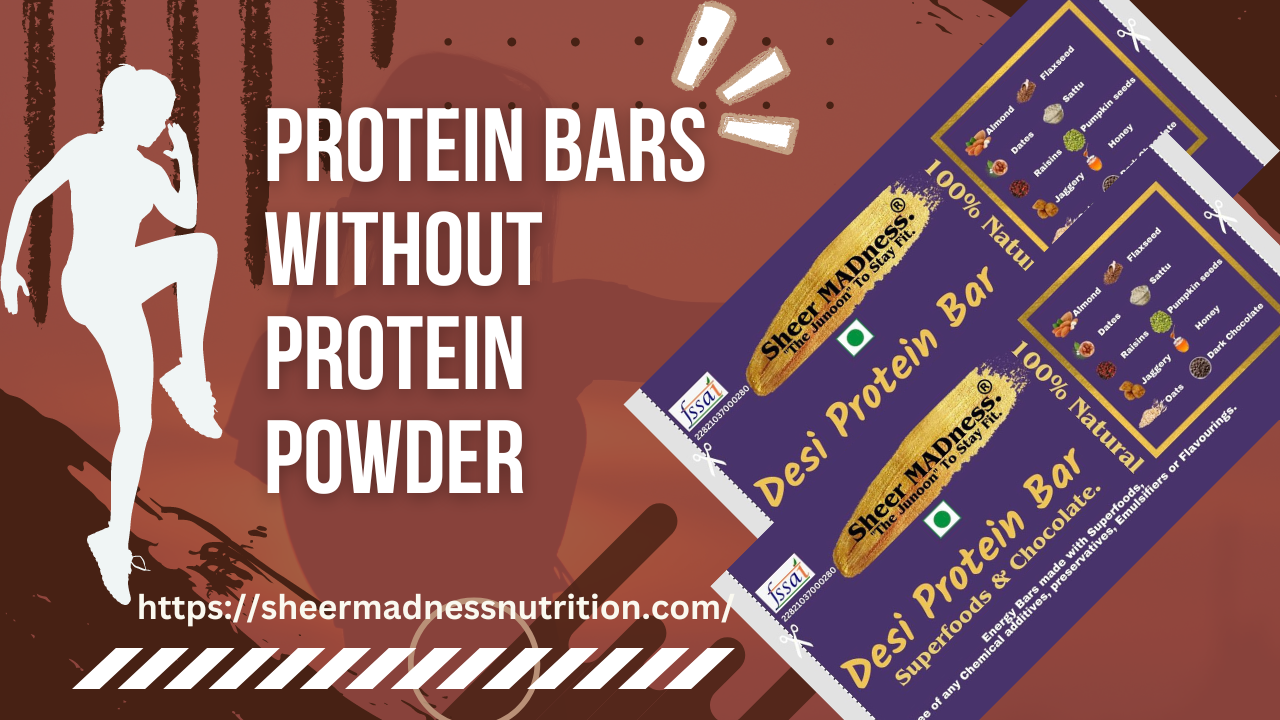
Direct answer: Protein bars without protein powder derive their protein entirely from whole foods — oats, almonds, sattu, flaxseed, pumpkin seeds — rather than from chemically extracted protein concentrates or isolates. Sheer MADness Protein Bars, Energy Bars, and Millet Bars contain zero protein powder of any kind. Every gram of protein comes from the whole-food ingredients you can see on the front of the pack.
Most Indian protein bars use whey protein concentrate, whey protein isolate, soy protein concentrate, or pea protein isolate as their primary or sole protein source. These are industrial products — not foods. Understanding the chemistry behind their production explains why a growing segment of Indian health consumers specifically seeks protein bars made without protein powder.
I’m Chef Ashutosh Awasthi, founder of Sheer MADness, professional chef, marathon runner, and author of Great Health Comes from Exercise & Nutrition. I formulated every Sheer MADness bar specifically without protein powder — not as a marketing decision, but as a food philosophy decision. Let me explain the chemistry and the nutritional science behind why this matters.
Most people recognize that manufacturers process protein powders. Fewer people know the specific industrial processes involved — because the industry has no incentive to explain them.
Whey protein isolate begins as liquid whey — the watery by-product of cheese production. This liquid undergoes a multi-step industrial process. Ion exchange chromatography separates the protein fraction from lactose, fat, and other milk compounds using acid and base chemicals that shift protein solubility. Manufacturers then spray-dry the resulting liquid at high temperatures to convert it into powder, which bar manufacturers purchase.
The result is a product with 90 percent or more protein by weight and essentially zero fibre, zero omega-3, minimal vitamins, and minimal minerals. Processing removes or destroys every dairy nutrient except the protein fraction.
The Soy protein isolate undergoes an even more aggressive extraction process. Soy oil is first removed using hexane — an industrial petroleum-based solvent. Manufacturers dissolve the defatted soy meal in an alkaline solution and then use acid precipitation to isolate the protein. They then spray-dry the resulting curd.
Research published in a Washington-based consumer advocacy report found hexane residues in soy protein products derived through this process. Hexane is a neurotoxic petroleum solvent with no place in food. The fact that it appears in the supply chain of one of the most widely used “health food” protein sources is a specific concern that the soy protein industry does not prominently disclose.
Furthermore, soy protein concentrate and isolate at the doses present in commercial bars contain isoflavones at concentrations significantly above traditional fermented soy food consumption — raising concerns for thyroid-sensitive individuals that we have covered in the thyroid post.
Pea protein isolate — the most common alternative in “vegan” bars — undergoes alkaline water extraction followed by acid precipitation. Manufacturers grind yellow split peas, mix them with water at an alkaline pH, and centrifuge the mixture to separate the protein from the starch and fibre. They then use acid precipitation to isolate the protein, neutralise it, and spray-dry it.
The process effectively removes the pea’s natural fibre content (approximately 6 grams per 100 grams in whole peas), its natural starch complex, and a significant portion of its vitamins and minerals. Manufacturers obtain a protein fraction with an approximately 80 percent concentration, stripping away the food matrix that makes the whole pea nutritious beyond its protein content.
A 2025 study published in Scientific Reports on protein digestibility across 1,641 bars found that pea and rice protein isolate bars showed the lowest protein digestibility — as low as 47 percent in some cases. The chemical extraction process that concentrates the protein also reduces the food-matrix context that makes protein digestible. The bar shows 20 grams of protein on the label. The body absorbs as little as 9.4 grams.
Whole-food protein is protein that remains inside its natural food structure. No chemical extraction. Zero solvent treatment. No alkaline precipitation or spray drying. The protein arrives in the bar as part of the whole food it always was.
Sattu is roasted chickpea flour. The chickpea is ground after roasting. The protein — 20 to 22 grams per 100 grams — remains inside the chickpea flour alongside its natural fibre, iron, magnesium, folate, and starch. No extraction step removes these companion nutrients. The food matrix is intact.
Almonds are whole almonds, pressed and mixed into the bar. Their protein — approximately 21 grams per 100 grams — arrives with their natural Vitamin E, magnesium, calcium, healthy monounsaturated fats, and prebiotic fibre. No extraction step. No spray drying.
Oats are whole rolled oats. Their protein — approximately 13 grams per 100 grams — arrives with their natural beta-glucan fibre, thiamine, magnesium, and iron. The protein and fibre are inseparable because the bar uses the whole grain.
This food-matrix integrity is the nutritional advantage of whole-food protein over protein powder. The 2025 Scientific Reports study confirms it quantitatively — whole-food protein sources showed consistently better digestibility than isolated protein concentrates across 1,641 bars studied.
Furthermore, the DIAAS (Digestible Indispensable Amino Acid Score) — the most accurate measure of protein quality — consistently rates protein from complementary whole-food combinations as equivalent to animal protein when the right food combinations are used. Sattu, almonds, and oats together provide a complete essential amino acid profile through natural complementary combining — the same principle Indian food culture has applied for centuries through dal and roti.
This section covers the most important and least discussed aspect of protein powder in bars.
Most protein powders are labelled simply as “whey protein isolate” or “pea protein isolate.” The extraction chemistry — acid baths, alkaline solutions, industrial centrifuges, spray dryers — never appears on the label. A consumer reading “whey protein isolate” has no indication that this ingredient was produced through a multi-step industrial chemical process.
This is legal under food labelling regulations. The final product is whey protein isolate regardless of how it was produced. However, a consumer choosing a “natural” protein bar who selects one with whey protein isolate as its primary ingredient is choosing a chemically produced industrial protein fraction — not a natural food.
The industrial concentration of protein through extraction paradoxically reduces the digestibility of the protein it was supposed to maximise. The 2025 Scientific Reports study found this specifically — bars with the highest protein concentrations from isolates frequently showed the lowest digestibility percentages.
This happens because protein digestibility depends on the food matrix context. Digestive enzymes evolved to process protein within the complex food structures of whole foods. Spray-dried isolated protein — stripped of its natural food context — presents an unfamiliar substrate to digestive enzymes. The result is reduced digestion efficiency compared to protein arriving in its natural whole-food form.
A Sheer MADness bar with 8 to 10 grams of whole-food protein from sattu, almonds, and oats delivers more usable amino acids to the body per gram of stated protein than a bar with 20 grams of pea protein isolate at 47 percent digestibility.
Let me be completely specific about where the protein in Sheer MADness bars comes from and how much each ingredient contributes.
Sattu (roasted chickpea flour) — approximately 20 to 22 grams of protein per 100 grams. In a 40-gram bar containing approximately 10 to 12 grams of sattu, this contributes roughly 2 to 2.5 grams of protein.
Almonds — approximately 21 grams of protein per 100 grams. In a bar containing approximately 8 to 10 grams of almonds, this contributes roughly 1.7 to 2 grams of protein.
Oats — approximately 13 grams of protein per 100 grams. In a bar containing approximately 12 to 15 grams of oats, this contributes roughly 1.6 to 2 grams of protein.
Flaxseed — approximately 18 grams of protein per 100 grams. In a bar containing approximately 5 to 8 grams of flaxseed, this contributes roughly 0.9 to 1.4 grams of protein.
Pumpkin seeds and melon seeds together — approximately 20 grams of protein per 100 grams combined. Together contributing approximately 1 to 1.5 grams in the bar.
Total: approximately 8 to 10 grams of whole-food protein per bar — from six separate plant protein sources, each providing complementary amino acid profiles. No protein powder was added. No extraction chemistry was applied. Every gram of protein arrived in the bar as part of the whole food that contained it.
Bloating, gas, and cramping after commercial protein bars are extremely common complaints in India. In many cases, the cause is not the protein itself but the processing residues, lactose traces in whey, or the unnatural concentration of isolated protein that the gut’s digestive enzyme systems weren’t designed to handle at these concentrations.
Whole-food protein from sattu, almonds, and oats produces none of these reactions in the vast majority of people. Indian digestive systems have processed sattu efficiently for generations. The digestive compatibility of whole-food protein is established through centuries of daily consumption — not through laboratory testing.
Most protein powders available in India are derived from either dairy (whey, casein) or soy. Both present specific challenges for Indian vegetarians. Dairy-derived whey is incompatible with lactose intolerance affecting 60 to 70 percent of Indian adults. Soy isolate carries thyroid sensitivity concerns and the hexane extraction issue detailed above.
Sattu, almonds, oats, and flaxseed are culturally familiar Indian vegetarian foods with no dairy, no soy, and no chemical extraction in their history. For Indian vegetarians specifically, protein from these sources is the most appropriate and most physiologically compatible choice available.
A person who reads ingredient labels carefully immediately identifies “whey protein isolate” or “pea protein isolate” as ingredients requiring explanation. The extraction chemistry isn’t on the label — but the industrial origin of these ingredients is recognisable to educated consumers.
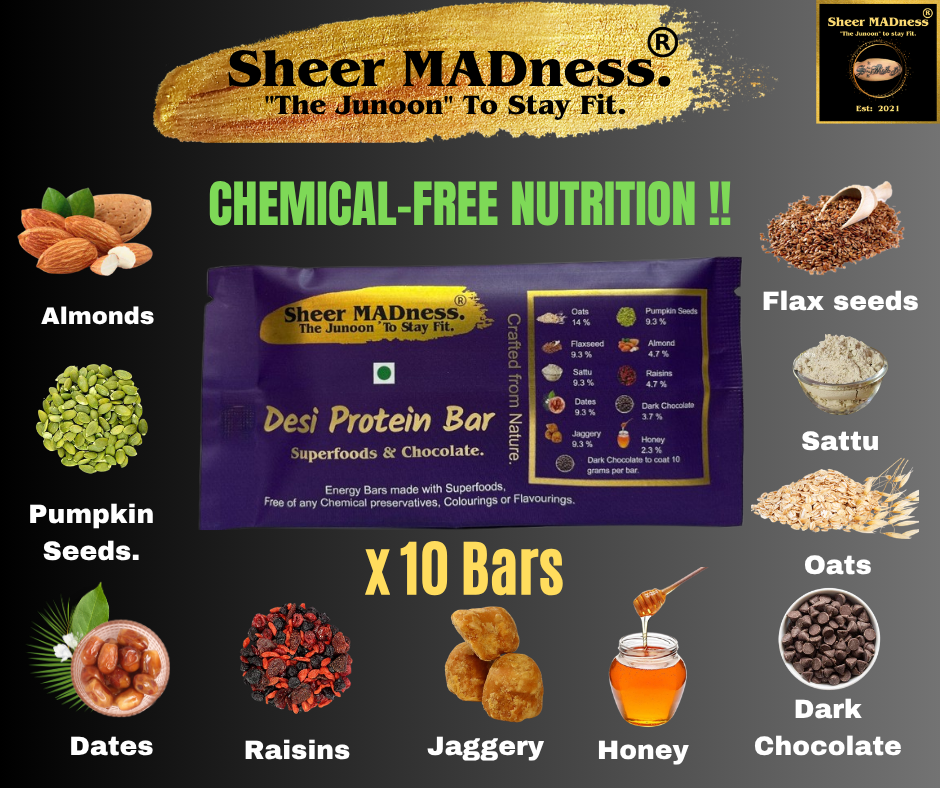
Since 2021, Sheer MADness displays every ingredient with its own image on the front of every pack. Oats, almonds, sattu, flaxseed, pumpkin seeds, melon seeds, dates, raisins, jaggery, honey, and dark chocolate. Every one is a recognisable food. No ingredient requires a chemistry explanation. This is what protein without protein powder looks like — transparent, identifiable, and honest.
Competitive athletes in India face specific concerns about protein supplements. The World Anti-Doping Agency has documented numerous doping violations attributable to contaminated protein supplements — particularly protein powders — where undisclosed substances were present in the manufacturing supply chain.
Protein bars without protein powder eliminate this supply chain contamination risk entirely. Sattu is roasted chickpea flour — there is no pharmaceutical contamination pathway from chickpea roasting. Almonds are tree nuts — no contamination pathway from whole nut processing. For competitive athletes who must maintain clean supplement records, whole-food protein bars without protein powder are the cleanest available choice.
Sheer MADness Protein Bars, Energy Bars, and Millet Bars are, to our knowledge, the only commercially available Indian protein bars that simultaneously meet these criteria.
Zero whey protein concentrate or isolate. No soy protein concentrate or isolate. Zero pea protein isolate or rice protein concentrate. No casein. No collagen protein. Zero egg white protein. No protein ingredient that was produced through an industrial extraction process.
Furthermore, zero chemical preservatives, zero artificial sweeteners, zero sugar alcohols, and zero synthetic additives of any kind. The bars are preserved with oxygen absorbers. The chemistry of every ingredient is exactly as it left the kitchen — unchanged by either protein extraction chemistry or preservation chemistry.
The protein in every Sheer MADness bar is the protein that naturally existed in oats, sattu, almonds, flaxseed, pumpkin seeds, and melon seeds before they were combined into a bar. Nothing was extracted, concentrated, or spray-dried. Nothing chemical was added.
I want to explain this from a professional chef’s perspective — because chefs think about protein differently from food scientists.
A food scientist asks: how do I maximise protein per gram of bar weight? The answer leads inevitably to protein powder — the most efficient way to concentrate protein mass.
I ask: where does this protein come from, and what does the food that contained it contribute beyond the protein? Sattu contributes protein alongside iron, folate, fibre, and two thousand years of Indian digestive compatibility. Almonds contribute protein alongside Vitamin E, magnesium, calcium, and healthy fats. Oats contribute protein alongside beta-glucan, thiamine, and gut microbiome support.
The protein in Sheer MADness bars does not exist independently of the food that contains it. It cannot be separated from the nutritional value of the whole food — because it was never extracted from it.
This is the chef’s answer to protein powder: food is more than the sum of its analysed nutrients. A bar built from whole foods delivers the whole food, not just the fraction the label measures.
India’s traditional protein foods were always whole-food, powder-free sources. This is not coincidence. It is the result of centuries of nutritional wisdom applied to Indian ingredients and Indian bodies.
Sattu laddoos were not made from sattu protein isolate. They were made from whole sattu. Almond halwa was not made from almond protein powder. It was made from whole almonds. The wrestlers, farmers, and labourers who consumed these foods daily for sustained strength and energy were consuming whole-food protein in its most complete nutritional form.
The protein powder industry arrived in India primarily through imported Western fitness culture — built around dairy-derived whey and later around soy, pea, and rice isolates that bear no relationship to Indian food tradition.
Sheer MADness returns to the Indian protein tradition. Sattu, almonds, oats, flaxseed, and seeds. Whole foods. No extraction chemistry or spray drying. No industrial processing between field and bar.
Since 2021, Sheer MADness displays every ingredient with its own image on the front of every pack. When every ingredient is visible before you open the bar, you can verify that no protein powder is present simply by looking.
If you see “oats,” “almonds,” “sattu,” “flaxseed,” “pumpkin seeds,” “melon seeds” — and no entry that says “whey protein isolate” or “pea protein isolate” — you are looking at a protein bar without protein powder.
That verification is available on every Sheer MADness pack, every time, before purchase. No other Indian bar brand does this consistently.
Sheer MADness holds a registered trademark under the Government of India. The Natural Plant Protein formula is patent published under Patent No. 202331036733, searchable on Intellectual Property India. The brand holds a valid FSSAI licence and GSTIN registration.
| Feature | Sheer MADness — Whole-Food Protein | Typical Isolate Bar — Protein Powder |
|---|---|---|
| Protein source | Sattu, almonds, oats, flaxseed, seeds | Whey isolate, pea isolate, soy concentrate |
| Extraction chemistry | None — whole foods only | Alkaline processing, acid precipitation, spray drying |
| Protein digestibility | High — whole-food matrix | Variable — 47 to 86% per 2025 Scientific Reports |
| Fibre from same ingredient | Yes — food matrix intact | Zero — stripped during extraction |
| Vitamins from same ingredient | Yes — Vitamin E, B vitamins, folate | Minimal — removed during processing |
| Minerals from same ingredient | Yes — iron, zinc, magnesium | Minimal — removed during processing |
| Omega-3 from same ingredient | Yes — flaxseed ALA in food matrix | Absent |
| Hexane contamination risk | Zero — no soy isolate | Present in soy isolate supply chain |
| Doping contamination risk | Minimal — whole foods, no supplement supply chain | Present — protein supplement supply chain |
| Label transparency | Every ingredient named and pictured on front | “Protein blend” or INS codes in small print |
| Lactose-free | Yes — no dairy protein | No — whey contains residual lactose |
| Digestive disruption | Very low — culturally familiar whole foods | Common — especially whey for lactose-intolerant |
| Price per bar | ₹60 | ₹80 to ₹200 |
What are protein bars without protein powder?
Protein bars without protein powder derive all their protein from whole-food ingredients — oats, almonds, sattu, flaxseed, seeds — rather than from chemically extracted protein concentrates or isolates. The protein arrives as part of the whole food, intact within its natural food matrix with the fibre, vitamins, and minerals the original food contained.
Is whole-food protein as effective as protein powder?
Yes — for daily nutritional use. The 2025 Scientific Reports study found protein digestibility from isolate bars as low as 47 percent. Whole-food protein in its natural matrix shows consistently better digestibility. Furthermore, whole-food protein arrives with fibre, vitamins, minerals, and healthy fats that protein powder strips away. The practical protein delivery per bar is comparable or better, with dramatically superior total nutritional value.
How does Sheer MADness achieve protein without protein powder?
By using six complementary whole plant protein sources — sattu (chickpea flour, 20-22g protein per 100g), almonds (21g per 100g), oats (13g per 100g), flaxseed (18g per 100g), pumpkin seeds, and melon seeds — that together provide 8 to 10 grams of whole-food protein per bar through natural food composition, not chemical extraction.
Why is pea protein isolate not considered whole-food protein?
Pea protein isolate is produced through alkaline water extraction and acid precipitation of yellow split peas — an industrial chemical process that removes the pea’s natural fibre, starch, vitamins, and minerals to concentrate the protein fraction. The result is chemically similar to other isolates despite coming from a plant source. Whole pea flour would be whole-food protein; pea protein isolate is not.
Yes — and specifically advantageous for competitive athletes who must avoid supplement contamination risks. Whole-food protein sources have no pharmaceutical supply chain contamination pathways. Protein powder supply chains carry documented contamination risks that have caused doping violations globally. Sheer MADness bars derive all protein from whole plant foods with no supplement supply chain involvement.
Does whey protein isolate have hexane contamination?
Whey protein isolate does not use hexane — hexane contamination is a specific concern with soy protein isolate, which uses hexane solvent for oil extraction before protein isolation. Soy protein isolate, soy protein concentrate, and some rice protein isolates may carry hexane residues from their manufacturing process. Sheer MADness bars contain none of these.
How much protein can whole foods provide without protein powder?
Sattu provides 20 to 22 grams of protein per 100 grams — comparable to many protein powders. Almonds provide 21 grams per 100 grams. Together with oats, flaxseed, and seeds, whole-food protein sources deliver 8 to 10 grams per 40-gram bar — sufficient for daily nutritional snacking purposes without any protein powder.
Is Sheer MADness the only protein bar in India without protein powder?
To our knowledge, Sheer MADness is the only commercially available Indian protein bar brand that uses no protein powder of any type across all products while simultaneously maintaining zero chemical additives, zero artificial sweeteners, zero chemical preservatives, and complete front-of-pack ingredient transparency.
Protein bars without protein powder are not a niche product or a wellness trend. They are a return to the most honest and most complete form of protein nutrition available — protein that arrives as part of the whole food that always contained it, with the fibre, vitamins, minerals, and food-matrix context that protein powder extraction systematically strips away.
The industrial chemistry of whey isolation, pea protein extraction, and soy protein processing was developed to maximise protein concentration per gram — a useful objective for supplement manufacturers. It was not developed with nutritional completeness in mind. The 2025 Scientific Reports finding that some isolate bars deliver as little as 47 percent of their stated protein as usable nutrition is the most direct quantitative evidence of what that concentrated-but-incomplete approach actually delivers.
Sheer MADness bars deliver 8 to 10 grams of whole-food protein from six complementary plant sources — every gram of protein inside the food that always contained it, chemically unchanged, nutritionally intact. At ₹60 per bar, with every ingredient displayed on the front of the pack since 2021, they are India’s most transparent and most honest protein bar category.
The protein powder bar is an industrial product disguised as food. The whole-food protein bar is simply food.
I would also request you to kindly read my previous post about “Healthiest Protein Bar in India“.
a) Everyone is an individual, so what suits me may not suit the next person.
b) If a person has a medical condition, a doctor’s advice and prescribed medication will only help.
c) While buying any protein bar from the market, read the labels carefully. Watch out for whey protein isolate, soy protein concentrate, pea protein isolate, rice protein concentrate, INS 320 (BHA), INS 321 (BHT), maltitol, sorbitol, sucralose, and other industrially produced ingredients that quietly appear in most commercial bars.
If you are interested in buying chemical-free Natural Plant Protein Moringa, Health Drinks for Kids, or our delicious chemical-free Energy Bars, Protein Bars, and Millet Bars, shop at Sheer MADness.
You can also find us on Flipkart, Jio Mart, or ONDC in India.
d) Exercise is the key to fitness. Exercise and nutrition are two sides of the same coin and always go hand in hand.
e) Excess of anything is wrong, even the best whole-food snack. Consume only recommended quantities.
f) Rome was not built in a day. Discipline and consistency are the only keys to lasting health.
g) It is not only exercise and protein that builds health. A healthy gut, macro and micronutrients, body type, rest, and lifestyle all matter. Of all these, exercise and nutrition are within our control. Focus on these two primary aspects first.
h) The most important part of fitness is that nothing is better than exercise and a balanced meal.
Article by Chef Ashutosh Awasthi
Disclaimer: Our products are a source of HEALTHY NUTRIENTS and are COMPLETELY FREE OF ANY ADDED CHEMICALS. We do not claim to cure any medical condition. The content provided is informational. We do not claim to diagnose or treat a person with any specific medical condition.