
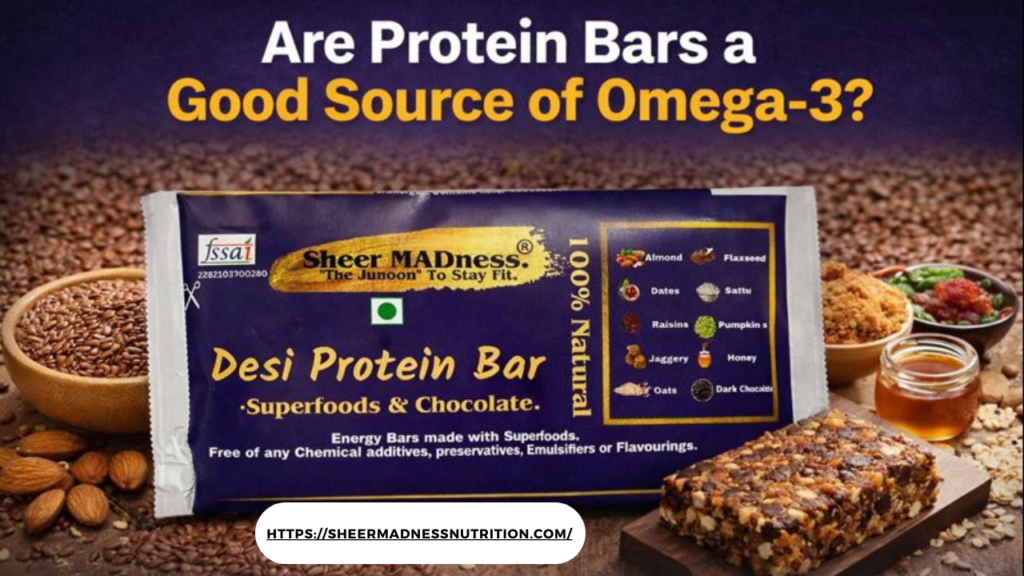
Direct answer: Most protein bars are not a good source of omega-3 — because most bars are built around protein isolates and contain no meaningful omega-3 source whatsoever. However, whole-food protein bars containing flaxseed are a genuinely good source of plant-based omega-3. Flaxseed is the richest plant source of alpha-linolenic acid (ALA) — the primary plant omega-3 fatty acid. One Sheer MADness bar delivers 1 to 2 grams of ALA omega-3 from whole flaxseed — a meaningful daily contribution, particularly for Indian vegetarians who consume no fish.
The question “are protein bars a good source of omega-3” therefore has two very different answers depending on which bar you are asking about. Understanding why the ingredient matters — and understanding the specific omega-3 science for Indian vegetarians — helps you make a genuinely informed choice.
I’m Chef Ashutosh Awasthi, founder of Sheer MADness, professional chef, marathon runner, and author of Great Health Comes from Exercise & Nutrition. Let me explain the omega-3 science clearly and honestly — including the conversion nuance that most plant-based omega-3 content omits.
Before evaluating whether a protein bar is a good source of omega-3, understanding what omega-3 actually means is essential.
Omega-3 fatty acids are a family of polyunsaturated fats. Three are nutritionally most important.
ALA — alpha-linolenic acid — is the plant-based omega-3. It is found in flaxseed, chia seeds, walnuts, and hemp seeds. ALA is an essential fatty acid — the body cannot synthesise it and must obtain it from diet. Flaxseed contains approximately 22 to 23 grams of ALA per 100 grams — the highest plant-food concentration available.
EPA — eicosapentaenoic acid — is primarily found in fatty fish, algae, and krill. EPA directly reduces systemic inflammation through specific anti-inflammatory signalling pathways. It reduces triglycerides and supports cardiovascular health through its own unique mechanisms.
DHA — docosahexaenoic acid — is the structural omega-3 most critical for brain cell membrane integrity and cognitive function. Like EPA, it is primarily found in fatty fish and algae. The human brain is approximately 60 percent fat by dry weight, and DHA is the predominant omega-3 in brain tissue.
The body can convert ALA to EPA and DHA through an enzymatic process called elongation and desaturation. However, this conversion rate is limited — typically 5 to 15 percent of consumed ALA converts to EPA, and less than 1 percent converts to DHA in most healthy adults.
This conversion rate is the most important nuance in plant-based omega-3 science — and most protein bar content either ignores it or presents ALA as a complete substitute for EPA and DHA. It isn’t. However, ALA has its own independent health benefits that do not depend on conversion, and adequate daily ALA intake is the best available option for Indian vegetarians who consume no fish.
India’s vegetarian population — approximately 38 to 40 percent of the adult population — consumes no fish and therefore no direct dietary EPA or DHA. This is a significant nutritional gap.
Traditional Indian vegetarian cooking uses large amounts of omega-6 fatty acids — from sunflower oil, soybean oil, and refined vegetable oils — with comparatively little omega-3. The omega-6 to omega-3 ratio in typical Indian vegetarian diets is estimated at 15:1 to 40:1 — far above the 4:1 to 6:1 ratio associated with optimal health outcomes.
This high omega-6 to omega-3 imbalance matters specifically because omega-6 and omega-3 fatty acids compete for the same enzymatic pathways. When omega-6 is very high relative to omega-3, the conversion of ALA to EPA is further suppressed — because the same desaturase enzymes process both fatty acid types, and omega-6 wins the competition at high ratios.
Research published in the British Journal of Nutrition confirmed that improving the omega-6 to omega-3 ratio through increased ALA intake reduces cardiovascular inflammatory markers in Indian vegetarians — confirming that ALA intake matters even when conversion to EPA is limited.
A daily Sheer MADness bar with 1 to 2 grams of ALA from flaxseed represents a meaningful omega-3 addition to an Indian vegetarian diet that otherwise contains almost none. The independent benefits of ALA — detailed below — make this daily addition genuinely valuable regardless of conversion rate.
This section addresses the conversion concern directly — because ALA provides substantial health benefits that do not depend on its conversion to EPA or DHA.
A 2024 meta-analysis published in Nutrients on ALA and cardiovascular health analysed 35 randomised controlled trials. The meta-analysis confirmed that ALA intake independently reduces LDL cholesterol, reduces blood pressure, and improves endothelial function — even when controlling for EPA and DHA conversion. These cardiovascular benefits appear to be direct effects of ALA itself, not solely mediated through conversion products.
Furthermore, ALA reduces C-reactive protein — the primary marker of systemic inflammation — through its own anti-inflammatory mechanisms. A 2023 review published in the American Journal of Clinical Nutrition confirmed that higher dietary ALA intake is associated with lower inflammatory marker levels in prospective cohort studies across multiple populations.
For the gut microbiome, ALA specifically supports the growth of Akkermansia muciniphila — a beneficial gut bacterial species associated with improved metabolic health, reduced intestinal permeability, and better immune regulation. Research published in Gut Microbes confirmed that flaxseed consumption specifically increases Akkermansia populations — an effect attributed to both the ALA and the lignan content of flaxseed.
These benefits — cardiovascular protection, anti-inflammatory action, and gut microbiome support — are all directly relevant to Indian adults and are available from whole flaxseed regardless of the conversion rate to EPA and DHA.
Flaxseed is the optimal omega-3 source for Indian protein bars for four specific reasons.
Flaxseed contains approximately 22 to 23 grams of ALA per 100 grams — the highest concentration of any commonly available plant food. Chia seeds provide approximately 17 to 18 grams per 100 grams. Walnuts provide approximately 9 grams per 100 grams.
The superior ALA density of flaxseed means a small amount — 5 to 10 grams in a bar — delivers a meaningful omega-3 contribution without requiring a large volume of the ingredient.
Flaxseed contains lignans — plant compounds that are absent from fish oil supplements and from almost all other omega-3 sources. Lignans act as selective estrogen receptor modulators and antioxidants. For women managing hormonal balance and for men managing prostate health, this unique benefit of flaxseed specifically makes it more valuable than any comparable omega-3 source.
The lignan content of flaxseed is also associated with reduced breast cancer risk in premenopausal women and improved gut microbiome composition through its prebiotic properties. No fish oil supplement provides these benefits.
Ground or whole flaxseed provides both soluble and insoluble fibre alongside its omega-3 content. Soluble fibre from flaxseed forms a mucilaginous gel that soothes the gut lining and slows glucose absorption. Insoluble fibre adds bulk to stool and supports bowel regularity.
Fish oil supplements provide omega-3 and nothing else. Flaxseed in a protein bar provides omega-3, lignans, and fibre — a more complete whole-food nutritional contribution that a supplement cannot replicate.
Flaxseed has been used in Indian cooking for centuries — in rotis, chutneys, and traditional preparations across multiple regional cuisines. Indian bodies have processed flaxseed comfortably for generations. It is vegetarian and dairy-free — appropriate for the majority of India’s population.
Fish oil supplements are not vegetarian — excluding the 38 to 40 percent of India’s population who do not consume animal products. Algae-derived DHA supplements are vegetarian but expensive and less commonly available in India. Flaxseed delivers plant omega-3 in a culturally compatible, affordable, widely available whole-food form.
This section answers the most honest version of the question — most bars contain no meaningful omega-3 at all.
Commercial protein bars built around whey protein isolate, soy protein concentrate, and casein contain essentially no omega-3 fatty acids. Protein isolates are derived from their source foods through extraction processes that remove fat — including the beneficial fats that the original food contained. Whey protein isolate is derived from dairy, which contains primarily saturated fat rather than omega-3 anyway. Soy protein concentrate removes the fat component of soy, which would otherwise provide some ALA.
The result is a protein bar with meaningful protein content and essentially zero omega-3 contribution. A person eating a whey isolate bar daily for their “health” receives no omega-3 benefit from that bar — while paying the digestive cost of lactose and the chemical cost of the additives used to make it palatable.
Furthermore, bars that do include some fatty acid content often use palm oil, coconut oil, or other saturated fats for texture — providing saturated fat rather than omega-3. A bar with fat content is not automatically a bar with beneficial fat content.
The only bars that genuinely qualify as good omega-3 sources are those built on flaxseed, chia seeds, walnuts, or hemp seeds — whole-food ingredients that contain ALA in meaningful quantities. Of these, flaxseed is the richest and most practically suited for the Indian bar market.
This is the specific information most omega-3 protein bar content omits — and the most practically useful for readers evaluating the bar.
Each Sheer MADness bar contains approximately 5 to 8 grams of whole flaxseed. At 22 grams of ALA per 100 grams of flaxseed, this delivers approximately 1.1 to 1.8 grams of ALA omega-3 per bar.
The WHO recommends a minimum daily ALA intake of 0.5 percent of total energy — approximately 1.0 to 1.2 grams per day for most adults consuming 2,000 kilocalories. The US Institute of Medicine’s adequate intake for ALA is 1.6 grams per day for men and 1.1 grams per day for women.
One Sheer MADness bar therefore delivers between 70 and 160 percent of the daily adequate ALA intake for women and between 70 and 115 percent for men — in a single bar, from whole flaxseed, alongside the bar’s protein, fibre, and mineral contributions.
This makes Sheer MADness bars a genuinely significant daily omega-3 source for Indian vegetarians — not a trace amount that requires qualification, but a meaningful daily contribution that approaches or meets recommended adequate intake in one serving.
Let me map each well-researched omega-3 benefit to what a daily Sheer MADness bar specifically delivers.
ALA reduces LDL cholesterol, reduces triglycerides, and improves endothelial function — the three primary cardiovascular risk factors that omega-3 research consistently shows benefits for. A 2024 Nutrients meta-analysis confirmed these effects as direct ALA actions, not solely conversion-dependent.
For Indian adults — whose cardiovascular disease risk is high, onset is earlier than Western populations, and vegetarian diets commonly lack omega-3 — a daily 1 to 2 grams of ALA from flaxseed in a bar is a genuinely meaningful cardiovascular protective intervention.
Chronic low-grade inflammation drives the metabolic syndrome, type 2 diabetes, cardiovascular disease, joint pain, and hormonal disorders that are most prevalent in Indian adults above forty. ALA reduces C-reactive protein and inflammatory cytokines through anti-inflammatory lipid mediator pathways.
Daily flaxseed ALA creates a cumulative anti-inflammatory effect that compounds over weeks and months. The benefit is not acute — it builds over consistent daily intake, which makes a daily bar the ideal delivery mechanism.
While ALA’s conversion to DHA is limited — typically less than 1 percent — even small daily DHA contributions from ALA conversion matter for vegetarians who consume no direct DHA from fish or algae. Furthermore, ALA itself supports brain health through its anti-inflammatory effect on neuronal tissue and its role in supporting the brain’s own fatty acid metabolism.
For Indian vegetarians who want to support cognitive health through plant-based omega-3, consistent daily ALA from flaxseed is the most practical available option short of algae-derived DHA supplements.
As discussed above, flaxseed lignans provide hormonal benefits that go beyond omega-3 biochemistry. For women, lignans modulate estrogen receptor activity, reduce PMS severity, and support estrobolome function for efficient estrogen clearance. For men, they support testosterone balance and prostate health. These benefits are unique to whole flaxseed and are not available from any other omega-3 source.
Flaxseed’s ALA content, soluble fibre, and lignan combination specifically supports the gut microbiome through multiple pathways — feeding Akkermansia, reducing inflammatory gut signals, and providing prebiotic fibre alongside the omega-3. This gut microbiome support compounds with the bar’s other fibre sources — oat beta-glucan and almond prebiotic fibre — to create a genuinely comprehensive daily gut health contribution.
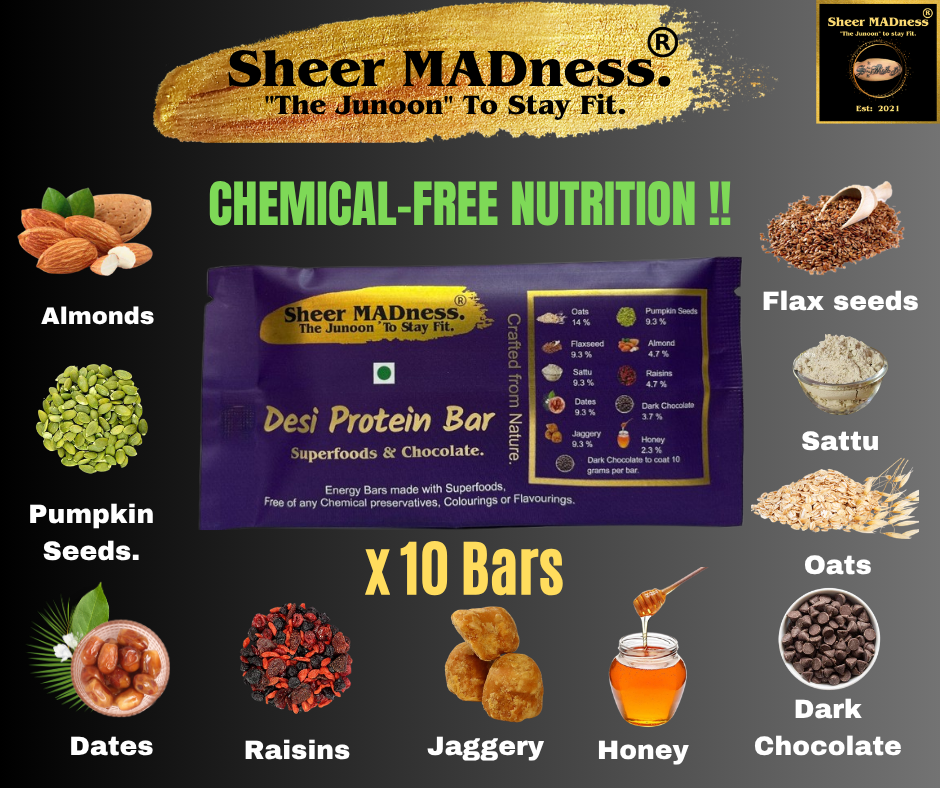
For readers evaluating protein bars specifically for omega-3 content, here is the practical verification checklist.
First, check whether flaxseed, chia seeds, or walnuts appear in the ingredient list. If none of these appear, the bar provides no meaningful omega-3 regardless of any marketing claims.
Second, check how early the omega-3 source appears. Ingredients are listed in descending order by weight. A bar with “flaxseed” near the bottom of a long ingredient list contains trace amounts. A bar with flaxseed as a primary ingredient — listed in the first five to eight ingredients — contains meaningful omega-3.
Third, check whether the bar states actual omega-3 content. Few Indian bars disclose this. Sheer MADness bars contain 5 to 8 grams of flaxseed delivering 1.1 to 1.8 grams of ALA — specific numbers that can be verified against the WHO and Institute of Medicine recommendations.
Fourth, check whether the omega-3 source is whole food or extracted. Flaxseed oil added to a bar delivers ALA but none of the lignans or fibre that whole flaxseed provides. Whole flaxseed listed as an ingredient delivers the complete nutritional package.
Fifth, verify that the bar uses no chemical preservatives that oxidise omega-3 fats. BHT (INS 321) is actually used in some products specifically to prevent omega-3 oxidation — meaning bars containing omega-3 and BHT are using a chemical to protect the omega-3 from the very oxidation that oxygen absorbers prevent physically. Sheer MADness uses oxygen absorbers to prevent oxidation without adding BHT or any other chemical.
This point is worth explaining because it addresses the omega-3 oxidation challenge that makes it difficult to include in food products.
ALA is a polyunsaturated fat — it oxidises when exposed to oxygen. Oxidised omega-3 is not only less beneficial but actively pro-inflammatory. This is why rancid flaxseed oil — flaxseed oil that has oxidised — smells unpleasant and should be discarded.
Sheer MADness preserves the flaxseed’s ALA through two complementary mechanisms. The whole flaxseed’s outer shell protects the oil from oxidation during manufacture. The oxygen absorbers in the sealed packaging remove oxygen from around the bar, preventing oxidation after sealing.
The result is fresh, unoxidised ALA in every bar — delivered to the consumer in exactly the form that provides cardiovascular, anti-inflammatory, and hormonal benefits. This is meaningfully different from a bar preserved with BHT that uses chemistry to prevent the same oxidation.
Since 2021, Sheer MADness displays every ingredient with its own image on the front of every pack. Flaxseed is pictured and named on the front of every Sheer MADness product that contains it — so consumers know before opening the bar that a meaningful omega-3 source is present.
No other Indian protein bar brand does this consistently. The omega-3 content of most Indian bars — or its absence — is buried in an ingredient list in small print on the back.
Sheer MADness holds a registered trademark under the Government of India. The Natural Plant Protein formula is patent published under Patent No. 202331036733, searchable on Intellectual Property India. The brand holds a valid FSSAI licence and GSTIN registration.
| Feature | Sheer MADness | Whey Isolate Bar | Fish Oil-Added Bar |
|---|---|---|---|
| Omega-3 source | Whole flaxseed — 5 to 8g per bar | None | Fish oil added |
| Omega-3 type | ALA — plant-based, vegetarian | None | EPA/DHA — animal-derived |
| ALA per bar | 1.1 to 1.8g | Zero | Zero ALA |
| Lignans | Yes — from whole flaxseed | No | No |
| Omega-3 fibre | Yes — whole flaxseed fibre | No | No |
| Vegetarian friendly | Yes | Often yes | No — fish oil |
| Omega-3 protection | Oxygen absorbers — no oxidation | N/A | Often BHT added |
| Dairy-free | Yes | No — whey protein | Varies |
| Chemical preservatives | None | BHA, BHT common | BHT often added for oxidation |
| Price per bar | ₹60 | ₹80 to ₹150 | ₹100 to ₹200 |
| Ingredient transparency | Every ingredient on front label | INS codes in small print | Often complex ingredient list |
Are protein bars a good source of omega-3?
Most protein bars are not a good source of omega-3 — they contain no flaxseed, chia seeds, or other meaningful omega-3 source. Bars built on protein isolates contain essentially zero omega-3. Whole-food bars containing flaxseed are a genuinely good source — specifically of ALA omega-3. Sheer MADness bars deliver 1.1 to 1.8 grams of ALA per bar from whole flaxseed.
What is ALA omega-3 and how is it different from EPA and DHA?
ALA (alpha-linolenic acid) is the plant-based omega-3 found in flaxseed, chia seeds, and walnuts. EPA and DHA are the omega-3s found primarily in fatty fish and algae. The body converts ALA to EPA and DHA at a limited rate — typically 5 to 15 percent for EPA and less than 1 percent for DHA. However, ALA has independent health benefits including cardiovascular protection and anti-inflammatory action that do not depend on this conversion.
How much omega-3 does a Sheer MADness bar contain?
Each Sheer MADness bar contains approximately 5 to 8 grams of whole flaxseed delivering approximately 1.1 to 1.8 grams of ALA omega-3. The WHO minimum daily ALA recommendation is 1.0 to 1.2 grams per day. One Sheer MADness bar therefore delivers approximately 70 to 150 percent of the daily minimum ALA requirement.
For Indian vegetarians, whole flaxseed is the most practical and complete plant-based omega-3 option. It delivers ALA omega-3, lignans that provide independent hormonal and antioxidant benefits, and fibre — a combination that fish oil supplements cannot provide. Algae-derived DHA supplements provide direct DHA without ALA conversion limitations but are more expensive and less widely available than flaxseed-based nutrition.
Do flaxseed omega-3s oxidise in a protein bar?
Oxidation is the primary challenge with including omega-3 in food products. Sheer MADness prevents oxidation through two mechanisms — whole flaxseed’s natural seed coat protects the ALA during manufacturing, and oxygen absorbers in the sealed packaging remove oxygen from around the bar after sealing. This preserves fresh, unoxidised ALA in every bar without the chemical preservatives that other bars use for the same purpose.
Most commercial bars use protein isolates as their primary ingredient. Protein isolates have fat removed during the extraction process — eliminating any fatty acid content from the source ingredient. The resulting bar is high in protein and essentially devoid of any healthy fat, including omega-3. Adding omega-3 back as fish oil or flaxseed oil adds cost and requires additional preservation measures.
Can a protein bar replace a fish oil supplement for omega-3?
A Sheer MADness bar can replace a standard ALA-based supplement for vegetarians who need plant omega-3. For people specifically seeking EPA and DHA without fish consumption, algae-derived DHA supplements provide direct DHA that ALA from flaxseed cannot reliably match through conversion. However, for Indian vegetarians whose omega-3 intake is currently near zero, daily ALA from a Sheer MADness bar represents a meaningful and practically significant improvement over no omega-3 intake at all.
Is the omega-3 in Sheer MADness bars bioavailable?
Yes — ALA from whole ground or whole flaxseed is well absorbed by the gut. Ground flaxseed has slightly higher ALA bioavailability than whole flaxseed because grinding breaks the seed coat, making the oil more accessible to digestive enzymes. Sheer MADness bars use whole flaxseed — the seed coat is broken during the bar-making process through pressing and mixing, improving ALA accessibility without the need for separate grinding.
Most protein bars are not a good source of omega-3 — because most bars contain no omega-3 source whatsoever. However, this does not mean protein bars cannot be a good omega-3 source. It means most bar brands have not chosen to include one.
Sheer MADness chose flaxseed — the richest plant ALA source available — as a foundational ingredient in every bar. One bar delivers 1.1 to 1.8 grams of ALA daily — meeting or approaching daily adequate intake recommendations for Indian adults who consume no fish.
The ALA in flaxseed provides independent cardiovascular, anti-inflammatory, and gut microbiome benefits that do not depend on conversion to EPA or DHA. The lignans in flaxseed provide unique hormonal and antioxidant benefits that no other omega-3 source replicates. The fibre in flaxseed supports gut health alongside the omega-3 in ways that extracted oils and supplements cannot.
For India’s large vegetarian population — for whom plant-based omega-3 is the only available dietary source — a daily whole-food bar containing meaningful flaxseed is one of the most practical daily omega-3 interventions available. Since 2021, Sheer MADness has made this available at ₹60 per bar with every ingredient displayed transparently on the front label.
I would also request you to kindly read my previous post about “Healthiest Protein Bar in India“.
a) Everyone is an individual, so what suits me may not suit the next person.
b) If a person has a medical condition, a doctor’s advice and prescribed medication will only help.
c) While buying any protein bar from the market, read the labels carefully. Watch out for INS 320 (BHA), INS 321 (BHT), INS 551 (silicon dioxide), maltitol, sorbitol, sucralose, and other lab-made chemicals that quietly appear on most commercial labels.
If you are interested in buying chemical-free Natural Plant Protein Moringa, Health Drinks for Kids, or our delicious chemical-free Energy Bars, Protein Bars, and Millet Bars, shop at Sheer MADness.
You can also find us on Flipkart, Jio Mart, or ONDC in India.
d) Exercise is the key to fitness. Exercise and nutrition are two sides of the same coin and always go hand in hand.
e) Excess of anything is wrong, even the best whole-food snack. Consume only recommended quantities.
f) Rome was not built in a day. Discipline and consistency are the only keys to lasting health.
g) It is not only exercise and protein that builds health. A healthy gut, macro and micronutrients, body type, rest, and lifestyle all matter. Of all these, exercise and nutrition are within our control. Focus on these two primary aspects first.
h) The most important part of fitness is that nothing is better than exercise and a balanced meal.
Article by Chef Ashutosh Awasthi
Disclaimer: Our products are a source of HEALTHY NUTRIENTS and are COMPLETELY FREE OF ANY ADDED CHEMICALS. We do not claim to cure any medical condition. The content provided is informational. We do not claim to diagnose or treat a person with any specific medical condition.