

Direct answer: Moringa leaf powder contains all nine essential amino acids — histidine, isoleucine, leucine, lysine, methionine, phenylalanine, threonine, tryptophan, and valine — making it one of the very few plant foods that qualify as a complete protein source. Research published in the journal OCL confirmed moringa leaves have a total amino acid content of 91.8 grams per 100 grams of crude protein, with essential amino acids comprising approximately 41.9 grams per 100 grams of protein. When moringa is combined with almonds and flaxseed — as in Sheer MADness Plant Protein Moringa — the complementary amino acid profiles of these three whole foods create an even more complete and bioavailable plant protein than moringa alone.
This matters enormously for Indian vegetarians. The long-standing concern about plant protein — that individual plant foods lack one or more essential amino acids — does not apply to moringa. It also does not apply to Sheer MADness Plant Protein Moringa, which combines three complementary whole-food protein sources specifically to ensure every essential amino acid is present at meaningful concentrations.
I am Chef Ashutosh Awasthi, founder of Sheer MADness, professional chef, marathon runner, and author of Great Health Comes from Exercise & Nutrition. I built this brand around whole-food plant nutrition specifically because I understand — as a chef and as a daily user of these ingredients — that real food provides amino acids in a form, context, and completeness that protein isolates cannot match. Let me explain the amino acid science completely and honestly.
Most people think about protein as a single nutrient. The number on the label — 20g, 25g, 30g — becomes the sole measure of protein quality. This is one of the most important oversimplifications in nutrition.
Protein is not a single compound. It is a word we use to describe chains of amino acids. There are approximately 20 amino acids that the human body uses to build proteins. Nine of these are essential — the body cannot synthesise them from other compounds and must obtain them from food. The other eleven are non-essential — the body can make them from other amino acids or metabolic precursors when dietary supply is adequate.
A protein food is only as useful as its amino acid profile. A food with 30 grams of protein that is severely deficient in one essential amino acid limits the body’s ability to use the other 29 grams for protein synthesis — because protein synthesis requires all essential amino acids simultaneously. The limiting amino acid concept — identified decades ago by nutritional biochemistry — establishes that the rate of protein synthesis is constrained by the most deficient essential amino acid, not by the total protein quantity.
This is why amino acid completeness matters more than protein grams. And this is why moringa’s complete essential amino acid profile is one of its most important and most underappreciated nutritional characteristics.
Let me cover each of the nine essential amino acids present in moringa leaf powder — because understanding what each one does explains why their presence in moringa is genuinely valuable for daily health and not simply an academic data point.
Leucine is the most important amino acid for muscle protein synthesis. It directly activates mTORC1 — the cellular protein complex that initiates the construction of new muscle proteins. Research published in the Journal of the International Society of Sports Nutrition established that leucine acts as a “leucine trigger” — intracellular leucine concentration must reach approximately 2 to 3 grams per meal to maximise mTOR activation and thus maximise muscle protein synthesis rates.
Moringa leaf contains leucine at approximately 6.5 to 7.5 grams per 100 grams of protein — a meaningful concentration. In Sheer MADness Plant Protein Moringa, the almond component adds additional leucine, compounding the total leucine availability from a single serving. This is specifically why the whole-food blend outperforms moringa alone for muscle-building purposes.
Isoleucine works alongside leucine and valine as one of the three branched-chain amino acids (BCAAs). It specifically regulates glucose uptake into muscle cells during and after exercise — improving the efficiency of glycogen restoration. Isoleucine also participates in haemoglobin synthesis and is essential for immune function.
Moringa provides isoleucine at approximately 3.7 to 4.5 grams per 100 grams of protein — a significant concentration. For athletes managing both muscle recovery and energy metabolism simultaneously, isoleucine from moringa addresses both needs.
Valine is the third branched-chain amino acid. It participates in energy production in muscle tissue, specifically providing an alternative fuel source when glycogen is depleted during prolonged exercise. It is also essential for tissue repair and for maintaining the positive nitrogen balance that indicates net protein anabolism rather than catabolism.
Positive nitrogen balance — where protein synthesis exceeds protein breakdown — is the nutritional state that muscle maintenance and growth require. Adequate valine alongside leucine and isoleucine is necessary to maintain this state during periods of training stress.
Lysine is the most critical essential amino acid to understand in the Indian nutritional context — because it is the amino acid most commonly deficient in Indian vegetarian diets.
Grains — rice, wheat, maize — are low in lysine. A diet built primarily on grains without adequate legume complementation consistently produces lysine insufficiency. India’s vegetarian population relies heavily on grains, making lysine the most important limiting amino acid for Indian vegetarians who don’t carefully diversify their protein sources.
Moringa is rich in lysine — providing approximately 4.3 to 5.1 grams per 100 grams of protein. This is specifically significant for Indian vegetarians: moringa provides the amino acid that rice-heavy diets most consistently fail to deliver in adequate quantities. The combination of moringa with sattu — present in Sheer MADness Desi Plant Protein bars — or with legumes at meals, provides the lysine-methionine complementarity that Indian vegetarian diets require.
Furthermore, lysine is essential for collagen synthesis — the structural protein of skin, tendons, ligaments, and bone matrix. It is required for calcium absorption from the gut. It supports carnitine synthesis — the compound that transports fatty acids into mitochondria for energy production. Lysine deficiency therefore compromises not just protein synthesis but also bone health, skin integrity, and fat metabolism simultaneously.
Methionine is a sulphur-containing amino acid with several critical functions beyond protein synthesis. It is the primary methyl donor in metabolic processes — providing methyl groups for the methylation reactions that inactivate hormones, process toxins in the liver, regulate gene expression through DNA methylation, and synthesise neurotransmitters.
Methionine is also the precursor to cysteine — a non-essential amino acid that becomes conditionally essential when methionine supply is inadequate. Cysteine participates in glutathione synthesis — the body’s primary endogenous antioxidant — making adequate methionine supply essential for antioxidant defence.
Moringa provides methionine alongside the complementary whole foods in Sheer MADness Plant Protein Moringa — almonds and flaxseed — which add their own methionine contributions. The total methionine from the blend is greater than from moringa alone.
Threonine is required for mucin production — the glycoproteins that form the protective mucous layer lining the gut. This gut lining integrity is foundational for gut health. When threonine is inadequate, mucin production declines, gut barrier function weakens, and intestinal permeability increases — the condition sometimes called “leaky gut” that drives systemic inflammation.
Furthermore, threonine is essential for immunoglobulin production — the antibody proteins that constitute the immune system’s primary pathogen defence. Threonine deficiency specifically impairs antibody synthesis and weakens immune response. Moringa’s threonine content directly supports the gut integrity and immune function that healthy daily life requires.
Phenylalanine is the dietary precursor to tyrosine, which is in turn the precursor to dopamine, norepinephrine, and epinephrine — the catecholamine neurotransmitters that regulate mood, motivation, alertness, and stress response. Adequate phenylalanine supply therefore has direct consequences for cognitive function and emotional wellbeing.
For professionals managing demanding cognitive workloads, for students in intensive examination preparation, and for anyone managing the neurological demands of modern urban Indian life — adequate phenylalanine from daily whole-food sources like moringa provides the neurotransmitter substrate that mental performance depends on.
Tryptophan is the precursor to serotonin — the primary neurotransmitter of mood and emotional regulation — and to melatonin, the hormone that regulates the sleep-wake cycle. The conversion pathway requires both tryptophan from food and vitamin B6 as a cofactor. Moringa provides both.
Women’s serotonin synthesis rates are naturally lower than men’s — making dietary tryptophan availability more important for women’s mood regulation, particularly in the premenstrual phase when serotonin requirements increase. Adequate daily tryptophan from moringa specifically supports serotonin production for the hormonal mood regulation that many Indian women manage.
Histidine was long classified as essential only in childhood and conditionally essential in adults. More recent research has confirmed it is essential throughout life. Histidine is the precursor to histamine — not just the inflammatory compound of allergic reactions, but also a neurotransmitter involved in cognitive function and wakefulness. It is also required for carnosine synthesis — a dipeptide in muscle tissue that buffers the lactic acid accumulation during intense exercise, delaying muscular fatigue.
Athletes and active adults with adequate histidine status have better carnosine levels and consequently better high-intensity exercise tolerance. Moringa’s histidine content contributes to this specific athletic performance mechanism.
The fact that moringa provides all nine essential amino acids is notable. However, the truly important question is not just whether all nine are present, but whether they are present at adequate concentrations relative to human requirements — this is what protein quality scoring systems measure.
The DIAAS (Digestible Indispensable Amino Acid Score) is the most modern and most scientifically rigorous measure of protein quality. It evaluates protein quality based on the digestibility of each individual essential amino acid — not just the protein as a whole. A DIAAS score of 1.0 or above means the protein meets all indispensable amino acid requirements. A score below 1.0 means the protein is limiting in at least one essential amino acid.
Research published in the journal Food Research International evaluated moringa leaf protein and found DIAAS values ranging from 0.84 to 1.16 depending on the reference population used — with values exceeding 1.0 for certain population groups. For context, soy protein isolate has a DIAAS of approximately 0.90, while dairy-derived proteins have DIAAS values ranging from 1.0 to 1.2.
This means moringa’s amino acid quality is competitive with soy protein isolate — the benchmark “complete” plant protein — and approaches the quality of dairy protein. Furthermore, when moringa is combined with almonds and flaxseed in the Sheer MADness formulation, the complementary amino acid profiles of these three sources compensate for each other’s individual limitations, pushing the combined DIAAS score higher than any single ingredient alone.
This is the most important section for understanding why Sheer MADness Plant Protein Moringa delivers superior amino acid completeness to any single-ingredient moringa product.
Moringa is excellent in lysine and leucine but relatively moderate in methionine and cysteine. Almonds are higher in methionine and arginine — compensating for moringa’s methionine limitation. Flaxseed is rich in methionine and cysteine — adding the sulphur amino acids that complete the profile. Together, these three whole-food protein sources cover the essential amino acid spectrum more completely than any single source alone.
This is not a novel concept. Indian food culture has applied complementary protein combining for centuries — dal (legumes, high in lysine) paired with roti (grains, higher in methionine). Rajma with rice. Sattu with milk. The intuitive nutritional wisdom of Indian cooking was applied protein combining — ensuring essential amino acid completeness through food diversity rather than chemical extraction.
Sheer MADness Plant Protein Moringa formalises this wisdom with the most nutritionally sophisticated whole-food combination available. Moringa provides the complete essential amino acid backbone alongside exceptional micronutrient density. Almonds add methionine, healthy fats for fat-soluble nutrient absorption, Vitamin E, magnesium, and calcium. Flaxseed adds methionine, cysteine, omega-3 fatty acids, lignans, and soluble fibre.
The result is a protein powder that delivers not just protein — but protein in its most complete, most bioavailable, most nutritionally rich whole-food form. No industrial extraction required. Zero chemical denaturisation. No synthetic amino acid supplementation to compensate for extraction losses. Just three whole foods, combined the way Indian culinary tradition always knew to combine them.
A 2025 study published in Scientific Reports on protein digestibility across 1,641 commercial protein bars found that products built on isolated plant proteins — pea protein isolate, rice protein concentrate — showed some of the lowest protein digestibility scores, with values as low as 47 percent. This means a product claiming 20 grams of pea protein isolate may deliver as little as 9.4 grams of usable amino acids.
Moringa protein in its whole-leaf powder form digests within the natural food matrix that the gut’s digestive enzymes evolved to process. The protein arrives surrounded by the fibre, fats, and micronutrients of the whole leaf — the context that supports efficient enzymatic protein hydrolysis and amino acid absorption.
Furthermore, the isolation process that creates pea protein isolate, rice protein concentrate, or soy protein isolate specifically removes the non-protein components of the original food — the fibre, the antioxidants, the minerals — that contribute to the food’s total nutritional value. Isolated plant protein delivers a concentrated protein fraction stripped of the nutritional richness that makes the whole food valuable.
Moringa leaf powder retains all of these companion nutrients alongside its protein. When consumed as part of Sheer MADness Plant Protein Moringa, the protein arrives with the antioxidants of moringa leaf, the healthy fats of almonds and flaxseed, the calcium and magnesium of almonds, the omega-3 and lignans of flaxseed, and the anti-inflammatory curcumin of turmeric — a complete nutritional package that no protein isolate can replicate.
Indian vegetarian diets — which represent approximately 38 to 40 percent of the Indian adult population — have a documented amino acid challenge that is worth addressing directly.
Traditional Indian vegetarian diets centred on rice, wheat, and vegetables are adequate in total calories but can be deficient in lysine (from grain-heavy eating without adequate legume complementation) and in sulphur amino acids methionine and cysteine (if dairy and egg consumption is also limited).
The ICMR-NIN 2024 Dietary Guidelines specifically recommend dietary diversity and adequate protein through a combination of pulses, grains, nuts, and seeds — recognising that no single plant food provides the complete amino acid profile that animal protein does, and that complementary combining is essential for Indian vegetarian protein adequacy.
Sheer MADness Plant Protein Moringa specifically addresses this Indian vegetarian amino acid challenge. Moringa provides lysine — the amino acid most deficient in grain-heavy Indian diets. Almonds and flaxseed provide methionine and cysteine — the sulphur amino acids most deficient in dairy-free vegetarian diets. The combination provides what Indian vegetarian diets most consistently lack, from the most appropriate whole-food sources available.
This is food designed specifically for Indian nutritional needs — not an imported supplement format adapted for Indian taste preferences.
Indian vegetarians and vegans — for whom moringa’s lysine and leucine address the specific amino acid gaps most common in Indian plant-based diets. The complete essential amino acid profile from Sheer MADness Plant Protein Moringa provides what no single grain or legume alone can.
Active adults and athletes — for whom leucine’s mTOR activation and isoleucine’s glycogen replenishment specifically support muscle protein synthesis and exercise recovery. The BCAA content of moringa — leucine, isoleucine, and valine — directly serves the performance and recovery demands of regular training.
Women managing hormonal health — for whom tryptophan supports serotonin synthesis for mood regulation, phenylalanine supports dopamine and norepinephrine for energy and motivation, and threonine supports the gut integrity that determines estrogen clearance efficiency.
Seniors managing muscle loss — for whom leucine’s role in overcoming the anabolic resistance of ageing makes the leucine concentration in moringa specifically valuable. The ESPEN 2023 senior nutrition guidelines confirm that higher leucine doses are required in older adults to achieve the same mTOR activation and muscle protein synthesis as in younger adults.
Children and growing adolescents — for whom histidine is genuinely essential and all nine amino acids are required at adequate concentrations for growth, bone development, immune function, and neurodevelopment simultaneously.
Sheer MADness Plant Protein Moringa is the only moringa protein product in India that displays every ingredient — moringa leaf powder, almonds, flaxseed, turmeric, and cardamom — with its own image on the front of every pack. This has been the practice since 2021.
No generic “moringa protein” label claiming completeness without showing the complete ingredient list. No protein blend of anonymous sources behind a “plant protein” marketing claim. Every source of every amino acid in this product is visible, identifiable, and traceable to its whole-food origin before you open the pouch.
The product is vacuum packed — removing air from inside the sealed pouch to prevent oxidation without adding any chemical preservative. The amino acids, proteins, and micronutrients of moringa, almonds, flaxseed, turmeric, and cardamom are chemically unchanged from the day they left the kitchen. No preservation chemistry alters the food’s nutritional composition.
This matters for amino acid integrity specifically. Certain amino acid bonds are sensitive to heat and oxidative degradation over time. The vacuum packing that Sheer MADness uses preserves the amino acid profile of the whole-food ingredients more reliably than chemical preservative methods that change the food’s chemistry to achieve shelf stability.
Sheer MADness holds a registered trademark under the Government of India. The Natural Plant Protein formula is patent published under Patent No. 202331036733, searchable on Intellectual Property India. The brand holds a valid FSSAI licence and GSTIN registration.
| Essential Amino Acid | Primary Function | Moringa Concentration (per 100g protein) | Complemented By |
|---|---|---|---|
| Leucine | mTOR activation — muscle protein synthesis trigger | 6.5 to 7.5g | Almonds add leucine |
| Isoleucine | BCAA — glucose uptake, haemoglobin support | 3.7 to 4.5g | Flaxseed complements |
| Valine | BCAA — tissue repair, nitrogen balance | 4.2 to 5.0g | Flaxseed complements |
| Lysine | Collagen, calcium absorption, carnitine synthesis | 4.3 to 5.1g | Highest plant-food lysine |
| Methionine | Methylation, glutathione precursor, cysteine precursor | Moderate | Almonds and flaxseed add methionine |
| Threonine | Gut mucin production, immunoglobulin synthesis | 3.4 to 4.2g | Flaxseed complements |
| Phenylalanine | Dopamine, norepinephrine precursor | 4.8 to 5.6g | Complete in moringa |
| Tryptophan | Serotonin and melatonin precursor | 1.8 to 2.4g | Complete in moringa |
| Histidine | Carnosine synthesis, histamine neurotransmitter | 2.2 to 2.8g | Complete in moringa |
Does moringa contain all essential amino acids?
Yes. Moringa leaf powder contains all nine essential amino acids — histidine, isoleucine, leucine, lysine, methionine, phenylalanine, threonine, tryptophan, and valine. Research published in the journal OCL confirmed moringa’s essential amino acid content at approximately 41.9 grams per 100 grams of protein. This makes moringa one of the very few plant foods to qualify as a complete protein source.
Is moringa protein better than pea protein for amino acid completeness?
For Indian consumers specifically, moringa’s amino acid profile is more relevant than pea protein’s. Moringa is particularly rich in lysine — the amino acid most deficient in Indian grain-heavy vegetarian diets. Furthermore, moringa protein arrives in its natural whole-food matrix with antioxidants, iron, B vitamins, and calcium that pea protein isolate strips away during chemical extraction.
What is the DIAAS score for moringa protein?
Research published in Food Research International found moringa leaf protein DIAAS values ranging from 0.84 to 1.16 depending on the reference population used. Values exceeding 1.0 indicate the protein meets all indispensable amino acid requirements for that population. This is competitive with soy protein isolate (DIAAS approximately 0.90) and approaches dairy protein quality.
Why does Sheer MADness combine moringa with almonds and flaxseed?
To create complementary amino acid combining that addresses the individual limitations of each ingredient. Moringa is high in lysine but moderate in methionine. Almonds and flaxseed are higher in methionine and cysteine. Together, the three sources cover the complete essential amino acid spectrum more fully than any single source alone — the same principle behind traditional Indian dal and roti combinations.
Leucine — present in moringa at 6.5 to 7.5 grams per 100 grams of protein. Leucine is the specific amino acid that activates the mTOR pathway, which drives muscle protein synthesis at the cellular level. In Sheer MADness Plant Protein Moringa, the almond component adds additional leucine, increasing the total leucine availability per serving.
Is moringa protein complete enough for Indian vegetarians?
Yes — particularly when formulated with complementary whole-food sources as in Sheer MADness Plant Protein Moringa. Moringa provides the lysine that Indian grain-heavy diets typically lack. Almonds and flaxseed provide the methionine and cysteine that dairy-free vegetarian diets may be short of. The combination specifically addresses the amino acid gaps most prevalent in Indian vegetarian nutritional patterns.
Does amino acid integrity change during storage?
Some amino acids are sensitive to oxidative degradation over time. Sheer MADness uses vacuum packing — removing air from the sealed pouch — to prevent oxidation without adding chemical preservatives. This preserves the amino acid profile of the whole-food ingredients more reliably than chemical preservation methods that alter the food’s chemistry to achieve shelf stability.
Can moringa protein support senior muscle maintenance?
Yes — specifically through its leucine content. The ESPEN 2023 senior nutrition guidelines confirm that older adults require higher leucine doses per meal to overcome anabolic resistance and achieve the same mTOR activation as younger adults. Moringa’s leucine content, amplified by the almond contribution in Sheer MADness Plant Protein Moringa, specifically supports the elevated leucine requirement of senior muscle maintenance.
Moringa is one of the most nutritionally remarkable plant foods identified in modern nutritional science — and its complete essential amino acid profile is one of the most important reasons why.
For Indian vegetarians, specifically, moringa provides the amino acid that Indian grain-heavy diets most consistently lack — lysine — alongside the leucine that activates muscle protein synthesis, the tryptophan that supports serotonin production for mood, the threonine that maintains gut lining integrity, and the phenylalanine that provides neurotransmitter substrate for cognitive function.
Sheer MADness Plant Protein Moringa takes this complete protein and makes it more complete through whole-food complementary combining. Almonds add methionine and arginine. Flaxseed adds methionine and cysteine. Turmeric adds the anti-inflammatory curcumin that reduces the inflammation that impairs protein utilisation. Cardamom makes the whole blend genuinely enjoyable as a daily drink.
Five whole-food ingredients. Every amino acid essential to human health. No protein isolate. Zero extraction chemistry. No synthetic additive. Every ingredient visible on the front of the pack since 2021.
This is what complete plant protein looks like when a chef formulates it — not a chemist chasing protein percentage numbers, but someone who understands that the best nutrition comes from real food, honoured in its whole form.
I would also request you to please read my previous post: Benefits of Moringa Plant protein, the versatile Superfood powerhouse.
a) Everyone is an individual, so what suits me may not suit the next person.
b) If a person has a medical condition, a doctor’s advice and prescribed medication will only help.
c) While buying any protein powder from the market, read the labels carefully. Watch out for INS codes, Anti-caking agent, INS 551 (Silicon dioxide), BHA (Butylated hydroxyanisole), BHT (Butylated hydroxytoluene), and other lab-made chemicals. The best protein source is one that you can trace every amino acid to a whole-food ingredient on the label.
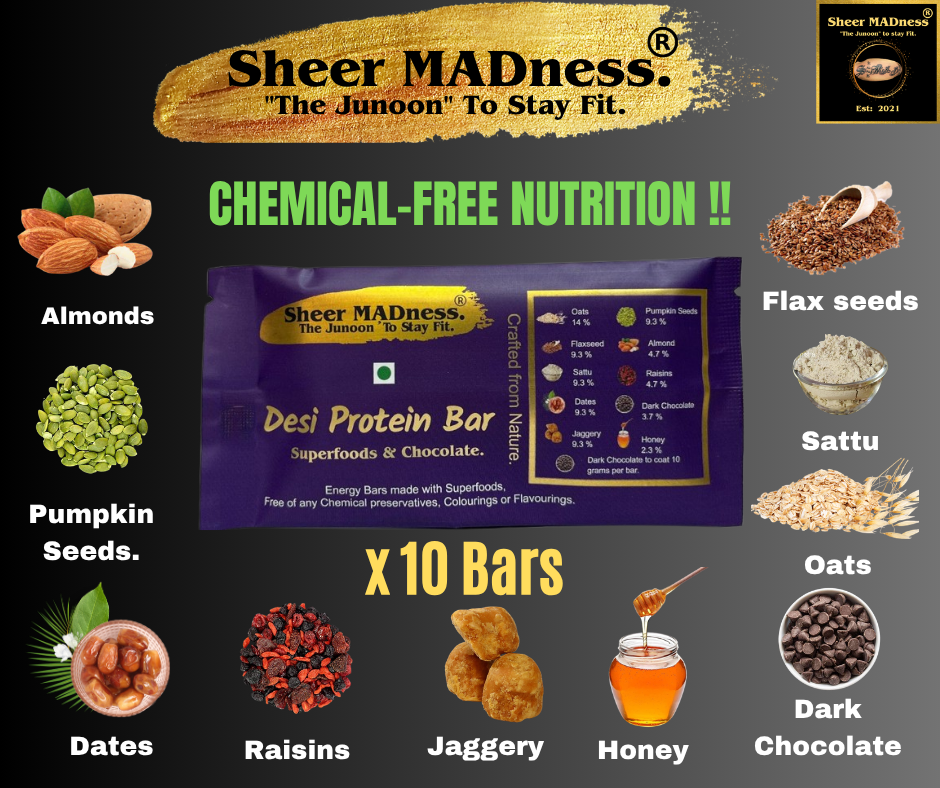
If you are interested in buying chemical-free Natural Plant Protein Moringa, Health Drinks for Kids, or our delicious chemical-free Energy Bars, Protein Bars, and Millet Bars, shop at Sheer MADness.
You can also find us on Flipkart, Jio Mart, or ONDC in India.
d) Exercise is the key to fitness. Exercise and nutrition are two sides of the same coin and always go hand in hand.
e) Excess of anything is wrong, even the best whole-food superfood. Consume only recommended quantities.
f) Rome was not built in a day. Discipline and consistency are the only keys to lasting health.
g) It is not only exercise and protein that builds health. A healthy gut, macro and micronutrients, body type, rest, and lifestyle all matter. Of all these, exercise and nutrition are within our control. Focus on these two primary aspects first.
h) The most important part of fitness is that nothing is better than exercise and a balanced meal.
Article by Chef Ashutosh Awasthi
Disclaimer: Our products are a source of HEALTHY NUTRIENTS and are COMPLETELY FREE OF ANY ADDED CHEMICALS. We do not claim to cure any medical condition. The content provided is informational. We do not claim to diagnose or treat a person with any specific medical condition.