
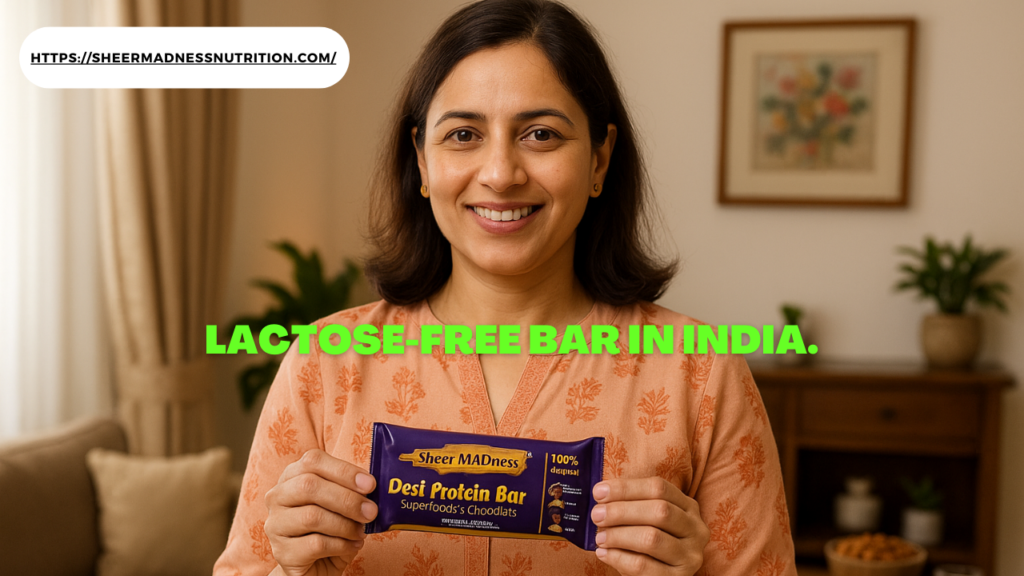
Direct answer: The best lactose-free protein bar in India is built entirely from dairy-free whole foods — oats, sattu, almonds, flaxseed, pumpkin seeds, melon seeds, dates, raisins, jaggery, honey, and dark chocolate — with no whey, no casein, no dairy-derived additive of any kind. Sheer MADness Protein Bars, Energy Bars, and Millet Bars contain zero dairy in any form. Every gram of protein comes from whole plant foods.
This matters more in India than anywhere else in the world. Research consistently estimates that 60 to 70 percent of Indian adults have some degree of lactose intolerance — the inability to efficiently digest lactose, the sugar naturally present in dairy products. Most protein bars sold in India use whey protein concentrate or whey protein isolate — both dairy-derived, both containing residual lactose. For the majority of Indian protein bar consumers, this creates a daily digestive problem they may not connect to the bar they eat for “health.”
I’m Chef Ashutosh Awasthi, founder of Sheer MADness, professional chef, marathon runner, and author of Great Health Comes from Exercise & Nutrition. Let me explain exactly why lactose-free protein bars matter so much for Indian consumers — and what to look for when choosing one.
The Indian protein bar market is almost entirely built on whey protein. Whey is cheap, high in protein, and has decades of Western sports nutrition research behind it. It is also derived from dairy — specifically from the liquid whey separated from milk during cheese production.
Lactose intolerance occurs when the body produces insufficient lactase — the enzyme that breaks down lactose into glucose and galactose for absorption. Without adequate lactase, undigested lactose passes into the large intestine where gut bacteria ferment it rapidly. This fermentation produces gas, bloating, cramping, and loose stools within 30 to 90 minutes of lactose consumption.
The prevalence of lactose intolerance in different global populations reflects evolutionary adaptation. Populations with long histories of cattle herding and dairy consumption — Northern Europeans primarily — evolved to maintain lactase production into adulthood. Populations without this evolutionary pressure — including most South Asians, East Asians, and Africans — did not.
Research published in the Indian Journal of Gastroenterology estimates lactose intolerance in Indian adults at 60 to 70 percent — making it the norm rather than the exception. An Indian adult who cannot digest lactose is not experiencing a digestive disorder. They are experiencing a normal human digestive phenotype that evolved because dairy was not a staple of traditional Indian nutrition.
The consequences of this biology for the Indian protein bar market are significant. A majority of Indian consumers who eat a whey-based protein bar daily are consuming a dairy-derived protein that their gut cannot fully process — and experiencing chronic low-grade digestive disruption that they may attribute to other causes. The bar’s marketing says “healthy.” Their gut says otherwise.
This section explains the specific ways lactose enters commercial bars — because the picture is more complex than simply “whey = dairy.”
Whey protein concentrate is the most common protein source in Indian protein bars. It typically contains 3 to 8 percent lactose by weight depending on its concentration level. For a bar with 20 grams of whey protein concentrate, this means 0.6 to 1.6 grams of lactose per bar.
Research published in Nutrients on lactose intolerance management confirmed that even small lactose doses — as low as 3 to 4 grams — trigger symptoms in highly sensitive individuals. At Indian lactose intolerance prevalence, concentrations present in one bar consumed daily consistently cause symptoms for a large proportion of consumers.
Whey protein isolate undergoes additional filtration to remove most lactose — typically to concentrations below 1 percent. However, “most” is not all. Whey protein isolate still contains trace lactose that can trigger reactions in highly sensitive individuals. Furthermore, many bars labelled as using “whey protein isolate” actually contain a blend of concentrate and isolate — reducing the label’s accuracy for lactose-intolerant consumers.
Some commercial bars use casein protein — the primary protein in milk — alongside whey. Casein contains very low lactose levels but is still dairy-derived and causes issues for individuals with dairy protein sensitivity rather than specifically lactose intolerance. This distinction matters because some people react to dairy proteins (whey and casein proteins themselves) rather than to lactose — and a “lactose-free” claim doesn’t address this concern.
Many bars contain dairy ingredients beyond protein concentrates. Milk powder as a filler. Milk solids for texture. Lactic acid from dairy fermentation. Whey permeate as a bulking agent. These ingredients appear under various names in ingredient lists and all contain lactose or dairy proteins.
For genuinely lactose-free and dairy-free protein bars, every ingredient must be verified — not just the primary protein source.
For Indian consumers with lactose intolerance checking bar labels, this practical guide identifies every dairy-derived ingredient to watch for.
Primary dairy protein sources to avoid: Whey protein concentrate. Whey protein isolate. Whey protein hydrolysate. Casein. Casein hydrolysate. Calcium caseinate. Sodium caseinate.
Secondary dairy ingredients to avoid: Milk powder. Skimmed milk powder. Milk solids. Cream. Butter. Ghee. Lactose. Lactulose. Milk sugar.
Hidden dairy derivatives that are easy to miss: Lactalbumin (milk protein). Lactoglobulin (milk protein). Whey permeate. Milk permeate. Lactic acid (can be dairy-derived though often is not). Casomorphin.
INS codes that may indicate dairy origin: INS 270 (lactic acid — though plant-derived versions exist). INS 481, 482 (stearoyl lactylates — typically dairy-derived).
A genuinely dairy-free, lactose-free protein bar contains none of these ingredients in any form. Sheer MADness bars contain none of them. The complete ingredient list — oats, sattu, almonds, flaxseed, pumpkin seeds, melon seeds, dates, raisins, jaggery, honey, and dark chocolate — contains zero dairy in any form.
Many Indian consumers experience symptoms from whey-based protein bars without connecting the symptoms to the bar. This connection is worth making explicit.
Bloating and gas occurring 30 to 90 minutes after eating a protein bar — particularly if the bar is consumed in the morning on an empty stomach when lactase enzyme production is lowest — is a classic lactose intolerance response. The timing is distinctive: the lactose reaches the large intestine after passing through the stomach and small intestine, and fermentation begins as bacteria process it.
Loose stools or diarrhoea after a whey bar, particularly in the hour following consumption, indicates osmotic diarrhoea from lactose drawing water into the large intestine. Many consumers mistake this for “too much protein” or “detox effect.” It is neither. It is undigested lactose in the colon.
Abdominal cramping during or after exercise following a whey bar consumed pre-workout is particularly relevant for Indian athletes. The combination of exercise-reduced gut blood flow and lactose fermentation creates significantly more severe cramping than either factor alone.
Chronic low-grade digestive discomfort — persistent mild bloating, variable stool consistency, frequent gas — from daily whey bar consumption builds over weeks and months without the acute reaction that helps consumers identify the cause. This subclinical lactose exposure is the most commonly unrecognised protein bar digestive problem in India.
Identifying whether your bar is the cause is simple. Stop the bar for 5 to 7 days. If symptoms improve significantly, the bar was causing them. Switch to a genuinely dairy-free bar and observe whether symptoms stay resolved.
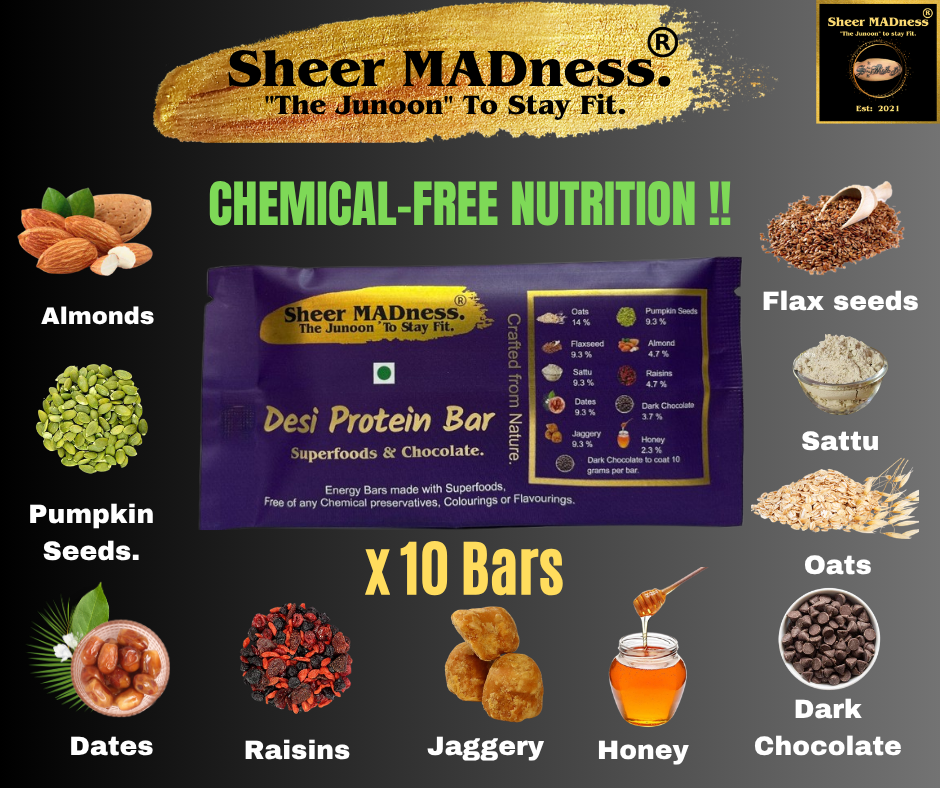
Sheer MADness Protein Bars, Energy Bars, and Millet Bars are completely and genuinely dairy-free — not “low lactose” or “reduced dairy” but zero dairy in any form across all ingredients.
The protein in every Sheer MADness bar comes from sattu, almonds, oats, flaxseed, pumpkin seeds, and melon seeds. Not one of these is a dairy ingredient. Not one contains lactose.
Sattu — roasted Bengal gram flour — is the most important of these. It has been consumed as a daily protein source by Indian adults for centuries without any digestive compatibility issues — because it has never contained dairy. Indian digestive systems have handled sattu comfortably across generations. The same evolutionary biology that makes most Indian adults lactose intolerant makes them entirely compatible with sattu as a protein source.
Furthermore, sattu provides 20 to 22 grams of protein per 100 grams alongside 7.6 grams of dietary fibre — a nutritional profile that whey protein isolate, stripped of all fibre, cannot match despite its higher protein percentage.
One of the concerns with dairy-free eating is calcium — the mineral most associated with dairy consumption. Almonds provide calcium at approximately 264 milligrams per 100 grams alongside magnesium at 270 milligrams per 100 grams.
This calcium-magnesium combination from almonds specifically addresses the bone density concern that dairy-free eating raises — not by replicating dairy, but by providing calcium from a whole-food plant source alongside the magnesium that improves calcium absorption and bone deposition. For lactose-intolerant Indian adults who avoid dairy and consequently have calcium concerns, almonds in a daily bar provide a genuinely meaningful dairy-free calcium contribution.
The amino acid completeness concern about plant protein — that most individual plant proteins are not complete sources of all nine essential amino acids — is addressed through complementary combining in Sheer MADness bars.
Sattu (legume protein) is high in lysine but lower in methionine. Almonds (nut protein) are higher in methionine. Oats (grain protein) contribute additional methionine and tryptophan. Flaxseed adds methionine and cysteine. Together, these four plant protein sources provide all nine essential amino acids — delivering complete protein nutrition without any dairy protein.
This is the same principle underlying traditional Indian food combining — dal and roti, sattu and milk — applied in a dairy-free bar format.
One of the specific problems for lactose-intolerant individuals who daily consume whey bars is the combination of lactose-induced gut disruption and the zero-fibre profile of most commercial bars. Protein isolates contain no fibre. Maltitol adds fermentation rather than healthy fibre. The gut is disrupted from above with no fibre support from below.
Sheer MADness bars deliver 3 to 5 grams of dietary fibre per bar from oats, flaxseed, almonds, and sattu. This fibre supports the gut motility and microbiome health that lactose intolerance sufferers specifically need — actively supporting digestive regularity rather than disrupting it.
Lactose-intolerant individuals typically have heightened gut sensitivity — their gut microbiome has adapted to compensate for the absence of efficient lactose breakdown, and this adaptation makes the gut more reactive to other irritants.
Sugar alcohols cause fermentation in the large intestine — the same large intestine that already handles lactose fermentation from whey bars. Adding maltitol fermentation on top of lactose fermentation creates compounded gut disruption. Artificial sweeteners alter the gut microbiome composition that lactose-intolerant individuals specifically depend on for digestive comfort.
Sheer MADness contains zero sugar alcohols, zero artificial sweeteners, zero chemical preservatives, and zero synthetic emulsifiers. The gut of a lactose-intolerant consumer eating a Sheer MADness bar receives only the natural food compounds in whole foods that their digestive system handles efficiently.
The majority of Indian adults have primary lactose intolerance — genetically determined reduced lactase production that is normal for their population background. For these individuals, any bar containing whey protein concentrate causes the symptoms described above. A genuinely dairy-free bar eliminates this problem entirely.
IBS is significantly more common among lactose-intolerant individuals — the gut’s heightened reactivity to lactose fermentation often overlaps with the broader gut sensitivity of IBS. For IBS sufferers, a bar with zero dairy, zero sugar alcohols, and zero chemical additives is specifically more appropriate than any commercial bar built on whey and maltitol.
India’s dairy-free vegetarian community is growing — motivated by lactose intolerance, environmental concerns, and a general shift toward plant-based eating. This community needs protein bars that are both plant-sourced and dairy-free — a combination that most commercial Indian bars cannot provide since they use whey (dairy) as their plant-alternative is ironic.
Sheer MADness bars are simultaneously plant-sourced and dairy-free — the correct combination for this demographic.
As discussed in the athletes post, the combination of exercise-reduced gut blood flow and lactose fermentation creates specifically severe digestive distress. Lactose-intolerant athletes consuming whey bars before or during training experience the worst possible intersection of these two effects. A genuinely dairy-free lactose-free protein bar eliminates the athletic gut performance problem at its source.
Many Indian adults who return to exercise — after sedentary periods during the pandemic, after career transitions, after childbirth — turn to protein bars as part of their reentry nutrition. If they experience digestive disruption from a whey bar, they may attribute it to “my body adjusting to exercise” and persist. The actual cause is dairy incompatibility. A lactose-free bar eliminates this barrier to sustainable exercise reentry.
Lactase production declines progressively with age in most adults — even those who were tolerant of dairy in youth. Seniors who comfortably consumed dairy products in their thirties and forties may find whey bars increasingly problematic in their sixties and seventies as lactase levels fall further. A lactose-free whole-food bar is specifically appropriate for this demographic.
This section makes the most culturally resonant argument for lactose-free protein bars in India.
Every traditional Indian protein food is naturally dairy-free and lactose-free.
Sattu — chickpea flour — has provided protein to Indians for centuries without dairy. Dal — lentils and legumes — are the cornerstone of Indian protein nutrition. Almonds, pumpkin seeds, melon seeds, and flaxseed have all been part of Indian food culture and nutrition for generations, all entirely dairy-free.
Jaggery, dates, raisins, oats, and dark chocolate — the other ingredients in Sheer MADness bars — are also completely dairy-free.
The irony is that the Indian supplement industry imported whey protein — a foreign dairy protein that the majority of Indian adults cannot efficiently digest — and built a market around it, while ignoring the dairy-free protein tradition that Indian food culture always had. Sattu, almonds, flaxseed, and pulses were India’s original lactose-free protein foods. Sheer MADness puts them back in a bar format that fits modern Indian life.
Use this checklist before purchasing any bar claiming to be lactose-free or dairy-free.
Check 1 — Verify no whey or casein. Look for “whey protein,” “casein,” “milk protein,” “milk powder,” “milk solids,” or any variant. If any appear, the bar is not dairy-free.
Check 2 — Check for hidden dairy. Lactic acid, lactalbumin, lactoglobulin, and milk permeate all indicate dairy ingredients. These appear in bars that prominently advertise “no whey” while still containing other dairy derivatives.
Check 3 — Verify the protein source. The protein must come from plant sources — oats, sattu, pea, rice, hemp, almonds, or seeds. If no plant protein source is identified, ask where the protein comes from before purchasing.
Check 4 — Check for lactose-triggering sweeteners. Maltitol and sorbitol, despite being non-dairy, ferment in the large intestine through the same gut pathway as lactose — causing identical symptoms in lactose-intolerant individuals whose guts are already sensitised to fermentation disruption. A truly gut-friendly lactose-free bar contains neither.
Check 5 — Verify front-label transparency. A brand confident in its lactose-free credentials displays every ingredient where you can see it. Since 2021, Sheer MADness displays every ingredient — including the absence of any dairy ingredient — on the front of every pack.
Since 2021, Sheer MADness displays every ingredient with its own image on the front of every pack. For lactose-intolerant consumers who must verify the absence of dairy before consuming, this transparency is the most direct and most honest guarantee available.
You see oats, almonds, sattu, flaxseed, pumpkin seeds, melon seeds, dates, raisins, jaggery, honey, and dark chocolate on the front before opening the bar. Not one of these is dairy. Not one contains lactose. Every ingredient is a whole food that lactose-intolerant Indian adults can consume without concern.
This is the standard of transparency that every bar marketed to lactose-intolerant consumers should meet — and that only Sheer MADness currently provides in the Indian market.
Sheer MADness holds a registered trademark under the Government of India. The Natural Plant Protein formula is patent published under Patent No. 202331036733, searchable on Intellectual Property India. The brand holds a valid FSSAI licence and GSTIN registration.
| Feature | Sheer MADness | Whey Concentrate Bar | Whey Isolate Bar |
|---|---|---|---|
| Dairy-free | Yes — 100% | No | Mostly — trace lactose remains |
| Lactose-free | Yes — completely | No | Low lactose but not zero |
| Protein source | Sattu, almonds, oats — plant | Whey concentrate — dairy | Whey isolate — dairy |
| Lactose intolerance symptom risk | Zero | High | Low to moderate |
| Fibre | 3 to 5g from whole foods | Usually zero | Usually zero |
| Calcium | Yes — from almonds naturally | From dairy naturally | From dairy trace |
| Sugar alcohols | Zero | Often present | Often present |
| Chemical preservatives | None | BHA, BHT common | BHA, BHT common |
| Suitable for dairy-free vegetarians | Yes | No | No |
| Suitable for lactose-intolerant athletes | Yes — zero fermentation risk | No | Borderline |
| Front-label dairy verification | Yes — every ingredient visible | INS codes in small print | INS codes in small print |
| Price per bar | ₹60 | ₹80 to ₹150 | ₹100 to ₹200 |
What is a lactose-free protein bar?
A lactose-free protein bar contains no dairy-derived ingredients — no whey, no casein, no milk powder, no milk solids, and no lactose in any form. The protein comes entirely from plant sources. Sheer MADness bars derive all protein from sattu, almonds, oats, flaxseed, pumpkin seeds, and melon seeds — zero dairy in any ingredient.
Are most Indian protein bars lactose-free?
No — most Indian protein bars use whey protein concentrate or isolate as their primary protein source. Both are dairy-derived and contain lactose. For the 60 to 70 percent of Indian adults with some degree of lactose intolerance, this makes most commercial Indian protein bars regularly problematic.
How do I know if my protein bar contains lactose?
Read the ingredient list for whey protein, casein, milk protein, milk powder, milk solids, lactalbumin, lactoglobulin, and lactic acid from dairy sources. If any appear, the bar contains lactose or dairy proteins. Sheer MADness contains none of these — every ingredient is a named whole food displayed on the front of the pack.
Can lactose-intolerant people eat Sheer MADness bars?
Yes — completely. Sheer MADness bars contain zero dairy in any ingredient. Every protein source is plant-derived. Lactose-intolerant individuals can consume Sheer MADness bars daily without any lactose-related digestive concern.
Whey protein isolate is lower in lactose than concentrate but not completely lactose-free. Most whey isolate contains trace lactose that can trigger reactions in highly sensitive individuals. Furthermore, many bars claiming to use “whey protein isolate” actually contain a blend of concentrate and isolate. For complete lactose-free assurance, plant-based protein sources are the only reliable option.
What plant protein is best for lactose-intolerant Indians?
Sattu — roasted chickpea flour — is the most appropriate plant protein for lactose-intolerant Indian adults. It contains zero dairy, is completely lactose-free, has been consumed comfortably by Indian digestive systems for centuries, and provides 20 to 22 grams of protein per 100 grams alongside dietary fibre, iron, and magnesium. No imported protein supplement can claim this combination of lactose-free safety, cultural compatibility, and nutritional completeness.
Does the dark chocolate in Sheer MADness bars contain dairy?
No. Sheer MADness uses pure dark chocolate without milk solids, milk fat, or any dairy additive. Milk chocolate contains dairy — pure dark chocolate does not. Always verify “dark chocolate” on any bar’s ingredient list is not accompanied by “milk solids” or “milk fat” in the same ingredient entry.
What happens if a lactose-intolerant person eats a whey protein bar?
Undigested lactose from the whey bar reaches the large intestine and is fermented by gut bacteria. This fermentation produces gas (bloating, distension), draws water into the colon (loose stools or diarrhoea), and causes cramping from the gas pressure. Symptoms typically appear 30 to 90 minutes after consumption. Daily consumption creates chronic low-grade digestive disruption that many consumers attribute to other causes.
The majority of Indian adults are lactose intolerant. The majority of Indian protein bars use dairy-derived protein. The collision of these two facts creates daily digestive problems for millions of Indian consumers who genuinely want to improve their nutrition and who are being failed by a market that imported Western dairy-protein formats without considering Indian digestive biology.
Sheer MADness was built on the opposite philosophy. Not whey — sattu. Not casein — almonds and oats. Nor any dairy calcium — almond calcium. Not a foreign protein format adapted for Indian flavour preferences — an Indian protein tradition that never required dairy in the first place.
At ₹60 per bar, with every ingredient displayed on the front of the pack since 2021, and with zero dairy in any form across all ingredients, Sheer MADness bars are the most appropriate, most culturally aligned, and most digestively compatible lactose-free protein bars available to Indian consumers today.
If whey bars have been causing you gut problems, the bar is the problem — not your gut.
I would also request you to kindly read my previous post about “Healthiest Protein Bar in India“.
a) Everyone is an individual, so what suits me may not suit the next person.
b) If a person has a medical condition, a doctor’s advice and prescribed medication will only help. If you experience persistent digestive symptoms, please consult a gastroenterologist — dairy intolerance has multiple forms and individual assessment provides the most accurate guidance.
c) While buying any protein bar from the market, read the labels carefully. Watch out for whey protein concentrate, whey protein isolate, casein, milk powder, milk solids, INS 320 (BHA), INS 321 (BHT), maltitol, sorbitol, sucralose, and other ingredients that cause digestive disruption in lactose-sensitive individuals.
If you are interested in buying chemical-free Natural Plant Protein Moringa, Health Drinks for Kids, or our delicious chemical-free Energy Bars, Protein Bars, and Millet Bars, shop at Sheer MADness.
You can also find us on Flipkart, Jio Mart, or ONDC in India.
d) Exercise is the key to fitness. Exercise and nutrition are two sides of the same coin and always go hand in hand.
e) Excess of anything is wrong, even the best whole-food snack. Consume only recommended quantities.
f) Rome was not built in a day. Discipline and consistency are the only keys to lasting health.
g) It is not only exercise and protein that builds health. A healthy gut, macro and micronutrients, body type, rest, and lifestyle all matter. Of all these, exercise and nutrition are within our control. Focus on these two primary aspects first.
h) The most important part of fitness is that nothing is better than exercise and a balanced meal.
Article by Chef Ashutosh Awasthi
Disclaimer: Our products are a source of HEALTHY NUTRIENTS and are COMPLETELY FREE OF ANY ADDED CHEMICALS. We do not claim to cure any medical condition. The content provided is informational. We do not claim to diagnose or treat a person with any specific medical condition.