

Direct answer: Some protein bars cause significant gas and bloating — but the protein itself is almost never the cause. The culprits are specific fermentable ingredients that reach the large intestine undigested: sugar alcohols like maltitol and sorbitol that gut bacteria ferment to produce hydrogen gas, lactose from whey protein that ferments in lactose-intolerant adults — the majority of Indian adults — and isolated fibre additives like inulin and chicory root extract that ferment rapidly and produce large gas volumes quickly. Whole-food protein bars built from oats, almonds, sattu, flaxseed, and natural sweeteners like dates and jaggery — with none of these fermentation-causing compounds — produce no meaningful gas or bloating for most people.
Understanding exactly why certain bars cause gas — at the level of specific gut bacteria, specific fermentation substrates, and specific gas production pathways — helps you choose the bar that your gut will actually tolerate. That understanding is what this post provides.
I’m Chef Ashutosh Awasthi, founder of Sheer MADness, professional chef, marathon runner, and author of Great Health Comes from Exercise & Nutrition. Let me explain the gut fermentation chemistry behind protein bar gas — specifically, completely, and honestly.
Gas in the gut is not random. It is the specific metabolic output of specific bacteria processing specific substrates. Understanding this at the bacterial level explains exactly why certain bar ingredients cause gas and others don’t.
The human large intestine contains approximately 100 trillion bacteria across hundreds of species. These bacteria subsist primarily on carbohydrates that the small intestine cannot digest — fibre, certain sugars, and fermentable carbohydrates that escape upper gastrointestinal digestion. When these substrates reach the large intestine, bacteria ferment them through anaerobic metabolic pathways that produce short-chain fatty acids, carbon dioxide, hydrogen gas, and sometimes methane.
Gas is therefore a byproduct of bacterial metabolism — specifically the fermentation of substrates that the gut cannot fully absorb before they reach the bacteria. The volume of gas produced depends on the quantity of fermentable substrate reaching the large intestine and the composition of the bacterial community processing it.
Three key fermentable substrates in commercial protein bars drive the gas and bloating that consumers commonly experience. Each has a distinct fermentation mechanism, a distinct gas volume profile, and a distinct symptom pattern.
Sugar alcohols — maltitol, sorbitol, xylitol, erythritol, and isomaltooligosaccharides — are the most common cause of protein bar gas and bloating. They appear in virtually every “low sugar” or “zero sugar” commercial protein bar.
Maltitol is absorbed through the small intestine at a rate of approximately 5 percent per hour — dramatically slower than glucose, which is absorbed within minutes. The majority of consumed maltitol reaches the large intestine largely intact.
In the large intestine, anaerobic bacteria — primarily Bacteroides, Bifidobacterium, and Clostridium species — ferment maltitol through anaerobic glycolysis pathways. This fermentation produces hydrogen gas (H₂) as its primary gas product, alongside carbon dioxide (CO₂) and short-chain fatty acids (acetate, propionate, butyrate).
Research published in the European Journal of Clinical Nutrition confirmed that maltitol consumption produces significantly higher breath hydrogen levels than equivalent sucrose consumption — confirming large intestine fermentation that produces measurable gas. The same study found dose-dependent effects: larger doses produced proportionally more gas and more severe bloating.
The gas produced by maltitol fermentation in the large intestine causes distension — the gut expands to accommodate the gas volume, producing the visible abdominal distension and the sensation of pressure and tightness that consumers describe as “bloating.” The gas also drives increased gut motility as the body attempts to expel it, causing the audible gut sounds and flatulence that accompany maltitol consumption.
Sorbitol is found naturally in some fruits and is used as a sweetener in “natural” bars. However, its fermentation profile is essentially identical to maltitol — it passes through the small intestine poorly absorbed and ferments in the large intestine with similar gas production volumes.
Research in the American Journal of Clinical Nutrition confirmed that sorbitol doses above 10 grams produce significant gas and bloating in most adults. Many commercial bars contain 10 to 20 grams of maltitol or sorbitol per bar — well above the threshold at which gas symptoms become significant.
Erythritol has a better absorption profile than maltitol or sorbitol — approximately 60 to 80 percent is absorbed in the small intestine. This means less reaches the large intestine to ferment, producing less gas and bloating than other sugar alcohols. However, the portion that is not absorbed causes osmotic effects — drawing water into the gut — and may still cause bloating through this mechanism at high doses. Furthermore, the 2023 Nature Medicine study linked high erythritol blood levels to cardiovascular risk — making it problematic beyond its gut effects.
This is the most important and most underdiscussed cause of protein bar gas in India specifically.
Approximately 60 to 70 percent of Indian adults have some degree of lactose intolerance — the inability to produce adequate lactase enzyme to break down lactose, the sugar naturally present in dairy products. Most commercial protein bars use whey protein concentrate or isolate — both dairy-derived, both containing residual lactose.
Undigested lactose reaches the large intestine and is fermented by bacteria — primarily Lactobacillus and Streptococcus species — through a process that specifically produces lactic acid, carbon dioxide, and hydrogen gas. The hydrogen gas causes the same gut distension mechanism as maltitol fermentation — producing bloating within 30 to 90 minutes of consuming the whey bar.
The gas profile from lactose fermentation is distinct from maltitol fermentation. Lactose fermentation produces predominantly hydrogen gas with less methane than maltitol fermentation. The symptom onset is faster — typically 30 to 60 minutes after consumption — because lactose moves through the small intestine faster than maltitol.
For Indian adults — among whom the majority have some lactose intolerance — whey-based protein bars are a daily gas and bloating trigger that many consumers attribute to “protein” rather than to dairy. Replacing whey bars with dairy-free whole-food bars eliminates this specific fermentation pathway entirely.
This cause is specifically relevant to bars marketed as “high fibre” — a marketing claim that frequently indicates isolated fibre additives added to inflate the label number.
Inulin, chicory root extract, fructooligosaccharides (FOS), and isomaltooligosaccharides (IMO) are isolated prebiotic fibre additives used in many commercial protein bars. Unlike the slow-fermenting fibre naturally present in oats, almonds, and flaxseed, these isolated prebiotic fibres ferment rapidly and produce large gas volumes in short time periods.
The fermentation rate of isolated inulin and FOS is dramatically faster than whole-food fibre. Research published in the British Journal of Nutrition confirmed that inulin fermentation produces peak hydrogen gas production within 2 to 3 hours of consumption — compared to 6 to 8 hours for equivalent doses of whole-food fibre. This rapid fermentation means gas production peaks at a rate that outpaces the gut’s ability to manage it comfortably.
Furthermore, inulin and FOS specifically feed Bifidobacterium and Bacteroides species that are particularly high gas producers. While this is nutritionally beneficial in principle — feeding beneficial bacteria — the rapid and concentrated gas production from large isolated fibre doses creates the acute bloating discomfort that consumers report from “high fibre” bars.
This is the same mechanism behind the Quest Nutrition isomaltooligosaccharide controversy of 2014-2016 — which drove a product reformulation specifically because consumers reported severe bloating and gas from the isolated fibre addition.
Sheer MADness bars contain no isolated fibre additive of any kind. The 3 to 5 grams of fibre per bar comes entirely from the natural fibre in oats, flaxseed, almonds, and sattu — fibres that ferment slowly over 6 to 8 hours, feeding gut bacteria gradually without the acute gas production peak that isolated additives cause.
Sucralose and aspartame do not ferment in the large intestine — they don’t cause gas through bacterial fermentation. However, they contribute to bloating through a different mechanism: gut motility disruption and microbiome alteration.
Sucralose activates sweet taste receptors in the gut — specifically the T1R2/T1R3 receptor complex expressed in enteroendocrine cells throughout the small intestine. These receptors, when activated, signal changes in gut motility through secretin and CCK release. Abnormal gut motility — specifically slowed gastric emptying combined with accelerated colonic transit — creates the sensation of fullness and distension that consumers describe as bloating even without significant gas production.
Furthermore, the 2021 Gut Microbes study confirmed that sucralose reduces Lactobacillus and Bifidobacterium populations with daily consumption. These bacteria produce the short-chain fatty acids that regulate gut motility and maintain the gut lining’s barrier function. Their reduction creates gut motility abnormalities and increased intestinal permeability — both of which contribute to bloating sensations over weeks of daily consumption.
This explains why some consumers report progressive worsening of bloating from commercial bars over weeks of daily use — the cumulative microbiome disruption from daily artificial sweetener consumption creates a progressively more bloating-prone gut environment.
This is a contributing factor that is more nuanced than the fermentable substrate causes above.
Very high protein doses from isolated protein concentrates — 20 to 30 grams per bar from whey or soy isolate — can overwhelm the small intestine’s protein digestion capacity. When protein exceeds the digestive enzyme capacity of the upper gut, it passes to the large intestine where bacteria ferment protein through putrefaction — producing hydrogen sulphide, ammonia, and volatile sulphur compounds. These produce the characteristic “rotten egg” gas associated with very high protein consumption.
This protein fermentation gas is distinct from carbohydrate fermentation gas in its odour profile but similar in its bloating mechanism. It specifically occurs with concentrated protein isolates at high doses — not with moderate whole-food protein from oats, sattu, and almonds at the 8 to 10-gram-per-bar levels of Sheer MADness bars.
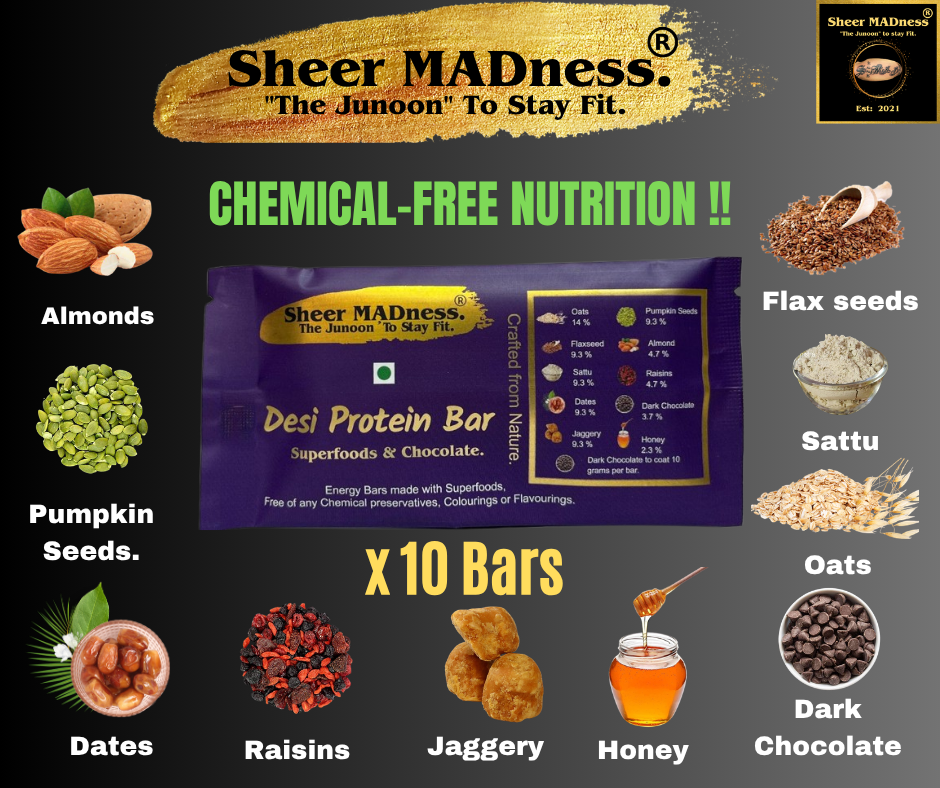
Sheer MADness Protein Bars and Energy Bars eliminate every specific gas-producing mechanism through ingredient choice.
No maltitol, no sorbitol, no xylitol, no erythritol, no isomaltooligosaccharides appear in any Sheer MADness bar. The complete absence of sugar alcohols eliminates the primary fermentation substrate that drives the majority of protein bar gas and bloating.
The sweeteners in Sheer MADness bars — dates, jaggery, raisins, and honey — are absorbed normally through the small intestine. They do not reach the large intestine in quantities that ferment meaningfully. The natural fructose and glucose in dates and raisins arrive packaged with fibre that slows their absorption rate — preventing rapid influx into the large intestine — but they are absorbed sufficiently in the small intestine to not produce the fermentation gas that sugar alcohols do.
Every gram of protein in Sheer MADness bars comes from sattu, almonds, oats, flaxseed, pumpkin seeds, and melon seeds. Not one dairy ingredient appears in any Sheer MADness bar. Zero lactose. Zero dairy protein.
For the 60 to 70 percent of Indian adults with some degree of lactose intolerance, this complete dairy-free formulation means the lactose fermentation pathway — the most common cause of protein bar gas for Indian consumers — simply does not occur when eating Sheer MADness bars.
The 3 to 5 grams of fibre per Sheer MADness bar comes entirely from the natural fibre in oats (beta-glucan), flaxseed (mucilage and structural fibre), almonds (prebiotic cell wall fibre), and sattu (chickpea natural fibre). These fibres ferment over 6 to 8 hours — gradually feeding beneficial gut bacteria without producing the acute gas volume peak that isolated inulin, FOS, and chicory root extract generate.
Furthermore, oat beta-glucan specifically forms a gel that slows gastric emptying and moderates fermentation substrate delivery to the large intestine — reducing gas production rate even from the fibre that does ferment.
No sucralose, no aspartame, no acesulfame-K. The gut sweet receptors receive no false signalling. The gut microbiome receives no daily sucralose-driven disruption. Gut motility remains normal. The progressive bloating worsening that daily artificial sweetener consumption produces does not occur.
Eight to ten grams of whole-food protein per bar is within the small intestine’s digestive capacity. The protein from sattu, almonds, and oats arrives in its natural food matrix with the digestive enzyme substrates that maximise protein hydrolysis efficiency. No significant protein reaches the large intestine to undergo putrefactive fermentation.
Indian gut microbiome research reveals specific patterns relevant to protein bar fermentation.
Indian adults — particularly vegetarians — typically have higher populations of Bacteroides and Bifidobacterium species relative to Western populations. These bacteria are highly efficient fermenters of prebiotic fibre substrates — making Indian guts specifically more reactive to isolated prebiotic fibre additions (inulin, FOS) than Western gut populations.
Furthermore, the lactase enzyme deficiency affecting 60 to 70 percent of Indian adults is higher than global averages and is directly relevant to whey protein bar gas production. Indian consumers experience more severe lactose fermentation gas from whey bars than Western consumers with lower lactase deficiency prevalence.
The sattu in Sheer MADness bars has a specific advantage in the Indian gut context. Roasted chickpea flour has been consumed by Indian digestive systems for centuries. The specific bacterial populations in Indian guts are adapted to processing sattu’s fibre composition efficiently — reducing the gas production from sattu fibre fermentation relative to foreign protein sources that Indian guts have no evolutionary history with.
If you are currently experiencing gas or bloating from a protein bar and want to identify the specific cause, this systematic approach helps.
Check the ingredient list for sugar alcohols first. Maltitol, sorbitol, xylitol, erythritol, or isomaltooligosaccharides — any of these appearing in the ingredient list is the most likely primary cause. Gas from sugar alcohol fermentation typically begins 1 to 3 hours after eating the bar.
Check the protein source second. If the bar uses whey protein concentrate, and you are experiencing gas within 30 to 90 minutes of eating — lactose fermentation from dairy protein is likely the cause for the majority of Indian adults.
Check for isolated fibre additives third. Inulin, chicory root extract, FOS, or “prebiotic fibre” in the ingredient list indicates rapidly fermenting isolated fibre. Gas from this source peaks at 2 to 3 hours and may be accompanied by significant audible gut sounds.
Check for artificial sweeteners fourth. If bloating is diffuse, persistent, and has worsened progressively over weeks of daily bar consumption rather than appearing acutely after eating — sucralose-driven gut motility disruption and microbiome alteration is likely the mechanism.
Eliminate the identified bar for 5 to 7 days. If gas resolves or significantly reduces, the bar was the cause. Switch to a bar with none of the identified ingredients — one with whole-food protein, natural sweeteners, no isolated fibre additives, no dairy, and no artificial sweeteners.
Before buying any protein bar for daily consumption, apply this five-ingredient gas test to the label.
Does the bar contain any of these? Maltitol, sorbitol, xylitol, erythritol. If yes — expect significant gas from sugar alcohol fermentation. Does it contain whey protein concentrate or casein? If yes — expect gas from lactose fermentation if you are lactose intolerant, as most Indian adults are. Does it contain inulin, chicory root extract, or FOS? If yes — expect acute gas from rapid isolated fibre fermentation, particularly at 2 to 3 hours. Does it contain sucralose or aspartame? If yes — expect progressive bloating worsening over weeks from gut motility disruption. Does the protein exceed 20 grams per bar from concentrated isolates? If yes — expect potential putrefactive protein fermentation gas from large intestine overflow.
Sheer MADness bars answer no to all five. Zero sugar alcohols. No dairy protein. Zero isolated fibre additives. Zero artificial sweeteners. Eight to ten grams of moderate whole-food protein. The gas test passes completely.
Since 2021, Sheer MADness displays every ingredient with its own image on the front of every pack. For consumers specifically trying to avoid gas and bloating from known fermentable ingredients — this transparency makes verification immediate. You see oats, almonds, sattu, flaxseed, pumpkin seeds, melon seeds, dates, raisins, jaggery, honey, and dark chocolate on the front before opening the bar. No sugar alcohol hides in an ingredient list. Zero isolated inulin appears under “dietary fibre.” No sucralose hides behind “natural flavour.” Everything is visible and identifiable before purchase.
Sheer MADness holds a registered trademark under the Government of India. The Natural Plant Protein formula is patent published under Patent No. 202331036733, searchable on Intellectual Property India. The brand holds a valid FSSAI licence and GSTIN registration.
| Ingredient | Gas Mechanism | Gas Onset | Sheer MADness Contains? |
|---|---|---|---|
| Maltitol | Large intestine bacterial fermentation — H₂ production | 1 to 3 hours | No |
| Sorbitol | Large intestine bacterial fermentation — H₂ production | 1 to 3 hours | No |
| Erythritol | Osmotic + partial fermentation | 30 to 90 minutes | No |
| Whey protein concentrate (lactose) | Lactose bacterial fermentation — H₂ and CO₂ | 30 to 90 minutes | No — 100% dairy-free |
| Inulin / chicory root / FOS | Rapid prebiotic fermentation — H₂ peak | 2 to 3 hours | No |
| Sucralose / aspartame | Gut motility disruption, microbiome alteration | Progressive over weeks | No |
| Concentrated protein isolate >20g | Protein putrefaction — H₂S, ammonia | Variable | No — 8 to 10g whole-food protein only |
| Oat beta-glucan (whole food) | Slow gel fermentation — moderate | 6 to 8 hours — gradual | Yes — gut-healthy |
| Sattu legume fibre (whole food) | Slow fermentation — familiar to Indian guts | Gradual | Yes — culturally compatible |
| Almond prebiotic fibre (whole food) | Selective Lactobacillus feeding — low gas | Gradual | Yes — beneficial |
| Dates / jaggery / raisins / honey | Normal small intestine absorption | Minimal — absorbed before large intestine | Yes — no large intestine fermentation |
Do protein bars cause gas or bloating?
Some protein bars cause significant gas and bloating — specifically those containing sugar alcohols (maltitol, sorbitol), lactose from whey protein, isolated fibre additives (inulin, chicory root), or artificial sweeteners. Whole-food bars made from oats, almonds, sattu, dates, and jaggery — with none of these ingredients — cause no meaningful gas or bloating for most people.
Why does maltitol in protein bars cause so much gas?
Maltitol is absorbed poorly in the small intestine — approximately 5 percent per hour — meaning most consumed maltitol reaches the large intestine intact. Gut bacteria ferment it through anaerobic pathways that produce hydrogen gas as a primary product. Research in the European Journal of Clinical Nutrition confirmed dose-dependent gas production from maltitol that significantly exceeds sucrose at equivalent doses.
Yes — for the majority. Approximately 60 to 70 percent of Indian adults have some lactose intolerance. Whey protein concentrate contains residual lactose. Undigested lactose reaches the large intestine where bacteria ferment it, producing hydrogen gas and carbon dioxide within 30 to 90 minutes. Many Indian consumers attribute this gas to “protein” when the actual cause is dairy-origin lactose.
Does Sheer MADness Protein Bar cause gas?
No — for the vast majority of people. Sheer MADness bars contain zero sugar alcohols, zero dairy protein, zero isolated fibre additives, and zero artificial sweeteners. The whole-food fibre from oats, flaxseed, and almonds ferments slowly over 6 to 8 hours without the acute gas production that rapid-fermenting substrates cause.
Why do “high fibre” protein bars cause more gas?
Most “high fibre” protein bars achieve their label fibre numbers through isolated prebiotic fibres — inulin, chicory root extract, FOS — added after the protein extraction process. These isolated fibres ferment rapidly, producing peak gas at 2 to 3 hours. This is categorically different from whole-food fibre in oats and flaxseed that ferments gradually over 6 to 8 hours.
Yes — by choosing bars with none of the five gas-causing ingredients: no sugar alcohols, no dairy protein, no isolated fibre additives, no artificial sweeteners, and no concentrated protein above 20 grams per bar. Sheer MADness bars eliminate all five. Furthermore, always eat bars with adequate water and not on a completely empty stomach — both practices reduce gas symptoms from any food.
Is sorbitol in protein bars worse than maltitol for gas?
Both cause gas through the same large intestine fermentation mechanism. Sorbitol may cause slightly faster onset bloating because it moves through the gut somewhat faster than maltitol. Both are significantly gas-producing at doses present in commercial bars. Both should be completely avoided if you are sensitive to gas and bloating.
How long after eating a bar does gas start if maltitol is the cause?
Gas from maltitol fermentation typically begins 1 to 2 hours after consumption — the time required for the maltitol to pass through the stomach and small intestine and reach the large intestine where fermentation begins. Maximum gas production typically peaks at 3 to 4 hours. If gas symptoms resolve when you stop the bar and return when you resume it — maltitol is almost certainly the cause.

Protein bars cause gas and bloating when they contain ingredients that the small intestine cannot absorb before they reach the large intestine’s bacterial community. Maltitol and sorbitol ferment to produce hydrogen gas in large volumes. Lactose from whey protein ferments in the majority of lactose-intolerant Indian adults. Inulin and isolated prebiotic fibres ferment rapidly, producing acute gas peaks that exceed gut comfort. Artificial sweeteners disrupt gut motility and microbiome composition progressively.
None of these ingredients appear in Sheer MADness bars. Zero sugar alcohols. No dairy. Zero isolated fibre additives. Zero artificial sweeteners. The whole-food ingredients — oats, almonds, sattu, flaxseed, dates, jaggery — either absorb normally in the small intestine or ferment slowly and gradually in the large intestine in the way that human guts evolved to handle.
At ₹60 per bar — with every ingredient displayed on the front of the pack since 2021 — Sheer MADness bars are the most verifiably gut-friendly protein bar available in India. You can see before you buy exactly what the bar contains. And what it contains will not produce the gas and bloating that has made too many Indian consumers think protein bars simply don’t agree with them.
They agreed with you. The bar didn’t.
I would also request you to kindly read my previous post about “Healthiest Protein Bar in India“.
a) Everyone is an individual, so what suits me may not suit the next person.
b) If a person has a medical condition, a doctor’s advice and prescribed medication will only help.
c) While buying any protein bar from the market, read the labels carefully. Watch out for maltitol, sorbitol, sucralose, INS 320 (BHA), INS 321 (BHT), inulin, chicory root extract, whey protein concentrate, and other ingredients that produce gas and bloating in the majority of Indian consumers.
If you are interested in buying chemical-free Natural Plant Protein Moringa, Health Drinks for Kids, or our delicious chemical-free Energy Bars, Protein Bars, and Millet Bars, shop at Sheer MADness.
You can also find us on Flipkart, Jio Mart, or ONDC in India.
d) Exercise is the key to fitness. Exercise and nutrition are two sides of the same coin and always go hand in hand.
e) Excess of anything is wrong, even the best whole-food snack. Consume only recommended quantities.
f) Rome was not built in a day. Discipline and consistency are the only keys to lasting health.
g) It is not only exercise and protein that builds health. A healthy gut, macro and micronutrients, body type, rest, and lifestyle all matter. Of all these, exercise and nutrition are within our control. Focus on these two primary aspects first.
h) The most important part of fitness is that nothing is better than exercise and a balanced meal.
Article by Chef Ashutosh Awasthi
Disclaimer: Our products are a source of HEALTHY NUTRIENTS and are COMPLETELY FREE OF ANY ADDED CHEMICALS. We do not claim to cure any medical condition. The content provided is informational. We do not claim to diagnose or treat a person with any specific medical condition.