

Direct answer: No — moringa plant protein powder will not make you fat. The only mechanism through which any food causes fat gain is a sustained caloric surplus — consuming more calories than the body expends over time. Sheer MADness Plant Protein Moringa provides approximately 80 to 100 kilocalories per two-tablespoon serving — a modest caloric contribution that does not meaningfully alter caloric balance for most adults. Beyond its low caloric density, moringa protein actively supports body composition management through four specific mechanisms: high-TEF protein increases daily energy expenditure, multiple satiety hormones triggered by its protein and fibre reduce subsequent calorie intake, AMPK activation shifts metabolism toward fat oxidation rather than fat storage, and its low glycaemic index profile prevents the insulin spikes that specifically drive visceral fat accumulation. Moringa protein powder does not make you fat — and for most Indian adults, it makes it easier to maintain a healthy body weight.
I am Chef Ashutosh Awasthi, founder of Sheer MADness, professional chef, marathon runner, and author of Great Health Comes from Exercise & Nutrition. A man who transformed from overweight to a marathon runner in my forties. I understand body composition from personal experience as well as from decades of professional nutrition study. Let me explain the weight management science behind moringa honestly and completely.
Before any discussion of whether a specific food causes weight gain, the fundamental energy balance principle must be stated clearly — because it is the only mechanism through which body fat accumulates.
Body fat increases when, and only when, caloric intake exceeds caloric expenditure over a sustained period. This is not a dietary philosophy or a nutritional school of thought. It is thermodynamic law applied to human metabolism. The body stores excess energy as triglycerides in adipose tissue. It releases stored energy when caloric intake falls below expenditure.
No specific food — not moringa, not almonds, not rice, not jaggery — directly causes fat gain independent of total caloric context. The question is never “does food X make you fat” in isolation. The honest question is: “Does food X, within the context of my total daily caloric intake, contribute to a sustained caloric surplus?”
For moringa protein powder — at approximately 80 to 100 kilocalories per two-tablespoon serving — the answer is that it contributes a modest caloric addition that is more than offset by its satiety and metabolic benefits for virtually all consumers in typical serving quantities.
India faces a distinctive obesity paradox: significant metabolic disease burden — Type 2 diabetes, metabolic syndrome, non-alcoholic fatty liver disease — at BMI levels below the Western obesity threshold of 30. This is the thin-fat Indian phenotype — a body composition characterised by low skeletal muscle mass alongside high visceral adiposity, producing metabolic disease at BMI values of 23 to 26 that Western populations would consider normal weight.
The primary dietary driver of India’s visceral fat accumulation is not protein or healthy fat intake. It is the high refined carbohydrate load of India’s transitioning urban diet — refined wheat (maida), white rice, sugar, and the rapidly expanding ultra-processed food consumption that generates large postprandial insulin spikes, directing glucose toward hepatic and visceral fat storage rather than muscle glycogen.
This is the most important context for the moringa weight management discussion. Moringa protein powder does not contribute to the refined carbohydrate-insulin-visceral fat pathway. Its low glycaemic index (moringa has minimal glucose content), its high protein TEF, its fibre-driven satiety, and its AMPK-mediated fat oxidation promotion all operate in the opposite direction from India’s primary visceral fat driver.
Let me establish the actual caloric context for Sheer MADness Plant Protein Moringa.
A two-tablespoon (approximately 20 grams) serving of Sheer MADness Plant Protein Moringa provides:
Protein: approximately 8 to 10 grams — 32 to 40 kilocalories
Healthy fats from almonds and flaxseed: approximately 4 to 5 grams — 36 to 45 kilocalories
Carbohydrate from moringa fibre and trace natural compounds: approximately 2 to 3 grams — 8 to 12 kilocalories
Total: approximately 76 to 97 kilocalories
For context, a standard cup of chai with milk and sugar provides approximately 70 to 90 kilocalories. Sheer MADness Plant Protein Moringa provides similar total calories — but with 8 to 10 grams of complete protein, meaningful fibre, omega-3, and micronutrient density that a cup of sugary tea provides none of.
The relevant comparison is not whether moringa adds calories (every food does) but whether replacing a typical Indian mid-morning snack — a few biscuits (100 to 150 kcal with minimal protein), a cup of sweet chai (80 kcal, no protein), or namkeen (150 kcal with negligible protein and high sodium) — with a moringa preparation results in a better caloric and nutritional outcome. For every comparison, the moringa preparation provides more satiety per calorie from its protein, more micronutrient density, and less insulin-stimulating refined carbohydrate.
This is the most important fat-prevention mechanism of moringa protein — and the one with the strongest human clinical trial evidence base.
When protein reaches the small intestine and large intestine, it stimulates a cascade of satiety hormones that collectively reduce appetite and subsequent food intake. This is not a psychological satiety effect — it is a hormonal cascade with specific molecular mechanisms.
GLP-1 (glucagon-like peptide-1) — secreted by intestinal L-cells in response to protein and fibre — reduces gastric emptying, stimulates pancreatic insulin secretion proportional to blood glucose (the incretin effect), and acts on hypothalamic appetite-regulating centres to reduce hunger signalling. GLP-1 is the basis of the most effective class of obesity pharmaceutical currently available (GLP-1 agonists — semaglutide, liraglutide).
PYY (peptide YY) — secreted alongside GLP-1 from intestinal L-cells — specifically acts on the hypothalamic arcuate nucleus to reduce appetite through NPY/AgRP neuron inhibition. PYY secretion is protein-dependent — higher protein meals produce higher PYY responses and longer satiety duration.
CCK (cholecystokinin) — secreted by intestinal I-cells in response to protein and fat — stimulates pancreatic enzyme secretion, reduces gastric emptying rate, and signals satiety through the vagus nerve to the brainstem.
Ghrelin suppression — ghrelin is the primary hunger-stimulating hormone, secreted from gastric fundus cells. Protein consumption more effectively suppresses ghrelin release than carbohydrate or fat meals — reducing the hunger signal duration after a protein-containing meal compared to carbohydrate-only alternatives.
Research published in the American Journal of Clinical Nutrition confirmed that high-protein meals produce significantly higher GLP-1 and PYY responses and significantly greater ghrelin suppression compared to isocaloric carbohydrate-dominant meals — resulting in 20 to 30 percent lower ad libitum caloric intake at the subsequent meal.
Moringa protein triggers these exact satiety hormone mechanisms. Two tablespoons of Sheer MADness Plant Protein Moringa in warm milk produces the protein-driven GLP-1, PYY, and CCK secretion that reduces hunger for the following 2 to 4 hours — specifically reducing the likelihood of snacking on the refined carbohydrate foods that drive visceral fat accumulation in Indian urban diets.
As established in the metabolism post, protein has a Thermic Effect of Food (TEF) of 20 to 30 percent — the highest of any macronutrient. For every 100 kilocalories from protein consumed, 20 to 30 kilocalories are expended in the metabolic processing of that protein.
The practical consequence: a 90-kilocalorie two-tablespoon serving of Sheer MADness Plant Protein Moringa with 9 grams of protein provides approximately 18 to 27 kilocalories of net caloric contribution to energy balance after TEF is accounted for — versus a 90-kilocalorie serving of refined carbohydrate (biscuits, white rice) with only 5 to 9 kilocalories of TEF expense and full net caloric availability.
Replacing refined carbohydrate snacks with moringa protein preparations therefore reduces net caloric absorption — specifically through the TEF mechanism — even when the total listed calorie count appears similar.
Sheer MADness Plant Protein Moringa delivers fibre from three simultaneous sources — moringa leaf fibre, flaxseed mucilage, and almond prebiotic fibre. These three fibre types work differently but all contribute to satiety and reduced caloric intake:
Moringa leaf dietary fibre increases meal volume and slows gastric emptying — producing mechanical satiety that extends the time before hunger returns.
Flaxseed mucilage forms a viscous gel in the gut — the same mechanism as oat beta-glucan — that specifically slows gastric emptying and reduces postprandial glucose response. The EFSA-approved mechanism for viscous fibre is specifically the reduction of glucose absorption rate that prevents insulin spikes and promotes stable blood glucose — the anti-fat-storage mechanism at the carbohydrate level.
Almond prebiotic fibre feeds Faecalibacterium prausnitzii and produces butyrate — which research published in Cell Metabolism has confirmed specifically reduces appetite through its effects on intestinal gluconeogenesis and free fatty acid receptor signalling that suppresses feeding behaviour.
The triple fibre source in Sheer MADness Plant Protein Moringa produces a sustained composite satiety effect that extends well beyond the immediate post-consumption window.
This is the mechanism most directly relevant to India’s specific obesity pattern — and the most important reason why moringa protein powder specifically does not contribute to the fat accumulation pattern most prevalent among Indian urban adults.
Insulin is the primary anabolic hormone directing cellular nutrient uptake. When blood insulin is elevated — as it is following the consumption of high-glycaemic carbohydrates — insulin specifically promotes:
Glucose uptake into adipocytes for conversion to triglycerides. Suppression of hormone-sensitive lipase — the enzyme that releases triglycerides from adipose tissue for oxidation. Stimulation of lipoprotein lipase in adipose tissue — promoting triglyceride uptake from bloodstream VLDL into fat cells.
These combined effects mean that periods of elevated insulin are periods of net fat storage. The higher and more frequent the insulin spikes from dietary refined carbohydrates, the greater the cumulative fat storage signal over time.
Moringa protein powder produces a dramatically lower insulin response than the refined carbohydrate snacks it replaces:
Moringa leaf: very low glycaemic index — minimal glucose content
Almonds: GI approximately 0 — monounsaturated fats produce no insulin response
Flaxseed: GI approximately 0 — ALA omega-3 produces no insulin response
The moringa preparation’s minimal insulin stimulation means the post-consumption hormonal environment favours fat oxidation over fat storage — the hormonal opposite of a refined carbohydrate snack.
This is the specific mechanism through which replacing Indian mid-morning or mid-afternoon refined carbohydrate snacks with Sheer MADness Plant Protein Moringa preparations specifically reduces India’s most prevalent visceral fat accumulation pathway.
The metabolism post detailed how moringa’s chlorogenic acid and quercetin activate AMPK — the cellular energy sensor. Here the practical weight management implication of that mechanism deserves specific development.
When AMPK is activated by moringa’s compounds, the cell is shifted from energy-storing mode to energy-producing mode. In adipocytes, AMPK activation specifically inhibits fatty acid synthase (FAS) — the enzyme that synthesises new fatty acids for triglyceride storage — and activates hormone-sensitive lipase — the enzyme that releases stored triglycerides for oxidation.
In hepatocytes, AMPK activation inhibits SREBP-1c — reducing de novo lipogenesis from dietary carbohydrates. This is the specific mechanism through which moringa reduces the hepatic fat synthesis that drives non-alcoholic fatty liver disease — India’s most rapidly growing metabolic condition.
In skeletal muscle, AMPK activation increases fatty acid oxidation and glucose uptake — improving body composition by directing nutrients toward lean tissue function rather than fat storage.
These AMPK-mediated effects collectively shift daily body composition balance toward lower fat accumulation — not through caloric magic, but through metabolic pathway preferences that favour oxidation over storage.
The most useful answer to “Will moringa protein make me fat?” comes from comparing what happens when you replace your current mid-morning snack with moringa:
| Scenario | Calories | Protein | Insulin Spike | Satiety Duration | Net Fat Storage Signal |
|---|---|---|---|---|---|
| 2 Marie biscuits (typical Indian snack) | 130 kcal | 2g | High (refined wheat) | 30-45 minutes | High |
| Chai with 2 tsp sugar and milk | 80 kcal | 2g | Moderate (sugar) | 20-30 minutes | Moderate |
| Sheer MADness moringa in warm milk (200ml) | 180 kcal | 15g (with milk) | Low (protein + fat) | 2-3 hours | Very low |
The moringa-milk preparation has more total calories than the biscuits alone — but produces dramatically lower insulin response, four to six times the protein satiety effect, three to four times longer appetite suppression, and significantly less fat storage signalling. The net effect on daily caloric balance and body composition is substantially better from the moringa preparation.
For completeness and E-E-A-T credibility, the conditions under which moringa could theoretically contribute to weight gain must be acknowledged.
If someone adds Sheer MADness Plant Protein Moringa to their daily diet without replacing any existing food or reducing any other intake — simply adding 90 to 100 kilocalories net — this additional caloric contribution over weeks and months could theoretically contribute to very modest weight gain if they are already at precise caloric balance. At one tablespoon daily in water (approximately 40 kilocalories), this is approximately 14,600 additional annual kilocalories — equivalent to approximately 1.9 kilograms of theoretical fat gain if no other adjustment is made.
In practice, moringa’s satiety effects — GLP-1, PYY, CCK, ghrelin suppression — mean that most people consuming moringa protein automatically compensate by eating less at subsequent meals, negating the additional caloric contribution. However, for someone in a carefully managed caloric restriction programme, awareness of moringa’s caloric contribution and explicit substitution (replacing rather than adding) is the appropriate approach.
This is the honest, complete answer — moringa will not make you fat in normal consumption contexts, but like any food with caloric content, it does add calories that must be contextualised within total daily intake.
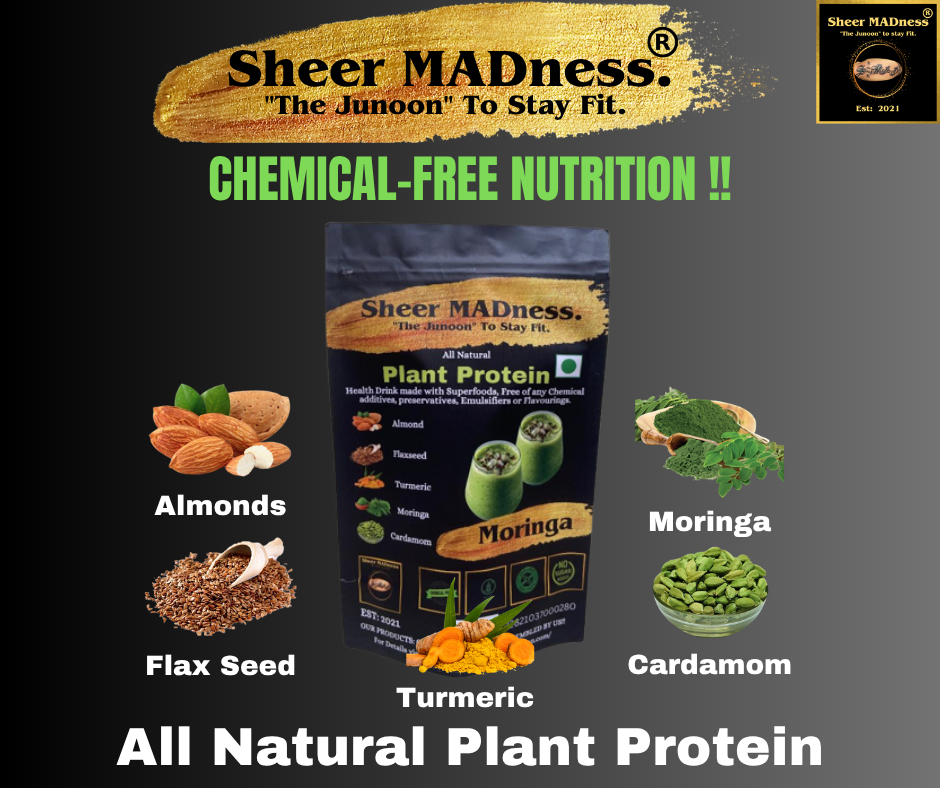
The most effective weight management use of Sheer MADness Plant Protein Moringa is as a deliberate replacement for high-glycaemic, low-protein mid-morning or mid-afternoon snacks. Two tablespoons in 250ml of warm milk or warm water provides a preparation with substantially better satiety, lower insulin response, and better nutritional density than biscuits, chai, namkeen, or processed snack foods.
Consuming a tablespoon of moringa in warm water 20 to 30 minutes before a main meal specifically triggers GLP-1 and CCK secretion that reduces the meal-time appetite — supporting portion control at the most calorie-dense eating occasion of the day.
As established in the weight training and endurance posts, moringa protein after exercise supports muscle protein synthesis. Higher lean muscle mass raises resting metabolic rate — specifically the most sustainable long-term fat management strategy available, because it permanently increases the daily caloric expenditure against which all food intake is balanced.
Sheer MADness Plant Protein Moringa contains zero refined carbohydrate. No maltodextrin. No glucose syrup. Zero refined sugar. No white rice flour. No corn starch.
This absence is, for weight management, more important than any specific ingredient present. Because every ingredient present — moringa protein, almond fat, flaxseed ALA — contributes to satiety and fat oxidation signalling. And because nothing present triggers the high-insulin fat storage cascade that drives India’s specific visceral fat accumulation pattern.
The positive composition and the negative composition together define why moringa protein powder does not make you fat — and specifically why it is the most appropriate plant protein preparation for the weight-conscious Indian consumer.
Sheer MADness holds a registered trademark under the Government of India. The Natural Plant Protein formula is patent published under Patent No. 202331036733, searchable on Intellectual Property India. The brand holds a valid FSSAI licence and GSTIN registration.
Will moringa protein powder make me fat?
No. Moringa protein powder provides approximately 80 to 100 kilocalories per two-tablespoon serving — a modest caloric contribution that is more than offset by its satiety effects. Its protein triggers GLP-1, PYY, and CCK satiety hormones that reduce subsequent caloric intake. Moringa’s fibre slows gastric emptying and reduces appetite. Its low glycaemic index prevents the insulin spikes that drive visceral fat storage. Its AMPK activation favours fat oxidation over fat storage. In normal consumption contexts, moringa protein supports rather than opposes body weight management.
What is the only thing that actually makes you fat?
Body fat accumulates only when caloric intake exceeds caloric expenditure over a sustained period — caloric surplus. No specific food causes fat gain independent of total caloric context. Moringa protein powder provides 80 to 100 kilocalories per serving — less than most Indian mid-morning snacks — and its high TEF, satiety hormones, and fibre reduce total daily caloric intake in the hours following consumption.
India’s dominant fat gain mechanism is the refined carbohydrate-insulin-visceral fat pathway. High-glycaemic foods (refined wheat, white rice, sugar) spike insulin, which directs glucose toward adipocyte fat synthesis and prevents fat release from storage. Moringa protein produces minimal insulin stimulation — replacing high-glycaemic snacks with moringa preparations specifically reduces the daily insulin-fat-storage signal that drives India’s metabolic obesity pattern.
How does moringa protein reduce appetite?
Moringa’s protein stimulates GLP-1, PYY, and CCK secretion from intestinal cells — the same satiety hormones targeted by the most effective obesity medications currently available. These hormones slow gastric emptying, signal fullness to the hypothalamus, and suppress ghrelin (the primary hunger hormone). Research confirms high-protein meals produce 20 to 30 percent lower caloric intake at subsequent meals compared to isocaloric carbohydrate meals.
What is the Thermic Effect of Food and how does it affect moringa?
TEF is the calories expended digesting and metabolising food. Protein TEF is 20 to 30 percent — the highest of any macronutrient. A 90-kilocalorie moringa serving with 9g protein costs approximately 18 to 27 calories to metabolise, leaving only 63 to 72 net calories versus a refined carbohydrate snack’s 5 to 9 calorie TEF on the same total caloric value. This TEF advantage specifically reduces the net caloric contribution of moringa protein versus equivalent-calorie carbohydrate alternatives.
If moringa is added to an existing diet without replacing any other food — purely as an addition — it contributes 80 to 100 net kilocalories per serving that could theoretically contribute to modest weight gain if no automatic dietary compensation occurs. In practice, moringa’s satiety effects mean most people automatically eat less at subsequent meals. For weight management purposes, use moringa as a replacement for existing high-glycaemic snacks rather than a pure addition.
Why doesn’t the healthy fat in almonds and flaxseed make moringa fattening?
Dietary fat does not directly cause fat storage — only caloric surplus does. The healthy monounsaturated fats in almonds and omega-3 ALA in flaxseed produce minimal insulin response (the key fat storage hormone) and specifically enhance fat oxidation through PPAR-α activation. They also produce CCK satiety signalling that reduces subsequent caloric intake. Healthy dietary fat from whole foods specifically supports body composition by promoting satiety and fat oxidation without the insulin-driven fat storage signal of refined carbohydrates.
Should I use moringa if I’m trying to lose weight?
Yes — moringa is specifically appropriate for weight management goals. Its high-TEF protein increases daily energy expenditure. Its fibre and satiety hormones reduce subsequent caloric intake. Moringa’s AMPK activation promotes fat oxidation. Its low glycaemic index prevents insulin-driven fat storage. Use it as a replacement for existing refined carbohydrate snacks — not as an addition — and pair with regular exercise for the most effective body composition results.

Weight gain comes from caloric surplus. Moringa protein does not create a caloric surplus — it creates a caloric environment that makes caloric surplus harder to maintain.
Its protein drives satiety hormones that reduce subsequent meal intake. Moringa’s fibre extends fullness for two to three hours. Its TEF consumes 20 to 30 percent of its protein calories in metabolic processing. Its AMPK activation directs cellular metabolism toward fat oxidation. Moringa’s low glycaemic index minimises the insulin signal that drives fat storage. Its zero refined carbohydrate eliminates the visceral fat accumulation mechanism most prevalent in India’s urban dietary pattern.
Moringa protein will not make you fat. Consumed as a replacement for India’s typical high-glycaemic, low-protein mid-morning snack — biscuits, sweet chai, namkeen — it will make fat accumulation less likely. That is the honest, evidence-based, India-specific answer to this question.
Sheer MADness Plant Protein Moringa: 80 to 100 kilocalories per serving. Eight to ten grams of complete protein. Meaningful satiety. Zero refined carbohydrate. Zero chemical additive. Every ingredient on the front of every pack since 2021.
I would also request you to please read my previous post: Benefits of Moringa Plant protein, the versatile Superfood powerhouse.
a) Everyone is an individual, so what suits me may not suit the next person.
b) If a person has a medical condition, a doctor’s advice and prescribed medication will only help. Obesity and metabolic syndrome are medical conditions requiring physician management. Diet and exercise are the foundation of weight management — but specific conditions may require medical intervention alongside lifestyle changes.
c) While buying any protein powder from the market, read the labels carefully. Watch out for INS codes, Anti-caking agent, INS 551 (Silicon dioxide), BHA (Butylated hydroxyanisole), BHT (Butylated hydroxytoluene), maltodextrin, glucose syrup, and refined carbohydrate ingredients that drive the insulin-fat storage pathway.
If you are interested in buying chemical-free Natural Plant Protein Moringa, Health Drinks for Kids, or our delicious chemical-free Energy Bars, Protein Bars, and Millet Bars, shop at Sheer MADness.
You can also find us on Flipkart, Jio Mart, or ONDC in India.
d) Exercise is the key to fitness. Exercise and nutrition are two sides of the same coin and always go hand in hand.
e) Excess of anything is wrong, even the best whole-food superfood. Consume only recommended quantities.
f) Rome was not built in a day. Discipline and consistency are the only keys to lasting health.
g) It is not only exercise and protein that builds health. A healthy gut, macro and micronutrients, body type, rest, and lifestyle all matter. Of all these, exercise and nutrition are within our control. Focus on these two primary aspects first.
h) The most important part of fitness is that nothing is better than exercise and a balanced meal.
Article by Chef Ashutosh Awasthi
Disclaimer: Our products are a source of HEALTHY NUTRIENTS and are COMPLETELY FREE OF ANY ADDED CHEMICALS. We do not claim to cure any medical condition. The content provided is informational. We do not claim to diagnose or treat a person with any specific medical condition.