

Direct answer: Moringa leaf protein powder is safe for daily consumption for most healthy adults — but safety is population-specific, not universal. Moringa leaf has been consumed as a food in South Asian and African cuisines for centuries with an excellent safety record at culinary and supplementary doses. For the general healthy adult population, moringa leaf powder at one to three tablespoons daily is safe and beneficial. However, four specific populations require medical discussion before beginning moringa: pregnant women (due to moringa root’s uterotonic properties, though leaf is generally considered safer), people on warfarin or anticoagulants, people on antidiabetic medications, and people with nut allergies (Sheer MADness contains almonds). A fifth concern for all consumers is product quality — heavy metal contamination in poorly sourced moringa from non-food-grade supply chains is a documented commercial quality risk.
I am Chef Ashutosh Awasthi, founder of Sheer MADness, professional chef, marathon runner, and author of Great Health Comes from Exercise & Nutrition. Safety is the most important question any consumer can ask about any food product. Let me answer it completely, honestly, and with the population-specific nuance that a genuine safety assessment requires.
Food safety assessment requires a structured framework — not a blanket yes or no. The key questions are:
Who is consuming it? Safety varies by population — healthy adults, pregnant women, children, seniors, people on medications all have different relevant considerations.
Which part of the plant? Moringa oleifera has multiple parts with distinctly different safety profiles. Leaf, root, seed, seed oil, bark, and flower all have different chemical compositions and different safety considerations.
At what dose? Every substance has a dose-dependent safety profile. Moringa leaf is safe at culinary and supplementary doses; at extremely high doses, oxalates and phytates become relevant considerations.
From what source? Poorly sourced moringa from contaminated growing environments can carry heavy metals. Food-grade supply chains with appropriate quality controls are essential.
In what form? Raw root can be toxic; dried leaf powder is safe. The form of moringa matters as much as moringa itself.
This framework guides the complete safety discussion that follows.
Moringa oleifera leaves are the part used in Sheer MADness Plant Protein Moringa — and they have the most extensively documented safety profile of any part of the moringa plant.
Moringa leaves have been consumed as a regular food in South Indian cuisine (murungai keerai), Philippine cuisine (malunggay), Filipino traditional diets, and across Sub-Saharan Africa for centuries at culinary quantities far exceeding supplement servings. Populations consuming drumstick leaves several times per week as a vegetable — multiple generations in Tamil Nadu, Karnataka, and Andhra Pradesh — represent the most reliable long-term safety evidence available: generations of routine consumption without adverse health outcomes in the general population.
The European Food Safety Authority (EFSA) reviewed available moringa leaf safety evidence in 2017. EFSA concluded that moringa leaf is well-tolerated at customary dietary amounts and supplement doses used in clinical trials (typically 250 to 500 milligrams per day in concentrated extract form, equivalent to several grams of leaf powder). No serious adverse events were attributable to moringa leaf in the reviewed literature.
Clinical trials using moringa leaf powder at supplementary doses — including the galactagogue trials in lactating mothers, the blood glucose management trials in diabetics, and the cholesterol management studies — have not reported significant adverse events at typical supplementary serving sizes.
For healthy adults with no contraindicated medications, moringa leaf powder at two to three tablespoons daily is safe for regular and long-term consumption.
This is the most critical safety distinction — and the one most frequently overlooked in moringa safety discussions.
Moringa root and root bark contain alkaloids — specifically benzyl isothiocyanate and spirochin — at significantly higher concentrations than the leaves. These compounds have documented uterotonic properties (ability to contract uterine smooth muscle) and have been traditionally used as abortifacients in some South Asian and African traditional medicine practices.
The presence of these alkaloids in moringa root is the primary basis for the medical caution about moringa during pregnancy. However — and this distinction is critical — the uterotonic alkaloids are concentrated in the root, not the leaf. Moringa leaf powder does not contain benzyl isothiocyanate at concentrations associated with uterotonic effects.
Sheer MADness Plant Protein Moringa uses only moringa leaf powder — explicitly not root, not bark, not seed in high quantity. The label transparency — every ingredient visible on the front of every pack since 2021 — allows verification of the part used.
The complete part-specific safety profile:
Moringa LEAF — safe for healthy adults, safe for seniors, generally safe for breastfeeding mothers at normal doses (consult physician), requires caution in pregnancy (discuss with obstetrician), requires discussion for people on warfarin and antidiabetics.
ROOT — contraindicated during pregnancy, contraindicated during lactation, and not used in any food product from reputable brands.
Moringa SEED — contains lectins and other bioactive compounds at high concentrations; not recommended in large quantities; moringa seed oil for topical use has a different profile.
Moringa BARK — similar alkaloid concerns to root; not a food ingredient in reputable formulations.
For healthy adults without contraindicated medications or conditions, moringa leaf powder is safe at one to three tablespoons daily as a food supplement. The well-documented safety from centuries of culinary use, clinical trial evidence, and regulatory review supports this assessment.
Standard caveats for all dietary supplements apply: start with a smaller quantity (one tablespoon) and increase gradually to observe individual digestive response; do not exceed recommended serving sizes; ensure product quality from reputable sources (discussed below).
The safety classification for moringa during pregnancy is nuanced. Moringa leaf in culinary quantities — as consumed as a vegetable in South Indian cooking — has not been associated with adverse pregnancy outcomes in populations consuming it traditionally. However, moringa leaf at supplementary concentrated doses during pregnancy has not been studied in adequately powered controlled trials.
The conservative and medically responsible guidance is: discuss moringa supplementation with your obstetrician before beginning during pregnancy. Do not consume moringa root, moringa root bark, or any moringa product that does not specify leaf-only formulation.
As detailed in the lactating mothers post, moringa leaf powder has been specifically studied in breastfeeding mothers in multiple controlled trials with positive outcomes and no serious adverse events reported. Moringa leaf has a long tradition of specific use in South Indian postpartum diets for nursing mothers.
The conservative guidance remains: discuss with your obstetrician or lactation consultant before beginning. Avoid moringa root completely.
Moringa leaf is consumed as a vegetable by children in South Indian households without identified adverse effects. As a concentrated supplement, it has not been systematically studied in children. The conservative guidance for children is: consult a paediatrician before giving moringa supplements, use appropriate age-adjusted quantities, and choose quality products with verified ingredient sourcing.
As detailed in the seniors post, moringa’s drug interaction profile requires specific discussion for seniors managing multiple medications. The drug interaction section below provides the complete reference.
Moringa leaf contains oxalates — compounds that can contribute to kidney stone formation in susceptible individuals and that are specifically problematic for people with chronic kidney disease or oxalate stone history. People with diagnosed kidney disease or history of oxalate kidney stones should discuss moringa with their nephrologist before consuming it regularly.
Sheer MADness Plant Protein Moringa contains almonds — a tree nut. People with tree nut allergies should not consume this product. The moringa leaf powder ingredient itself does not have documented allergenic properties at the population level, but individual sensitivity is possible with any novel food.
This section consolidates the drug interaction guidance covered across multiple posts in this series into the single comprehensive safety reference.
Moringa leaf contains Vitamin K (phylloquinone). Warfarin works by blocking Vitamin K-dependent coagulation factor synthesis. When dietary Vitamin K intake increases from moringa, warfarin’s anticoagulation effectiveness may be reduced — potentially increasing clot risk.
Clinical guidance: Do not start moringa without discussing with the prescribing cardiologist or haematologist. If approved, begin with consistent daily intake (not intermittent) and arrange more frequent INR monitoring during introduction. Report any INR changes to the anticoagulation management team.
Moringa’s chlorogenic acid and quercetin activate AMPK, producing mild blood glucose-lowering effects. These effects can compound the glucose-lowering action of metformin, sulfonylureas (glipizide, glibenclamide), or insulin — potentially causing hypoglycaemia.
Clinical guidance: Discuss with your diabetologist before starting. Begin with a small dose (one tablespoon daily). Monitor blood glucose more frequently in the first four weeks. Report any hypoglycaemia symptoms (sweating, tremor, confusion, dizziness) immediately.
Moringa’s potassium (259mg/100g) and magnesium (368mg/100g) have mild blood pressure-supporting effects that can add to the action of ACE inhibitors, ARBs, calcium channel blockers, or diuretics.
Clinical guidance: For people with well-controlled blood pressure on stable medication, this additive effect is generally mild. For people with orthostatic hypotension or blood pressure that is difficult to control, discuss with your physician before adding moringa.
Moringa contains glucosinolates — compounds with mild goitrogenic properties at very high doses. Moringa at normal supplement doses is unlikely to significantly affect thyroid function in most people. However, for people taking levothyroxine, maintaining one-hour separation between thyroid medication and moringa consumption is appropriate precaution to prevent any potential absorption interference.
Some early laboratory research suggests moringa’s bioactive compounds may affect CYP3A4 enzyme activity — the enzyme responsible for metabolising many antiretroviral medications. People on HIV antiretroviral therapy should discuss moringa with their HIV physician before beginning.
Moringa’s immune-modulating properties are beneficial for general immune health but require caution for people on immunosuppressant therapy (cyclosporine, tacrolimus, mycophenolate) following organ transplantation or managing autoimmune disease. Discuss with the managing specialist before use.
This is a safety dimension that no existing moringa safety discussion in the Indian supplement market addresses directly — and it is the most important commercial quality safety consideration.
Moringa trees are known to be efficient bioaccumulators — absorbing heavy metals from soil and water through their roots and concentrating them in leaf tissue. Moringa grown in contaminated agricultural land — near industrial facilities, using contaminated irrigation water, or in soil with elevated naturally occurring heavy metals — can accumulate lead, cadmium, arsenic, and mercury at concerning concentrations in the dried leaf powder.
Research in multiple Asian and African moringa supply markets has found commercially available moringa powders with heavy metal concentrations exceeding international food safety standards — including lead above 1 ppm and cadmium above 0.3 ppm thresholds in some samples.
For Indian consumers, the specific risk arises from moringa sourced from regions with industrial contamination, mining activity, or intensive pesticide-using agriculture — where heavy metal runoff contaminates soil and water. Unverified supply chains sourcing the cheapest available moringa without heavy metal testing expose consumers to this risk.
For consumers evaluating moringa product quality and safety:
Look for products with transparent sourcing — where the moringa grows matters for heavy metal safety. Brands that specify their moringa sourcing region and agricultural practices are making a verifiable quality commitment.
Look for FSSAI-licensed products — FSSAI licensing requires adherence to food safety standards including contaminant limits. Sheer MADness holds a valid FSSAI licence.
Look for ingredient transparency — front-of-pack labelling with all ingredients named and visible (as Sheer MADness has done since 2021) is the gold standard for ingredient sourcing accountability.
Avoid products combining moringa with undisclosed “proprietary blends” that obscure ingredient sources and quantities.
The existing post cites a “WHO recommendation of 5-10 grams daily” — this citation is not verifiable in WHO documentation. The WHO has not issued specific daily intake recommendations for moringa leaf powder as a dietary supplement.
The appropriate dose guidance based on clinical trial evidence and traditional use is:
As a food supplement: two to three tablespoons (approximately 20 to 30 grams) of Sheer MADness Plant Protein Moringa per day is within the range used in clinical trials without adverse events. This is equivalent to approximately 4 to 6 grams of moringa leaf powder component (given the blend also contains almond, flaxseed, turmeric, and cardamom).
Start with one tablespoon daily for the first two weeks, observing for any digestive response. Increase to two tablespoons if well-tolerated. Three tablespoons daily is the upper end of typical supplementary use.
Extremely high doses — several hundred grams of moringa leaf powder daily, far exceeding any reasonable supplementary use — could cause issues with oxalate accumulation, but this is not a practical concern at normal serving sizes.
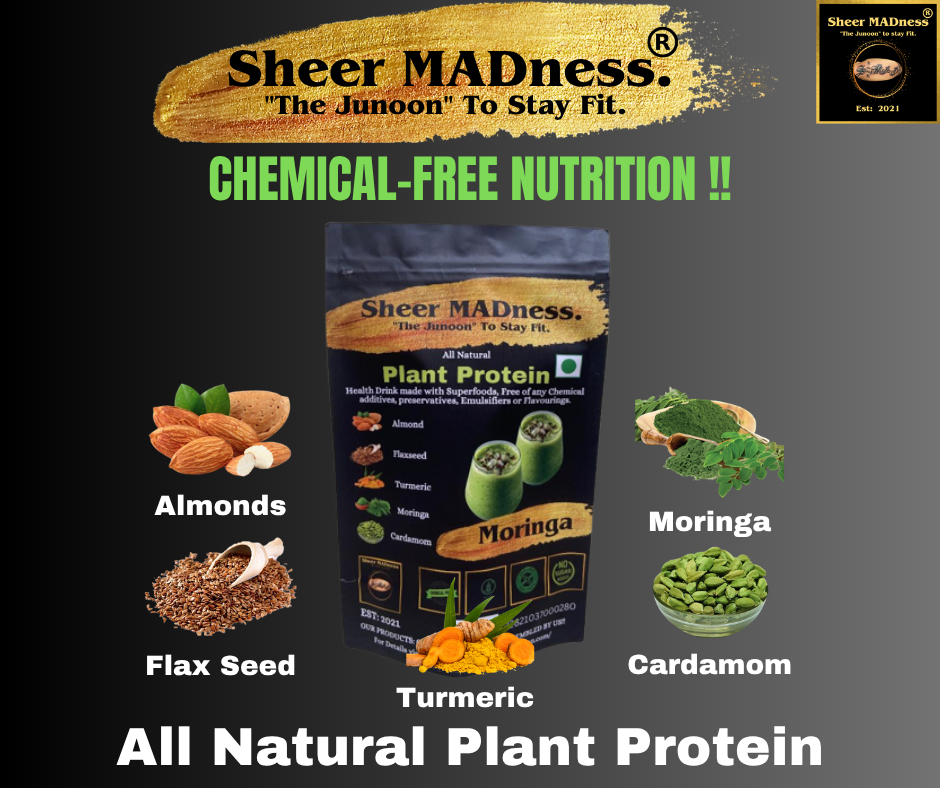
Zero BHA (INS 320) and zero BHT (INS 321) — synthetic antioxidant preservatives classified as potentially hepatotoxic at cumulative daily exposure. Sheer MADness preserves the product through vacuum packing — removing oxygen without introducing any chemical preservative.
Zero sucralose — documented to reduce beneficial gut bacteria with daily consumption. Not a direct toxicity concern but a cumulative gut health safety concern.
Zero silicon dioxide (INS 551) — an inert anticaking agent that is generally safe but represents unnecessary mineral particle ingestion with no nutritional value.
Zero artificial flavour — undisclosed chemical mixtures that may include sensitising compounds without individual safety evaluation at combined doses.
The chemical-free formulation of Sheer MADness Plant Protein Moringa is not simply a marketing preference — it is a specific safety feature that removes the compounds most associated with cumulative daily supplement consumption concerns.
| Population | Moringa Leaf Safety | Action Required |
|---|---|---|
| Healthy adults (no medications) | Safe for daily use | No special action — standard gradual introduction |
| Seniors without contraindicated medications | Safe with monitoring | Standard introduction, monitor blood glucose and BP |
| Seniors on warfarin | Requires medical discussion | Discuss with anticoagulation team before starting |
| Seniors/adults on antidiabetics | Requires medical discussion | Discuss with diabetologist, monitor glucose |
| Adults on antihypertensives | Generally safe; caution for orthostatic hypotension | Discuss if blood pressure difficult to control |
| Adults on thyroid medication | Generally safe | One-hour separation from levothyroxine |
| Adults on antiretrovirals | Requires medical discussion | Discuss with HIV physician |
| Adults on immunosuppressants | Requires medical discussion | Discuss with managing specialist |
| Pregnant women | Caution; leaf generally safer than root | Discuss with obstetrician |
| Breastfeeding mothers | Generally safe for leaf | Discuss with lactation consultant |
| Children | Culinary amounts safe; supplements — caution | Consult paediatrician |
| People with nut allergies | Not safe — contains almonds | Do not use this product |
| People with kidney disease or oxalate stones | Caution | Discuss with nephrologist |
| People seeking quality assurance | Safe if properly sourced | Check FSSAI licence, sourcing transparency |
Sheer MADness holds a registered trademark under the Government of India. The Natural Plant Protein formula is patent published under Patent No. 202331036733, searchable on Intellectual Property India. The brand holds a valid FSSAI licence and GSTIN registration.
Is moringa protein powder safe for daily use?
Moringa leaf protein powder is safe for daily use for most healthy adults — supported by centuries of culinary use in South Asian and African cuisines and by clinical trial data. Safety is not universal: people on warfarin, antidiabetics, antihypertensives, antiretrovirals, or immunosuppressants require physician discussion before beginning. People with nut allergies should not use Sheer MADness Plant Protein Moringa (contains almonds).
What is the most important safety distinction in moringa?
The moringa leaf vs moringa root distinction is the most critical safety consideration. Moringa leaf — used in Sheer MADness — is safe for healthy adults at normal supplementary doses. Moringa root contains uterotonic alkaloids (benzyl isothiocyanate, spirochin) that are contraindicated during pregnancy and lactation. Never consume moringa root preparations.
This citation is not verifiable in WHO documentation. The WHO has not issued specific daily intake recommendations for moringa leaf powder as a dietary supplement. Appropriate dose guidance based on clinical trials and traditional use is one to three tablespoons (approximately 20 to 30 grams of the Sheer MADness blend, or approximately 4 to 6 grams of the moringa leaf component) per day. Start with one tablespoon and increase gradually.
Can moringa cause heavy metal toxicity?
Moringa trees are efficient bioaccumulators and can concentrate heavy metals from contaminated growing environments. Commercial moringa powders from unverified supply chains have been found with lead and cadmium above international food safety thresholds in some markets. Choose products from FSSAI-licensed brands with transparent sourcing — as Sheer MADness is. The FSSAI licence requires adherence to food contaminant standards.
Is moringa safe for people with kidney disease?
Moringa leaf contains oxalates — compounds specifically problematic for people with chronic kidney disease or history of oxalate kidney stones. People with kidney disease should discuss moringa with their nephrologist before regular consumption.
Moringa leaf itself has low allergenic potential in the general population. However, Sheer MADness Plant Protein Moringa contains almonds — a tree nut that is one of the most common food allergens. People with tree nut or almond allergies should not use this product. If you experience any rash, itching, swelling, or breathing difficulty after consuming moringa products, discontinue immediately and seek medical attention.
Is moringa safe during pregnancy?
This requires physician discussion. Moringa leaf in culinary quantities has a long tradition of use in South Asian pregnancies without documented adverse outcomes. At supplementary concentrated doses during pregnancy, controlled safety data is insufficient for a definitive recommendation. The conservative guidance is: discuss with your obstetrician before beginning. Avoid all moringa root preparations categorically.
Why does Sheer MADness’s chemical-free formulation matter for safety?
The absence of BHA (INS 320), BHT (INS 321), sucralose, silicon dioxide, and artificial flavours means daily moringa consumers are not simultaneously accumulating daily doses of these synthetic compounds alongside the moringa’s nutritional benefits. Vacuum packing preserves the product without requiring any chemical preservative — a specific safety choice that reduces the cumulative synthetic chemical load of daily supplement consumption.

Moringa leaf protein powder is safe for most healthy adults — and has been consumed as a food for centuries across South Asia and Africa at quantities that far exceed supplement servings, without the population-level adverse health outcomes that would attend any genuine safety risk.
The honest and complete safety answer requires four distinctions: leaf is safe, root is not; healthy adults are safe, certain medication users require discussion; culinary doses are safe, extremely high experimental doses raise oxalate concerns; quality-sourced moringa is safe, heavy-metal-contaminated poorly-sourced moringa is a commercial quality risk.
Sheer MADness Plant Protein Moringa uses only moringa leaf — the safe part. It holds an FSSAI licence with the contaminant standards compliance that entails. Sheer MADness has zero chemical additive. It displays every ingredient on the front of every pack since 2021. And it comes from a brand whose founder is accountable by name and personal professional reputation for the product he puts his face on.
That is the complete, honest answer to whether moringa protein powder is safe.
I would also request you to please read my previous post: Benefits of Moringa Plant protein, the versatile Superfood powerhouse.
a) Everyone is an individual, so what suits me may not suit the next person.
b) If a person has a medical condition, a doctor’s advice and prescribed medication will only help. The drug interaction considerations in this post are especially important for anyone managing chronic conditions with daily prescription medications.
c) While buying any protein powder from the market, read the labels carefully. Watch out for INS codes, Anti-caking agent, INS 551 (Silicon dioxide), BHA (Butylated hydroxyanisole), BHT (Butylated hydroxytoluene), and all synthetic additives. Also check FSSAI licence number, ingredient sourcing transparency, and whether the product specifies “moringa leaf” versus unspecified “moringa” that could include root preparations.
If you are interested in buying chemical-free Natural Plant Protein Moringa, Health Drinks for Kids, or our delicious chemical-free Energy Bars, Protein Bars, and Millet Bars, shop at Sheer MADness.
You can also find us on Flipkart, Jio Mart, or ONDC in India.
d) Exercise is the key to fitness. Exercise and nutrition are two sides of the same coin and always go hand in hand.
e) Excess of anything is wrong, even the best whole-food superfood. Consume only recommended quantities.
f) Rome was not built in a day. Discipline and consistency are the only keys to lasting health.
g) It is not only exercise and protein that builds health. A healthy gut, macro and micronutrients, body type, rest, and lifestyle all matter. Of all these, exercise and nutrition are within our control. Focus on these two primary aspects first.
h) The most important part of fitness is that nothing is better than exercise and a balanced meal.
Article by Chef Ashutosh Awasthi
Disclaimer: Our products are a source of HEALTHY NUTRIENTS and are COMPLETELY FREE OF ANY ADDED CHEMICALS. We do not claim to cure any medical condition. The content provided is informational. We do not claim to diagnose or treat a person with any specific medical condition.